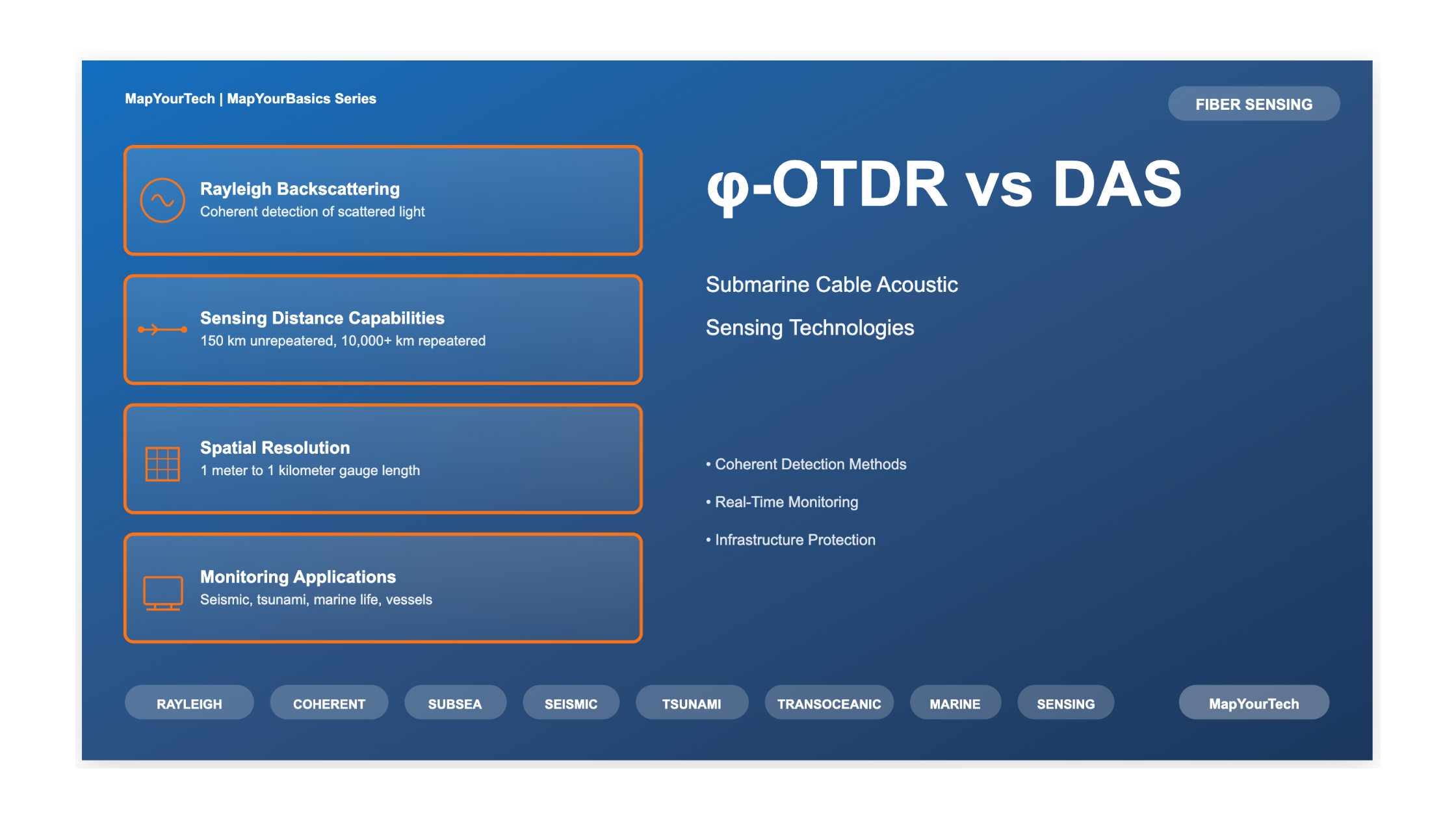
φ-OTDR vs DAS: Submarine Cable Acoustic Sensing
Comparing Distributed Sensing Technologies for Subsea Infrastructure Monitoring and Environmental Applications
Introduction
Submarine fiber optic cables, which carry 99% of global data traffic, have evolved beyond their original communication purpose to become powerful distributed sensing platforms. Two primary optical sensing techniques—Phase-Sensitive Optical Time Domain Reflectometry (φ-OTDR) and Distributed Acoustic Sensing (DAS)—have emerged as transformative technologies for monitoring subsea infrastructure, detecting seismic events, tracking marine life, and protecting cables from external threats.
The fundamental challenge in submarine cable monitoring is achieving high sensitivity over transoceanic distances while maintaining compatibility with existing transmission infrastructure. Both φ-OTDR and DAS exploit Rayleigh backscattering in optical fibers to detect minute changes in strain, temperature, and acoustic disturbances. However, they differ significantly in implementation, range, sensitivity, and application suitability. Understanding these differences is essential for network operators, system designers, and researchers developing next-generation subsea sensing capabilities.
Critical Context: The emergence of fiber sensing in submarine cables represents a paradigm shift from passive transmission infrastructure to active environmental and security monitoring systems. With over 1.4 million kilometers of submarine cables deployed globally, the potential for transforming these assets into a planetary-scale sensor network is extraordinary.
Fundamental Principles of Optical Fiber Sensing
Rayleigh Backscattering Mechanism
Both φ-OTDR and DAS rely on Rayleigh scattering, an elastic scattering phenomenon caused by microscopic refractive index fluctuations within the optical fiber. When coherent light propagates through the fiber, a small fraction (~0.0001%) is continuously scattered backward toward the source. This backscattered signal carries information about local fiber conditions—strain, temperature, pressure, and vibration—encoded in its phase, amplitude, and polarization.
The local Rayleigh backscatter coefficient β is typically 10-7 m-1 for standard single-mode fiber. For a probe pulse of duration T, the effective reflection coefficient γ can be expressed as:
where:
α = fiber attenuation coefficient (~0.2 dB/km or 5×10⁻⁵ m-1)
ν = light velocity in fiber (~2×10⁸ m/s)
T = pulse width
The two-way attenuation means the backscattered signal experiences twice the fiber loss in decibels. Spatial resolution is determined by the pulse width: Δz = νT/2. A 10 μs pulse provides approximately 1 km resolution, while shorter pulses enable finer spatial discrimination at the cost of reduced signal-to-noise ratio.
Coherent vs. Direct Detection
The critical distinction between φ-OTDR and conventional OTDR lies in the detection method. Traditional OTDR uses direct detection (intensity measurement), which is adequate for fault location but insensitive to phase information. Phase-sensitive techniques employ coherent detection, mixing the backscattered signal with a local oscillator (LO) to recover both amplitude and phase. This coherent amplification dramatically improves sensitivity—up to 20 dB compared to direct detection—enabling detection of sub-nanometer fiber deformations.
Coherent OTDR achieves sensitivity improvements through optical heterodyne or homodyne detection. The photocurrent resulting from mixing the backscattered signal Es with the local oscillator Elo is proportional to their interference product, revealing phase relationships lost in direct detection.
Figure 1: Detailed comparison of direct detection (conventional OTDR) and coherent detection (φ-OTDR) methods. Coherent detection uses a 90° optical hybrid to recover both in-phase (I) and quadrature (Q) components, providing 15-20 dB sensitivity improvement and enabling phase-sensitive strain measurements.
Phase-Sensitive OTDR (φ-OTDR) Architecture
System Configuration
φ-OTDR systems employ a highly coherent narrow-linewidth laser source (typically <1 kHz linewidth) to maintain phase stability over the measurement duration. The coherence length must exceed twice the fiber span length to preserve interference fidelity. A portion of the laser output is pulsed and launched into the fiber, while the continuous wave portion serves as the local oscillator for coherent detection.
Modern φ-OTDR implementations use frequency-multiplexed approaches to overcome the fundamental tradeoff between sensing range and update rate. By launching multiple frequency-shifted pulses simultaneously, the effective measurement rate can exceed the fiber round-trip time limitation. This technique, demonstrated by Iida et al., enables distributed acoustic sensing at update rates exceeding 100 kHz over coastal fiber segments.
Signal Processing and Demodulation
The raw φ-OTDR signal consists of a complex time series representing the interference pattern between backscattered light and the local oscillator. Digital signal processing extracts dynamic phase changes through various algorithms including wavelet transforms, short-time Fourier transforms, and machine learning-based pattern recognition. Continuous wavelet transform (CWT) has proven particularly effective for detecting nonstationary vibration events, as demonstrated by Qin et al. in their analysis of distributed vibration sensors.
Phase unwrapping and noise reduction are critical preprocessing steps. Typical φ-OTDR systems achieve strain sensitivities of 1 nε (nano-strain) with spatial resolutions of 1-10 meters and temporal sampling rates of 1-10 kHz, making them suitable for detecting acoustic waves, seismic activity, and mechanical disturbances along the fiber.
Distributed Acoustic Sensing (DAS) Implementation
DAS as φ-OTDR Variant
Distributed Acoustic Sensing is essentially a commercialized, optimized variant of φ-OTDR specifically designed for acoustic and vibration monitoring applications. The term "DAS" typically refers to turnkey interrogator systems that provide pre-processed acoustic data in engineering units (strain rate, acceleration, or particle velocity) rather than raw optical phase measurements. DAS systems prioritize real-time performance, user-friendly interfaces, and application-specific signal conditioning.
The fundamental sensing principle remains identical to φ-OTDR—coherent Rayleigh backscatter interferometry—but DAS systems incorporate advanced features such as automatic gain control, adaptive filtering, multi-channel parallel processing, and event detection algorithms. Commercial DAS interrogators from vendors like OptaSense, Silixa, and Fotech Solutions typically operate at 10-20 kHz sampling rates with gauge lengths of 10 meters, optimized for acoustic frequency response.
Submarine Cable DAS Configurations
Implementing DAS on operational submarine cables presents unique engineering challenges. The maximum unrepeatered range for DAS is approximately 150-200 km, limited by the cumulative signal-to-noise ratio degradation. For longer submarine systems with optical amplifiers, cross-coupling between transmit and return fibers in repeaters enables distributed sensing by redirecting Rayleigh backscatter to the return path.
Two cross-coupling architectures exist: output-to-output coupling (connecting the output ports of transmit and return amplifiers) and output-to-input coupling (transmit amplifier output to return amplifier input). The coupling coefficient is typically -25 dB, carefully chosen to provide adequate backscatter signal while avoiding coherent Rayleigh noise that could degrade data transmission. This high-loss, low-loss balance (HLLB) coupling design allows DAS operation on live submarine cables without disrupting telecommunications traffic.
Figure 2: Detailed DAS implementation on repeatered submarine cable system. Cross-coupling at each repeater transfers Rayleigh backscatter from the transmit fiber to the return fiber, enabling distributed sensing over transoceanic distances. The -25 dB coupling coefficient balances sensing performance against coherent Rayleigh noise that could degrade telecommunications traffic.
Technical Comparison: φ-OTDR vs DAS
| Parameter | φ-OTDR (Generic Technology) | DAS (Application-Specific System) |
|---|---|---|
| Fundamental Principle | Coherent Rayleigh backscatter interferometry | Same as φ-OTDR (optimized implementation) |
| Detection Method | Coherent (heterodyne or homodyne) | Coherent with advanced signal processing |
| Spatial Resolution | 1 m to 1 km (pulse-width dependent) | 1-50 m (typically 10 m gauge length) |
| Sampling Rate | 100 Hz to 100 kHz+ | 1-20 kHz (optimized for acoustic band) |
| Maximum Range (Unrepeatered) | Up to 200 km | Up to 150 km (SNR limited) |
| Repeatered Cable Range | Theoretically unlimited with cross-coupling | 10,000+ km with repeater cross-coupling |
| Sensitivity | Sub-nε strain sensitivity | ~1 nε dynamic strain (high SNR) |
| Measurand | Phase change (strain, temperature, vibration) | Strain rate, acoustic amplitude, particle velocity |
| Laser Requirements | Narrow linewidth (<1 kHz) coherent laser | Same (commercially packaged) |
| Signal Processing | Research-grade algorithms, custom DSP | Real-time processing, turnkey software |
| Output Format | Raw phase/amplitude data | Engineering units (strain, amplitude, dB) |
| Typical Applications | Research, customized sensing experiments | Seismic monitoring, infrastructure protection, environmental sensing |
| Commercial Availability | Limited (research systems) | Multiple commercial vendors (OptaSense, Silixa, etc.) |
| Installation Complexity | Requires optical engineering expertise | Plug-and-play interrogator units |
| Cost | Variable (custom implementations) | $200k-$1M+ per interrogator system |
Key Insight: The relationship between φ-OTDR and DAS is analogous to the relationship between laboratory spectroscopy and a commercial spectrometer. φ-OTDR is the underlying physics principle; DAS is the engineered product optimized for field deployment in acoustic monitoring applications.
Submarine Cable Sensing Applications
Seismic Monitoring and Earthquake Early Warning
DAS deployed on submarine cables has revolutionized offshore seismology. The dense spatial sampling (10-meter gauge length) and high temporal resolution (1-10 kHz) enable detection of P-waves, S-waves, and surface waves from earthquakes with unprecedented detail. Research by Lindsey et al. demonstrated illumination of seafloor faults using dark fiber DAS, while Sladen et al. showed distributed sensing of earthquakes and ocean-solid earth interactions on operational telecom cables.
Earthquake early warning (EEW) systems benefit enormously from offshore DAS arrays. Yin et al. conducted real-data testing of DAS for offshore EEW, demonstrating that submarine cables can detect P-wave arrivals seconds before destructive S-waves reach coastal populations. The magnitude estimation accuracy using DAS strain-rate measurements rivals traditional seismometer networks, with the advantage of continuous spatial coverage rather than discrete station locations.
Tsunami Detection and Coastal Safety
DAS technology shows promise for augmenting tsunami early warning systems. Xiao et al. investigated DAS potential for detecting infragravity waves and tsunamis induced by earthquakes, using frequency-wavenumber domain transformations and beam-forming techniques. Experimental results successfully retrieved infragravity and tsunami wave signatures using subsea optical fiber off the Oregon coast. The ability to detect pressure variations and water-column displacement through fiber strain provides complementary data to traditional DART buoys and tide gauges.
Marine Mammal Monitoring
One of the most unexpected DAS applications is passive acoustic monitoring of marine mammals. Landrø et al. demonstrated sensing of whales, storms, ships, and earthquakes using an Arctic fiber optic cable, while Bouffaut et al. achieved "eavesdropping at the speed of light" on baleen whale vocalizations. The acoustic frequency signatures of whale calls (10-1000 Hz) fall within the optimal DAS sensitivity band, and the continuous spatial coverage allows tracking of whale movements along migration routes spanning thousands of kilometers.
Vessel Detection and Cable Protection
DAS provides real-time vessel detection and tracking capabilities crucial for protecting submarine cables from fishing and anchoring damage. Morten et al. demonstrated integrated DAS and Automatic Identification System (AIS) for real-time cable threat monitoring. The acoustic signature of ship propellers, hull vibrations, and anchor deployment can be detected tens of kilometers away, providing early warning to network operators. Machine learning algorithms can classify vessel types and predict trajectories, enabling proactive threat assessment.
Figure 3: Application spectrum of DAS on submarine cables spanning seismic monitoring (0.01-10 Hz), tsunami detection (10-100 Hz), whale tracking (100-1000 Hz), and vessel detection (1-10 kHz). Different phenomena occupy distinct frequency bands within DAS measurement capability.
Operational Challenges and System Limitations
Signal-to-Noise Ratio Management
The primary challenge in submarine cable sensing is maintaining adequate SNR over transoceanic distances. Rayleigh backscatter is extremely weak—approximately -40 dB relative to the launched pulse—and experiences twice the fiber attenuation during round-trip propagation. For a typical 0.2 dB/km fiber loss, a 100 km segment imposes 40 dB total loss on the backscattered signal. Coherent detection provides 15-20 dB sensitivity advantage over direct detection, but extending DAS beyond 150-200 km requires optical amplification or advanced signal processing techniques.
Averaging multiple measurements improves SNR proportional to the square root of the number of averages (N). However, excessive averaging reduces temporal resolution—a critical tradeoff for detecting transient events like earthquakes or vessel movements. Optimal system design balances spatial resolution (pulse width), sensitivity (averaging), and update rate (repetition frequency) according to application requirements.
Coherent Rayleigh Noise in Live Cables
When implementing DAS on operational submarine cables carrying live traffic, coherent Rayleigh noise (CRN) becomes a concern. CRN arises from interference between the backscattered DAS probe signal and co-propagating data channels on the return fiber. If wavelengths are identical in both directions, coherent mixing produces intensity fluctuations that degrade transmission performance. The -25 dB cross-coupling coefficient in repeaters is carefully chosen to provide sufficient backscatter signal for sensing while keeping CRN below the system penalty threshold (typically <0.5 dB OSNR degradation).
Data Volume and Processing Requirements
DAS generates massive data volumes. A single interrogator monitoring 100 km of fiber at 10 m spatial resolution and 10 kHz sampling rate produces 100,000 channels × 10,000 samples/second = 1 billion data points per second. At 16-bit resolution, this equals 2 GB/s raw data rate, or 172.8 TB per day. Real-time processing, compression, and intelligent event detection algorithms are essential for practical deployments. Machine learning techniques, particularly convolutional neural networks (CNNs), have shown promise for automatic seismic phase picking and vessel classification, reducing data storage requirements by orders of magnitude.
Environmental Sensitivity Variations
Not all submarine cables exhibit identical sensing performance. Fiber mechanical coupling to external disturbances depends on cable construction, burial depth, seabed type, and water depth. Cables buried under sediment show reduced acoustic sensitivity compared to surface-laid cables. Temperature sensitivity is also depth-dependent—shallow water cables experience greater temperature fluctuations that can mask small strain signals. Sensitivity-enhanced cables with specialized optical packaging have been developed to improve DAS performance, but retrofitting existing systems remains challenging.
Advanced Techniques: Live C-OTDR and Polarization Sensing
Coherent OTDR on Legacy Cables
Recent breakthroughs by Mazur et al. demonstrated real-time in-line coherent distributed sensing over legacy submarine cables without requiring cross-coupling modifications. By using constant-power probe signals and leveraging the commercial coherent transceivers already present for data transmission, phase and polarization monitoring became possible across entire transoceanic spans. This "live C-OTDR" technique achieves 0.2 km spatial resolution over 10,000+ km with medium-to-high sensitivity, providing subkilometer fault localization and environmental sensing capabilities on every deployed cable.
Polarization-Based Seismic Sensing
Zhan et al. pioneered optical polarization-based seismic and water wave sensing on transoceanic cables, demonstrating that fiber birefringence changes induced by seismic strain can be detected through state-of-polarization (SOP) monitoring at span endpoints. This approach, which operates at 60-100 km resolution (span length), complements DAS by providing lower spatial resolution but simpler implementation using existing optical loop infrastructure in repeaters. Polarization sensing detected earthquakes, ocean tides, and internal gravity waves, validating the concept for global tsunami monitoring networks.
Optical Interferometry Arrays
Marra et al. demonstrated ultrastable laser interferometry for earthquake detection using terrestrial and submarine cables, achieving strain sensitivities approaching 10-12 (picostrains) through phase comparison between ultra-stable lasers. This technique enables geodetic-quality measurements of seafloor deformation, tectonic strain accumulation, and slow-slip earthquakes. The combination of high-resolution DAS (meters) and ultra-low-noise interferometry (span-scale) provides multi-scale sensing from individual fault segments to plate boundary-scale processes.
Emerging Trend: The integration of DAS, polarization sensing, and interferometric techniques on the same submarine cable creates a multi-parameter sensor network with unprecedented spatial and temporal resolution. This convergence is driving the transformation of telecommunication infrastructure into a global geophysical observatory.
Future Directions and Industry Adoption
Scaling to 100+ Operational Cables
The submarine cable industry is moving toward widespread fiber sensing deployment. As of 2025, the scientific community has demonstrated successful fiber-optic methods on dozens of cables, and scaling to 100 operational cables incorporating environmental sensing is projected within the next few years. This expansion requires synergy between cable owners, government agencies, and academic institutions to address regulatory, data sharing, and infrastructure investment challenges.
Cable protection benefits and scientific value create a mutually beneficial alignment of interests. Network operators gain real-time threat monitoring and fault localization, while researchers access unprecedented ocean and earth observation capabilities. SMART (Science Monitoring And Reliable Telecommunications) repeaters, which integrate temperature, pressure, and acceleration sensors into submarine repeaters, complement fiber sensing by providing point measurements at repeater locations.
Artificial Intelligence and Automated Analysis
Machine learning is revolutionizing DAS data interpretation. Zhu et al. demonstrated seismic arrival-time picking on DAS data using semi-supervised learning, achieving accuracy comparable to expert human analysts at a fraction of the processing time. Deep neural networks (DNNs) can classify earthquakes, distinguish whale species by acoustic signature, and identify vessel types from propeller noise. Transfer learning enables models trained on terrestrial seismometer data to generalize to submarine DAS recordings, accelerating deployment of automated monitoring systems.
Regulatory and Data Governance Issues
As submarine cables transition from pure telecommunications infrastructure to dual-use sensing platforms, new regulatory frameworks are emerging. Questions around data ownership, privacy, and military applications require careful consideration. The risk of subsea cables becoming targets in strategic competition necessitates transparent policies that preserve the commercial integrity of cable systems while enabling beneficial scientific and safety applications. International cooperation through organizations like the International Cable Protection Committee (ICPC) will be essential for establishing governance standards.
Key Principles Summary
- φ-OTDR and DAS are related technologies: φ-OTDR is the underlying coherent Rayleigh backscatter interferometry principle, while DAS refers to commercial turnkey systems optimized for acoustic monitoring.
- Both techniques exploit the same physical phenomenon—phase-sensitive detection of Rayleigh backscattered light—to measure dynamic strain, temperature, and vibration along optical fibers.
- Spatial resolution ranges from 1 meter to 1 kilometer depending on pulse width, with typical DAS systems using 10-meter gauge lengths optimized for acoustic sensing.
- Unrepeatered DAS range is limited to 150-200 km by signal-to-noise ratio; repeatered cables can extend sensing to 10,000+ km using cross-coupling in optical amplifiers.
- Applications span seismic monitoring, tsunami detection, marine mammal tracking, vessel detection, cable protection, and environmental science.
- Live C-OTDR techniques enable distributed sensing on legacy cables without wetplant modifications, achieving subkilometer resolution across entire transoceanic systems.
- Coherent Rayleigh noise management is critical for implementing DAS on operational cables—cross-coupling coefficients must balance sensing sensitivity against transmission performance degradation.
- Data volume challenges require real-time processing, compression, and machine learning-based event detection to make submarine DAS deployments operationally viable.
- Multi-technique integration (DAS + polarization sensing + interferometry) provides complementary spatial and temporal resolution for comprehensive ocean and earth monitoring.
- The transformation of submarine cables into planetary-scale sensor networks represents one of the most significant opportunities in 21st-century geophysics and oceanography.
Conclusion
Phase-Sensitive Optical Time Domain Reflectometry (φ-OTDR) and Distributed Acoustic Sensing (DAS) represent a technological convergence that is transforming submarine fiber optic cables from passive data conduits into active environmental sensing platforms. While φ-OTDR describes the fundamental physics of coherent Rayleigh backscatter detection, DAS refers to the commercial realization of this principle in turnkey systems optimized for acoustic and vibration monitoring.
The technical distinctions between these approaches are primarily implementation-focused rather than fundamental. Both rely on the same underlying physics—interferometric detection of phase changes in Rayleigh backscattered light—but DAS systems package this capability with real-time signal processing, application-specific algorithms, and user-friendly interfaces suited for field deployment. The choice between custom φ-OTDR implementations and commercial DAS systems depends on application requirements, available expertise, and budget constraints.
Submarine cable applications have demonstrated extraordinary potential across diverse domains: earthquake early warning systems that can save thousands of lives, marine mammal monitoring networks spanning entire ocean basins, vessel tracking for cable protection and maritime security, and geophysical observatories providing unprecedented insight into Earth's dynamic processes. The ability to retrofit existing cables with sensing capabilities through live C-OTDR techniques means that over 1.4 million kilometers of deployed submarine infrastructure can become a global sensor network without requiring expensive new installations.
Looking forward, the integration of DAS with complementary techniques such as polarization sensing and optical interferometry will create multi-parameter observation systems with spatial resolution ranging from meters to ocean basins. Machine learning and artificial intelligence will automate data interpretation, enabling real-time event detection and classification at scales previously impossible. As the submarine cable industry, scientific community, and regulatory bodies collaborate to address technical, policy, and governance issues, the vision of a planetary-scale fiber sensing network is rapidly becoming reality. This transformation represents not merely a technological achievement but a fundamental expansion of humanity's ability to understand and protect the ocean environment and the critical infrastructure upon which modern civilization depends.
References
- Hartog, A. (2017). An Introduction to Distributed Optical Fibre Sensors. CRC Press. https://doi.org/10.1201/9781315119014
- Lu, Y., Zhu, T., Chen, L. (2010). Distributed vibration sensor based on coherent detection of phase-OTDR. Journal of Lightwave Technology, 28(22).
- Masoudi, A., Belal, M., Newson, T. (2013). A distributed optical fibre dynamic strain sensor based on phase-OTDR. Measurement Science and Technology, 24(8). https://doi.org/10.1088/0957-0233/24/8/085204
- Lindsey, N.J., Dawe, T.C., Ajo-Franklin, J.B. (2019). Illuminating seafloor faults and ocean dynamics with dark fiber distributed acoustic sensing. Science, 366(6469), 1103-1105. https://doi.org/10.1126/science.aay5881
- Sladen, A., Rivet, D., Ampuero, J.P. (2019). Distributed sensing of earthquakes and ocean-solid earth interactions on seafloor telecom cables. Nature Communications, 10. https://doi.org/10.1038/s41467-019-13793-z
- Yin, J., Soto, M.A., Ramírez, J., Kamalov, V., Zhu, W., Husker, A., Zhan, Z. (2023). Real-data testing of distributed acoustic sensing for offshore earthquake early warning. Seismological Record, 3, 269-277.
- Landrø, M., Bouffaut, L., Kriesell, H.J., et al. (2022). Sensing whales, storms, ships and earthquakes using an Arctic fibre optic cable. Scientific Reports, 12. https://doi.org/10.1038/s41598-022-23606-x
- Bouffaut, L., Taweesintananon, K., Kriesell, H.J., et al. (2022). Eavesdropping at the speed of light: distributed acoustic sensing of baleen whales in the arctic. Frontiers in Marine Science, 9. https://doi.org/10.3389/fmars.2022.901348
- Morten, J.P., Connelly, M., Bjørnstad, S., Brenne, J.K. (2023). Integrated DAS and AIS for Real-Time Cable Threat Monitoring. SubOptic Conference.
- Mazur, M., Fontaine, N.K., Ryf, R., et al. (2024). Real-Time In-Line Coherent Distributed Sensing Over a Legacy Submarine Cable. Optical Fiber Communication Conference (OFC).
- Zhan, Z., Cantono, M., Kamalov, V., et al. (2021). Optical polarization-based seismic and water wave sensing on transoceanic cables. Science, 371(6532), 931-936.
- Marra, G., Clivati, C., Luckett, R., et al. (2018). Ultrastable laser interferometry for earthquake detection with terrestrial and submarine cables. Science, 361(6401), 486-490. https://doi.org/10.1126/science.aat4458
- Qin, Z., Chen, L., Bao, X. (2012). Continuous wavelet transform for nonstationary vibration detection with phase-OTDR. Optics Express, 20(18), 20459-20465.
- Iida, D., Toge, K., Manabe, T. (2017). Distributed measurement of acoustic vibration location with frequency multiplexed phase-OTDR. Optical Fiber Technology, 36(1).
- ITU-T Recommendation G.976 (2014). Test methods applicable to optical fibre submarine cable systems.
- Brenne, J.K., Morten, J.P., Jacobsen, J., et al. (2023). Distributed acoustic sensing solution for repeatered networks. SubOptic Conference.
- Williams, E.F., Fernández-Ruiz, M.R., Magalhaes, R., et al. (2019). Distributed sensing of microseisms and teleseisms with submarine dark fibers. Nature Communications, 10(1).
- Zhu, W., Biondi, E., Li, J., et al. (2023). Seismic arrival-time picking on distributed acoustic sensing data using semi-supervised learning. Nature Communications, 14. https://doi.org/10.1038/s41467-023-43355-3
- Li, J., Kim, T., Lapusta, N. (2023). The break of earthquake asperities imaged by distributed acoustic sensing. Nature, 620, 800-806.
- Sanjay Yadav (2025). Optical Network Communications: An Engineer's Perspective – Bridge the Gap Between Theory and Practice in Optical Networking. MapYourTech.

Optical Communications & Network Automation Expert | Author of 3 Books for Optical Engineers | Founder, MapYourTech
Optical networking engineer with nearly two decades of experience across DWDM, OTN, coherent optics, submarine systems, and cloud infrastructure. Founder of MapYourTech. Read full bio →
Follow on LinkedInRelated Articles on MapYourTech