8 min read

Complete Optical Reach Classifications
Comprehensive Technical Guide to SR, DR, FR, LR, ER, and ZR Optical Transceivers
From 100 Meters to 120 Kilometers: Understanding Every Reach Category
Introduction
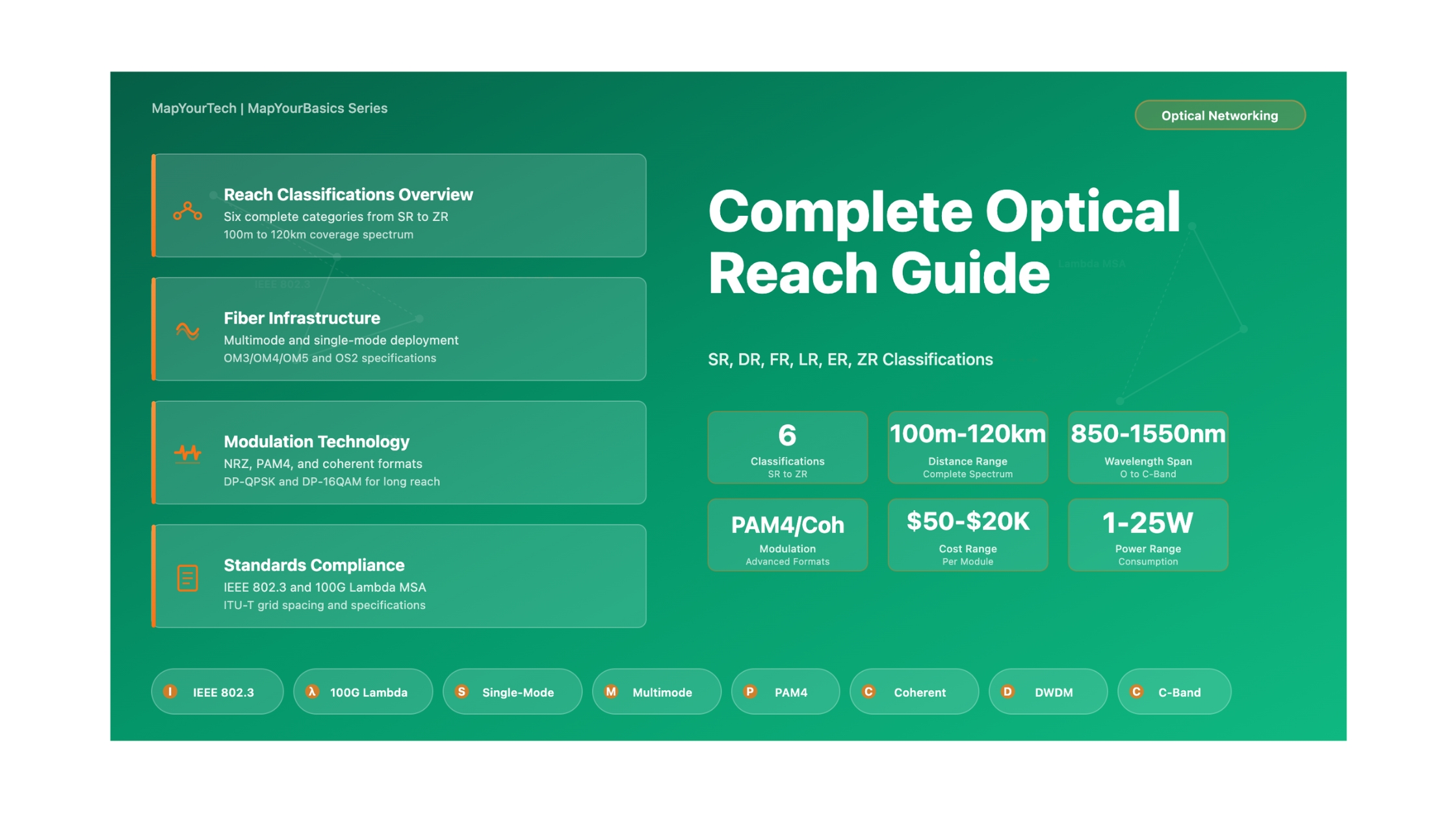
Optical reach classifications provide a standardized framework for categorizing transceivers based on maximum transmission distance capabilities. This comprehensive guide covers all six major reach classifications currently deployed in modern optical networks: Short Reach (SR), Data Center Reach (DR), Fabric/Front Reach (FR), Long Reach (LR), Extended Reach (ER), and ZR (the longest reach designation). These classifications span the complete distance spectrum from 100 meters to 120 kilometers, addressing applications from high-density data centers to regional network deployments.
Each reach classification represents specific technical capabilities defined by IEEE standards (particularly 802.3 for Ethernet), ITU-T recommendations, and various Multi-Source Agreements (MSAs) including the 100G Lambda MSA. The classifications involve distinct trade-offs in technology complexity, fiber type requirements, cost, power consumption, and achievable transmission distance.
About the ZR Designation
The "ZR" designation follows the alphabetical naming convention in optical transceivers (SR, LR, ER, ZR), where Z simply indicates the longest reach category beyond ER. Industry professionals sometimes playfully call it "Ze Best Reach" because it represents the maximum pluggable optics reach capability. ZR is not an acronym but rather the next letter in the alphabet sequence used for reach classifications.
Overview of All Reach Classifications
| Classification | Distance | Fiber Type | Wavelength | Key Technology | Primary Use Case |
|---|---|---|---|---|---|
| SR (Short Reach) | 100-400m | Multimode (OM3/OM4) | 850nm | VCSEL | Data center intra-building |
| DR (Data Center Reach) | 500m | Single-Mode (OS2) | 1310nm | EML + PAM4 | Data center campus |
| FR (Fabric/Front Reach) | 2km | Single-Mode (OS2) | 1310nm | Cooled EML + PAM4 | Campus networks, nearby DCI |
| LR (Long Reach) | 10km | Single-Mode (OS2) | 1310nm | DFB Laser | Metro access |
| ER (Extended Reach) | 40km | Single-Mode (OS2) | 1550nm | EML (C-band) | Metro core, regional |
| ZR (Longest Reach) | 80-120km | Single-Mode (OS2) | 1550nm | Coherent DSP | Long-haul metro, DCI |
Note: The reach classifications follow an alphabetical naming convention, with ZR representing the furthest reach category - sometimes informally referred to as "Ze Best Reach" in the industry.
1. Short Reach (SR) - 100 to 400 Meters
1.1 Technical Overview
Short Reach transceivers represent the most widely deployed optical interface in modern data centers, using 850nm VCSELs (Vertical Cavity Surface Emitting Lasers) over multimode fiber. SR optics provide the optimal balance of performance, cost, and power efficiency for intra-facility connectivity where distances do not exceed a few hundred meters.
Key Technical Specifications:
- Wavelength: 850nm (first optical window)
- Laser Technology: Uncooled VCSEL arrays
- Fiber Type: OM3, OM4, or OM5 multimode (50µm core)
- Power Budget: 6-9 dB
- Module Power: 1-2.5W
- Module Cost: $50-$200
2. Data Center Reach (DR) - 500 Meters
2.1 Technical Overview
Data Center Reach transceivers fill an important gap between multimode SR and long-reach LR, providing 500 meter transmission over single-mode fiber using PAM4 modulation. DR was specifically defined by IEEE 802.3cd to address data center campus deployments.
Key Technical Specifications:
- Wavelength: 1310nm (O-band)
- Laser Technology: Cooled EML
- Modulation: PAM4 (50-106 Gbaud)
- Power Budget: 8-9 dB
- Module Power: 3-4W (100G), 10-12W (400G)
- Module Cost: $150-$300 (100G)
3. Fabric/Front Reach (FR) - 2 Kilometers
3.1 Technical Overview
Fabric Reach extends single-mode transmission to 2 kilometers using enhanced laser technology. FR transceivers were introduced by the 100G Lambda MSA to address the gap between DR (500m) and LR (10km).
Key Technical Specifications:
- Wavelength: 1310nm (O-band)
- Laser Technology: Cooled EML with improved linewidth
- Modulation: PAM4
- Power Budget: 10-11 dB
- Module Power: 3.5-4.5W (100G)
- Module Cost: $200-$400 (100G)
4. Long Reach (LR) - 10 Kilometers
4.1 Technical Overview
Long Reach transceivers represent the most widely deployed metro access technology, using 1310nm DFB lasers for 10 kilometer transmission. LR optics are the standard for metro Ethernet and medium-distance data center interconnects.
Key Technical Specifications:
- Wavelength: 1310nm
- Laser Technology: Uncooled DFB
- Power Budget: 11-15 dB
- Module Power: 2-4W
- Module Cost: $200-$500
5. Extended Reach (ER) - 40 Kilometers
5.1 Technical Overview
Extended Reach transceivers operate at 1550nm (C-band) to leverage the lowest fiber attenuation window, supporting 40 kilometer transmission for metropolitan core networks.
Key Technical Specifications:
- Wavelength: 1550nm (C-band)
- Laser Technology: EML, sometimes with TEC
- Power Budget: 15-18 dB
- Module Power: 3-5W
- Module Cost: $500-$1,500
6. ZR (Longest Reach) - 80 to 120 Kilometers
6.1 Technical Overview and Naming Convention
ZR transceivers represent the ultimate in pluggable optical reach, using either high-performance direct detection (for 10G/40G) or coherent detection with DSP (for 100G/400G+). The "ZR" designation follows the alphabetical reach naming convention (SR → LR → ER → ZR), where Z indicates this is the longest reach category available in pluggable form factors.
The "Ze Best Reach" Nickname
While ZR is simply an alphabetical designation (not an acronym), industry professionals often humorously call it "Ze Best Reach" because it represents the maximum unamplified distance achievable with pluggable transceivers. This playful nickname has become widely recognized in optical networking circles, though it is not an official term.
Key Technical Specifications:
- Wavelength: 1550nm (C-band, ITU grid)
- Technology (10G-40G): Cooled DFB + APD receiver
- Technology (100G-400G): Coherent detection with DSP
- Power Budget: 24-28 dB
- Module Power: 5-8W (10G), 10-15W (100G), 15-25W (400G)
- Module Cost: $5,000-$20,000
- DWDM Compatible: Yes
6.2 Coherent ZR Technology
Modern 100G and 400G ZR transceivers use coherent detection with advanced modulation formats:
100GBASE-ZR (Coherent)
- Modulation: DP-QPSK (Dual-Polarization QPSK)
- Symbol Rate: 32-34 Gbaud
- DSP Functions: Chromatic dispersion compensation, PMD compensation, FEC
- Distance: 80km standard, 120km with premium fiber
400GBASE-ZR (Coherent)
- Modulation: DP-16QAM
- Symbol Rate: ~60 Gbaud
- Spectral Efficiency: 6 bits/s/Hz
- Distance: 80km standard, up to 120km optimized
- Power: 15-25W
6.3 Applications
- Long-Distance Metro: Ring spans 60-80km between sites
- Regional Networks: Inter-city connections
- Data Center Interconnect: Maximum metro distance DCI, financial trading
- Submarine Landing: Landing station to inland hub
Complete Comparison Matrix
| Factor | SR | DR | FR | LR | ER | ZR |
|---|---|---|---|---|---|---|
| Distance | 100-400m | 500m | 2km | 10km | 40km | 80-120km |
| Fiber | MMF | SMF | SMF | SMF | SMF | SMF |
| Wavelength | 850nm | 1310nm | 1310nm | 1310nm | 1550nm | 1550nm |
| Power Budget | 6-9 dB | 8-9 dB | 10-11 dB | 11-15 dB | 15-18 dB | 24-28 dB |
| Module Cost (100G) | $100-$200 | $150-$300 | $200-$400 | $300-$500 | $500-$1.5K | $10K-$15K |
| Module Power | 1-2.5W | 3-4W | 3.5-4.5W | 2-4W | 3-5W | 5-25W |
| Technology | VCSEL | EML + PAM4 | EML + PAM4 | DFB | EML | Coherent |
Selection Guidelines
Distance-Based Selection Framework
- 0-400m: Use SR for lowest cost and power
- 400-500m: Consider DR for single-mode infrastructure benefits
- 500m-2km: FR provides optimal cost-performance for campus
- 2-10km: LR is the standard choice for metro access
- 10-40km: ER for metro core applications
- 40km+: ZR ("Ze Best Reach") for maximum unamplified transmission
Infrastructure Future-Proofing
Always deploy single-mode fiber for backbone and inter-building connections, even if current requirements only need SR or DR distances. The 10-15% fiber cost premium is justified by the ability to upgrade to longer-reach optics (FR, LR, ER, or ZR) as needed without fiber replacement.
Conclusion
Understanding all six optical reach classifications—SR, DR, FR, LR, ER, and ZR—enables optimal network design decisions across the complete distance spectrum from 100 meters to 120 kilometers. The ZR designation, following the alphabetical naming convention and sometimes playfully called "Ze Best Reach," represents the maximum pluggable transceiver capability, achieving 80-120 kilometer transmission through advanced coherent technology.
The recent introduction of DR and FR classifications fills important gaps in the reach spectrum, providing cost-effective options for data center campus and enterprise deployments. These intermediate reaches reduce the need for over-engineering while maintaining single-mode infrastructure benefits for future flexibility.
Key selection principles include matching transceiver reach to actual distance requirements with 20-25% margin, deploying single-mode fiber infrastructure for all backbone applications, considering total cost of ownership including power consumption, and standardizing on 2-3 reach classifications to reduce operational complexity.
References
- IEEE 802.3 – Ethernet standards family including 802.3cd (DR/FR specifications)
- 100G Lambda MSA – Multi-Source Agreement defining DR and FR transceiver specifications
- ITU-T G.652 – Characteristics of single-mode optical fiber
- ITU-T G.694.1 – DWDM frequency grid specifications
- ITU-T G.694.2 – CWDM wavelength grid specifications
- QSFP-DD MSA, QSFP28 MSA, SFP+ MSA – Form factor specifications
- OIF Implementation Agreements – 100G, 400G, and coherent interface specifications
- Sanjay Yadav, "Optical Network Communications: An Engineer's Perspective" – Bridge the Gap Between Theory and Practice in Optical Networking.
Developed by MapYourTech Team
For educational purposes in Optical Networking Communications Technologies
Note: This guide is based on industry standards, best practices, and real-world implementation experiences. Specific implementations may vary based on equipment vendors, network topology, and regulatory requirements. Always consult with qualified network engineers and follow vendor documentation for actual deployments.
Feedback Welcome: If you have any suggestions, corrections, or improvements to propose, please feel free to write to us at feedback@mapyourtech.com
Unlock Premium Content
Join over 400K+ optical network professionals worldwide. Access premium courses, advanced engineering tools, and exclusive industry insights.
Already have an account? Log in here