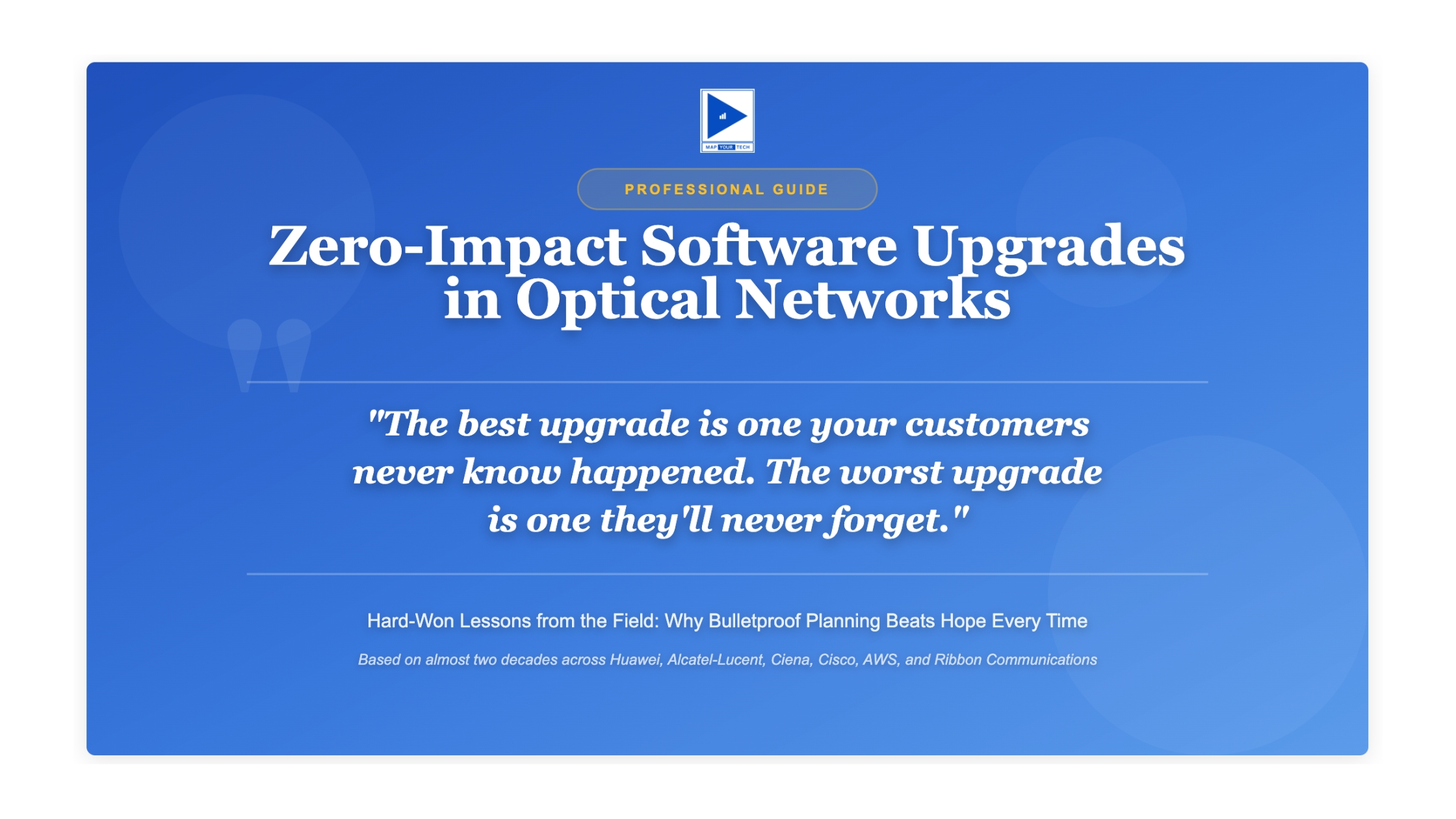

Zero-Impact Software Upgrades in Optical Networks
Hard-Won Lessons from the Field: Why Bulletproof Planning Beats Hope Every Time
After years of managing critical optical network infrastructure, I've learned one truth that stands above all others: hope is not a strategy.
Every network upgrade carries risk, and the difference between a flawless execution and a career-defining outage comes down to preparation, process, and the willingness to walk away if conditions aren't right.
Throughout my career, including my time at AWS where I witnessed firsthand the power of rigorous post-mortem analysis and the 5 Whys methodology, I've developed six non-negotiable requirements before touching production network software. These aren't theoretical ideals from a textbook; they're practical rules forged through escalation outage calls, critical rollback procedures, and the occasional victory of a perfect zero-impact upgrade.
This guide represents the synthesis of industry best practices, vendor methodologies, standards from organizations like ITU-T and MEF, and most importantly, real-world operational experience. Whether you're managing a metro DWDM network, a nationwide optical transport infrastructure, or data center interconnects, these principles apply universally.
But here's the paradox: while we must approach upgrades with extreme caution, we cannot allow fear to alter progress. Networks running end-of-life equipment create risks far greater than well-planned upgrades. The key is finding the balance between operational safety and technological currency.
SECTION 01The Six Pillars of Zero-Impact Upgrades
Before we dive into technical details, let me share the framework that has guided every major upgrade I've executed. These six pillars are not suggestions; they are requirements. If you cannot satisfy all six, you should not proceed with the upgrade.
Bulletproof Plan with Zero-Impact Design
A bulletproof plan means every step is documented, every contingency considered, and every assumption validated. Zero-impact design means you've identified how to maintain service continuity throughout the entire upgrade window.
What this looks like in practice:- Detailed Method of Procedure (MOP) with step-by-step commands
- Traffic rerouting strategy using protection paths or redundant systems
- Time estimates for each step with built-in buffers
- Verification commands and expected outputs documented
- Clear go/no-go decision points with objective criteria
Tested and Validated Rollback Process
Your rollback procedure must be as thoroughly tested as the upgrade itself. When things go wrong at 3 AM, you need a rollback plan you can execute half-asleep under stress.
What this looks like in practice:- Complete configuration backups stored off-device
- Previous software image preserved and accessible
- Step-by-step rollback commands documented and tested
- Rollback time calculated (critical for decision-making)
- Trigger conditions for initiating rollback clearly defined
Restoration Team Ready and Capable
Having the right people available when things go wrong is not negotiable. Your restoration team must include engineers who understand the system deeply, have escalation authority, and are mentally prepared for rapid decision-making under pressure.
What this looks like in practice:- Primary and backup engineers identified and on-call
- Clear roles defined (implementer, observer, decision-maker)
- Vendor support engaged with TAC case pre-opened
- Out-of-band management access tested and working
- Communication channels established (bridge, chat, escalation path)
Lab Simulation with Zero-Impact Validation
Lab testing is where you discover the problems that would otherwise become production outages. Your lab environment must mirror production as closely as possible.
What this looks like in practice:- Physical lab with identical hardware models or validated virtual simulation
- Production configurations replicated in lab
- Complete upgrade procedure executed successfully
- Rollback procedure tested and timed
- Edge cases and failure scenarios tested deliberately
Senior Review and Checklist Completion
Peer review catches the mistakes that familiarity blindness creates. Having senior engineers review your plan isn't about distrust; it's about adding diverse perspectives and catching assumptions that might prove dangerous.Request to reviewers ;dont just review for sake of reviewing as your friend ask for it as formality. Always consider it critical an dif you cant in hurry ,feel free to deny review.
What this looks like in practice:- Change Advisory Board (CAB) approval obtained
- Comprehensive pre-upgrade checklist completed
- Independent engineer review of MOP before execution
- All prerequisites verified (licensing, compatibility, capacity)
- Risk assessment documented and acknowledged
Worst-Case Mitigation Planning
Murphy's Law is real in network operations. The worst-case scenario you haven't planned for is exactly what will happen. Thinking through nightmare scenarios and preparing mitigation strategies transforms potential disasters into managed incidents.
What this looks like in practice:- Failure Mode and Effects Analysis (FMEA) completed
- Spare hardware available on-site if applicable
- Alternate access methods tested (console, out-of-band)
- Customer notification templates prepared
- Escalation triggers defined with contact information
Critical Decision Point: Resources and Team Confidence
Proceed with upgrade ONLY when:
- Resources are adequate: You have sufficient skilled personnel available throughout the maintenance window AND during the post-upgrade monitoring period, OR
- Automation compensates for resource constraints: You have concrete, practical automation that can execute end-to-end with minimal human intervention and has proven rollback capabilities
Never proceed when you're short-staffed hoping "it'll be fine." Resource shortage is a valid reason to postpone.
Message to Managers and Senior Engineers: Empower Your Team
If you're assigning upgrades to junior or less experienced engineers, you have a critical responsibility:
- Provide complete information: Don't assume they know what you know. Share the full context, strategy, and reasoning behind each step
- Ensure MOP accuracy: Verify the Method of Procedure reflects current network state—outdated MOPs with missing information are a recipe for disaster
- Create psychological safety: Make it crystal clear that calling for help is expected and encouraged, not a sign of weakness
- Encourage questioning: If anything seems unclear, suspicious, or different from the MOP—STOP and escalate immediately. Better a delayed upgrade than an outage caused by proceeding with uncertainty
Remember: Most manual errors stem from inadequate information, outdated procedures, or fear of asking questions—not from engineer incompetence. Create an environment where "I'm not sure, let me check" is celebrated, not criticized.
Lessons from Major Outages: When Manual Processes Fail
Recent global incidents underscore why rigorous processes and team empowerment matter:
Optus Triple-Zero Outage (Australia, September 2025): A routine firewall upgrade at 12:30 AM on September 18, 2025 caused a 14-hour outage affecting emergency services (000 calls) across multiple states. Approximately 455 calls to Triple Zero failed, and at least four deaths were linked to the incident. The misconfiguration was not detected despite initial testing showing normal calls were connecting. Key lesson: Emergency service dependencies make network upgrades life-critical operations requiring absolute certainty before execution.
911 Outage (Louisiana & Mississippi, USA, September 2025): On September 25, 2025, multiple fiber cuts caused widespread 911 outages across Louisiana and Mississippi for several hours. The outages affected major cities including New Orleans, Baton Rouge, and Jackson. AT&T fiber optic lines were damaged, resulting in emergency services being unavailable across multiple parishes and counties. Key lesson: When lives depend on your network, "adequate" preparation isn't good enough—only bulletproof planning suffices.
AT&T Network Outage (USA, February 2024): On February 22, 2024 at 2:42 AM, a misconfigured network element during routine maintenance triggered automated protection mechanisms that disconnected all devices simultaneously. The 12+ hour outage blocked more than 92 million voice calls and over 25,000 attempts to reach 911. The configuration error did not conform to AT&T's established procedures, and peer review was not performed. Key lesson: Understanding cascading failure modes and planning recovery capacity for worst-case scenarios is non-negotiable.
CrowdStrike Global IT Outage (July 19, 2024): Described as the largest IT outage in history, affecting 8.5 million Windows devices globally and causing an estimated $5.4 billion in Fortune 500 losses. A faulty configuration update (Channel File 291) passed validation due to a bug in CrowdStrike's Content Validator component. The logic error was introduced at 04:09 UTC and reverted by 05:27 UTC, but millions of systems had already downloaded the faulty update. Key lesson: Test your testing tools. Validate your validation processes. Human review catches what automated checks miss.
The Common Thread: These outages weren't caused by technology failures—they resulted from process failures: inadequate testing, missing peer review requirements, insufficient validation, and lack of psychological safety for engineers to question suspicious circumstances. Every one was preventable with the Six Pillars framework.
The Non-Negotiable Rule
If you cannot satisfy all six pillars, do not proceed with the upgrade. Postpone, gather more resources, or adjust scope. The pressure to "just get it done" has caused more outages than any technical failure. Your job is to protect the network, not to meet arbitrary timelines.
Automation: The Force Multiplier for Consistent Execution
As networks scale and upgrade frequency increases, manual execution of even the best-documented procedures becomes a bottleneck. The companies I've worked with—from Huawei's early automation scripts to AWS's fully orchestrated upgrade pipelines—all learned the same lesson: automation transforms upgrades from risky manual operations into reliable, repeatable processes.
The journey from manual to automated upgrades isn't binary. It's a spectrum that organizations progress along as their capabilities mature. Understanding where you are on this spectrum and how to advance is crucial for scaling operational excellence.
The Automation Maturity Spectrum
During my time at Cisco TAC, I saw customers at every stage of this journey. At Ciena, we did multiple submarine trials and capacity inservice-upgrades requiring intensive and cautious semi-automatic power level tweakings and link optimisation based on fiber characterization to help cable-operators move up their capacity . At AWS, I lived in the fully automated end state. Here's the progression:
Level 1: Manual Execution with Documentation
Engineers follow written MOPs step-by-step. Verification is manual. Rollback requires human decision-making. This is where most organizations start, and it's perfectly acceptable for infrequent upgrades on small networks.
Level 2: Script-Assisted Execution
Pre-upgrade checks run via scripts. Configuration backups automated. Post-upgrade verification uses automated health checks. Engineers still make go/no-go decisions and execute the upgrade manually. This is the sweet spot for many mid-sized operators.
Level 3: Orchestrated Semi-Automation
Python/Ansible playbooks execute the upgrade sequence. Human approval gates at critical checkpoints. Automated rollback triggers on failure conditions. Telemetry streaming provides real-time health monitoring. This is where I operated at Ribbon Communications with service provider customers.
Level 4: Full Automation with Canary Deployment
Zero-touch provisioning and upgrades. Automated canary testing on small population. Progressive rollout based on success metrics. Self-healing rollback on anomaly detection. This is the AWS model—where upgrades happen continuously without human intervention for each instance.
Choosing Your Automation Level
The right level of automation depends on your network size, upgrade frequency, and team capabilities. A 50-node metro network upgraded quarterly may thrive at Level 2. A 5,000-node global backbone upgraded weekly needs Level 3 or 4. The key is matching automation investment to operational reality, not chasing the latest trend.
Building Blocks of Semi-Automated Upgrades
From my experience implementing automation across different platforms, certain building blocks prove universally valuable:
Pre-Flight Validation Scripts: Before any human touches production, automated scripts verify prerequisites. At AWS, we wouldn't let an upgrade proceed unless automated checks confirmed: all redundancy operational, configuration backed up, compatible software versions verified, sufficient storage available, and no conflicting changes in progress. These checks eliminated 60% of potential upgrade failures before they started.
NETCONF/YANG-Based Configuration Management: During my time building automation tools at AWS, we relied heavily on NETCONF for programmatic device interaction. Unlike CLI scraping (which breaks when vendors change output format), NETCONF provides structured data and transactional semantics. This means you can test configuration changes, validate them, and commit as an atomic operation—or abort if validation fails. For optical networks, YANG models like OpenROADM standardize this across vendors.
Telemetry-Driven Health Monitoring: Real-time streaming telemetry changed the game for upgrade validation. Instead of waiting minutes for SNMP polls or parsing CLI output, we consumed optical power levels, FEC statistics, and protocol states as they happened. This enabled automated "soak testing" where the system monitors for 5-10 minutes post-upgrade before declaring success. Any degradation in OSNR, increase in corrected FEC errors, or link flaps triggered immediate rollback.
Staged Rollback Mechanisms: The best automation I've seen had rollback triggers at multiple stages. If pre-checks fail, abort before touching production. If upgrade execution encounters errors, immediate rollback to saved configuration. If post-upgrade validation fails, automated restoration of previous software image. If soak period reveals degradation, triggered restoration with automatic incident creation. Each stage had clear decision criteria and required no human interpretation.
The 80/20 Rule(inspired by Pareto Principle) of Upgrade Automation
In my experience, you can achieve 80% of the safety and efficiency benefits with 20% of the automation effort. Focus on: automated pre-upgrade validation, automated configuration backup and restoration, automated post-upgrade health checks, and standardized rollback procedures. These four capabilities transform upgrade reliability without requiring a multi-year automation transformation.
Practical Implementation: Learning from Industry Experience
Through my industry experience, I've had the privilege to witness and participate in remarkable transformations. One particularly instructive case involved a service provider upgrading 200+ optical nodes quarterly for security patches. The traditional approach required 8-hour maintenance windows with four engineers per site—clearly unsustainable at scale and a recipe for human error.
The solution implemented was Level 2.5 automation (script-assisted with selective orchestration):
Week 1-2: Developed Python scripts using Paramiko for device interaction. Scripts performed pre-upgrade validation (version check, backup verification, redundancy status) and generated compliance reports. Investment: 40 engineer-hours.
Week 3-4: Built Ansible playbooks for the upgrade sequence. Human approval required before activation step and after soak period. Automated rollback if health checks failed. Investment: 60 engineer-hours.
Week 5-6: Created Grafana dashboards fed by streaming telemetry (OSNR, FEC errors, interface states, routing protocol convergence). Investment: 30 engineer-hours.
Results after first production deployment: Maintenance window reduced from 8 hours to 2.5 hours. Engineer count reduced from 4 to 2 (one to execute, one to monitor). Most importantly, zero failed upgrades in first six months (compared to 12% failure rate previously). The automation investment paid for itself in three upgrade cycles.
Key Learning: This transformation taught us that thoughtful automation doesn't just improve efficiency—it fundamentally changes reliability. What's more powerful is that these lessons were shared across the industry, helping others avoid the same pitfalls we initially encountered. When we share both our successes and failures, everyone's networks become more resilient.
Automation Doesn't Eliminate Planning
A common mistake is believing automation makes the Six Pillars optional. It doesn't. Automation implements the pillars more consistently than humans can, but someone still needs to design the rollback logic, define health check thresholds, and plan for worst-case scenarios. In hyperscale environments, teams often spend more time planning automated upgrades than they ever spent planning manual ones—the difference is they plan once and execute thousands of times. This taught me that automation amplifies good processes and also amplifies bad ones—so get the process right first.
Starting Your Automation Journey
If you're currently at Level 1 (manual execution), here's a pragmatic path forward based on lessons learned throughout my career across various organizations:
Month 1: Standardize your MOPs. You can't automate inconsistent processes. Ensure every upgrade follows the same sequence with the same verification steps.
Month 2: Automate configuration backups. This is low-risk, high-value. Use simple scripts (Python + Paramiko or Ansible) to backup configs before every change and store them in version control (Git).
Month 3: Build pre-upgrade validation scripts. Check redundancy status, verify software compatibility, confirm storage capacity. Start small—even five automated checks eliminate common mistakes.
Month 4: Implement automated post-upgrade validation. Compare before/after state (interface counts, protocol adjacencies, route counts, optical power levels). Alert if anything changed unexpectedly.
Month 5-6: Pilot orchestrated execution on non-critical nodes. Use Ansible or Python to execute the upgrade sequence with human approval gates. Monitor closely and refine.
Month 7+: Gradually expand automation scope based on confidence and lessons learned. The key is evolutionary improvement, not revolutionary transformation.
The organizations that excel at upgrades—whether running 50 nodes or 50,000—share a common trait: they treat automation as an investment in reliability, not just efficiency. Every script written, every playbook tested, every dashboard built makes the next upgrade safer than the last. That compounding improvement is how you transform network operations from reactive firefighting to proactive excellence.
SECTION 02The Balancing Act: Safety vs. End-of-Life Risk
While the six pillars emphasize caution, there's an equally important principle: don't delay upgrades so long that hardware and software reach end-of-life or end-of-support. This creates a different but equally serious set of risks including security vulnerabilities.
Understanding the Lifecycle Timeline
Vendor lifecycle management follows a predictable pattern that network operators must track proactively:
| Milestone | Definition | Operational Impact | Risk Level |
|---|---|---|---|
| End of Sale (EOS) | Last date to purchase through vendor channels | Difficult to expand capacity; must source from grey market | Low |
| End of Software Maintenance | No new bug fixes for non-critical issues | Software defects require upgrade to supported platform | Medium |
| End of Support (LDOS) | No technical assistance or security patches | Discovered vulnerabilities have no remediation path | Critical |
| Past LDOS | Equipment beyond all vendor support | Compliance failures, security exposure | Severe |
The Real Cost of Delayed Upgrades
Running end-of-life equipment creates compounding risks that far exceed the risks of a well-planned upgrade:
Security Vulnerability Exposure
Research shows that nearly 48% of known exploitable vulnerabilities exist on systems past their support lifecycle. When a zero-day vulnerability is discovered in your optical transport platform, there will be no patch. Your only option is emergency hardware replacement, which is inherently high-risk and disruptive.
Compliance and Regulatory Risk
Standards like PCI DSS, SOX, and ISO 27001 require running supported systems with current security patches. Running EOL equipment creates audit failures, potential fines, and legal liability if breaches occur.
Innovation Deficit
Fast-moving companies cannot scale on obsolete technology. Modern network demands (400G/800G coherent optics, Layer-0 to Layer-3 overlays, streaming telemetry, AI-driven automation) require current software. Delaying upgrades creates technical debt that eventually forces a massive, risky transformation under time pressure.
Recommended Upgrade Cadence
Software Patches and Minor Updates
Quarterly at minimum, with critical security patches within 48-72 hours of release and validation
Major Software Version Upgrades
Annually or bi-annually, staying no more than N-1 (one version behind current release)
Transponder/Coherent Optics Refresh
Every 3-5 years driven by capacity needs (100G → 400G → 800G technology evolution)
ROADM Infrastructure Refresh
Every 5-7 years to gain flexgrid support, automation features, and CDC-F capabilities
Amplifier Refresh
Every 7-10 years (longest cycle since capacity can increase via end equipment while retaining EDFAs)
Best Practice: The N-1 Strategy
Run one version behind the current release. This provides stability while benefiting from recent improvements and security patches. Early adopters discover bugs for you, but you're close enough to current that vendor support is excellent and feature gaps are minimal.
Conclusion: The Discipline of Excellence
We've covered a vast amount of ground in this guide, from the philosophical foundations of the Six Pillars to the technical details of platform-specific procedures. Let me bring this back to where we started: hope is not a strategy.
After years of managing optical network infrastructure and countless upgrades both successful and educational, here's what I know for certain:
Core Truths About Network Upgrades
- Preparation determines outcomes. The quality of your planning, lab testing, and team readiness has a direct correlation to upgrade success.
- Process discipline beats heroics. Consistent execution of proven procedures outperforms ad-hoc troubleshooting every time.
- Learning is non-negotiable. Every upgrade, successful or not, should generate insights that improve the next one.
- Balance caution with velocity. The risk of never upgrading equals or exceeds the risk of well-planned upgrades.
- Culture matters as much as technology. Blameless post-mortems, psychological safety, and continuous learning create excellence.
The optical networks you manage are critical infrastructure. They carry emergency services, financial transactions, healthcare data, and the daily communications of millions of people. This responsibility is both a privilege and a calling that demands our best work.
When you prepare thoroughly, test rigorously, execute with discipline, and learn continuously, you transform network upgrades from sources of anxiety into opportunities for improvement. You build confidence in your team, trust with your customers, and resilience in your infrastructure.
The Six Pillars aren't just requirements; they're a mindset. They represent a commitment to excellence that says: we will not risk our network on hope; we will earn our success through preparation.
Remember: Every upgrade is a learning opportunity. When things go perfectly according to plan, we validate our processes. When they don't, we gain insights that make us better. Share your successes so others can replicate them. Share your challenges so others can avoid them. This is how we collectively raise the bar for our entire industry.
Go forth and upgrade with confidence. And when things inevitably don't go exactly as planned (because Murphy's Law is real and that's okay), conduct your 5 Whys with curiosity rather than blame, implement your action items with commitment, and emerge stronger with lessons to share.
That's how we build the reliable networks our world depends on—together, one upgrade at a time, always learning, always improving.
Unlock Premium Content
Join over 400K+ optical network professionals worldwide. Access premium courses, advanced engineering tools, and exclusive industry insights.
Already have an account? Log in here