Why it is Good to have ORL >30dB for general fiber links?
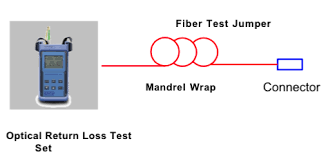
Optical return loss (ORL) is the logarithmic ratio of the launch (incident) power divided by the total reflected power seen at the launch point. The total reflected power is the total accumulated reflected optical power measured at the launch caused by fiber Rayleigh scattering and Fresnel reflections. Rayleigh scattering is the scattering of light along the entire length of the fiber, caused by elastic collisions between the light wave and fiber molecules. This results in some of the light to be reflected back to the source. Rayleigh scattering is intrinsic to the fiber and therefore cannot be eliminated.
Fresnel reflections occur in the light path where there is an abrupt change in the refractive index such as at connections and splices. The further away a reflective event is from the fiber launch point the less
it contributes to the total reflected power. Therefore, fiber connections and splices closest to the laser contribute the most to the ORL. ORL is always expressed as a positive decibel. The higher the ORL the lower the reflected power.

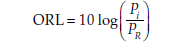
where ORL = optical return loss, dB
PR = total reflected power seen at the launch point, mW
Pi = launch or incident power, mW

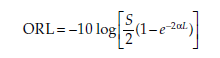
where S = backscattering capture coefficient, approximately 0.0015
for standard fiber at 1550 nm
L= fiber length, km
α= attenuation coefficient, 1/km
See calculation for ORL for SMF at 1550nm.
Assume fiber attenuation is 0.22 dB/km at 1550 nm,
S = 0.0015 with a nonreflective end.
L=20Km
After calculation using above generic values; ORL will come as ~30 dB.
ITU-T G.959.1 recommends a minimum ORL of 24 dB for 2.5, 10, and 40 Gbps fiber links.

Optical Communications & Network Automation Expert | Author of 3 Books for Optical Engineers | Founder, MapYourTech
Optical networking engineer with nearly two decades of experience across DWDM, OTN, coherent optics, submarine systems, and cloud infrastructure. Founder of MapYourTech. Read full bio →
Follow on LinkedIn