11 min read
Managed Optical Fiber Networks (MOFN): The Infrastructure Evolution for Modern Data Centers
How MOFN delivers dark fiber performance with managed service convenience in the age of AI and hyperscale computing
Introduction
As artificial intelligence workloads and cloud computing demands continue to grow exponentially, network operators face a critical challenge: how to deliver the massive bandwidth, ultra-low latency, and dedicated capacity that hyperscalers and enterprises require, without forcing them to build and manage their own optical transport infrastructure. Traditional shared wavelength services cannot meet these demands, while building private dark fiber networks requires significant capital investment and operational expertise.
Managed Optical Fiber Networks (MOFN) have emerged as the solution that bridges this gap. MOFN combines the performance characteristics of private dark fiber with the operational convenience of managed services. This article explains what MOFN is, how it differs from alternative connectivity options, and why it has become the preferred choice for connecting modern data centers and AI training clusters.
What is MOFN
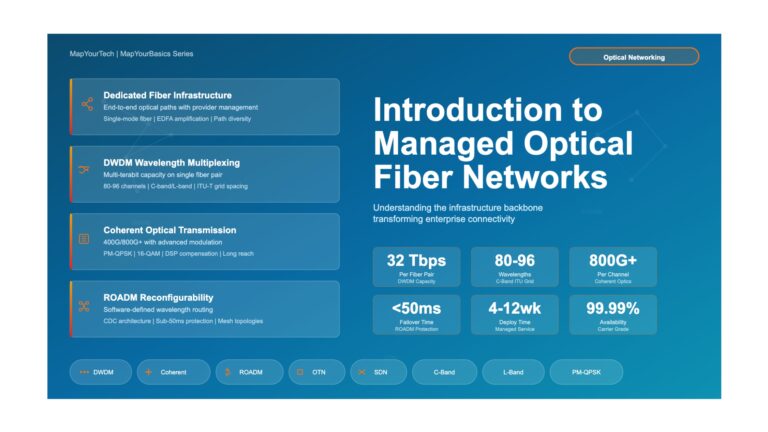
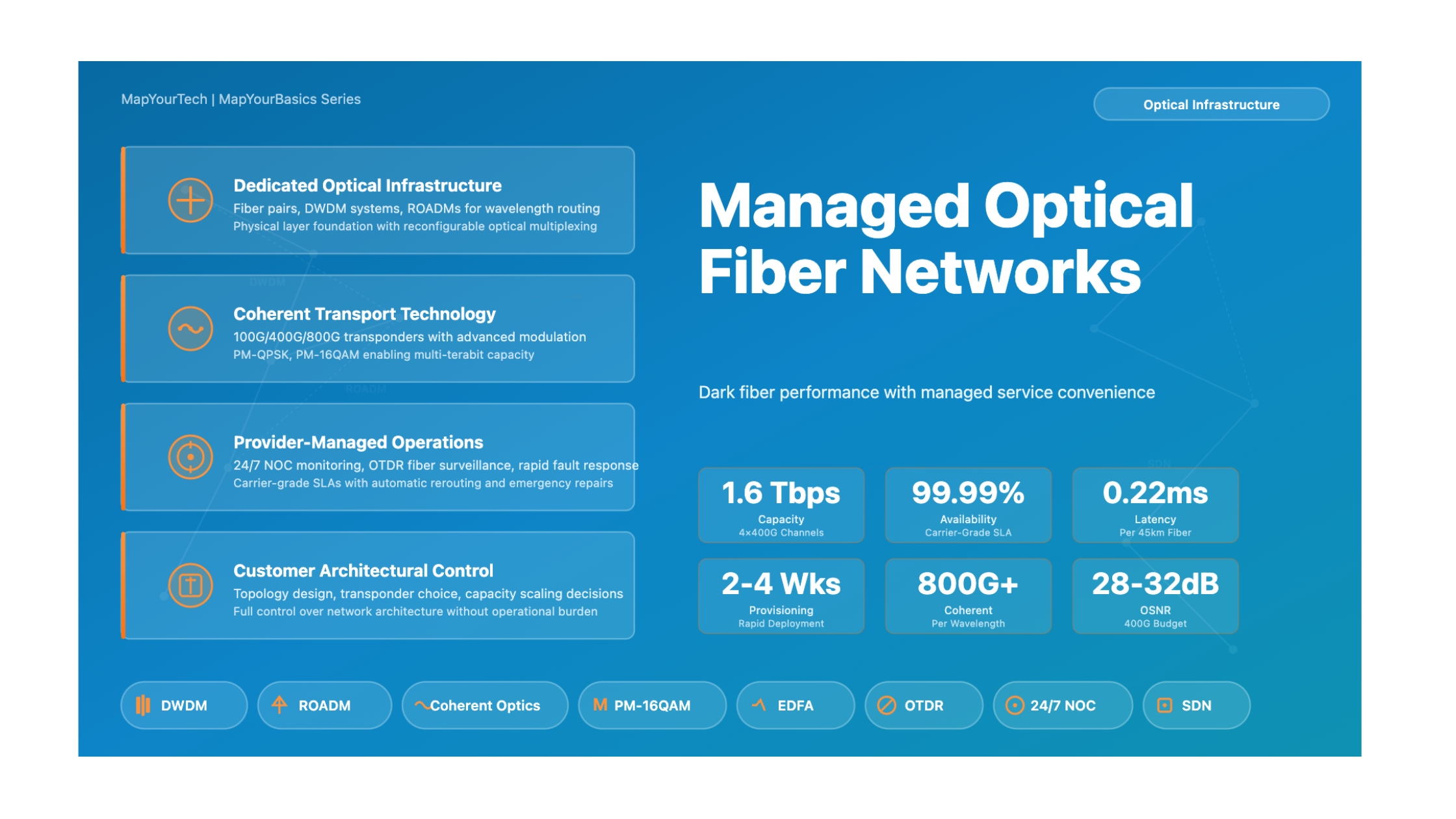
A Managed Optical Fiber Network is a high-capacity optical fiber infrastructure built, operated, and maintained by a third-party service provider on behalf of a customer. Unlike shared carrier services where multiple customers share the same physical and optical resources, MOFN provides an end-to-end dedicated optical path exclusively for a single customer. The provider handles all aspects of the optical transport layer including fiber plant maintenance, optical amplifier operations, network monitoring, and fault management, while the customer retains control over network architecture, capacity planning, and scaling decisions.
The physical architecture typically consists of fiber pairs connecting customer sites over metro or long-haul distances. These fibers support Dense Wavelength Division Multiplexing (DWDM) systems with Reconfigurable Optical Add-Drop Multiplexers (ROADMs) that enable dynamic wavelength routing and flexible capacity allocation. Modern MOFN deployments use coherent optical transponders operating at 100 Gbps, 400 Gbps, 800 Gbps and higher data rates with advanced modulation formats like PM-QPSK and PM-16QAM to maximize spectral efficiency.
The service provider installs and maintains optical amplifiers (EDFA or Raman) and regeneration sites along long routes to ensure signal quality meets strict performance requirements. A 24/7 Network Operations Center (NOC) continuously monitors the fiber plant using optical time-domain reflectometers (OTDR) and other monitoring systems to detect and rapidly respond to fiber cuts, equipment failures, or performance degradation. This carrier-grade operational model delivers high availability with stringent Service Level Agreements (SLAs) while eliminating the need for customers to staff and operate their own optical transport teams.
MOFN Service Models
MOFN End-to-End Architecture: Real-World Deployment
MOFN Compared to Alternative Connectivity Options
To understand the value that MOFN delivers, it is helpful to compare it against the two traditional alternatives: shared wavelength services and dark fiber. Each option involves different trade-offs in terms of performance, operational responsibility, capital requirements, and flexibility.
Shared wavelength services, sometimes called lit services or managed waves, provide customers with specific amounts of bandwidth (for example, a 100 Gbps or 400 Gbps circuit) over a carrier's shared optical infrastructure. Multiple customers share the same physical fiber and optical transport equipment. While this model offers plug-and-play simplicity with no capital investment required, it comes with limitations. The customer has no control over the optical layer architecture, capacity is fixed to what the provider allocates, and the shared nature means performance can be affected by other traffic on the network. Service activation times can be slow because the provider must coordinate across their entire shared infrastructure.
Dark fiber represents the opposite extreme. Here, the customer leases raw fiber strands and must install, operate, and maintain all optical transport equipment themselves. This gives complete control over the optical layer including choice of transponders, modulation formats, wavelength allocation, and network topology. Dark fiber delivers the lowest possible latency since there are no shared resources or intermediate processing hops. However, it requires significant upfront capital investment in optical equipment, dedicated staff with specialized optical networking expertise, and ongoing operational expenses for maintenance, monitoring, and upgrades. The customer assumes all responsibility for network operations including fault management and emergency repairs.
MOFN occupies the middle ground between these extremes. It provides dedicated optical infrastructure similar to dark fiber, but with the provider handling all operational responsibilities similar to managed wave services. The customer gets exclusive use of fiber capacity with full architectural control, while the provider manages equipment installation, network monitoring, fault response, and ongoing maintenance. This shared responsibility model delivers dark fiber performance characteristics without the operational burden or capital requirements of building a private network.
| Characteristic | Shared Wavelength | Dark Fiber | MOFN |
|---|---|---|---|
| Operational Model | Fully managed by provider | Customer self-managed | Provider-managed infrastructure, customer controls architecture |
| Capacity Allocation | Fixed bandwidth circuits | Limited only by optics | Dedicated, scalable on demand |
| Latency | Higher (shared processing) | Lowest possible | Ultra-low (dedicated path) |
| Capital Requirements | None (OpEx only) | Very high (all equipment) | Low to medium |
| Time to Deploy | Weeks to months | Months (permits, installation) | Weeks (using existing infrastructure) |
| SLA Guarantees | Standard carrier SLAs | None (customer responsibility) | High-assurance SLAs with 24/7 NOC |
| Network Visibility | Limited to circuit endpoints | Complete (customer tools) | Comprehensive (provider monitoring + customer access) |
| Scalability | Requires new circuit orders | Fast (customer controls) | Fast (provider provisions on dedicated infrastructure) |
| Best Suited For | Basic connectivity needs | Hyperscalers with optical teams | High-bandwidth users without optical operations staff |
This comparison shows why MOFN has gained rapid adoption. For organizations that need dark fiber level performance but lack the resources or desire to operate optical transport infrastructure, MOFN delivers the optimal balance. A cloud provider expanding into a new region, for example, can activate MOFN service in weeks rather than spending months obtaining permits and deploying dark fiber equipment. A financial services firm requiring ultra-low latency for trading applications gets dedicated optical paths without hiring specialized optical engineers.
Market Drivers and Future Outlook
Three converging trends are driving accelerated MOFN adoption across the telecommunications and data center industries. First, artificial intelligence workloads have created unprecedented demand for high-bandwidth, low-latency connectivity between distributed computing resources. Training large language models and other AI systems requires synchronizing massive datasets across GPU clusters, often distributed across multiple data center facilities. These AI training jobs can consume hundreds of terabytes per day in inter-data center traffic, far exceeding what traditional connectivity services can deliver. MOFN provides the dedicated, high-capacity optical paths that AI workloads demand.
Second, hyperscale cloud providers are expanding their global infrastructure footprints to serve customers in new markets and regions. Building out this infrastructure requires connecting hundreds of data center facilities with reliable, high-performance optical transport. Rather than constructing their own fiber networks in every new market, cloud providers are turning to MOFN to quickly establish connectivity using carrier-managed infrastructure. This allows them to focus their engineering resources on compute and software layers while leveraging carrier expertise in optical transport.
Third, data sovereignty and security requirements are pushing organizations toward dedicated infrastructure rather than shared public networks. Financial institutions, government agencies, healthcare systems, and other regulated industries require complete isolation of their network traffic from other users. MOFN provides this physical separation through dedicated fiber paths, meeting compliance requirements while avoiding the complexity of building private networks. The managed aspect means these organizations get enterprise-grade security monitoring and incident response from the carrier's security operations center.
Looking ahead, the MOFN market is expected to see continued strong growth through the remainder of the decade. As coherent optical technology advances to 800 Gbps and beyond, and as flexible-grid DWDM enables more efficient spectrum allocation, MOFN will deliver even higher capacities with better economics. Network automation and software-defined networking capabilities will make MOFN services more responsive to dynamic bandwidth demands. The combination of dedicated optical infrastructure, carrier-grade operational management, and advanced optical transport technology positions MOFN as the preferred connectivity model for modern data-intensive applications.
Conclusion
Managed Optical Fiber Networks represent an evolution in optical transport services that addresses the growing gap between basic shared connectivity and fully private dark fiber networks. By combining dedicated optical infrastructure with provider-managed operations, MOFN delivers the performance characteristics that modern applications require without the capital investment and operational complexity of building private networks. The architecture leverages state-of-the-art coherent optics, flexible DWDM systems, and automated network management to provide carrier-grade reliability with customer architectural control.
For network architects and infrastructure planners evaluating connectivity options for data center interconnection, AI training clusters, or other high-bandwidth applications, MOFN offers a compelling value proposition. It eliminates the trade-off between performance and operational simplicity that has historically characterized optical transport services. As bandwidth demands continue to grow and as optical technology advances, MOFN is positioned to become the standard model for connecting modern digital infrastructure.
References
Ciena, "Managed Optical Fiber Networks (MOFN) Solution Brief" – Types of MOFN and hyperscaler use cases.
Nokia, "Build better MOFNs using network automation" – Discusses MOFN deployment challenges and solutions.
Ribbon Communications, "How MOFN is Powering the AI-Driven Future of DCI" – MOFN benefits for data center interconnect.
Arelion, "Scalable Managed Optical Fiber Network" – Technical features and use cases across industries.
Sanjay Yadav, "Optical Network Communications: An Engineer's Perspective" – Bridge the Gap Between Theory and Practice in Optical Networking.
Developed by MapYourTech Team
For educational purposes in Optical Networking Communications Technologies
Note: This guide is based on industry standards, best practices, and real-world implementation experiences. Specific implementations may vary based on equipment vendors, network topology, and regulatory requirements. Always consult with qualified network engineers and follow vendor documentation for actual deployments.
Feedback Welcome: If you have any suggestions, corrections, or improvements to propose, please feel free to write to us at feedback@mapyourtech.com
Unlock Premium Content
Join over 400K+ optical network professionals worldwide. Access premium courses, advanced engineering tools, and exclusive industry insights.
Already have an account? Log in here