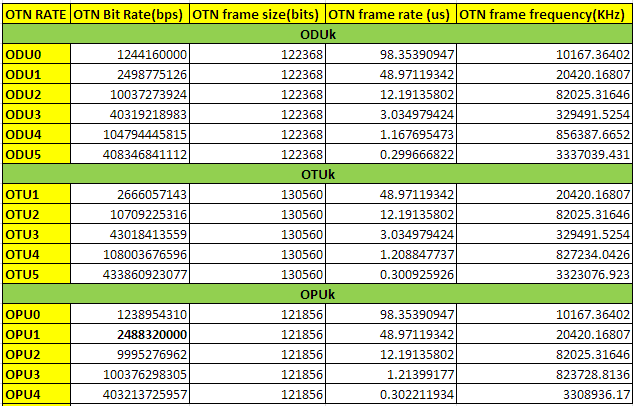
We know that in SDH frame rate is fixed i.e. 125us.
But in case of OTN, it is variable rather frame size is fixed.
So, frame rate calculation for OTN could be done by following method:-
Frame Rate (us) =ODUk frame size(bits)/ODUk bit rate(bits/s)…………………………………….(1)
Also, we know that
STM16=OPU1==16*9*270*8*8000=2488320000 bits/s
Now assume that multiplicative factor (Mk)** for rate calculation of various rates
| Mk= | OPUk=(238/239-k) | ODUk=239/(239-k) | OTUk=255/(239-k) |
Now, Master Formula to calculate bit rate for different O(P/D/T)Uk will be
Bit Rate for O(P/D/T)Uk b/s =Mk*X*STM16=Mk*X*2488320000 b/s………..(2)
Where X=granularity in order of STM16 for OTN bit rates(x=1,4,40,160)
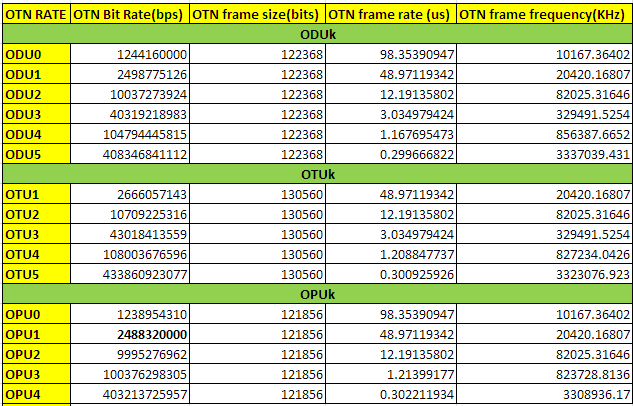
Putting values of equation(2) in equation(1) we will get OTN frame rates.
Eg:-
For further queries revert:)
**Multiplicative factor is just a simple math :eg. for ODU1/OPU1=3824/3808={(239*16)/(238*16)}
Here value of multiplication factor will give the number of times for rise in the frame size after adding header/overhead.
As we are using Reed Soloman(255,239) i.e we are dividing 4080bytes in sixteen frames (The forward error correction for the OTU-k uses 16-byte interleaved codecs using a Reed- Solomon S(255,239) code. The RS(255,239) code operates on byte symbols.).
Hence 4080/16=255…I have understood it you need to do simpler maths to understand..)

Optical Communications & Network Automation Expert | Author of 3 Books for Optical Engineers | Founder, MapYourTech
Optical networking engineer with nearly two decades of experience across DWDM, OTN, coherent optics, submarine systems, and cloud infrastructure. Founder of MapYourTech. Read full bio →
Follow on LinkedIn