Actually,Ethernet frames look like
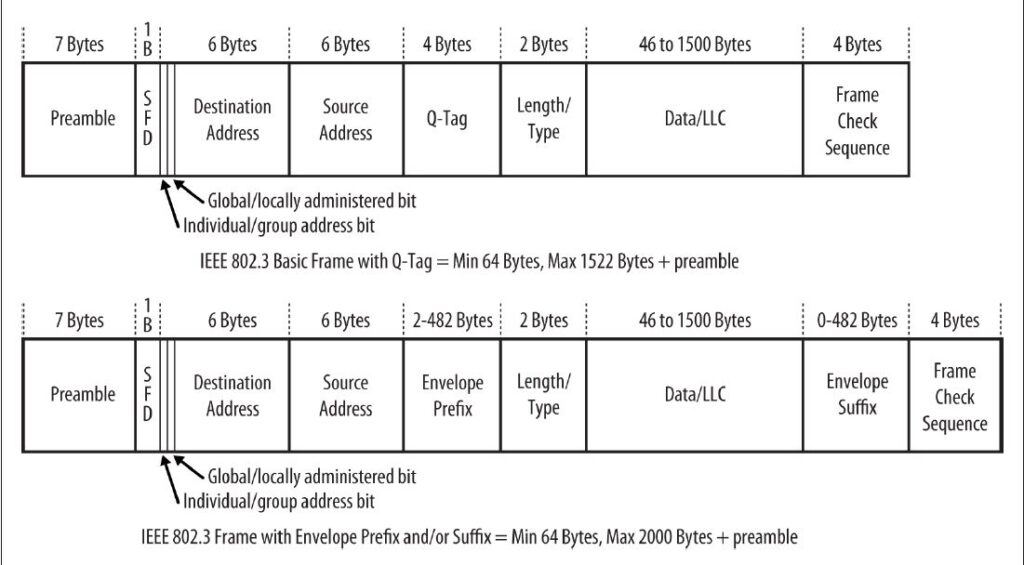
The function of the various parts is as follows:
Preamble/Start of Frame Delimiter, 8 Bytes – Alternate ones and zeros for the preamble, 11010101 for the SFD (Start of Frame Delimiter). This allows for receiver synchronisation and marks the start of frame.
Destination Address, 6 Bytes – The MAC destination address of the frame, usually written in hex, is used to route frames between devices. Some MAC addresses are reserved, or have special functions. For example FF:FF:FF:FF:FF:FF is a broadcast address which would go
to all stations.
Sources Address, 6 Bytes – The MAC address of the sending station, usually written in hex. The source address is usually built into a piece of equipment at manufacture. The first three bytes would identify the manufacturer and the second three bytes would be unique to the equipment. However there are some devices, test equipment for example, in which the address is changeable.
VLAN Tag, 4 Bytes (optional) – The VLAN tag is optional. If present it provides a means of separating data into “virtual” LANs, irrespective of MAC address. It also provides a “priority tag” which can be used to implement quality of service functions.
Length/Type, 2 Bytes – This field is used to give either the length of the frame or the type of data being carried in the data field. If the length/type value is less than 05DC hex then the value represents the length of the data field. If the value is greater than 0600 hex then it represents the type of protocol in the data field, for example 0800 hex would mean the frame was carrying
- 809B hex would mean the frame was carrying
AppleTalk.
Data, 46 to 1500 Bytes – The client data to be transported. This would normally include some higher layer protocol, such as IP or AppleTalk.
Frame Check Sequence, 4 Bytes – The check sequence is calculated over the whole frame by the transmitting device. The receiving device will re-calculate the checksum and ensure it matches the one inserted by the transmitter. Most types of Ethernet equipment will drop a frame with an incorrect or missing FCS.
The minimum legal frame size, including the FCS but excluding the preamble, is 64 bytes. Frames below the minimum size are known as “runts” and would be discarded by most Ethernet equipment.
The maximum standard frame size is 1522 bytes if VLAN tagging is being used and 1518 bytes if VLAN is not being used. It is possible to use frames larger than the maximum size. Such frames are called “Jumbo Frames” and are supported by some manufacturer’s equipment in various sizes up to 64 Kbyte. Jumbo frames are identical in form to standard frames but with a bigger data field.
This produces a better ratio of “overhead” bytes to data bytes and hence more efficient transmission. Jumbos are non-standard and manufacturer specific and therefore interoperability cannot be guaranteed.
The frames are transmitted from left to right, least significant bit first. The frames are separated by an “inter-packet gap”. The minimum length of the interpacket gap is 12 bytes. The inter-packet gap exists because in a half duplex system time is needed for the medium to go quiet before the next frame starts transmission. The inter-packet gap is not really needed for full duplex operation but is still used for consistency.
Auto-Negotiation
Most Ethernet devices support auto-negotiation. When two devices are first connected together they will send information to each other to “advertise” their capabilities. The devices will then configure themselves to the highest common setting. The capabilities negotiated are speed, full or half duplex operation and the use of flow control.

Optical Communications & Network Automation Expert | Author of 3 Books for Optical Engineers | Founder, MapYourTech
Optical networking engineer with nearly two decades of experience across DWDM, OTN, coherent optics, submarine systems, and cloud infrastructure. Founder of MapYourTech. Read full bio →
Follow on LinkedIn