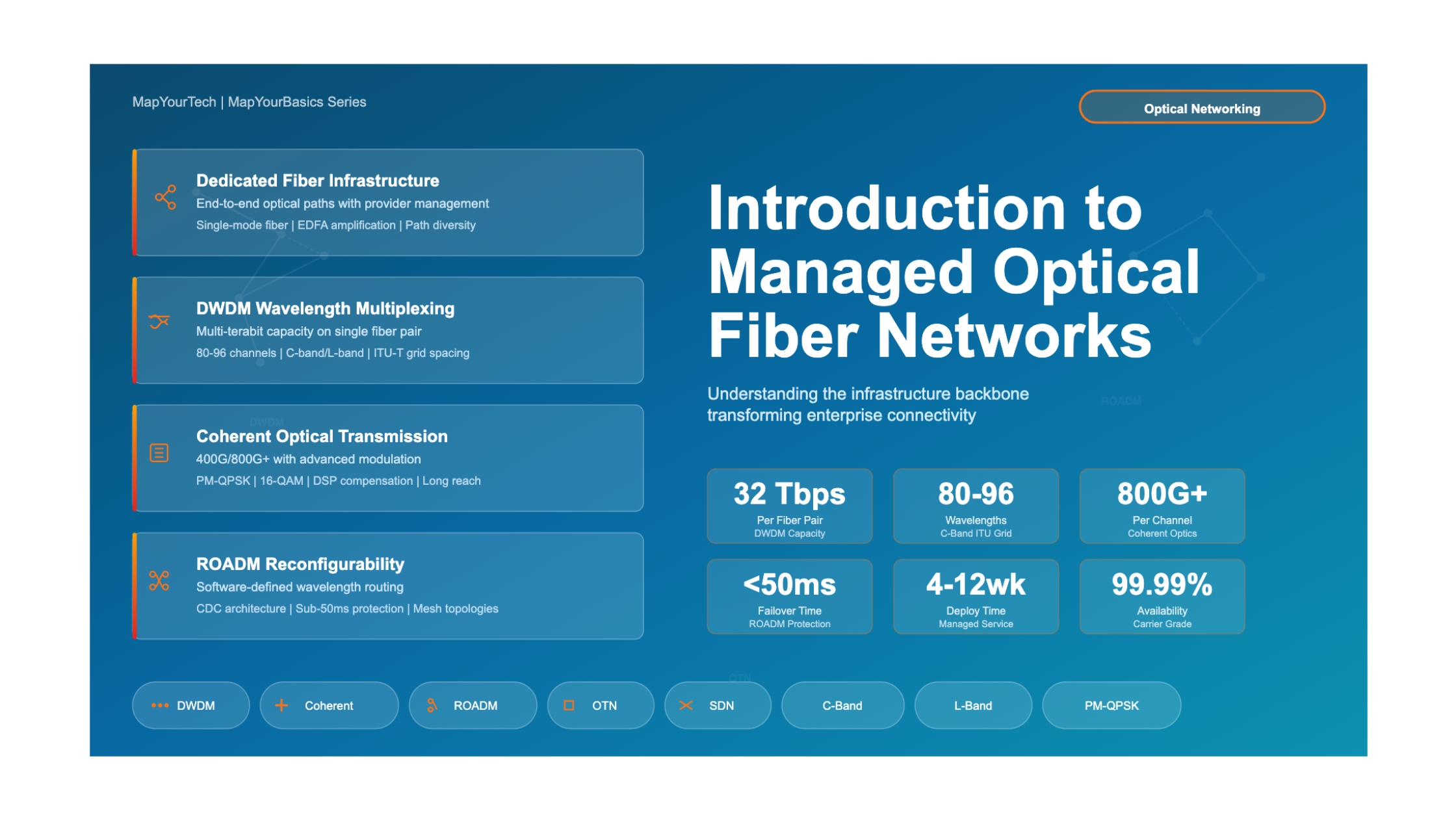
Introduction to Managed Optical Fiber Networks (MOFN)
Understanding the Infrastructure Backbone Transforming Enterprise and Hyperscale Connectivity
Introduction
The telecommunications industry is experiencing a transformation driven by explosive growth in artificial intelligence workloads, densification of fifth-generation wireless networks, and the maturation of hyperscale cloud environments. At the center of this evolution lies the Managed Optical Fiber Network (MOFN), a carrier-grade networking solution that delivers dedicated, end-to-end optical paths operated and maintained by service providers. This infrastructure model represents a strategic middle ground between the raw control of dark fiber and the simplified convenience of traditional lit bandwidth services.
MOFN provides enterprises and hyperscalers with high-capacity optical fiber infrastructure without the immense operational burdens associated with building and managing their own networks. Unlike shared wavelength services where multiple customers share the same fiber infrastructure, an MOFN delivers an isolated optical path dedicated to a single customer. This ensures predictable performance, enhanced security, and the ability to scale bandwidth on demand as business requirements evolve.
The scope of this article covers the fundamental architecture of MOFN systems, key deployment models, the technical components that enable high-capacity transmission, and the industries driving adoption. We examine how MOFN compares to alternative connectivity solutions such as dark fiber, traditional leased lines, and MPLS networks. The article also explores deployment strategies, challenges faced by service providers, and the security considerations that make MOFN attractive for mission-critical applications.
For network engineers and IT professionals evaluating connectivity options, understanding MOFN architecture provides insight into how modern optical networks deliver carrier-grade reliability while transferring operational complexity to specialized providers. This knowledge is important for making informed decisions about data center interconnection, private network builds, and long-haul transport requirements.
Background and Fundamentals
Evolution of Optical Networking Services
The optical networking landscape has evolved significantly over the past two decades. Early enterprise connectivity relied on time-division multiplexed circuits such as T1, T3, and SONET/SDH services, which provided fixed-bandwidth pipes with limited scalability. As data traffic grew exponentially, these legacy technologies proved inadequate for handling modern application demands.
The introduction of Dense Wavelength Division Multiplexing (DWDM) technology revolutionized optical transport by enabling multiple wavelengths to coexist on a single fiber pair. Each wavelength operates as an independent channel, allowing providers to deliver hundreds of gigabits or even terabits of aggregate capacity over existing fiber infrastructure. DWDM systems multiplex signals according to the ITU-T G.694.1 grid, typically with 50 GHz or 100 GHz channel spacing in the C-band (approximately 1530 nm to 1565 nm wavelength range).
Dark fiber emerged as an option for organizations requiring complete control over their optical layer. With dark fiber, customers lease unused fiber strands and deploy their own transmission equipment. While this model offers maximum flexibility and lowest latency, it places the entire burden of equipment procurement, installation, monitoring, and maintenance on the customer. For many organizations, particularly those outside the telecommunications industry, managing optical networks requires specialized expertise that is costly and difficult to retain.
MOFN emerged to address this gap. Service providers recognized that many customers desired the performance characteristics of private fiber networks without the operational complexity. By offering managed optical services, providers could leverage their existing fiber assets, operational expertise, and economies of scale to deliver dedicated optical capacity as a turnkey service. The customer receives a fully functional optical network with guaranteed service level agreements, while the provider handles installation, monitoring, maintenance, and troubleshooting.
Core MOFN Principles
A Managed Optical Fiber Network is built on several foundational principles that distinguish it from other connectivity models. First, the network provides end-to-end dedicated optical infrastructure for a single customer. The fiber strands and wavelengths allocated to one customer are isolated from other traffic, ensuring predictable performance without the contention issues common in shared networks.
Second, the service provider assumes full operational responsibility for the optical layer. This includes planning the network topology, installing and configuring transmission equipment, monitoring fiber plant health, managing optical power budgets, and responding to faults. Customers interact with a managed service rather than raw infrastructure, receiving performance dashboards, SLA reporting, and professional support from the provider's network operations center.
Third, MOFN solutions leverage modern optical technologies to maximize capacity and flexibility. Coherent optical transponders operating at 100 Gbps, 400 Gbps, 800 Gbps and beyond enable very high data rates with efficient spectral usage. Reconfigurable Optical Add-Drop Multiplexers (ROADMs) allow dynamic wavelength routing and the ability to adjust network topology without truck rolls. Flexible-grid DWDM (flexgrid) supports variable channel widths, enabling providers to allocate spectrum precisely based on customer requirements.
Finally, MOFN deployments incorporate advanced automation and visibility layers. Software-defined networking principles enable centralized control of the optical network, allowing rapid provisioning of new circuits and bandwidth adjustments through northbound APIs. Customers often receive portal access to monitor their network performance in real time, viewing metrics such as optical signal-to-noise ratio (OSNR), bit error rates, and latency measurements.
Technical Architecture and Key Components
Physical Layer Infrastructure
The foundation of any MOFN deployment is the fiber-optic infrastructure itself. Service providers utilize either existing dark fiber assets or construct new fiber routes based on customer requirements. In metropolitan areas, dense fiber networks already exist, owned by carriers, utilities, or specialized metro fiber providers. Providers can allocate specific fiber pairs from these networks to create dedicated paths for MOFN customers, significantly reducing deployment time compared to new construction.
Fiber plant design considers several technical factors. Single-mode fiber (SMF) is standard for MOFN applications due to its low attenuation (typically 0.2 dB/km in the C-band) and ability to support long transmission distances. Fiber routes are engineered with diversity in mind, utilizing geographically separated paths to protect against cable cuts. In urban environments, providers often deploy fiber through multiple conduit systems or along different utility corridors to ensure path diversity.
Optical amplifiers are placed strategically along fiber routes to compensate for signal attenuation. Erbium-Doped Fiber Amplifiers (EDFAs) are most common in the C-band, providing 15-30 dB of gain with relatively flat spectral response. For ultra-long-haul applications, Raman amplification may supplement EDFA stages to achieve lower noise figures and extended reach. The spacing between amplifier sites depends on fiber loss, typically ranging from 60 to 100 kilometers in modern networks.
At termination points, optical patch panels provide demarcation between the provider's network and customer equipment. These passive components allow flexible cross-connection of fibers and simplify maintenance procedures. Proper fiber management at these locations is important to prevent bend-induced losses and ensure long-term reliability.
DWDM and Optical Transport Systems
The optical transport layer multiplexes multiple wavelengths onto fiber pairs using DWDM technology. Modern DWDM systems support 80 to 96 channels in the C-band alone, with some systems extending into the L-band (1565 nm to 1625 nm) for additional capacity. Each channel operates independently, carrying data at rates from 10 Gbps to 800 Gbps or higher using coherent optical modulation.
Coherent detection has become the dominant transmission technology in MOFN deployments. Unlike intensity-modulated direct-detection systems, coherent transceivers modulate both the amplitude and phase of the optical carrier. Common modulation formats include Polarization-Multiplexed Quadrature Phase-Shift Keying (PM-QPSK) for 100 Gbps, 16-QAM for 200-400 Gbps, and higher-order modulation schemes for advanced applications. Digital Signal Processing (DSP) in the receiver compensates for chromatic dispersion, polarization mode dispersion, and fiber nonlinearities, enabling transmission over thousands of kilometers without optical-electrical-optical regeneration.
The relationship between optical frequency and wavelength is fundamental to DWDM operation. The wavelength λ relates to frequency f through the speed of light c according to λ = c / f. In practical terms, this means that a 50 GHz channel spacing in the C-band corresponds to approximately 0.4 nm wavelength separation. Precise laser frequency control and wavelength locking ensure that channels remain aligned with the ITU grid, preventing inter-channel interference.
Figure 2: DWDM wavelength multiplexing showing how multiple independent channels combine onto a single fiber pair, enabling multi-terabit capacity
Figure 1: MOFN architecture showing dedicated optical path with provider-managed transport equipment
Continue Reading This Article
Sign in with a free account to unlock the full article and access the complete MapYourTech knowledge base.
Reconfigurable Optical Add-Drop Multiplexers
ROADMs represent a critical enabling technology in modern MOFN deployments. These devices use Wavelength Selective Switches (WSS) to dynamically route individual wavelengths between fiber paths without optical-electrical-optical conversion. A WSS consists of micro-electro-mechanical systems (MEMS) mirrors or liquid crystal on silicon (LCoS) technology that steers each wavelength to its desired output port.
The key advantage of ROADMs is network flexibility. When a customer needs to add capacity or change routing, the provider can reconfigure wavelength paths through software control rather than dispatching technicians for manual fiber patching. This capability dramatically reduces service provisioning time from weeks to hours or even minutes in automated networks.
ROADM nodes are characterized by their degree, which refers to the number of fiber directions supported. A degree-2 ROADM supports linear topologies (point-to-point or chain configurations), while degree-4 or higher ROADMs enable mesh network designs with multiple path options. Colorless, Directionless, and Contentionless (CDC) ROADM architectures provide maximum flexibility by allowing any wavelength to be added or dropped at any port and directed toward any degree.
In MOFN applications, ROADMs enable several important functions. They support automatic protection switching, where traffic is rerouted around fiber cuts or equipment failures in sub-50 millisecond timeframes. They allow spectrum allocation to be adjusted dynamically as customer bandwidth needs grow. They also enable multi-tenant networks where a single physical infrastructure supports multiple isolated customer networks through wavelength segregation.
Figure 4: Common MOFN network topology patterns with their resilience characteristics and ideal use cases
Service Delivery Models
MOFN services are delivered through several distinct models, each offering different balances between provider management and customer control. Understanding these models helps clarify how MOFN fits into various network architectures.
In a standard MOFN deployment, the provider delivers an entire end-to-end fiber network dedicated to the customer. This includes fiber strands, optical amplifiers, ROADMs, and coherent transponders. The customer receives a turnkey optical network with specified capacity (for example, two 400 Gbps wavelengths) connecting their sites. The provider handles all installation, monitoring, and maintenance activities, while the customer simply connects their routers or switches to the transponder client interfaces.
A lit capacity MOFN resembles a managed wavelength service. The provider lights the fiber with their optical equipment and delivers specific bandwidth increments (such as 100 Gbps or 400 Gbps channels) to the customer. The customer may receive multiple wavelengths as their capacity requirements grow, with each wavelength operating independently. This model provides simplicity for customers who want plug-and-play connectivity without managing optical transport details.
The hybrid Open Line System (OLS) model represents a middle ground. The provider supplies a dedicated optical line system consisting of fiber plant, optical amplifiers, and ROADMs. The customer then deploys their own coherent transponders on this infrastructure, giving them control over modulation formats, baud rates, and forward error correction schemes. This approach appeals to hyperscalers and large enterprises that want to standardize on specific optical hardware across their global networks while offloading fiber plant management to the provider.
A fourth emerging model involves sliceable OLS, where the provider partitions spectrum on fiber pairs and virtually assigns wavelengths or spectrum blocks to different customers. This multi-tenant approach allows the provider to maximize fiber utilization while still delivering isolated optical paths to each customer. Advanced orchestration platforms manage the spectrum allocation and ensure that adjacent channels do not interfere with each other.
Figure 3: Visual comparison of MOFN service delivery models showing responsibility allocation between provider and customer
| Model | Provider Responsibility | Customer Responsibility | Key Advantages | Best For |
|---|---|---|---|---|
| Standard MOFN | Fiber, amplifiers, ROADMs, transponders, full operations | Connect client equipment (routers/switches) | Fully managed, rapid deployment, no optical expertise needed | Enterprises, medium-scale data centers |
| Lit Capacity | All optical equipment, wavelength provisioning | Client interfaces only | Simple plug-and-play, predictable capacity increments | Branch connectivity, regional networks |
| Hybrid OLS | Fiber plant, amplifiers, ROADMs, monitoring | Transponders, modulation selection, capacity planning | Customer controls optical layer, standardized equipment | Hyperscalers, large cloud providers |
| Sliceable OLS | Shared fiber infrastructure, spectrum management | Transponders, spectrum utilization | Efficient fiber use, flexible spectrum allocation | Multi-tenant scenarios, spectrum-as-a-service |
Network Automation and Visibility
Modern MOFN deployments incorporate sophisticated automation and monitoring systems that differentiate them from traditional managed services. Providers deploy centralized network control platforms that offer a single point of management for multi-vendor optical networks. These platforms expose northbound APIs that allow customers or provider operations staff to programmatically provision circuits, adjust bandwidth, and query network state.
Automated provisioning workflows replace manual configuration procedures. When a customer requests a new wavelength or bandwidth increase, the control system calculates optimal routing paths, configures transponders with appropriate modulation formats, sets ROADM cross-connects, and validates end-to-end connectivity. The entire process can complete in minutes rather than the days or weeks required for manual provisioning.
Continuous monitoring provides real-time visibility into optical network health. Optical Time Domain Reflectometry (OTDR) systems detect fiber breaks and localize faults to within meters of the actual problem. Optical channel monitors measure per-wavelength power levels and OSNR at various points in the network. Bit error rate counters and forward error correction statistics indicate when signal quality degradation might lead to service impact.
Customers typically receive access to a self-service portal or dashboard where they can view their network topology, monitor performance metrics, and submit change requests. Advanced analytics platforms correlate optical layer data with higher-layer performance indicators, helping identify root causes when application performance degrades. Some providers offer predictive maintenance capabilities that use machine learning to detect subtle trends that might indicate impending equipment failures.
Use Cases and Industry Applications
Data Center Interconnection
Data Center Interconnection (DCI) represents the largest and fastest-growing use case for MOFN services. Hyperscale cloud providers operate globally distributed data centers that must synchronize enormous volumes of data. Live virtual machine migration, distributed storage replication, and disaster recovery all require ultra-high bandwidth connectivity with predictable latency.
MOFN delivers the capacity and performance characteristics needed for modern DCI applications. Coherent 400 Gbps and 800 Gbps wavelengths provide sufficient bandwidth for terabytes of data movement. Dedicated fiber paths ensure consistent latency without the jitter and variation common in shared networks. The ability to scale capacity by adding wavelengths allows data center operators to match network growth with compute and storage expansion.
Major cloud providers utilize MOFN for both regional interconnection (connecting data centers within a metropolitan area or across adjacent states) and long-haul connectivity (linking facilities across continents). Metro DCI links typically span 50-200 kilometers and can achieve sub-millisecond latency. Long-haul DCI connections may traverse thousands of kilometers using multiple amplifier stages and advanced modulation formats optimized for distance.
Artificial intelligence and machine learning workloads are driving exponential growth in DCI bandwidth requirements. Training large language models often involves distributing computational tasks across multiple data centers and aggregating results. The GPU clusters used for AI training generate massive east-west traffic flows that benefit from dedicated optical connectivity. MOFN providers report that AI-related DCI demands are growing at 50-100% annually, far exceeding traditional enterprise traffic growth rates.
Financial Services and Low-Latency Trading
Financial institutions require ultra-low latency connectivity for algorithmic trading, market data distribution, and transaction processing. In high-frequency trading, microsecond latency differences can determine profitability. MOFN provides the physical layer foundation for these demanding applications.
Trading firms deploy MOFN links between exchanges, co-location facilities, and their primary data centers. Because MOFN uses dedicated fiber rather than shared infrastructure, latency remains constant and predictable. The provider can optimize fiber routes to minimize distance, further reducing propagation delay. Some MOFN deployments for financial services achieve one-way latency as low as 4-5 milliseconds over 1,000 kilometer distances.
Security considerations are paramount in financial applications. The physical isolation of MOFN fiber paths prevents eavesdropping that could occur in shared networks. Many financial customers implement encryption at the optical layer for additional protection. The dedicated nature of MOFN also eliminates concerns about traffic correlation or timing attacks that might be possible in multi-tenant environments.
Healthcare and Research
Healthcare organizations face unique connectivity challenges driven by medical imaging, electronic health records, and research collaboration. High-resolution medical imaging studies can generate gigabytes of data per patient. Telemedicine applications require reliable, high-quality video streaming. Research institutions need to transfer genomic sequencing data and collaborate on computational biology projects.
MOFN enables healthcare providers to interconnect hospitals, imaging centers, and data repositories with guaranteed bandwidth. A regional healthcare system might deploy MOFN to connect ten hospitals across a metropolitan area, supporting centralized PACS (Picture Archiving and Communication System) storage and real-time consultation between specialists. The predictable performance of MOFN ensures that diagnostic images load quickly regardless of concurrent network activity.
Academic research networks leverage MOFN for large-scale scientific collaboration. Particle physics experiments generate petabytes of data that must be distributed to research institutions worldwide for analysis. Astronomical observatories transmit massive telescope datasets to processing centers. Genomics facilities share sequencing results across international collaborations. MOFN provides the capacity and reliability required for these data-intensive research workflows.
Media and Content Distribution
Media companies working with 4K and 8K video content face extraordinary bandwidth requirements. Uncompressed 8K video at 60 frames per second consumes approximately 48 Gbps of bandwidth. Post-production workflows often involve moving raw footage between filming locations, editing facilities, and rendering farms. Live broadcast applications require guaranteed delivery without packet loss or jitter.
MOFN supports these media workflows with dedicated capacity and zero contention. A film studio might deploy MOFN connectivity between sound stages, editing suites, and cloud rendering services. Broadcasting companies use MOFN to interconnect studios, production trucks, and transmission facilities. Content delivery networks leverage MOFN for high-capacity peering connections and cache server distribution.
Enterprise Private Networks
Large enterprises with distributed operations often require private network infrastructure for security and performance reasons. Manufacturing companies need to interconnect factories and control systems. Retail chains require reliable connectivity between headquarters, distribution centers, and stores. Government agencies must meet strict security and compliance requirements for inter-site communications.
MOFN allows these organizations to build private optical networks without the capital expenditure and operational complexity of owning infrastructure. The managed service model ensures professional monitoring and rapid fault resolution. Service Level Agreements provide guaranteed uptime and performance metrics. The ability to scale bandwidth on demand accommodates business growth without forklift upgrades.
Key Takeaways: MOFN Applications
- Data center interconnection drives the majority of MOFN demand, with AI workloads accelerating bandwidth growth beyond 50% annually
- Financial services leverage MOFN for sub-millisecond latency trading applications where timing precision directly impacts profitability
- Healthcare and research institutions use MOFN to support medical imaging distribution and large-scale scientific data transfers
- Media production workflows benefit from dedicated capacity that eliminates contention for uncompressed high-resolution video transport
- Enterprise private networks gain carrier-grade reliability without the burden of building and operating optical infrastructure
Deployment Strategies and Operational Considerations
Leveraging Existing Infrastructure
Service providers approach MOFN deployment with a strong preference for utilizing existing fiber assets. In metropolitan areas, carriers typically own extensive dark fiber networks deployed over decades of network buildout. These fiber plants often include spare capacity that can be allocated to MOFN customers without new construction. By monetizing existing assets, providers reduce deployment time from months to weeks and minimize capital expenditure.
The process begins with a fiber plant survey to identify available routes between customer sites. Providers analyze fiber quality through OTDR testing to verify that existing strands meet performance requirements. Factors such as total fiber loss, splice loss, and connector quality determine whether a fiber pair is suitable for high-capacity coherent transmission. Fibers with excessive loss or impairments may require remediation or replacement.
When existing fiber proves adequate, the provider installs optical transport equipment at customer sites and intermediate amplifier locations. Coherent transponders are configured with modulation formats and baud rates appropriate for the link distance and quality. ROADMs are programmed to route wavelengths along designated paths. The optical line system is commissioned through end-to-end testing that validates power budgets, OSNR margins, and bit error rate performance.
Rural and long-haul deployments present greater challenges. Fiber infrastructure in sparsely populated areas is limited, and available routes may follow indirect paths that increase latency. In these scenarios, providers must often construct new fiber builds or negotiate access to utility-owned fiber (such as along power transmission corridors or railway rights-of-way). The lead time for new construction can extend to 12-18 months when permits, trenching, and fiber installation are required.
Multi-Vendor Interoperability
MOFN networks frequently incorporate equipment from multiple vendors, driven by customer preference, best-of-breed component selection, or supply chain diversification. Achieving interoperability in multi-vendor optical networks requires careful planning and adherence to open standards.
The Open Line System concept enables transponder interoperability by defining clear interfaces between customer transponders and the provider's optical line equipment. Industry specifications from organizations like the Optical Internetworking Forum (OIF) standardize parameters such as optical power levels, wavelength stability, and chromatic dispersion tolerance. When both customer and provider equipment comply with these specifications, transponders from different vendors can successfully transmit over the same fiber infrastructure.
ROADMs from different vendors can interoperate at the optical layer provided they implement compatible wavelength routing mechanisms and power management algorithms. Software-defined control platforms abstract vendor-specific command interfaces behind standardized northbound APIs. NETCONF/YANG data models and Transport API (T-API) specifications enable unified network control across heterogeneous equipment.
Despite these standardization efforts, multi-vendor integration requires substantial testing and validation. Providers typically establish lab environments where they verify interoperability between transponder and line system combinations before deploying in production networks. Performance testing confirms that vendor combinations achieve expected reach, capacity, and resilience characteristics.
Security Architecture
Security in MOFN deployments operates at multiple layers. Physical security begins with the dedicated nature of fiber allocation. Unlike shared wavelength services where multiple customers' traffic coexists on the same fiber, MOFN provides isolated fiber pairs or wavelengths dedicated to a single customer. This physical segregation prevents eavesdropping at the optical layer that could occur through power taps or optical splitters in shared networks.
Fiber routes are engineered with security in mind. Providers select paths through controlled access facilities and avoid publicly accessible areas where fiber could be compromised. Many MOFN customers specify diverse routing requirements where traffic is split across geographically separated fiber paths. If one path is cut or compromised, traffic automatically reroutes through the alternate path with minimal service disruption.
Encryption can be implemented at multiple layers. Some coherent transponders support native optical layer encryption that scrambles the optical signal itself. This provides protection even if someone gains physical access to the fiber. Alternatively, customers often implement encryption at the IP layer using IPsec or MACsec protocols running on routers connected to the optical network. The choice between optical and IP layer encryption depends on performance requirements, key management preferences, and compliance mandates.
Network access controls restrict who can modify MOFN configurations. Provider NOC systems implement role-based access control with audit logging of all configuration changes. Customers accessing self-service portals authenticate through multi-factor mechanisms and receive permissions limited to their specific network resources. APIs use token-based authentication and transport security to prevent unauthorized access or man-in-the-middle attacks.
Monitoring systems provide intrusion detection capabilities. Sudden changes in optical power levels might indicate fiber tapping attempts. Unexpected bit error rate increases could signal jamming or interference. Automated alerts notify NOC personnel of anomalies that might represent security incidents rather than routine equipment faults.
Service Level Agreements and Performance Guarantees
MOFN services are sold with strict Service Level Agreements that codify performance commitments and remediation procedures. Typical SLAs address availability, latency, and packet loss metrics. Availability commitments commonly target 99.9% to 99.99% uptime, translating to less than 9 hours or less than 1 hour of downtime per year respectively.
Latency SLAs specify maximum one-way or round-trip delay between endpoints. These targets reflect the physical limitations of fiber propagation (approximately 5 microseconds per kilometer) plus small contributions from transponder and ROADM processing. Providers typically guarantee latency within 10-15% of the theoretical minimum based on fiber route distance.
Packet loss commitments ensure that the optical layer delivers error-free transmission. Modern coherent systems with forward error correction achieve bit error rates better than 10^-15, effectively eliminating packet loss due to optical impairments. SLAs often specify zero packet loss under normal operating conditions, with allowances only during planned maintenance windows or force majeure events.
SLA enforcement includes financial penalties when performance falls short of commitments. Service credits typically scale with the severity and duration of outages. A brief outage might result in a monthly service credit equal to a few days of charges, while extended outages could trigger credits approaching full monthly fees. These financial incentives align provider and customer interests in maintaining network reliability.
Performance reporting provides transparency into SLA compliance. Providers deliver monthly reports showing actual availability, latency measurements, and any incidents that impacted service. Advanced platforms offer real-time dashboards where customers can monitor their network performance and validate SLA adherence continuously rather than waiting for periodic reports.
Comparison with Alternative Connectivity Models
Understanding how MOFN compares to other network service models clarifies its value proposition and appropriate use cases. Dark fiber represents one end of the spectrum, offering maximum control but requiring complete customer ownership of operational responsibilities. At the other end, shared lit services provide simplicity but limited performance guarantees and potential security concerns.
Dark fiber leases grant customers access to unused fiber strands. The customer must procure, install, and maintain all optical transport equipment including transponders, multiplexers, amplifiers, and monitoring systems. This model appeals to organizations with deep optical networking expertise and requirements for complete control over modulation formats, routing decisions, and capacity planning. The trade-off is substantial capital expenditure and the need for specialized staff to manage the network.
Traditional leased lines and MPLS services abstract the optical layer behind fixed-bandwidth circuits or virtual private networks. Customers receive predictable connectivity without managing physical infrastructure. However, these services typically operate over shared backbone networks where multiple customers' traffic is statistically multiplexed. This sharing can introduce latency variability and potential security concerns. Bandwidth increments are often predetermined (such as 1 Gbps or 10 Gbps steps) rather than dynamically scalable.
MOFN occupies a strategic middle position. Customers gain the performance characteristics of private fiber networks—dedicated bandwidth, consistent latency, physical isolation—without the operational burden of managing optical equipment. Service providers handle installation, monitoring, and maintenance while customers retain visibility into network performance and the ability to scale capacity as needed.
| Characteristic | Dark Fiber | MOFN | Shared Lit Service | MPLS VPN |
|---|---|---|---|---|
| Capital Investment | High (customer owns equipment) | Low to Medium (provider owns equipment) | Low (shared infrastructure) | Low (shared infrastructure) |
| Operational Responsibility | Customer manages entire network | Provider manages optical layer | Provider manages all layers | Provider manages all layers |
| Performance Predictability | Excellent (dedicated resources) | Excellent (dedicated resources) | Good (potential contention) | Fair (statistical multiplexing) |
| Security Isolation | Maximum (physically separated) | High (dedicated fiber/wavelengths) | Medium (shared physical layer) | Medium (logical separation) |
| Bandwidth Scalability | Flexible (limited by equipment) | Flexible (add wavelengths on demand) | Fixed increments | Fixed increments |
| Latency | Minimum (direct fiber path) | Near minimum (direct fiber path) | Variable (shared infrastructure) | Variable (packet processing) |
| Time to Deploy | Long (6-12 months) | Medium (4-12 weeks typical) | Short (days to weeks) | Short (days to weeks) |
| Ideal For | Hyperscalers with optical expertise | Enterprises needing dedicated capacity | Branch connectivity, standard applications | Corporate networks, distributed sites |
Deployment Decision Factors: Organizations should evaluate their optical networking expertise, capital budget constraints, performance requirements, and security needs when choosing between dark fiber, MOFN, and shared services. MOFN provides an optimal balance for organizations requiring dedicated, high-performance connectivity without the complexity of managing optical infrastructure.
Best Practices and Implementation Guidance
Requirements Gathering and Design
Successful MOFN implementations begin with thorough requirements analysis. Organizations should document bandwidth needs for the initial deployment and project growth over a three to five year horizon. Understanding whether traffic patterns are symmetric or asymmetric influences wavelength allocation decisions. Identifying mission-critical applications helps establish appropriate redundancy and protection requirements.
Latency sensitivity varies significantly across applications. Real-time trading and industrial control systems may require single-digit millisecond latency, while bulk data transfer applications can tolerate much higher delays. Documenting latency requirements early allows providers to optimize fiber routing and select appropriate network designs.
Security and compliance requirements must be established upfront. Organizations subject to regulatory frameworks like HIPAA, PCI-DSS, or government security mandates should communicate these constraints to providers during the design phase. Requirements for encryption, diverse routing, or specific audit logging capabilities can significantly influence network architecture.
Geographic scope determines deployment complexity. Metro-area connectivity between facilities in a single city is relatively straightforward, while continental or intercontinental requirements involve long-haul transmission that may require multiple provider partnerships or submarine cable systems. Understanding the full geographic scope helps providers assess feasibility and develop realistic deployment timelines.
Provider Selection and Evaluation
Selecting an MOFN provider requires evaluation across multiple dimensions. Fiber footprint is fundamental—providers can only deliver service where they have fiber infrastructure or partnerships. Organizations should verify that providers have fiber routes connecting all required sites with acceptable diversity characteristics.
Technical capabilities vary among providers. Some specialize in metro connectivity with advanced ROADM-based networks, while others focus on long-haul transport. Providers may support different optical technologies, modulation formats, or automation platforms. Understanding these technical differentiators helps match provider capabilities to specific requirements.
Operational maturity indicators include NOC staffing levels, mean time to repair metrics, and escalation procedures. Providers with experienced optical engineering teams and 24/7 monitoring capabilities are better positioned to deliver reliable service and rapid fault resolution. References from existing customers provide valuable insight into operational performance.
Commercial terms encompass pricing models, contract flexibility, and SLA structures. Some providers offer capacity-based pricing where customers pay per wavelength or bandwidth increment. Others use distance-based models where cost scales with fiber route length. Understanding pricing structures helps organizations forecast costs accurately and identify optimization opportunities.
Integration and Testing
Integrating MOFN connectivity into existing network infrastructure requires careful planning. IP layer integration involves configuring routing protocols (BGP, OSPF, or IS-IS) over the optical links. Organizations must decide whether to run these protocols directly between their routers or use provider-supplied layer 3 services.
Testing procedures should verify both optical layer performance and end-to-end application behavior. Optical layer testing includes measuring power levels, OSNR, chromatic dispersion, and bit error rates. These measurements confirm that the optical infrastructure meets design specifications and has adequate margins for long-term reliability.
End-to-end testing validates application performance across the new connectivity. Throughput testing confirms that the full rated bandwidth is available and that TCP window sizes are properly tuned. Latency measurements verify that the optical network delivers expected propagation delays without unexpected processing delays. Failover testing ensures that protection mechanisms activate correctly when primary paths fail.
Migration strategies depend on whether the MOFN is replacing existing connectivity or providing new capacity. For replacement scenarios, organizations typically run old and new networks in parallel during a transition period. Traffic is gradually migrated to the MOFN while monitoring application behavior and user experience. Only after confirming stable operation is the legacy network decommissioned.
Ongoing Operations and Optimization
After deployment, organizations should establish regular review cycles with their MOFN provider. Quarterly business reviews provide opportunities to assess network performance, discuss capacity planning, and address any operational issues. Providers typically share performance data, incident reports, and roadmap updates during these sessions.
Capacity planning requires projecting traffic growth and identifying when additional wavelengths or higher-rate optics become necessary. Leading organizations monitor bandwidth utilization trends and plan upgrades before congestion occurs. Because MOFN services can often add capacity with relatively short lead times (weeks rather than months), proactive planning prevents performance degradation.
Cost optimization opportunities may emerge as provider offerings evolve or as multiple contracts come up for renewal. Organizations with MOFN connectivity from multiple providers can sometimes consolidate onto a single provider's network, gaining volume discounts and simplified operations. Technology refresh cycles present opportunities to upgrade from older 100 Gbps systems to more cost-effective 400 Gbps or 800 Gbps coherent optics.
Disaster recovery planning should account for MOFN infrastructure. Organizations should document fiber route diversity, understand where protection switching occurs, and test failover procedures regularly. Disaster recovery drills should include scenarios where entire provider facilities become unavailable, validating that alternate routing paths function correctly.
Best Practices Summary
- Invest time in thorough requirements gathering including bandwidth projections, latency needs, and security requirements before engaging providers
- Evaluate provider fiber footprint, technical capabilities, operational maturity, and commercial terms to ensure good fit with organizational needs
- Implement comprehensive testing at both optical and application layers during deployment to validate performance and identify issues early
- Establish regular review cycles with providers to monitor performance, plan capacity, and optimize costs as network needs evolve
- Incorporate MOFN infrastructure into disaster recovery planning and conduct regular failover testing to ensure resilience
Conclusion
Managed Optical Fiber Networks represent a fundamental infrastructure model for organizations requiring high-capacity, dedicated connectivity without the operational complexity of owning optical networks. By combining the performance characteristics of private fiber with the convenience of managed services, MOFN enables enterprises and hyperscalers to focus on their core businesses while leveraging carrier expertise in optical networking.
The technical architecture of MOFN—encompassing single-mode fiber infrastructure, coherent optical transmission, DWDM multiplexing, and reconfigurable add-drop multiplexing—delivers the capacity and flexibility required for modern applications. Service providers offer multiple delivery models ranging from fully managed turnkey solutions to hybrid approaches where customers control transponder selection while providers manage the optical line system.
Industry adoption continues accelerating across data center interconnection, financial services, healthcare, media, and enterprise networking applications. The explosive growth in AI workloads is driving unprecedented demand for DCI capacity, with bandwidth requirements doubling or tripling annually at many hyperscale facilities. MOFN's ability to scale from hundreds of gigabits to multiple terabits per fiber pair positions it as the infrastructure of choice for these demanding applications.
Successful MOFN implementations require careful planning, provider evaluation, and ongoing operational engagement. Organizations that invest time in requirements gathering, thoroughly test deployments, and maintain regular dialogue with providers realize the full benefits of dedicated optical connectivity. As optical transmission technologies continue advancing with 800 Gbps and beyond coherent systems, MOFN will remain the foundation for mission-critical, high-capacity networking well into the future.
Looking Forward: The MOFN market is expected to grow substantially through the next decade, driven by continued data center expansion, 5G network densification, and emerging applications in edge computing and distributed AI. Organizations evaluating connectivity strategies should consider MOFN as a strategic infrastructure choice that provides scalability, security, and performance for long-term business growth.
References
ITU-T Recommendation G.694.1 – Spectral grids for WDM applications: DWDM frequency grid.
IEEE 802.3bs – 200 Gb/s and 400 Gb/s Ethernet.
Optical Internetworking Forum (OIF) – Implementation Agreements for Integrated Photonic Devices.
Sanjay Yadav, "Optical Network Communications: An Engineer's Perspective" – Bridge the Gap Between Theory and Practice in Optical Networking
Developed by MapYourTech Team
For educational purposes in Optical Networking Communications Technologies
Note: This guide is based on industry standards, best practices, and real-world implementation experiences. Specific implementations may vary based on equipment vendors, network topology, and regulatory requirements. Always consult with qualified network engineers and follow vendor documentation for actual deployments.
Feedback Welcome: If you have any suggestions, corrections, or improvements to propose, please feel free to write to us at [email protected]

Optical Communications & Network Automation Expert | Author of 3 Books for Optical Engineers | Founder, MapYourTech
Optical networking engineer with nearly two decades of experience across DWDM, OTN, coherent optics, submarine systems, and cloud infrastructure. Founder of MapYourTech. Read full bio →
Follow on LinkedInRelated Articles on MapYourTech