23 min read

Basics of Hollow Core Fiber: The Future of Ultra-Low Latency Optical Transmission
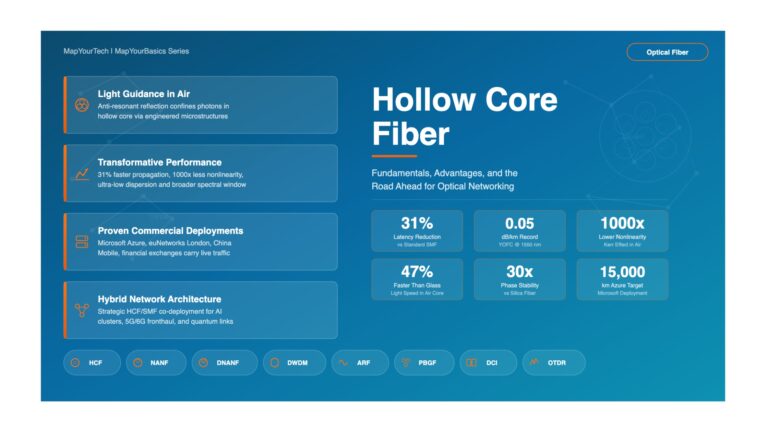
Discover how revolutionary hollow core fiber technology achieves 0.11 dB/km attenuation, enables >30 dBm launch power, and delivers unprecedented performance with negligible nonlinear effects
Introduction
Optical fiber technology has transformed global communications over the past five decades, enabling the transmission of vast amounts of data across continents and oceans. Traditional single-mode fibers, with their solid silica cores, have been the backbone of this revolution, achieving remarkable attenuation levels around 0.16-0.19 dB/km. However, as network demands continue to escalate and applications requiring ultra-low latency emerge, the industry has begun exploring radical alternatives to conventional fiber designs.
Hollow core fiber represents one of the most promising developments in optical transmission technology. Unlike traditional fibers where light travels through solid glass, hollow core fibers guide light through an air-filled void surrounded by a carefully engineered silica structure. This fundamental difference in design opens up possibilities that were previously unattainable with conventional fibers, including dramatically reduced latency, exceptional linearity, and the potential for even lower attenuation than standard silica fibers.
The implications of hollow core fiber technology extend far beyond incremental improvements. Recent breakthroughs have demonstrated attenuation levels as low as 0.11 dB/km, approaching and potentially surpassing the performance of conventional fibers. More significantly, hollow core fibers can handle optical powers exceeding 30 dBm per channel with negligible nonlinear penalties, a capability that fundamentally changes the economics and design paradigms of long-haul optical systems.
This article provides a comprehensive introduction to hollow core fiber technology, examining its underlying principles, performance characteristics, advantages, challenges, and potential applications. Whether you are a network engineer evaluating next-generation fiber options, a researcher exploring cutting-edge optical technologies, or a student seeking to understand the evolution of optical communications, this guide will equip you with the essential knowledge to understand this transformative technology.
1. Understanding Hollow Core Fiber Technology
1.1 What is Hollow Core Fiber?
Hollow core fiber represents a radical departure from conventional optical fiber design. In traditional single-mode fibers, the core consists of solid silica glass with a slightly higher refractive index than the surrounding cladding, typically achieved through germanium doping. Light propagates through this solid glass core via total internal reflection, with the core-cladding refractive index difference ensuring that light remains confined within the core.
In contrast, hollow core fiber features an air-filled void as the core, with light traveling primarily through this gaseous medium rather than through solid glass. The silica material surrounds the hollow core and provides the light-guiding mechanism, but the fundamental principle is different from total internal reflection. Instead, hollow core fibers rely on photonic bandgap effects or antiresonant reflection to confine light within the hollow core.
The most advanced hollow core fiber designs use nested antiresonant tubes that act to guide light and eliminate higher-order modes. These antiresonant structures create specific wavelength bands where light cannot couple into the glass cladding and is therefore forced to remain in the air core. This design approach has proven particularly successful in achieving low attenuation and maintaining single-mode operation.
1.2 How Light Guidance Works
The light-guiding mechanism in hollow core fibers differs fundamentally from conventional fibers. In antiresonant hollow core fibers, the nested tubes surrounding the core are designed with specific thicknesses and arrangements that create destructive interference for light attempting to enter the silica. When light at the operating wavelength strikes the glass-air interface at certain angles, the antiresonant condition ensures that very little light couples into the cladding tubes.
This antiresonant guidance mechanism is highly wavelength-dependent, which means hollow core fibers typically have narrower transmission windows compared to conventional fibers. However, within these transmission windows, the confinement can be extremely effective, with more than 99% of the optical mode residing in the air core rather than in the glass.
The fact that light travels primarily through air has profound implications. The speed of light in air is approximately 99.97% of the speed of light in vacuum, compared to only 68% in solid silica glass. This difference translates directly to reduced latency, with hollow core fibers offering approximately 30% lower latency than conventional fibers for the same physical distance.
Key Technical Specifications
At 1550 nm wavelength (state-of-the-art)
Per channel with negligible nonlinear penalty
Compared to conventional silica fibers
Possible optical transmission window
1.3 Structure and Design
The physical structure of hollow core fibers is considerably more complex than conventional fibers. A typical antiresonant hollow core fiber consists of a central hollow core with a diameter of approximately 30-40 micrometers, surrounded by multiple thin-walled capillary tubes arranged in a specific pattern. These tubes, often referred to as antiresonant nodes or cladding tubes, typically have wall thicknesses on the order of a few hundred nanometers.
The outer diameter of the fiber structure is similar to conventional fibers, typically 125 micrometers, allowing for compatibility with standard fiber handling and connectorization equipment. However, the cross-sectional complexity is far greater, with the nested tube structure requiring precise control during the manufacturing process.
Surface roughness at the glass-air interfaces plays a critical role in determining the fiber's attenuation. Even nanometer-scale imperfections can scatter light and increase losses. Recent manufacturing advances have focused on achieving extremely smooth interfaces, which has been key to reaching the record-low attenuation levels of 0.11 dB/km.
2. Performance Characteristics and Advantages
2.1 Ultra-Low Attenuation
One of the most remarkable achievements in hollow core fiber development has been the progressive reduction in attenuation. Early hollow core fibers suffered from losses of several dB/km, making them impractical for long-distance transmission. However, through continuous innovation in fiber design and manufacturing processes, researchers at institutions like the University of Southampton have achieved attenuation levels around 0.11 dB/km at 1550 nm wavelength.
This achievement is significant because it approaches and may eventually surpass the fundamental limits of conventional silica fibers. Standard single-mode fibers achieve attenuation in the range of 0.16-0.19 dB/km, with the best pure-silica-core fibers reaching approximately 0.16 dB/km. The theoretical limit for silica fibers due to Rayleigh scattering is around 0.142 dB/km at 1550 nm, meaning there is limited room for further improvement in conventional fiber technology.
In contrast, hollow core fibers are not fundamentally limited by Rayleigh scattering in the same way because light travels primarily through air rather than glass. The dominant loss mechanism is surface scattering at the glass-air interfaces. As manufacturing techniques continue to improve and surface roughness decreases, there is potential for hollow core fibers to achieve attenuation levels below 0.10 dB/km, or even approach the theoretical minimum for air-guided propagation, which could be as low as 0.04 dB/km in certain wavelength bands.
| Parameter | Conventional Single-Mode Fiber | Hollow Core Fiber (Current) | Hollow Core Fiber (Potential) |
|---|---|---|---|
| Attenuation at 1550 nm | 0.16-0.19 dB/km | 0.11 dB/km | 0.04 dB/km (theoretical) |
| Latency (relative) | Baseline (100%) | ~70% of SMF | ~70% of SMF |
| Nonlinear Threshold | ~20 dBm/channel | >30 dBm/channel | >35 dBm/channel |
| Stimulated Raman Scattering | Significant above 15 dBm | Virtually insignificant | Virtually insignificant |
| Chromatic Dispersion | ~17 ps/(nm·km) | Variable (design dependent) | Tailorable |
| Effective Area | 80-150 μm² | 700-1000 μm² | 700-1000 μm² |
2.2 Exceptional Linearity and High Power Handling
Perhaps the most transformative advantage of hollow core fibers is their exceptional linearity and ability to handle very high optical powers. In conventional silica fibers, nonlinear effects such as self-phase modulation, cross-phase modulation, four-wave mixing, and stimulated Raman scattering become problematic at launch powers above approximately 15-20 dBm per channel. These nonlinear effects limit the maximum transmitted power and can cause signal degradation, crosstalk between channels, and reduced system performance.
Hollow core fibers exhibit dramatically reduced nonlinear effects because most of the optical power propagates through air rather than silica. The nonlinear refractive index of air is approximately three orders of magnitude lower than that of silica glass. Experimental demonstrations have shown that hollow core fibers can support launch powers exceeding 30 dBm per channel with negligible nonlinear penalties. Some reports suggest that even higher powers may be possible.
This high power handling capability has several important implications for system design. First, it enables longer unrepeated spans in submarine cable systems. With the ability to launch higher power per channel without nonlinear penalties, the optical signal-to-noise ratio at the receiver can be improved, allowing for greater transmission distances before amplification is required. For example, a submarine cable using hollow core fiber with 0.11 dB/km attenuation and high launch power could potentially achieve unrepeated spans of 650 km or more using only discrete amplifiers at the terminals.
Second, the absence of stimulated Raman scattering opens up possibilities for using broader spectral bands. In conventional fibers, Raman scattering transfers energy from shorter wavelength channels to longer wavelength channels, creating power imbalances and limiting the practical usable bandwidth. In hollow core fibers, Raman scattering is virtually insignificant, enabling operators to consider using not only the C-band and L-band, but potentially extending into the S-band and even U-band, dramatically increasing the total available bandwidth.
Reduced Latency
Light travels approximately 30% faster through air than through silica glass, resulting in latency reduction of 1.5 microseconds per 100 km compared to conventional fibers. Critical for financial trading, real-time communications, and latency-sensitive applications.
High Power Handling
Can support launch powers exceeding 30 dBm per channel without nonlinear distortion. Enables longer unrepeated spans and improved signal-to-noise ratios, reducing the number of amplifiers required in long-haul systems.
Expanded Bandwidth
Absence of stimulated Raman scattering allows utilization of broader spectral bands beyond traditional C+L configurations. Potential for S+C+L or even OESCLU bands, increasing capacity by up to 7 times.
Lower Nonlinearity
Nonlinear effects reduced by approximately 1000 times compared to silica fibers. Eliminates traditional limitations on channel power and wavelength spacing, enabling more flexible network designs.
Improved OSNR
Combination of low attenuation and high launch power allows for improved optical signal-to-noise ratio. Enables higher-order modulation formats and increased spectral efficiency without additional amplification.
Reduced Amplifier Count
Longer spans reduce the number of optical amplifiers needed in submarine and terrestrial links. Decreases system complexity, power consumption, and overall deployment costs for long-haul networks.
2.3 Bandwidth and Spectral Efficiency
The combination of low attenuation and negligible nonlinear effects positions hollow core fibers as potential enablers for massive bandwidth expansion. Current submarine cable systems typically operate in the C-band (1530-1565 nm) or C+L-band (1530-1625 nm), providing approximately 4-9 THz of usable bandwidth depending on channel spacing and guard bands.
Hollow core fibers could support much broader transmission windows. With appropriate design, these fibers could operate across 50-60 THz of optical bandwidth, potentially extending from the S-band through the U-band (1460-1675 nm). This expanded bandwidth, combined with the ability to use denser wavelength spacing and higher launch powers, could increase the capacity of a single fiber pair by a factor of 5-7 times compared to current submarine systems.
When combined with spatial division multiplexing technologies such as multicore fibers, the capacity potential becomes even more dramatic. A hollow core multicore fiber with four cores could theoretically support aggregate capacities approaching or exceeding 1 Petabit per second on a single fiber. While such systems remain in the research phase, the fundamental physics of hollow core propagation removes many of the barriers that limit conventional fiber capacity.
Performance Comparison: Hollow Core vs Conventional Fiber
3. Current Challenges and Limitations
3.1 Manufacturing Complexity and Cost
Despite the impressive performance characteristics of hollow core fibers, significant challenges remain in manufacturing and deployment. The complex microstructure of hollow core fibers requires highly specialized fabrication processes. The nested antiresonant tube structure demands precise control of dimensions, wall thicknesses, and concentricity throughout the fiber draw process.
Current production capabilities for hollow core fibers are limited compared to conventional fiber manufacturing, which has benefited from decades of process optimization and economies of scale. The specialized equipment and careful process control required for hollow core fiber production result in substantially higher costs per kilometer compared to standard single-mode fiber. While conventional fiber for submarine applications might cost hundreds of dollars per kilometer, hollow core fiber costs are currently several times higher.
The fiber drawing process for hollow core fibers is also more demanding. Maintaining the precise dimensions and uniformity of the microstructure over kilometers of fiber length requires exceptional control of draw temperature, tension, and feed rates. Even minor variations can significantly impact the fiber's optical properties and increase attenuation.
Key Manufacturing Challenges
Surface Roughness Control: Achieving ultra-smooth glass-air interfaces is critical for low attenuation. Nanometer-scale imperfections can scatter light and increase losses. Current manufacturing processes must maintain surface roughness below specific thresholds across the entire fiber length.
Structural Uniformity: The antiresonant structure must remain uniform along the fiber length to maintain consistent guidance and prevent mode coupling. Any variation in tube dimensions or positions can degrade performance.
Mechanical Fragility: The thin-walled tube structure is more mechanically delicate than solid-core fibers, requiring careful handling during cabling and installation. Additional protective measures may be needed.
Splicing Complexity: Joining two hollow core fibers requires precise alignment of the complex microstructures. Conventional fusion splicing techniques developed for solid-core fibers may cause structural damage or introduce high splice losses.
3.2 Limited Production Capacity
As of 2025, hollow core fiber production remains largely in the research and development phase, with limited commercial availability. Major fiber manufacturers have demonstrated laboratory-scale production of high-quality hollow core fibers, but scaling to the volumes required for large submarine cable projects remains a significant challenge.
A typical transoceanic submarine cable system might require 10,000-15,000 kilometers of fiber pairs. Producing this quantity of hollow core fiber to consistent specifications and within reasonable timeframes would require substantial investment in manufacturing infrastructure and process development. Until production capabilities improve and costs decrease, hollow core fiber deployment will likely remain limited to niche applications where its unique benefits justify the higher cost.
3.3 System Integration Considerations
Integrating hollow core fibers into existing optical networks presents several practical challenges. While the outer diameter of hollow core fibers can match standard single-mode fibers, the internal structure differences require consideration in system design. Connectorization, splicing, and integration with conventional fiber-based components may require specialized techniques or equipment.
Additionally, the narrower transmission windows of hollow core fibers compared to conventional fibers may limit wavelength flexibility in some applications. While this is not a fundamental barrier, it does require careful wavelength planning and may reduce the ability to dynamically reconfigure wavelength assignments in operational networks.
4. Applications and Real-World Use Cases
4.1 Submarine Cable Systems
Submarine cable systems represent one of the most promising application areas for hollow core fiber technology. The combination of low attenuation, high power handling, and reduced nonlinear effects addresses several key challenges in transoceanic transmission. Long unrepeated spans are particularly attractive for submarine deployments because each optical amplifier added to the cable increases cost, complexity, and potential failure points.
With hollow core fiber's potential for 0.11 dB/km attenuation and the ability to launch high optical powers, unrepeated submarine spans could be extended from the current 300-400 km range to potentially 500-650 km or more. This reduction in amplifier count would decrease system power consumption, lower the probability of component failures over the cable's operational lifetime, and reduce the overall cost per bit transmitted.
In repeatered submarine systems, hollow core fiber could enable the use of broader spectral bands and higher channel counts, dramatically increasing the capacity of each fiber pair. Given the significant cost of deploying submarine cables, maximizing the capacity per fiber pair is economically attractive. The ability to potentially support C+L+S bands or even broader windows could increase submarine cable capacity by factors of 2-3 times or more compared to current systems.
Key Application Areas
- Ultra-Long-Haul Submarine Systems: Extended unrepeated spans reducing amplifier count and improving reliability for transoceanic links.
- Financial Trading Networks: Ultra-low latency links between financial centers where microsecond advantages provide competitive benefits.
- High-Capacity Metro Networks: Dense wavelength-division multiplexing systems requiring high launch power and broad spectral utilization.
- Data Center Interconnects: High-capacity, low-latency links between geographically distributed data centers requiring predictable performance.
- Scientific Research Facilities: Precision timing and synchronization applications where latency consistency is critical.
- Defense and Government Networks: Secure communications requiring reduced electromagnetic interference and enhanced performance characteristics.
4.2 Latency-Critical Applications
The approximately 30% latency reduction offered by hollow core fibers makes them particularly attractive for applications where transmission delay directly impacts performance or competitive advantage. High-frequency trading is the most commonly cited example, where financial institutions compete to execute trades with microsecond or even nanosecond advantages.
For a 1,000 km link between major financial centers, the latency difference between hollow core fiber and conventional fiber would be approximately 1.5 milliseconds. While this may seem insignificant in everyday terms, in algorithmic trading, this advantage can translate to millions of dollars in improved trade execution. Several specialized low-latency fiber links using hollow core technology are reportedly being evaluated for financial market connectivity.
Beyond financial trading, other latency-sensitive applications include real-time control systems, distributed computing clusters, and certain defense and government communications where predictable, minimal delay is critical. As 5G and future 6G networks evolve with increasingly stringent latency requirements, hollow core fiber could play a role in fronthaul and backhaul networks supporting these advanced wireless systems.
4.3 High-Power Transmission and Scientific Applications
The ability to transmit high optical powers without nonlinear distortion makes hollow core fiber valuable for certain scientific and industrial applications. High-energy laser delivery systems, where conventional fibers would suffer from nonlinear effects or even damage at high power levels, could benefit from hollow core fiber's power handling capabilities.
Precision timing and synchronization applications, such as those required for advanced scientific instruments, particle accelerators, and radio telescope arrays, require stable transmission characteristics and minimal dispersion. Hollow core fibers can be designed with specific dispersion properties and exhibit reduced temperature sensitivity compared to conventional fibers, making them suitable for these demanding applications.
5. Future Outlook and Development Roadmap
5.1 Technology Maturation Path
The evolution of hollow core fiber technology from research curiosity to practical deployment will require continued advances in several areas. Manufacturing process refinement to improve yield, consistency, and production rates is essential for commercial viability. As fabrication techniques mature and economies of scale begin to take effect, costs should gradually decrease, making hollow core fiber economically competitive for a broader range of applications.
Splicing and connectorization technologies must also evolve to enable practical field deployment. Current research is developing specialized fusion splicing techniques that can reliably join hollow core fibers with acceptably low splice losses. Mechanical splicing and connector technologies compatible with the unique microstructure of hollow core fibers are also under development.
System integration advances will be necessary to fully realize the potential of hollow core fiber in operational networks. This includes developing amplification schemes optimized for the broader bandwidths that hollow core fiber can support, as well as transmission systems capable of exploiting the higher launch powers and reduced nonlinear effects.
Projected Development Timeline
Near Term (2025-2027): Limited commercial deployments in high-value niche applications, particularly low-latency financial trading links and specialized scientific installations. Continued refinement of manufacturing processes and reduction in per-kilometer costs. Demonstration of hollow core fiber in submarine cable test beds and pilot projects.
Medium Term (2027-2030): Broader commercial availability with improved production capacity. Initial deployments in premium submarine cable routes where performance advantages justify higher costs. Development of multicore hollow core fiber variants for spatial division multiplexing. Integration with advanced transmission systems supporting ultra-broadband (50+ THz) operation.
Long Term (2030-2035): Mainstream adoption in new submarine cable installations as costs approach parity with conventional fibers. Standardization of splicing, testing, and deployment practices. Potential for hollow core fiber to become the default choice for new long-haul installations requiring maximum capacity and performance.
5.2 Complementary Technologies
Hollow core fiber is likely to be most impactful when combined with other emerging technologies. Spatial division multiplexing using multicore fibers represents one such complementary approach. Hollow core multicore fibers could combine the benefits of both technologies, enabling fiber pairs with multiple cores, each operating over ultra-wide spectral bands with high launch power per channel.
The combination of hollow core fiber and advanced spatial division multiplexing could enable individual fiber pairs to support aggregate capacities approaching or exceeding 1 Petabit per second. While such systems remain theoretical today, the fundamental physics supports their feasibility, and research programs are actively exploring these architectures.
Advanced modulation formats and digital signal processing techniques will also benefit from hollow core fiber's characteristics. The reduced nonlinear effects enable the use of higher-order modulation formats that would be impractical in conventional fibers at equivalent launch powers. This synergy between improved fiber transmission and advanced signal processing could yield capacity improvements beyond what either technology could achieve independently.
5.3 Market Adoption Factors
The pace of hollow core fiber adoption will ultimately depend on the balance between performance advantages and economic considerations. For applications where latency reduction directly translates to competitive advantage or revenue generation, adoption may proceed rapidly even at premium costs. Financial trading networks represent the clearest near-term market opportunity.
For submarine cable systems, adoption will depend on the total cost of ownership calculations that consider not only fiber cost but also system capacity, amplifier requirements, and operational expenses over the cable's lifetime. If hollow core fiber can enable meaningful reductions in amplifier count or substantial capacity increases, the business case may justify the technology even at higher initial costs.
Standardization efforts by organizations such as the ITU-T and industry forums will also influence adoption. Development of standards for hollow core fiber specifications, testing methodologies, and system integration practices will provide confidence for network operators considering deployment.
Hollow Core Fiber Attenuation Evolution Over Time
6. Comparison with Alternative Technologies
6.1 Hollow Core vs Multicore Fiber
Both hollow core fiber and multicore fiber technologies aim to overcome limitations of conventional single-mode fibers, but they take fundamentally different approaches. Multicore fibers increase capacity through spatial division multiplexing by incorporating multiple independent cores within a single fiber cladding. A typical submarine multicore fiber might have 4 cores, effectively quadrupling the transmission capacity compared to a single-core fiber of the same outer diameter.
Hollow core fiber, in contrast, maintains a single spatial path but enables broader spectral utilization and higher power per channel through reduced nonlinear effects. The capacity increase comes from using more wavelengths or achieving higher spectral efficiency rather than adding spatial channels.
These approaches are not mutually exclusive. Research is actively pursuing hollow core multicore fiber designs that could combine the benefits of both technologies. Such a fiber might have 4-7 hollow cores, each supporting ultra-broadband transmission with high launch power. This combination could theoretically enable a single fiber pair to support multiple petabits per second of total capacity.
From a practical deployment perspective, multicore fiber is somewhat closer to commercial readiness, with the first submarine cable using multicore technology reportedly being deployed. Hollow core fiber remains more developmental but offers unique advantages in latency and power handling that multicore fiber alone cannot provide.
6.2 System-Level Considerations
When evaluating hollow core fiber against alternatives, system-level factors beyond just fiber performance must be considered. The total capacity of a submarine or terrestrial system depends not only on the fiber but also on the available amplification technology, transponder capabilities, and power delivery infrastructure.
Current submarine cable systems face power limitations that constrain the total launched power and, consequently, the aggregate capacity. Adding more wavelengths or cores without addressing power delivery and amplifier efficiency may not yield proportional capacity increases. Hollow core fiber's high linearity allows more efficient use of available power, potentially providing system-level benefits even before considering attenuation improvements.
The reduced amplifier count enabled by hollow core fiber's low attenuation could also provide system-level advantages in reliability and operational simplicity. Fewer components generally mean lower failure rates and reduced maintenance requirements over the system's operational lifetime.
Conclusion
Hollow core fiber represents a transformative technology in optical communications, offering a fundamentally different approach to light guidance that overcomes key limitations of conventional silica fibers. With demonstrated attenuation levels of 0.11 dB/km and the potential to reach even lower losses, combined with exceptional linearity enabling launch powers exceeding 30 dBm per channel, hollow core fiber opens new possibilities for high-capacity, long-distance transmission.
The approximately 30% latency reduction achieved by guiding light through air rather than glass creates unique opportunities in applications where transmission delay directly impacts performance. For submarine cable systems, the combination of low attenuation and high power handling could enable longer unrepeated spans, reduced amplifier counts, and dramatically increased capacity per fiber pair through broader spectral utilization.
Significant challenges remain in manufacturing scalability, cost reduction, and practical deployment. Current production capabilities are limited, and the specialized fabrication requirements result in costs substantially higher than conventional fiber. However, as manufacturing processes mature and volumes increase, costs should gradually decline, making hollow core fiber economically viable for a broader range of applications.
The future of optical communications will likely involve a portfolio of technologies working in complementary ways. Hollow core fiber may find initial deployment in high-value niche applications such as low-latency trading links and premium submarine routes, gradually expanding to broader adoption as the technology matures. When combined with spatial division multiplexing and advanced signal processing, hollow core fiber could play a central role in enabling the next generation of petabit-scale optical networks.
For engineers and operators planning future network infrastructure, hollow core fiber represents an important technology to monitor. While not yet ready for mainstream deployment, its unique performance characteristics and improving manufacturing capabilities suggest that it could become a significant player in the optical communications landscape within the next 5-10 years. Understanding the principles, capabilities, and limitations of hollow core fiber technology positions network professionals to make informed decisions as this transformative technology continues to evolve.
References and Further Reading
[1] Fokoua, E.N., et al., "Loss in hollow-core optical fibers: mechanisms, scaling rules, and limits," Advanced Optics and Photonics, Optica Publishing Group.
[2] Richardson, D.J., et al., "Space-division multiplexing in optical fibres," Nature Photonics.
[3] Poletti, F., "Nested antiresonant nodeless hollow core fiber," Optics Express.
[4] ITU-T Recommendation G.654, "Characteristics of a cut-off shifted single-mode optical fibre and cable."
Recommended Book: Sanjay Yadav, "Optical Network Communications: An Engineer's Perspective" – Bridge the Gap Between Theory and Practice in Optical Networking.
Developed by MapYourTech Team
For educational purposes in Optical Networking Communications Technologies
Note: This guide is based on industry standards, best practices, and real-world implementation experiences. Specific implementations may vary based on equipment vendors, network topology, and regulatory requirements. Always consult with qualified network engineers and follow vendor documentation for actual deployments.
Feedback Welcome: If you have any suggestions, corrections, or improvements to propose, please feel free to write to us at feedback@mapyourtech.com
Unlock Premium Content
Join over 400K+ optical network professionals worldwide. Access premium courses, advanced engineering tools, and exclusive industry insights.
Already have an account? Log in here