Generic selectors
Exact matches only
Search in title
Search in content
Post Type Selectors
Articles
lp_course
lp_lesson
Back
HomeAnalysis800G ZR/ZR+ Power Budgets: Comprehensive Design Guide
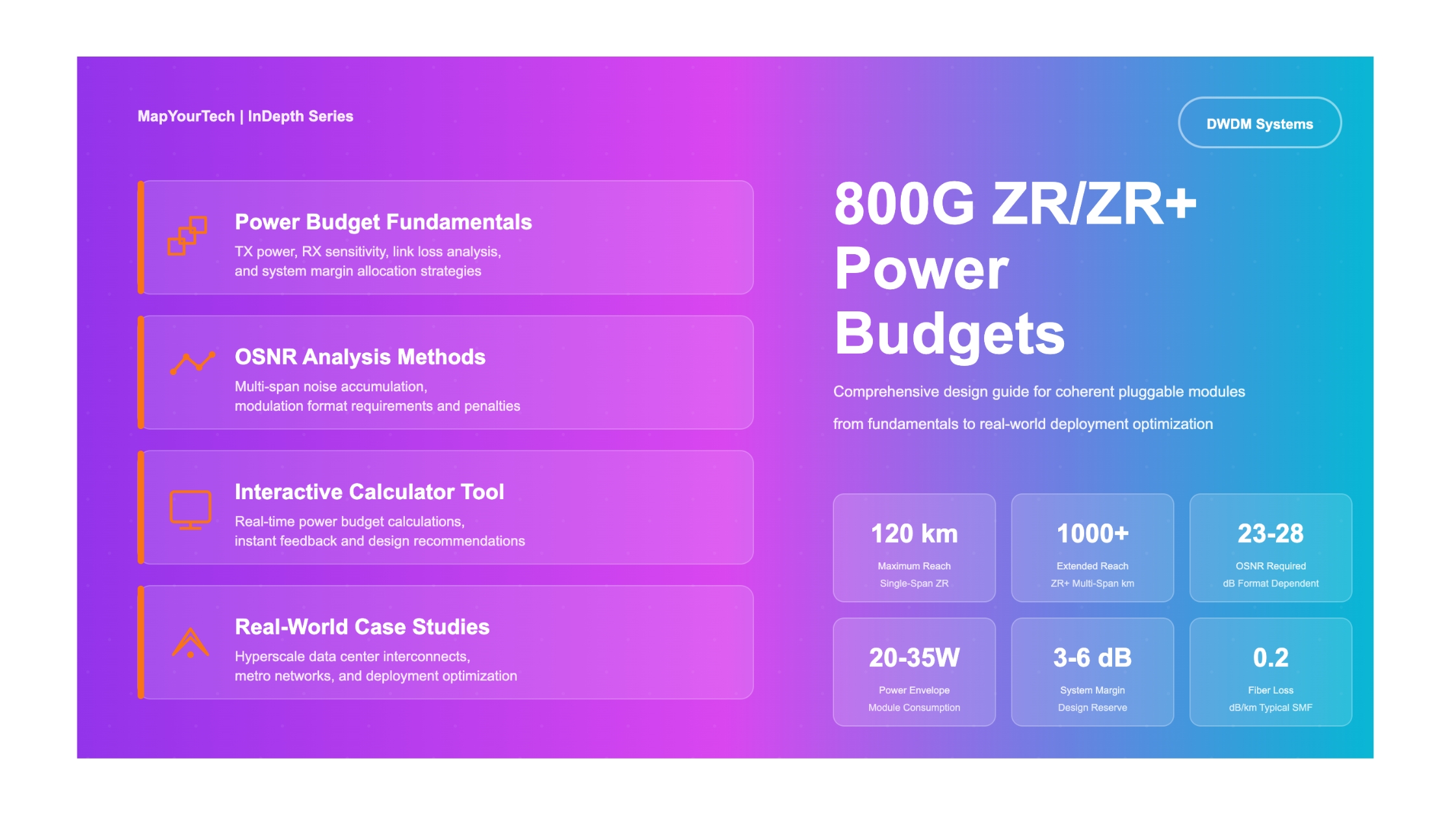
800G ZR/ZR+ Power Budgets: Comprehensive Design Guide

800G ZR/ZR+ Power Budgets: Comprehensive Design Guide

Last Updated: April 2, 2026
44 min read
125
800G ZR/ZR+ Power Budgets: Comprehensive Design Guide

800G ZR/ZR+ Power Budgets: Comprehensive Design Guide

Expert-Level Reference for Coherent Pluggable Module Link Planning, OSNR Analysis, and Deployment Optimization

Introduction

The deployment of 800G ZR and ZR+ coherent pluggable modules represents a transformative milestone in optical networking, delivering twice the capacity of 400G systems within similar power envelopes and form factors. As hyperscale data centers, cloud service providers, and telecommunications networks race to meet exponential bandwidth demands driven by artificial intelligence workloads, 5G backhaul, and distributed computing architectures, accurate power budget analysis has become the foundational discipline separating successful deployments from costly failures.

Tip:This comprehensive guide addresses the critical engineering challenge that network architects and optical design engineers face: how to accurately calculate, allocate, and verify optical power budgets for 800G coherent systems across diverse deployment scenarios. Unlike direct-detection systems where power budget calculations follow straightforward loss accounting, coherent systems introduce additional complexity through their interaction with Optical Signal-to-Noise Ratio (OSNR), chromatic dispersion tolerance, and nonlinear fiber effects. A 2 dB error in power budget estimation can reduce maximum reach by 20-25 km or force expensive amplifier additions that negate the economic advantages of pluggable coherent modules.

The industry context makes this topic particularly urgent. According to Cignal AI market analysis, more than 70% of coherent bandwidth deployed in 2025 utilized pluggable form factors, with 800G modules representing the fastest-growing segment. The global market for pluggable coherent modules reached $2 billion in 2025 and projections indicate growth to nearly $5 billion by 2029, with over 80% of deployments coming from cloud service providers implementing IP-over-DWDM architectures. This massive deployment wave requires engineers who can confidently design, validate, and troubleshoot 800G optical links without relying solely on vendor tools or conservative rules of thumb.

What This Guide Provides

This guide delivers practical engineering knowledge organized in multiple sections for ease of reading. First, we establish the fundamental specifications and operational modes of 800G ZR and ZR+ modules, including detailed comparisons across QSFP-DD and OSFP form factors. Second, we present systematic power budget calculation methodologies with worked examples covering data center interconnect, metro DWDM, and long-haul applications. Third, we address OSNR analysis, link planning under fiber impairments, and real-world case studies from recent deployments.

Throughout this guide, we prioritize accuracy over simplification. Every equation includes variable definitions and units. Every design guideline references industry standards or physics-based justifications. Every example uses realistic parameters from actual commercial modules available in 2025-2026.

1. Industry Context and Market Drivers

1.1 The Bandwidth Imperative

Global IP traffic growth continues at compound annual rates exceeding 25%, driven by three primary forces. First, artificial intelligence training and inference workloads create unprecedented demand for high-bandwidth, low-latency connectivity between GPU clusters distributed across multiple data center facilities. A single large language model training run can generate sustained traffic flows exceeding 1 Tbps between compute pods, with stringent latency requirements under 500 microseconds for parameter synchronization. Second, cloud-native architectures fragment compute, storage, and network functions across disaggregated infrastructure, multiplying inter-facility traffic by factors of 3-5× compared to traditional monolithic data center designs. Third, edge computing deployments for 5G, autonomous vehicles, and industrial IoT applications require high-capacity backhaul from thousands of distributed edge nodes to centralized processing facilities.

These traffic patterns exhibit two characteristics that favor 800G coherent solutions. The traffic is predominantly point-to-point or hub-and-spoke rather than broadcast, matching the unicast nature of DWDM links. Second, the distances involved typically range from 10 km to 1,000 km, falling squarely within the reach capabilities of coherent pluggable modules operating in ZR or ZR+ modes. Traditional approaches using separate optical transport equipment struggle to meet the economic and operational requirements of these applications.

1.2 The IP-over-DWDM Revolution

The fundamental architectural shift enabling 800G pluggable adoption is IP-over-DWDM, where router line cards directly terminate DWDM wavelengths without intermediate transponder shelves. By integrating coherent optics into QSFP-DD or OSFP modules that plug directly into router faceplates, network operators eliminate entire equipment categories. A typical metro aggregation node previously required separate router chassis, optical transport shelves with discrete transponders, and ROADM systems. The IP-over-DWDM architecture collapses this into router chassis with integrated coherent pluggables connecting directly to colorless/directionless ROADMs.

This consolidation delivers measurable economic benefits. Capital expenditure reductions of 40-65% have been documented in production deployments, primarily through eliminated transport equipment and reduced facility footprints. Operational expenditure decreases by 30-50% through unified management systems, reduced power consumption, and simpler troubleshooting workflows. Service provisioning time drops from weeks to hours, as wavelength addition no longer requires coordinated changes across multiple network layers. These advantages explain why major cloud providers and progressive telecommunications operators have adopted IP-over-DWDM as their standard architecture for new builds and major upgrades.

1.3 The 800G Evolution Path

The progression from 400G to 800G coherent pluggables followed the maturation of three enabling technologies. First, 4-nanometer and 3-nanometer CMOS process nodes enabled digital signal processors with sufficient compute density to execute 800G coherent algorithms within 20-30 watt power budgets. Earlier 7nm and 5nm processes could not achieve this performance level in pluggable thermal envelopes. Second, indium phosphide photonic integrated circuits achieved the optical output power and modulation bandwidth required for 118+ Gbaud operation. Third, advanced forward error correction codes with soft-decision decoding and probabilistic constellation shaping provided the coding gain necessary to maintain reach parity with 400G systems despite the higher baud rates and associated nonlinear penalties.

The standardization timeline reflects rapid industry consensus. The Optical Internetworking Forum launched the 800G Coherent project in December 2020, releasing the OIF-800ZR Implementation Agreement in December 2022. This aggressive timeline—24 months from project initiation to published standard—demonstrates the alignment of hyperscale operators, equipment vendors, and component suppliers around coherent pluggables as the future of metro and data center interconnect applications. The OpenROADM Multi-Source Agreement followed with 800G ZR+ specifications in early 2023, extending pluggable coherent to longer-reach applications requiring flexible modulation formats and wavelength tunability across C and L bands.

2. Fundamental Specifications and Standards

2.1 OIF 800ZR Specification Overview

The Optical Internetworking Forum 800ZR Implementation Agreement defines interoperable specifications for 800 Gbps coherent transmission over single-span DWDM links up to 120 km. The standard targets data center interconnect applications where point-to-point fiber links connect geographically distributed facilities without intermediate amplifier huts. This use case prioritizes simplicity, cost optimization, and multi-vendor interoperability over maximum reach or operational flexibility.

The core technical parameters establish a well-defined operating point. The standard mandates 118 Gbaud symbol rate, dual-polarization 16-QAM modulation, and transmission at 800 Gbps line rate with integrated soft-decision forward error correction. The optical spectrum occupies approximately 140 GHz, fitting within 150 GHz DWDM channel spacing with adequate guard bands. Wavelength operation spans the C-band from 191.35 THz to 196.10 THz (approximately 1528 nm to 1566 nm), corresponding to ITU-T DWDM grid channels. The specification defines both QSFP-DD and OSFP form factors with identical optical characteristics, allowing deployment flexibility based on router or switch platform requirements.

The transmitter output power specification of -10 to 0 dBm (typical -7 dBm) represents a careful compromise. Lower power would limit reach on lossy fiber plants, while higher power would increase nonlinear penalties and complicate thermal management in the pluggable module. The receiver sensitivity requirement of -19 dBm at 2.4E-4 pre-FEC bit error rate provides approximately 12 dB optical power budget in back-to-back configuration, adequate for the target 120 km single-span application with 3-4 dB system margin.

Parameter OIF 800ZR Specification Notes
Line Rate 800 Gbps After FEC overhead
Symbol Rate 118 Gbaud ±100 ppm tolerance
Modulation Format DP-16QAM Dual polarization, 16-state quadrature amplitude modulation
Spectral Width ~140 GHz 99% power bandwidth
Channel Spacing 150 GHz minimum ITU-T grid compatible
Wavelength Range 1528-1566 nm C-band, ITU channels 23-61
Transmit Power -10 to 0 dBm Typical -7 dBm
Receiver Sensitivity -19 dBm At 2.4E-4 pre-FEC BER
OSNR Requirement 28 dB minimum 0.1 nm reference bandwidth
Maximum Reach 80-120 km Standard G.652 fiber, unamplified
FEC Type oFEC (KP4) ~15% overhead, soft-decision
Power Consumption 20-25 W typical Module level, includes DSP

2.2 OpenROADM 800G ZR+ Extended Capabilities

The OpenROADM Multi-Source Agreement extends 800G coherent pluggables beyond single-span applications to multi-span metro and regional networks requiring flexible modulation, wavelength tunability, and compatibility with reconfigurable optical add-drop multiplexer systems. The ZR+ designation indicates enhanced capabilities compared to the baseline ZR specification, though the exact feature set varies somewhat across vendors implementing the OpenROADM MSA.

The primary technical enhancements address three limitations of 800ZR. First, ZR+ modules support multiple modulation formats including QPSK, 8-QAM, and 16-QAM, allowing operators to trade spectral efficiency for reach based on application requirements. A metro link of 200 km might use 16-QAM at 800 Gbps, while a regional link of 600 km switches to 8-QAM at 600 Gbps, and a long-haul link of 1,000+ km employs QPSK at 400 Gbps. This flexibility eliminates the need for multiple module types in inventory. Second, ZR+ modules implement probabilistic constellation shaping, an advanced coding technique that improves OSNR tolerance by 0.5-1.5 dB depending on modulation format and shaping aggressiveness. This gain translates to 50-150 km additional reach in typical amplified DWDM systems. Third, ZR+ modules provide full wavelength tunability across C and L bands with sub-GHz frequency accuracy, enabling automated wavelength provisioning in colorless ROADM architectures.

The performance specifications reflect these enhanced capabilities. Transmit power ranges from -10 dBm to +3 dBm depending on module class and operational mode, with high-power variants achieving 0 to +3 dBm for extended reach applications. Some implementations include integrated semiconductor optical amplifiers or erbium-doped fiber amplifier sections to boost output power without requiring external amplification. Receiver sensitivity improves to -21 to -23 dBm for lower-order modulation formats, providing optical budgets exceeding 20 dB in optimized configurations. OSNR requirements vary by modulation format: approximately 23 dB for QPSK, 26 dB for 8-QAM, and 28 dB for 16-QAM, all measured in 0.1 nm reference bandwidth.

Capability 800G ZR (OIF) 800G ZR+ (OpenROADM)
Target Application Single-span DCI, up to 120 km Multi-span metro/regional, up to 1,000+ km
Modulation Formats DP-16QAM only DP-QPSK, DP-8QAM, DP-16QAM
Data Rates 800 Gbps fixed 400/600/800 Gbps adaptive
Transmit Power -10 to 0 dBm -10 to +3 dBm (class dependent)
Receiver Sensitivity -19 dBm (16-QAM) -21 to -23 dBm (format dependent)
OSNR Required 28 dB (16-QAM) 23-28 dB (format dependent)
Constellation Shaping Not specified Probabilistic shaping (PCS)
Wavelength Tunability C-band, fixed grid C+L band, flexible grid
ROADM Compatibility Limited, fixed wavelength Full, colorless/directionless
FEC Coding oFEC standard oFEC + proprietary enhanced
Management Basic CMIS Enhanced telemetry, automation
Power Budget 9-12 dB typical 13-26 dB (mode dependent)
Interoperability Full, OIF certified Vendor-specific modes exist
Premium Article — Free 20% Preview

Read the Full Analysis with Premium

The remaining 80% of this article — the design numbers, trade-offs and field guidance — is part of MapYourTech Premium, along with the full premium library, courses and professional tools.

Instant access · Cancel anytime · 48-hour trial available
Sanjay Yadav

Optical Communications & Network Automation Expert | Author of 3 Books for Optical Engineers | Founder, MapYourTech

Optical networking engineer with nearly two decades of experience across DWDM, OTN, coherent optics, submarine systems, and cloud infrastructure. Founder of MapYourTech.

Follow on LinkedIn

You May Also Like

15 min read 6 0 Like Connector Types and Their Loss Budgets: SC, LC, MPO Skip to main content MapYourTech...
  • Free
  • July 11, 2026
16 min read 6 0 Like Cooled vs Uncooled Lasers: The Pluggable Power Trade-off Skip to main content MapYourTech |...
  • Free
  • July 11, 2026
16 min read 7 0 Like Automation Blast Radius: Scoping What a Bad Intent Can Touch Skip to main content...
  • Free
  • July 11, 2026

Course Title

Course description and key highlights

Course Content

Course Details