
Generic selectors
Exact matches only
Search in title
Search in content
Post Type Selectors
Articles
lp_course
lp_lesson
Back
HomeFundamentalsDeep Dive on GCC Channels in OTN Networks
Deep Dive on GCC Channels in OTN Networks

Deep Dive on GCC Channels in OTN Networks

Last Updated: April 2, 2026
37 min read
154
GCC Channels (GCC0/GCC1/GCC2) in OTN - Comprehensive Guide | MapYourTech
Deep Dive on GCC Channels in OTN Networks - Image 1

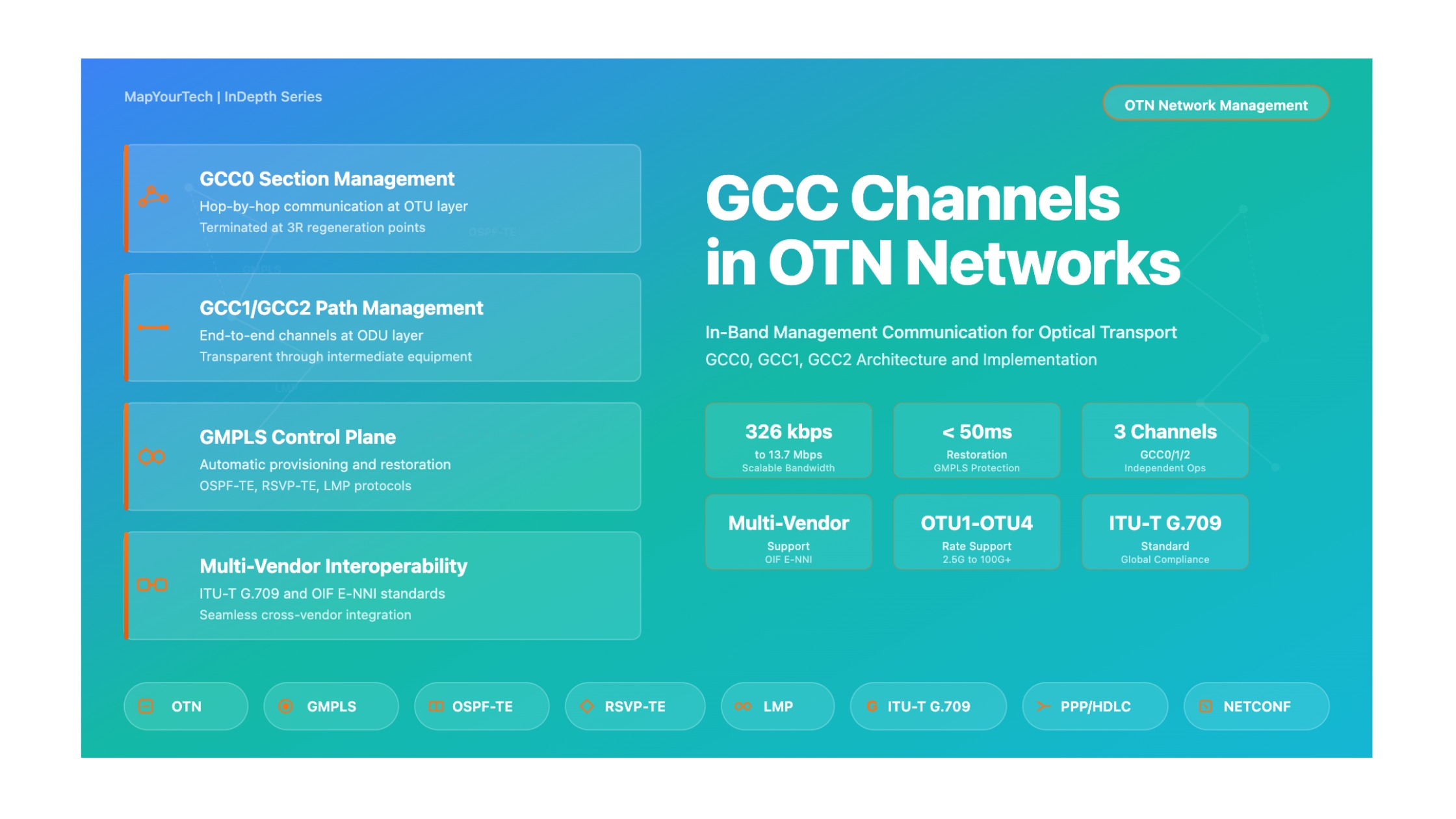
GCC Channels in OTN Networks

A Comprehensive Guide to General Communication Channels (GCC0, GCC1, GCC2) in Optical Transport Networks

Technical Reference for Optical Professionals

Introduction

In modern Optical Transport Networks (OTN), efficient management and control are as critical as the transport of client data itself. General Communication Channels (GCC) provide the fundamental in-band communication infrastructure that enables network elements to exchange management information, signaling protocols, and control plane traffic without requiring separate out-of-band management networks. These channels are embedded within the OTN frame overhead, creating a tightly coupled and reliable management framework.

The ITU-T G.709 standard defines three distinct GCC channels—GCC0, GCC1, and GCC2—each serving specific purposes within the OTN hierarchy. GCC0 operates at the Optical Transport Unit (OTU) layer and is terminated at every 3R regeneration point, making it ideal for section-level management and GMPLS signaling. GCC1 and GCC2, located within the Optical Data Unit (ODU) layer overhead, provide end-to-end communication channels that traverse multiple network segments without intermediate termination. This architectural separation ensures that management traffic can be appropriately segregated based on network layer functionality and operational requirements.

Understanding GCC channels is essential for network engineers, system architects, and operations teams who design, deploy, and maintain large-scale optical networks. These channels enable critical functions including dynamic routing protocols, automatic protection switching coordination, performance monitoring data exchange, and remote network element management. The bandwidth of each GCC channel scales with the OTN line rate—for example, GCC0 provides approximately 333 kbps at OTU1 rates and scales to over 13 Mbps at OTU4 rates—ensuring adequate capacity for increasingly sophisticated network management applications.

Importance of GCC Channels in Modern Networks

GCC channels eliminate the need for separate management networks by providing reliable in-band communication. They support GMPLS-based dynamic provisioning, enable carrier-grade protection switching, facilitate multi-vendor interoperability, and reduce operational complexity. In submarine and long-haul networks where every resource is optimized, GCC channels deliver critical management capabilities without consuming valuable payload bandwidth.

GCC Channels Architecture Overview

This diagram illustrates the three GCC channels within the OTN frame structure and their layer associations

OTN Frame Structure OTU Overhead GCC0 2 Bytes OTU Layer Section Level OTU Payload (Contains ODU) ODU Overhead GCC1 2 Bytes ODU Layer Path Level GCC2 2 Bytes ODU Layer Path Level ODU Payload (Client Data) Section End-to-End End-to-End • Terminated at 3R points • GMPLS Signaling • Network Management • End-to-end channel • Client information • Not touched by OTN • End-to-end channel • Client information • Independent of GCC1

Historical Context and Evolution

The development of GCC channels parallels the evolution of OTN technology itself. Prior to OTN, SONET/SDH networks used Data Communication Channels (DCC) embedded in the Section Overhead (SOH) and Line Overhead (LOH) for management purposes. These DCC channels provided fixed-rate communication at 192 kbps (D1-D3 bytes) and 576 kbps (D4-D12 bytes), which proved adequate for the management requirements of early optical networks.

When the ITU-T began standardizing OTN in the early 2000s, it became clear that next-generation optical networks would require more sophisticated management capabilities. The first edition of G.709 (2001) introduced the GCC concept, recognizing that modern optical networks would need scalable bandwidth for management traffic, support for dynamic control plane protocols like GMPLS, and the ability to carry management information across multiple vendor domains. Unlike SONET/SDH's fixed-rate DCCs, GCC channels were designed to scale proportionally with line rates, ensuring adequate management bandwidth as optical technologies evolved from 2.5 Gbps to 100 Gbps and beyond.

The distinction between GCC0 at the OTU layer and GCC1/GCC2 at the ODU layer reflects a fundamental architectural decision in OTN design. This separation allows for clear demarcation between section-level management (which may involve multiple vendors and operators) and path-level management (which remains under client control). As OTN evolved through successive G.709 editions—adding support for OTU4 (100G), ODUflex for variable-rate services, and OTUCn for flexible rate interfaces—GCC channels continued to provide essential management infrastructure, with bandwidth scaling automatically to meet the needs of increasingly complex network architectures.

Evolution of OTN GCC Channels

Timeline showing the development of GCC channels from SONET/SDH DCC to modern OTN implementations

1990s SONET/SDH DCC Channels Fixed: 192/576 kbps 2001 G.709 Edition 1 GCC0/1/2 Introduced OTU1/2 Support Scalable Bandwidth 2009 G.709 Edition 3 OTU3/OTU4 Added Up to 13.7 Mbps 2020 G.709 Edition 6 OTUCn Support FlexE Integration Multi-lane Support 2024-2025 Modern OTN 400G/800G Era Advanced Control Plane

Key Evolutionary Milestones

2001: Introduction of GCC channels with scalable bandwidth design principle in G.709 Edition 1
2009: Extension to higher rates (OTU3/OTU4) maintaining architectural consistency
2012: ODUflex introduction with corresponding GCC bandwidth scaling
2016: OTUCn multi-lane architecture with aggregated GCC channels
2020-2025: Integration with modern SDN controllers and automation platforms, enhanced GMPLS capabilities

Core Concepts and Fundamentals

GCC Channel Fundamentals

General Communication Channels (GCC) in OTN are clear channels embedded within the frame overhead, meaning they carry unformatted data whose structure and protocol are not specified by the G.709 standard itself. This design philosophy provides maximum flexibility, allowing network operators to implement various management protocols, proprietary signaling schemes, or standardized control plane protocols like GMPLS without requiring changes to the OTN frame structure itself.

The three GCC channels operate at different layers of the OTN hierarchy, each with distinct termination points and use cases. GCC0, located in the OTU overhead at bytes row 1, columns 11-12, is terminated and processed at every optical section boundary where 3R regeneration occurs. This makes GCC0 ideal for hop-by-hop management functions such as performance monitoring data exchange between adjacent network elements, fault isolation procedures, and section-level protection switching coordination. The 3R regeneration points typically occur at ROADM sites, inline amplifier locations with electrical processing, or at network element boundaries.

GCC1 and GCC2 channels reside in the ODU overhead at row 4, columns 1-2 and 3-4 respectively. These channels are reserved for end-to-end client communication and are designed to pass through intermediate OTN equipment transparently. Network operators commonly use GCC1/GCC2 for carrying client-layer management traffic, implementing overlay control planes, or establishing management VPNs between client equipment at network endpoints. The ITU-T recommendation explicitly states that OTN equipment should not terminate or interfere with GCC1/GCC2 traffic, preserving these channels for exclusive client use.

Detailed OTN Frame Structure with GCC Locations

Precise byte locations of GCC channels within the 16-byte OTN overhead structure

OTN Frame Structure - Overhead Bytes Organization 1 2 3 4 5 6 7 8 9 10 11 12 13 14 15 16 1 2 3 4 FAS OA1 OA1 OA1 OA2 OA2 OA2 MFAS MF SM TTI BIP-8 BEI/BDI GCC0 00 00 RES 00 00 RES JC1 RES 00 00 DMp/ti 00 TC ACT TCM6 TTI BIP-8 BEI/BDI TCM5 TTI BIP-8 BEI/BDI TCM4 TTI BIP-8 BEI/BDI FTFL FTFL RES JC2 00 TCM3 TTI BIP-8 BEI/BDI TCM2 TTI BIP-8 BEI/BDI TCM1 TTI BIP-8 BEI/BDI PM TTI BIP-8 BEI/BDI EXP RR RR RES 00 JC3 GCC1 00 00 GCC2 00 00 PCC / APS 00 00 00 00 RES 00 00 00 00 00 00 PSI 00 NJO PJO 00 Frame Alignment Signal OTU Overhead ODU Overhead OPU Overhead Reference: ITU-T Recommendation G.709 - Interfaces for the Optical Transport Network

Bandwidth Scaling Characteristics

One of the most significant advantages of GCC channels over their SONET/SDH predecessors is their scalable bandwidth model. The data rate of each GCC channel is directly proportional to the OTN line rate, calculated based on the frame structure and byte allocation. For OTU1 (approximately 2.66 Gbps line rate), each 2-byte GCC channel provides roughly 326.723 kbps. This scales to approximately 1.312 Mbps for OTU2 (10.7 Gbps), 5.272 Mbps for OTU3 (43.0 Gbps), and 13.702 Mbps for OTU4 (111.8 Gbps).

The bandwidth calculation follows from the frame rate and overhead byte allocation. An OTN frame consists of 4 rows and 4080 columns, with the overhead occupying 16 bytes (4 rows × 4 columns). The frame rate varies with the OTU rate: OTU1 operates at approximately 81.65 frames per microsecond, resulting in (2 bytes/frame) × (8 bits/byte) × (81.65 μframes/s) ≈ 326.723 kbps per 2-byte channel. This linear scaling ensures that as network capacities increase, management bandwidth grows proportionally, maintaining adequate capacity for control plane protocols and management applications.

For OTUCn flexible-rate interfaces introduced in G.709 Amendment 3, multiple GCC instances can be combined. An OTUCn consists of n tributary slots (OTU lanes), each carrying its own overhead including GCC bytes. The standard defines that GCC0 #1 through GCC0 #n can be combined into a single high-bandwidth channel with approximately n × 13.768 Mbps capacity. Similarly, GCC1 and GCC2 instances can be aggregated. Some implementations alternatively use only the first GCC instance (e.g., GCC0 #1) with standard bandwidth, leaving other instances unused—this is particularly common in vendor-specific interface implementations where maximum GCC bandwidth is not required.

OTU/ODU Type Line Rate (Approximate) Frame Rate GCC0 Bandwidth GCC1 Bandwidth GCC2 Bandwidth GCC1+2 Combined
OTU1 / ODU1 2.666 Gbps ~81.65 kHz 326.723 kbps 326.723 kbps 326.723 kbps 653.445 kbps
OTU2 / ODU2 10.709 Gbps ~328.30 kHz 1,312.405 kbps 1,312.405 kbps 1,312.405 kbps 2,624.810 kbps
OTU2e / ODU2e 11.096 Gbps ~340.18 kHz 1,360.598 kbps 1,360.598 kbps 1,360.598 kbps 2,721.196 kbps
OTU3 / ODU3 43.018 Gbps ~1.319 MHz 5,271.864 kbps 5,271.864 kbps 5,271.864 kbps 10,543.729 kbps
OTU4 / ODU4 111.810 Gbps ~3.426 MHz 13,702.203 kbps 13,702.203 kbps 13,702.203 kbps 27,404.406 kbps
OTU25 27.953 Gbps ~857.286 kHz 1,726.576 kbps 1,726.576 kbps 1,726.576 kbps 3,453.153 kbps
OTU50 55.906 Gbps ~1.715 MHz 3,453.153 kbps 3,453.153 kbps 3,453.153 kbps 6,906.305 kbps
OTUCn (per lane) ~111.81 Gbps per lane ~3.426 MHz per lane n × 13.768 Mbps n × 13.768 Mbps n × 13.768 Mbps n × 27.525 Mbps
Premium Article — Free 21% Preview

Read the Full Analysis with Premium

The remaining 79% of this article — the design numbers, trade-offs and field guidance — is part of MapYourTech Premium, along with the full premium library, courses and professional tools.


Instant access · Cancel anytime · 48-hour trial available
Sanjay Yadav

Optical Communications & Network Automation Expert | Author of 3 Books for Optical Engineers | Founder, MapYourTech

Optical networking engineer with nearly two decades of experience across DWDM, OTN, coherent optics, submarine systems, and cloud infrastructure. Founder of MapYourTech.

Follow on LinkedIn

You May Also Like

15 min read 6 0 Like Connector Types and Their Loss Budgets: SC, LC, MPO Skip to main content MapYourTech...
  • Free
  • July 11, 2026
16 min read 6 0 Like Cooled vs Uncooled Lasers: The Pluggable Power Trade-off Skip to main content MapYourTech |...
  • Free
  • July 11, 2026
16 min read 8 0 Like Automation Blast Radius: Scoping What a Bad Intent Can Touch Skip to main content...
  • Free
  • July 11, 2026

Course Title

Course description and key highlights

Course Content

Course Details