9 min read
The Gaussian Noise Model in Optical Networking
Understanding Why This Revolutionary Model Transformed Modern Optical Network Design
The Gaussian Noise (GN) model has fundamentally transformed how optical network engineers design, plan, and optimize fiber transmission systems. By treating complex nonlinear fiber effects as simple additive Gaussian noise, this model strikes an exceptional balance between computational efficiency and prediction accuracy, making it the industry's preferred choice for Quality of Transmission (QoT) estimation in modern coherent optical networks.
1. Introduction
Modern optical networks face a fundamental challenge: accurately predicting transmission performance across complex, multi-span fiber links while maintaining computational efficiency for real-time network management. The Gaussian Noise model emerged as the solution to this challenge, providing network operators with a practical yet sufficiently accurate tool for physical layer modeling.
The GN model's significance extends beyond mere academic interest. It forms the analytical engine powering tools like GnPy (Gaussian Noise in Python), which has become the de facto standard for vendor-neutral optical network planning in the era of disaggregated, open optical networks. Understanding why this model works, what makes it different, and its key advantages is essential for any optical networking professional working with modern coherent transmission systems.
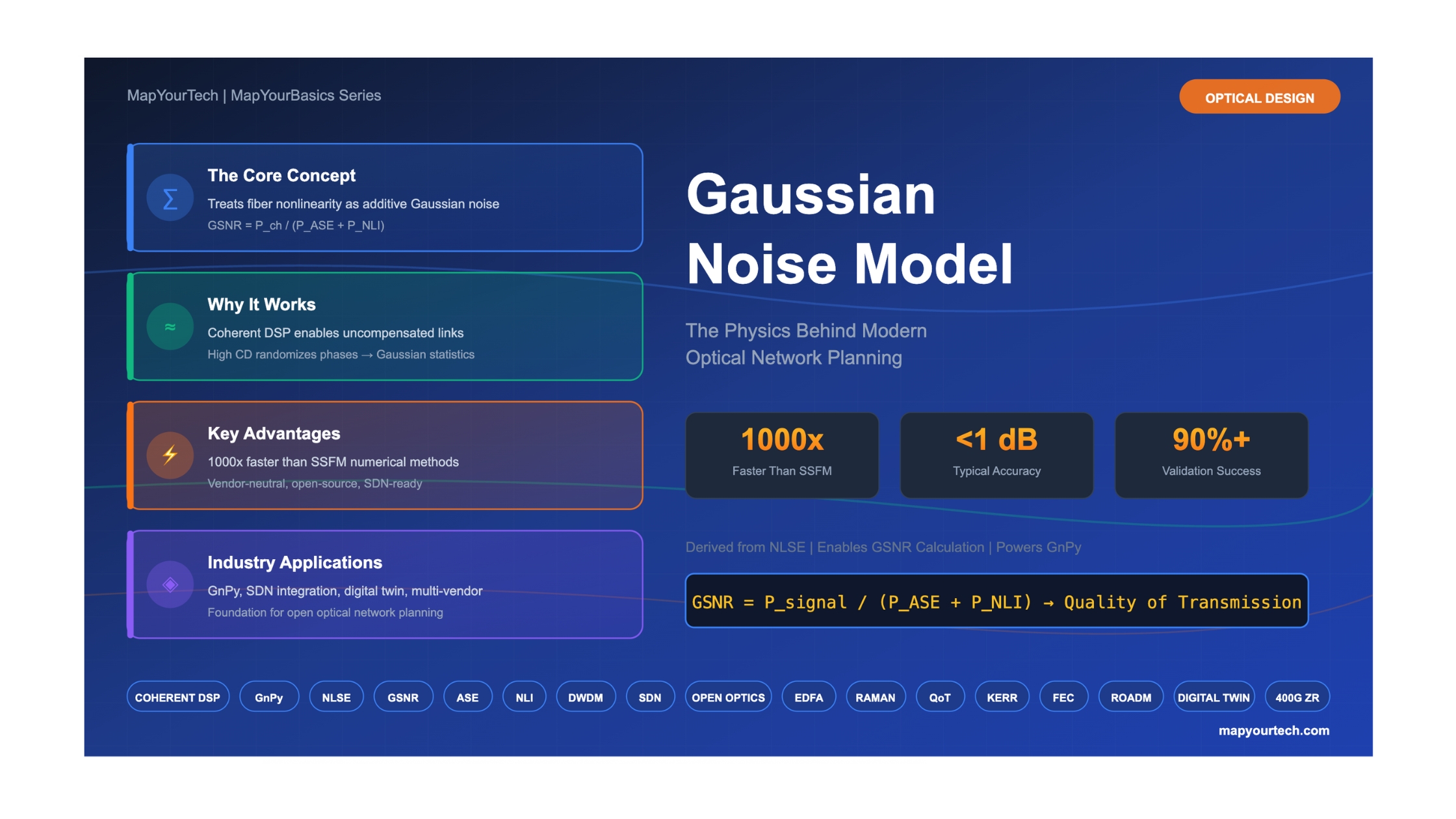
Figure 1: The GN Model conceptual framework - treating complex fiber nonlinearity as simple additive Gaussian noise
2. Why the Gaussian Noise Model is Used
2.1 The Problem It Solves
Fiber optic transmission systems suffer from two primary impairment sources: Amplified Spontaneous Emission (ASE) noise from optical amplifiers and Nonlinear Interference (NLI) from the Kerr effect in optical fiber. While ASE noise calculation is straightforward, accurately modeling fiber nonlinearity traditionally required computationally intensive numerical methods.
The GN model solves this by recognizing that under certain physical conditions, the aggregate effect of fiber nonlinearity can be treated statistically as additive Gaussian noise, just like ASE. This insight allows both impairment sources to be combined into a single, easily calculable metric: the Generalized Signal-to-Noise Ratio (GSNR).
GSNR Definition
Pch = Power of the channel of interest (W or dBm)
PASE = Accumulated ASE noise power (W or dBm)
PNLI = Accumulated Nonlinear Interference power (W or dBm)
2.2 The Technology Enabler: Coherent DSP
The GN model's rise coincided with the widespread adoption of coherent detection and digital signal processing (DSP). This technology shift enabled a new transmission paradigm called the "uncompensated link," where chromatic dispersion accumulated along the fiber is no longer compensated optically but rather electronically by the DSP in the receiver.
Figure 2: How coherent DSP technology enabled the GN model by creating uncompensated link architectures
The Symbiotic Relationship
The high accumulated chromatic dispersion in uncompensated links causes the phases of interacting signal components to decorrelate rapidly. This "randomization" effect causes the complex WDM signal to statistically "Gaussianize" over relatively short propagation distances, validating the GN model's core assumption. In essence, coherent DSP technology created the exact physical conditions that make the GN model accurate.
3. Physical Basis and Theoretical Foundations
3.1 Derivation from the NLSE
The GN model is derived from the fundamental equation governing light propagation in single-mode fiber: the Nonlinear Schrödinger Equation (NLSE). The derivation employs a first-order regular perturbation method, treating the nonlinear term as a small perturbation to the dominant linear effects (loss and dispersion).
Simplified NLSE (Frequency Domain)
E(z,f) = Complex field amplitude at distance z and frequency f
g(z,f) = Gain/loss function
β(f) = Propagation constant (dispersion)
γ = Nonlinear coefficient (W-1km-1)
* = Convolution operation
By making key statistical assumptions about the transmitted signal, it becomes possible to calculate the power spectral density (PSD) of the nonlinear perturbation field analytically. The foundational work by Poggiolini et al. (2012) consolidated and formalized these derivations, providing the explicit integral formulas implemented in modern planning tools.
Figure 3: How ASE and NLI noise accumulate along a multi-span optical link in the GN model framework
3.2 Historical Evolution
1990s: Early Concepts
Initial work treated nonlinear effects as Four-Wave-Mixing (FWM) among WDM spectral components. These models were not accurate for dispersion-managed systems prevalent at the time.
2000s: Coherent Revolution
Coherent detection and DSP enabled uncompensated link architectures, creating the physical conditions that validate GN model assumptions.
2012: Seminal Publication
Poggiolini's paper consolidated and formalized the GN model, providing extensive validation for modern coherent systems.
2018-Present: Industry Adoption
GnPy developed under TIP's OOPT group, becoming the de facto standard for open optical network planning.
4. Core Assumptions of the GN Model
The validity and accuracy of the GN model depend on three fundamental assumptions. Understanding these assumptions is critical for knowing when the model provides accurate predictions and when alternative approaches may be necessary.
Three Foundational Assumptions
- Signal Gaussianity: The aggregate WDM signal is treated as a stationary, spectrally shaped, random Gaussian process. This assumption is well-justified in uncompensated links where high accumulated dispersion randomizes signal phase relationships. The Enhanced GN (EGN) model corrects for deviations from this assumption.
- NLI as Additive Gaussian Noise: Nonlinear interference from the Kerr effect manifests as an additive noise source with Gaussian statistics, similar to ASE noise. Experimental evidence has largely confirmed NLI is approximately Gaussian in regimes of practical interest.
- Incoherent NLI Accumulation: NLI generated in each fiber span adds in power (not in complex field amplitude), neglecting coherent phase relationships between spans. While seemingly crude, this approximation is remarkably accurate in realistic network scenarios due to phase-averaging effects over non-identical spans.
Figure 4: The Gaussianization process - how chromatic dispersion randomizes signal phases, validating the GN model
When Assumptions Break Down
The GN model's accuracy can be reduced for links with low accumulated dispersion, such as single-span systems, links using Non-Zero Dispersion-Shifted Fiber (NZDSF) at low baud rates, or very short-reach metro links. In these cases, the NLI may not be perfectly Gaussian, and the model may overestimate its impact. The EGN model provides corrections for these scenarios.
5. What Makes the GN Model Different and Popular
The GN model's popularity stems from its unique position in the trade-off between accuracy and computational efficiency. Several distinct characteristics set it apart from alternative approaches.
Analytical Closed-Form Solutions
Unlike numerical methods that require iterative computation, the GN model provides closed-form mathematical expressions that can be evaluated in seconds rather than hours.
Physics-Based Foundation
Derived rigorously from the NLSE using perturbation theory, the model maintains a solid physical foundation rather than relying on empirical curve-fitting.
Vendor-Neutral Framework
Based on fundamental physics rather than proprietary specifications, enabling multi-vendor network planning without vendor lock-in.
Extensibility
The core model has been extended to handle Raman amplification (GGN model), modulation format corrections (EGN model), and ultra-wideband ISRS effects.
Validation Track Record
Extensive experimental validation has demonstrated GSNR predictions within 1 dB for more than 90% of experimental samples in multi-vendor testbeds.
SDN Integration Ready
Computational speed enables real-time path computation and integration into SDN controllers for impairment-aware network optimization.
6. Key Advantages Over Alternative Methods
To understand the GN model's significance, it helps to compare it with alternative simulation methodologies.
Figure 5: Computational speed comparison between GN model, commercial tools, and numerical methods
| Characteristic | GN Model / GnPy | Split-Step Fourier (SSFM) | Commercial Tools |
|---|---|---|---|
| Primary Use Case | Network-level planning, QoT estimation, SDN integration | High-fidelity research, model benchmarking | Component R&D, subsystem design |
| Computational Speed | Seconds per path | Hours to days per simulation | Minutes to hours |
| Accuracy | High for intended scenarios (~1 dB) | Very High (Gold Standard) | High to Very High |
| Cost | Free (Open Source) | Free but high computation cost | High (Commercial License) |
| Flexibility | Very High (fully scriptable) | High (requires expertise) | Low (proprietary) |
| Multi-Vendor Support | Native vendor-neutral | Depends on implementation | Usually single-vendor |
7. Practical Applications
The GN model enables numerous practical applications that were previously impractical or impossible with computationally intensive methods.
Figure 6: Key applications enabled by the GN model's computational efficiency
7.1 Network Planning Applications
Network operators use GN model-based tools for greenfield network design (new network construction), brownfield capacity management (upgrading existing networks), "what-if" analysis (evaluating design alternatives), and multi-vendor interoperability validation. The model's speed enables evaluation of thousands of potential lightpaths in the time traditional methods would require for just one.
7.2 Real-Time Network Management
Integration into SDN controllers enables impairment-aware path computation where the controller can instantly validate whether a requested lightpath is physically viable before attempting provisioning. This prevents service activation failures and optimizes resource allocation based on actual physical constraints.
7.3 Digital Twin Implementation
The GN model serves as the physics engine for creating a "digital twin" of the optical physical layer. This software abstraction allows operators to simulate network behavior, predict performance under various loading conditions, and plan for capacity upgrades without risking live traffic.
Industry Adoption
Commercial vendors like Smartoptics (SoSmart Planner) and Fujitsu (Virtuora NC) have integrated GnPy into their products. The model's validation by TIP's OOPT group and adoption by major operators has established it as the industry reference for open optical network planning.
8. GN Model Extensions and Variants
The base GN model has been extended to address its limitations and expand its applicability to more complex scenarios.
Figure 7: The GN model family showing key extensions for different application scenarios
9. Limitations and Boundary Conditions
Understanding the GN model's limitations ensures appropriate application and helps identify when alternative approaches may be necessary.
9.1 Known Limitations
Signal Gaussianity Assumption: Accuracy can be reduced for links with low accumulated dispersion, such as single-span systems or links using low-dispersion fiber at low baud rates. The EGN model provides corrections that can improve reach predictions by 5-15% in these scenarios.
Stateless Simulation: A single GnPy run calculates performance assuming a static spectral background. Dynamic effects from network churn (services being added and removed) require higher-level orchestration to model properly.
Input Data Quality: Prediction accuracy is fundamentally limited by the accuracy of input parameters. In brownfield scenarios, obtaining accurate data for aging fibers and amplifiers can be challenging and is a primary source of model-to-reality deviation.
9.2 When to Use Alternative Methods
The Split-Step Fourier Method (SSFM) should be used as the reference benchmark when exploring new physical regimes not extensively covered by existing GN model validations, including novel modulation formats, extremely high launch powers, or fibers with unusual dispersion characteristics. Commercial simulation suites remain appropriate for detailed component-level R&D and subsystem characterization.
10. Conclusion
The Gaussian Noise model represents a pivotal advancement in optical network engineering. By recognizing that fiber nonlinearity manifests as approximately Gaussian noise in modern coherent systems, the model provides a practical foundation for network-level planning that balances accuracy with computational efficiency.
Its significance extends beyond theoretical elegance. The GN model enables the open, disaggregated optical networking paradigm by providing a vendor-neutral physics engine that allows operators to design and manage multi-vendor networks without proprietary tool dependencies. As networks continue to grow in capacity and complexity, the ability to quickly and accurately predict transmission performance becomes increasingly critical.
For practitioners in optical networking, understanding the GN model is essential not just for using modern planning tools effectively, but for appreciating the physical principles that govern fiber transmission systems. The model's assumptions, advantages, and limitations should inform engineering decisions about when to trust its predictions and when additional validation may be warranted.
References
- P. Poggiolini, "The GN Model of Non-Linear Propagation in Uncompensated Coherent Optical Systems," Journal of Lightwave Technology, vol. 30, no. 24.
- ITU-T Recommendation G.694.1 – Spectral Grids for WDM Applications.
- Telecom Infra Project, "GNPy: An Open Source Planning Tool for Open Optical Networks."
- E. Grellier, A. Bononi, "Quality Parameter for Coherent Transmissions with Gaussian-Distributed Nonlinear Noise," Optics Express.
- Sanjay Yadav, "Optical Network Communications: An Engineer's Perspective" – Bridge the Gap Between Theory and Practice in Optical Networking.
Developed by MapYourTech Team
For educational purposes in Optical Networking Communications Technologies
Note: This guide is based on industry standards, best practices, and real-world implementation experiences. Specific implementations may vary based on equipment vendors, network topology, and regulatory requirements. Always consult with qualified network engineers and follow vendor documentation for actual deployments.
Feedback Welcome: If you have any suggestions, corrections, or improvements to propose, please feel free to write to us at feedback@mapyourtech.com
Unlock Premium Content
Join over 400K+ optical network professionals worldwide. Access premium courses, advanced engineering tools, and exclusive industry insights.
Already have an account? Log in here