
CDC ROADMs: Colorless, Directionless, Contentionless Architecture
Understanding CDC: Colorless, Directionless, and Contentionless Capabilities of Modern ROADM Architecture
Introduction
Reconfigurable Optical Add-Drop Multiplexers (ROADMs) have fundamentally transformed optical networking from static, manually-configured infrastructure into dynamic, software-controlled systems capable of adapting to changing traffic demands in real-time. The evolution from fixed optical add-drop multiplexers to modern CDC (Colorless, Directionless, Contentionless) ROADMs represents one of the most significant architectural advances in optical networking history, enabling the operational flexibility required for modern telecommunications networks serving cloud computing, 5G mobile, and high-speed data services.
This comprehensive technical guide provides an in-depth exploration of CDC ROADM architecture, examining theoretical foundations, technical implementations, operational advantages, and practical deployment considerations across metro, long-haul, and submarine optical networks. We investigate each of the three CDC capabilities—Colorless, Directionless, and Contentionless—in detail, analyze the underlying Wavelength Selective Switch (WSS) technology that enables CDC capabilities, discuss real-world implementations with case studies from tier-1 operators, and examine future evolution toward flex-grid, multi-band, and software-defined optical networking.
Critical Importance of CDC ROADMs in Modern Networks
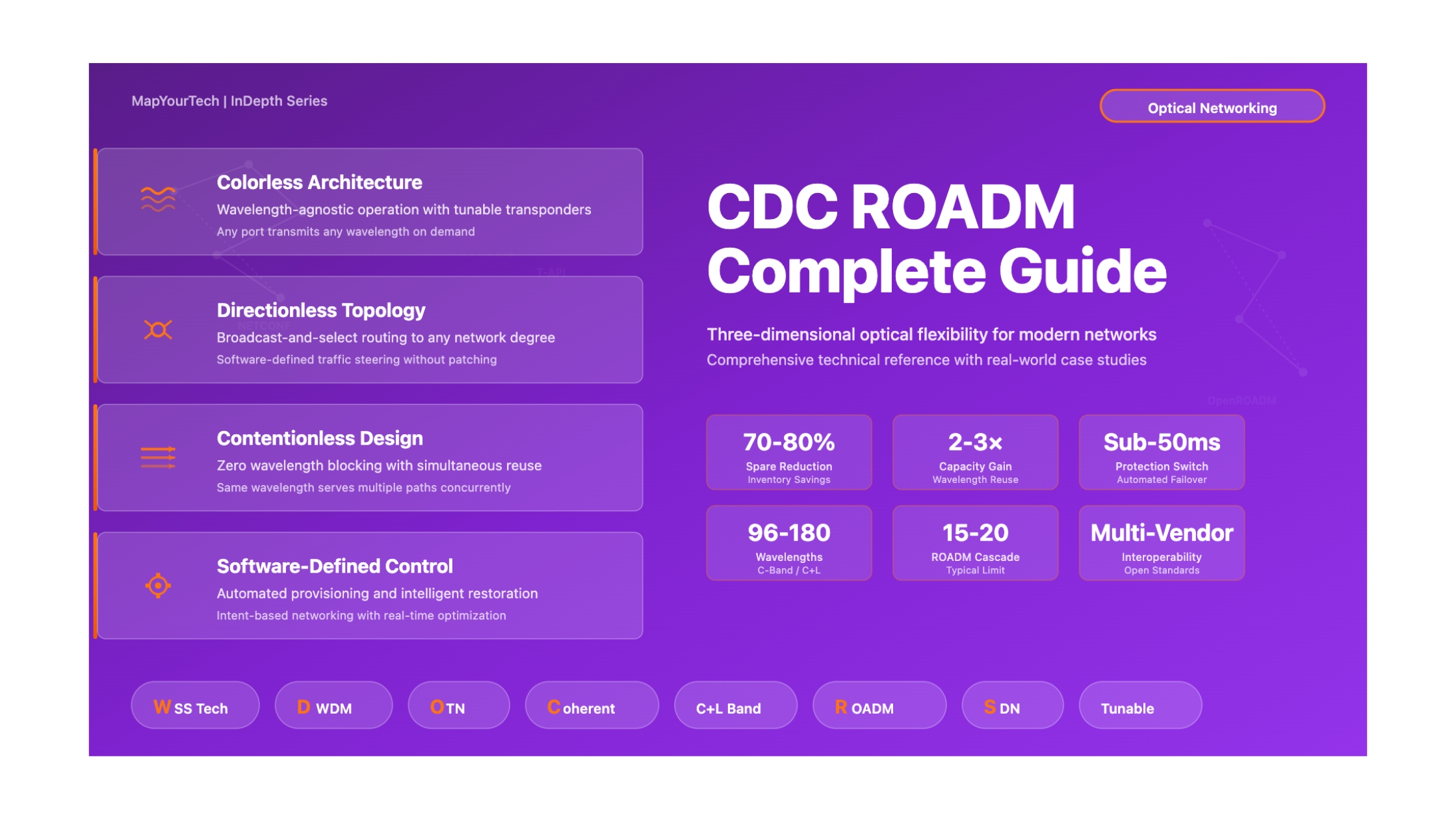
- Unprecedented Flexibility: Complete elimination of wavelength-to-port binding, directional constraints, and wavelength contention creates truly flexible optical infrastructure comparable to IP router flexibility
- Operational Transformation: Remote software reconfiguration replaces manual site visits, enabling service provisioning in minutes instead of days and reducing operational expenditure by 40-60% based on tier-1 operator reports
- Future-Proof Architecture: Native support for flex-grid bandwidth allocation with 6.25/12.5 GHz granularity accommodates 400G, 800G, 1.6T, and future higher-rate channels without hardware replacement
- Network Scalability: Mesh networking capabilities with automated restoration enable networks to scale to hundreds of nodes with sub-second failure recovery, critical for carrier-grade service level agreements
- Spectral Efficiency: WSS-based architecture with sharp filter roll-off reduces guard bands by 15-25% compared to fixed filters, increasing usable capacity proportionally—equivalent to adding 15-25% more fiber capacity at zero incremental cost
- Capital Efficiency: Colorless transponder pooling reduces required spare inventory by 70-80%, while directionless architecture eliminates need for port-specific capacity planning, significantly reducing both capital and operational expenditure
The scope of this guide encompasses fundamental concepts starting from basic ROADM operation, detailed technical architectures with block diagrams and signal flows, comprehensive performance analysis including OSNR budgets and power calculations, real-world deployment scenarios with case studies, troubleshooting methodologies, and future evolution including SDN integration and AI/ML-driven optimization. Mathematical models and design equations provide the analytical framework for network planning and optimization.
Understanding CDC ROADM architecture is essential for optical network engineers, planners, and architects involved in designing, deploying, or operating modern telecommunications infrastructure. Whether building metro aggregation networks, long-haul transport backbones, submarine cable systems, or data center interconnects, CDC capabilities have become the de facto standard for new ROADM deployments due to the compelling operational and economic advantages.
CDC ROADM Three-Dimensional Flexibility Model
Visualizing complete freedom in wavelength, direction, and contention domains
Historical context demonstrates why CDC capabilities emerged as essential rather than optional. Early optical networks used fixed optical add-drop multiplexers (OADMs) where wavelengths were permanently assigned to physical ports and fiber directions through fixed optical filters. Adding a new service required site visits to install wavelength-specific equipment, physically patch cables, and potentially replace filter modules. Network upgrades took weeks or months of planning and execution, with significant service disruption risks. Operational complexity increased exponentially with network size, making manual wavelength management unsustainable beyond 20-30 nodes.
The introduction of basic ROADMs with colored, directional ports improved flexibility by enabling remote wavelength selection via MEMS (Micro-Electro-Mechanical Systems) switches or early WSS devices. However, operators still faced fundamental constraints: wavelength λ1 could only be handled by Port 1, wavelength λ2 only by Port 2, and so forth (colored constraint). Additionally, traffic added on the "East add" path could only travel toward the East direction (directional constraint). These limitations created operational bottlenecks, complicated spare management, and prevented efficient wavelength reuse.
CDC ROADM architecture eliminates these constraints entirely through the combination of three independent but synergistic capabilities. Any tunable transponder can transmit or receive any wavelength within the system's spectral range (colorless). Traffic from any local transponder can be directed to any network degree without physical changes (directionless). The same wavelength can be used multiple times within the same node for different purposes without blocking or interference (contentionless). This three-dimensional freedom transforms optical networks into flexible, programmable infrastructure comparable to modern IP routers, enabling cloud-like operational models with rapid provisioning, automated failover, and dynamic optimization.
Fundamental Paradigm Shift: Hardware to Software
CDC ROADM represents more than an incremental improvement—it constitutes a paradigm shift from hardware-centric to software-centric optical networking. Just as server virtualization decoupled applications from physical hardware, enabling cloud computing, CDC ROADM decouples wavelength services from physical optical infrastructure. This abstraction layer enables software-defined optical networking (SDON) where network behavior is determined by software rather than hardware configuration, allowing operators to treat optical infrastructure as a resource pool rather than a collection of fixed assets.
Deep Dive: CDC Capabilities Explained
1. Colorless: Any Wavelength on Any Port
The "Colorless" attribute fundamentally changes transponder deployment and management by eliminating the rigid binding between physical ports and specific wavelengths. In traditional colored architectures, each physical add/drop port supports only one predetermined wavelength channel—Port 1 handles exclusively λ1 (for example, 193.1 THz), Port 2 exclusively λ2 (193.2 THz), and this pattern continues for all wavelengths. This one-to-one mapping creates operational rigidity: to add a service on λ5, you must have Port 5 available. If Port 5 is occupied but Port 12 is idle, you cannot use Port 12 for λ5—it can only handle λ12.
Colorless Architecture Technical Implementation: Colorless capability requires two key technologies working in concert. First, tunable coherent transponders with lasers that can be tuned across the entire C-band (approximately 1530-1565 nm, spanning 191.35-196.10 THz) or even C+L band (1530-1625 nm) for expanded capacity. Modern coherent transponders typically support tuning in 50 GHz steps aligned to the ITU-T G.694.1 frequency grid, with advanced models supporting 6.25 GHz steps for flex-grid operation, covering 80-96 channels in C-band or up to 180 channels across C+L band.
Read the Full Analysis with Premium
The remaining 89% of this article — the design numbers, trade-offs and field guidance — is part of MapYourTech Premium, along with the full premium library, courses and professional tools.