Spectral Hole Burning (SHB)
Spectral hole burning (SHB) is a major limitation of amplified WDM systems with high channel count. The main reason lies in the fact that there is no possibility of compensating for this effect.
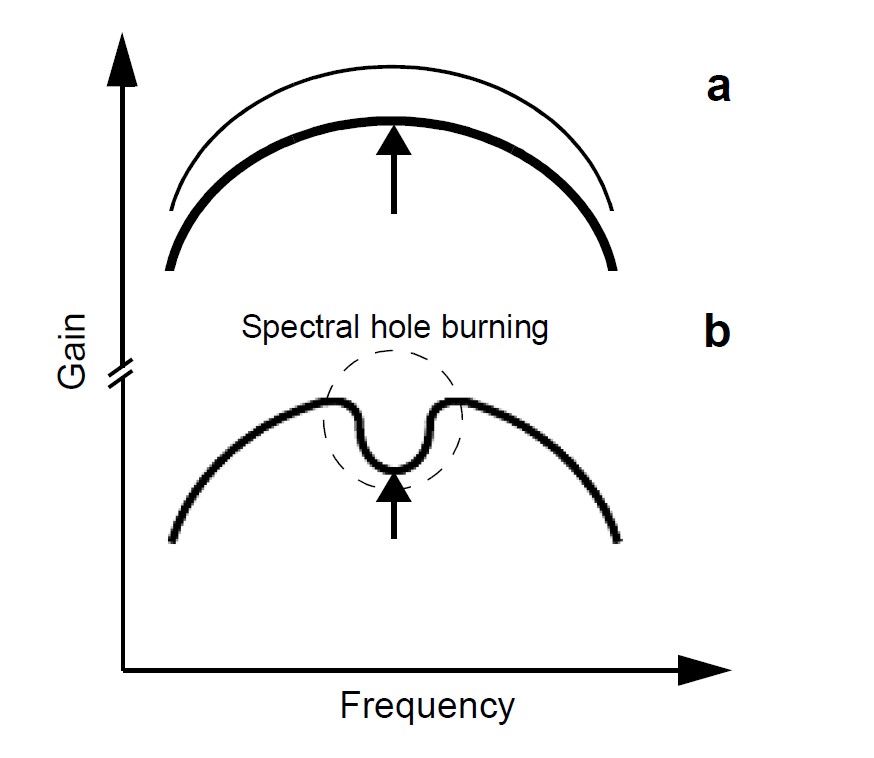
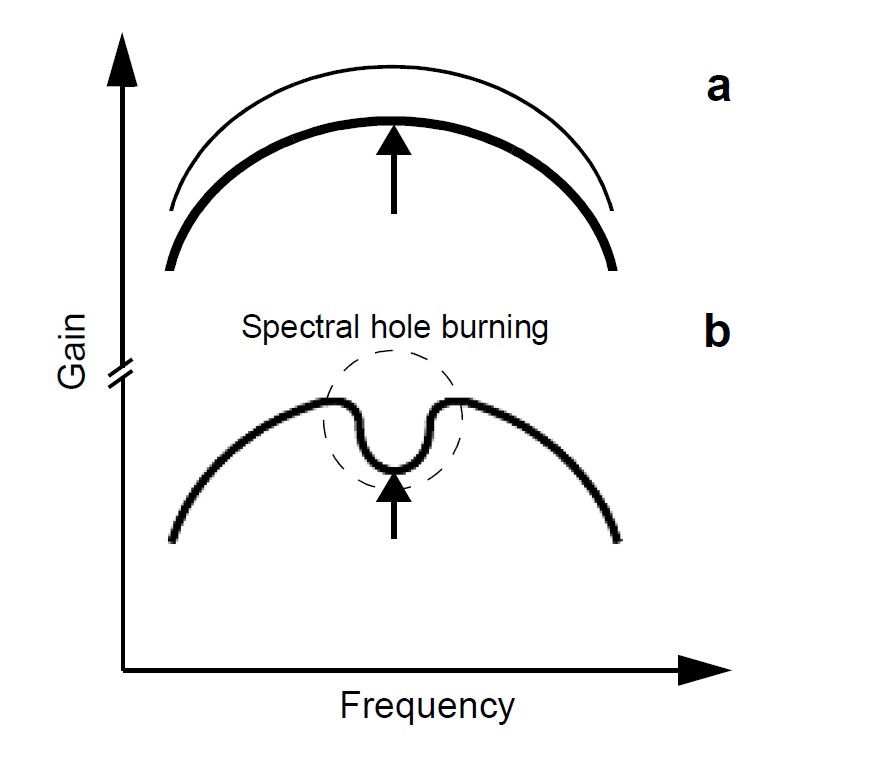
- Due to the inhomogeneous portion of the linewidth broadening of the dopant ions, the gain spectrum has an inhomogeneous component and gain saturation occurs, to a small extent, in an inhomogeneous manner. This effect is known as spectral hole burning because a high power signal at one wavelength can ‘burn’ a hole in the gain for wavelengths close to that signal by saturation of the inhomogeneously broadened ions. Spectral holes vary in width depending on the characteristics of the optical fiber in question and the power of the burning signal, but are typically less than 1 nm at the short wavelength end of the C-band, and a few nm at the long wavelength end of the C-band. The depth of the holes are very small, though, making it difficult to observe in practice.
-
- In addition, accurate predictions are very difficult to carry out. SHB acts as a selective oversaturation of specific erbium ion classes due to a precise matching of the signal wavelength with their corresponding Stark energy sublevels. Gain contributions of a given ion class to the overall amplifier gain spectrum will be dependent on the specific values of energy of the related Stark sublevel (determined by inhomogeneities in the local electric field in the glass as opposed to on the crystal) and of their population density (i.e. of the related induced saturation). Clearly, the overall gain spectrum of the amplifier may be distorted due to this SHB effect. The best-known induced distortion is the hole induced in the gain spectrum in the spectral vicinity of a saturated channel.
- This gives rise to a hole in the gain profile around the saturating channel wavelength, whose width is determined by temperature. Increasing temperature will increase this homogeneous broadening (and thus the hole width at the expense of its depth) while lower temperatures will reduce and make this hole deeper in the gain profile. . Since it is not possible to operate the amplifier at a lower temperature where the effect of homogeneous broadening vanishes, the system designer should account for the holes induced by each signal channel in the amplifier gain profile at room temperature

- SHB does not distort the overall gain profile because the sum of the different contributions has a flat transfer function. Problems may be encountered when some channel powers increase compared to other channels
- SHB could be seen (wrongly) at first glance as a regulating effect because the most favored channels will see a slightly lower gain due to the SHB they induce. This will indeed slightly reduces the power excursion between channels (the correcting effect being, however, much lower than the effect creating this SHB). The detrimental effect actually comes from the distortions induced in the amplifier gain spectrum due to thermal broadening. Other channels, located a few nanometers aside from the most favored ones will also see an induced reduced gain level, while such channels may not be gain favored like the channels that create the SHB effect. This will result in a decrease in the OSNR of such neighboring channels
- The SHB effect not only stresses the dynamic range of the system by increasing the burst power but it also degrades the OSNR performance. In particular, whilst the power change is limited to the beginning of the burst (during the formation of the hole), the OSNR impairment is observed at the end of burst,where the spectral holeis already completely formed by the burst.
SHB also has a limiting effect in the implementation of preemphasis of the less-favored channels. This technique consists of increasing the power of the worst channels at the transmitter side, at the expense of the best channels, leading to the same OSNR for all channels at the link output. This can be performed while keeping the EDFA output powers constant and decreasing the transmitted power of the best channels. However, the highest predistortion that can be performed at the link input in order to compensate for a given excursion in output OSNR is limited by SHB.

Optical Communications & Network Automation Expert | Author of 3 Books for Optical Engineers | Founder, MapYourTech
Optical networking engineer with nearly two decades of experience across DWDM, OTN, coherent optics, submarine systems, and cloud infrastructure. Founder of MapYourTech. Read full bio →
Follow on LinkedIn