Why is BER difficult to simulate or calculate?
For a given design at a BER (such as 10-12 and a line rate of OC-3, or 155 Mbps), the network would have one error in approximately 10 days. It would take 1000 days to record a steady state BER value. That is why BER calculations are quite difficult. On the other hand, Q-factor analysis is comparatively easy. Q is often measured in dB. The next question is how to dynamically calculate Q. This is done from OSNR.
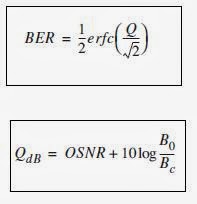
In other words, Q is somewhat proportional to the OSNR. Generally, noise calculations are performed by optical spectrum analyzers (OSAs) or sampling oscilloscopes, and these
measurements are carried over a particular measuring range of Bm. Typically, Bm is approximately 0.1 nm or 12.5 GHz for a given OSA. From Equation 4-12, showing Q in dB in
terms of OSNR, it can be understood that if B0 < Bc, then OSNR (dB )> Q (dB). For practical designs OSNR(dB) > Q(dB), by at least 1–2 dB. Typically, while designing a high bitrate system, the margin at the receiver is approximately 2 dB, such that Q is about 2 dB smaller than OSNR (dB).

Optical Communications & Network Automation Expert | Author of 3 Books for Optical Engineers | Founder, MapYourTech
Optical networking engineer with nearly two decades of experience across DWDM, OTN, coherent optics, submarine systems, and cloud infrastructure. Founder of MapYourTech. Read full bio →
Follow on LinkedIn