Future-Proofing Your Optical Engineering Career in the AI Era
A practical career roadmap for optical networking professionals at every experience level to stay relevant, grow faster, and lead the next wave of innovation
1. Introduction
The optical networking industry is undergoing its most significant transformation in decades. Artificial intelligence, network automation, co-packaged optics, and open disaggregated networking are reshaping not just how optical networks are built, but who builds them and what skills they need. For the first time, optical engineers are seeing job postings at companies like OpenAI, NVIDIA, and Meta that specifically ask for coherent optics expertise alongside Python scripting and automation tools. The lines between "optical engineer" and "software-defined networking engineer" are blurring faster than anyone predicted.
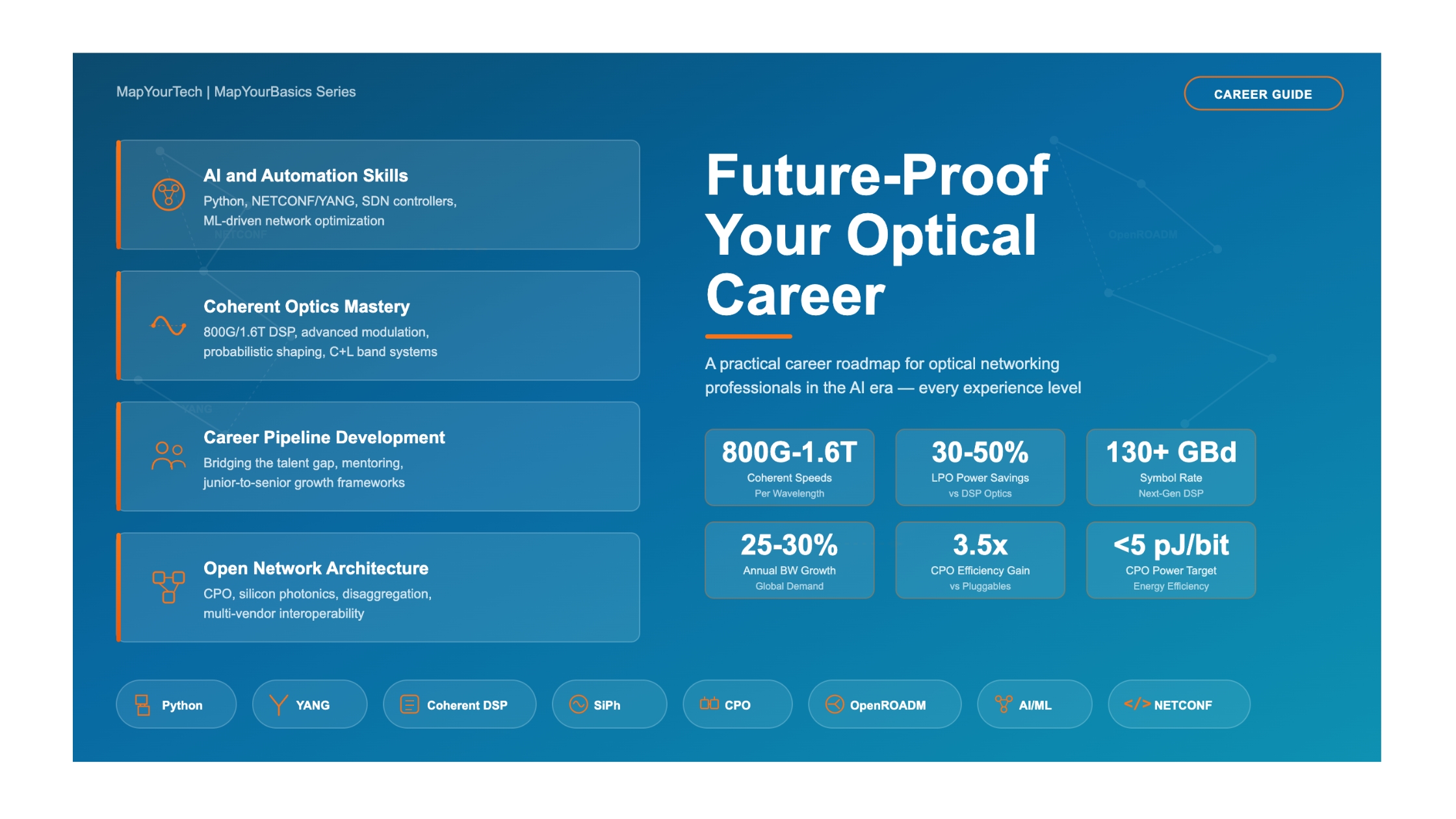
This is not a threat to optical engineering professionals. It is an extraordinary opportunity. The global demand for bandwidth is growing at roughly 25-30% per year, driven by AI training clusters, cloud computing, video streaming, and IoT. Companies like NVIDIA have invested heavily in co-packaged optics (CPO) for their next-generation AI networking switches, and as of 2026, the 1.6T coherent pluggable market is moving from early production into broader deployment. There has never been more demand for people who understand photons. But the engineers who thrive in this environment will be those who combine deep optical domain knowledge with new skills in automation, data analytics, and AI-assisted design.
2. The Changing Landscape: What Has Actually Changed
2.1 AI Is Transforming Both the "What" and the "How" of Optical Networking
AI affects optical engineering in two distinct ways that engineers must understand clearly. First, AI workloads are driving unprecedented demand for optical capacity. Hyperscale data centers now require 800G and 1.6T interconnects to connect GPU clusters for AI training. NVIDIA's announcement at GTC 2025 of co-packaged optical networking switches was a turning point: optical engines have moved from being peripheral equipment to being directly integrated into compute silicon. By 2026, this shift is well underway with multiple vendors shipping CPO-enabled products.
Second, AI tools are changing how optical engineers do their work. Machine learning algorithms now optimize DWDM channel loading, predict amplifier degradation from OSNR trends, automate link budget calculations, and even design photonic integrated circuits (PICs) by exploring non-intuitive geometries that human engineers would never consider. At OFC 2025, researchers demonstrated AI-designed PIC structures that outperformed human-designed equivalents, though the resulting geometries were often impossible for humans to intuitively understand. This trend has only accelerated into 2026, with AI-assisted design becoming a standard part of photonic R&D workflows.
AI is not replacing optical engineers. It is replacing optical engineers who do not adapt. The physics of light propagation, fiber nonlinearities, coherent detection, and amplifier noise have not changed. What has changed is the toolset used to work with these physics. An engineer who understands OSNR fundamentals and can also write a Python script to automate OSNR monitoring across 5,000 wavelengths is far more valuable than one who can only do the first task.
2.2 Open Networking and Disaggregation
The move toward open and disaggregated optical networks is accelerating. Open ROADM, OpenConfig, Open Line Systems (OLS), and open coherent pluggable standards (400G ZR/ZR+, now extending to 800G) are breaking down the traditional vendor-locked ecosystems. This shift means that optical engineers increasingly need to understand YANG data models, NETCONF/RESTCONF protocols, and SDN controllers alongside traditional optical concepts like flex-grid channel planning and amplifier gain optimization.
2.3 The Convergence of Datacom and Telecom Optics
Historically, telecom optical engineering and data center optical engineering were separate worlds. Telecom engineers worked with long-haul coherent DWDM systems, while datacom engineers focused on short-reach multimode optics. That boundary has collapsed. Coherent pluggable modules (400G ZR/ZR+) are now standard in data center interconnects. Linear-Drive Pluggable Optics (LPO), which eliminates the DSP from short-reach links to save 30-50% power, is already deployed in NVIDIA and Meta AI networks. Co-packaged optics (CPO) has moved from lab demonstrations to production, with Broadcom reporting one million link-hours without failures at Meta in late 2025, paving the way for broader CPO rollouts across hyperscale data centers in 2026.
This convergence means optical engineers must now understand both worlds. A telecom background in coherent detection and fiber impairments is directly applicable to DCI networks. A datacom background in high-volume transceiver testing and ASIC integration is increasingly relevant to telecom equipment vendors.
2.4 The Talent Pipeline Paradox: If AI Takes Junior Roles, Who Becomes Tomorrow's Senior Engineer?
There is a troubling contradiction emerging across the entire technology industry, and optical networking is not immune. Companies are increasingly using AI and automation tools to handle tasks that were traditionally assigned to junior and entry-level engineers: writing basic configuration scripts, running routine test plans, generating standard reports, performing first-level alarm triage, and even producing initial network designs. Some organizations have slowed hiring of fresh graduates altogether, expecting that senior engineers equipped with AI tools can cover the work that two or three juniors once handled. On the surface, the economics seem compelling. In practice, it is creating a dangerous gap that the industry has not yet fully reckoned with.
When companies eliminate the entry ramp, they are not just cutting costs today. They are hollowing out the pipeline that produces the very senior talent they depend on. This is already visible in some organizations where the average age of optical engineering teams is climbing steadily, institutional knowledge is concentrated in a shrinking number of experienced heads, and there is no succession plan for when those engineers retire or move on. The optical networking industry, with its deep physics foundations and complex system-level interactions, is particularly vulnerable to this problem because the learning curve is steep and cannot be shortcut by AI alone. You can use ChatGPT to generate a Python script, but you cannot use it to develop the judgment that comes from commissioning a live DWDM system at 2 AM when something unexpected happens.
If the industry stops investing in junior engineers today, within 5-7 years there will be a severe shortage of mid-level and senior optical engineers. AI can automate tasks, but it cannot automate the development of engineering judgment. The companies that continue to hire, train, and mentor fresh graduates — while giving them AI tools to accelerate their learning rather than replace their roles — will have an enormous competitive advantage when the talent shortage hits.
How to Bridge This Gap: Responsibilities at Every Level
For the Industry and Employers: Companies must rethink junior roles rather than eliminate them. Instead of hiring graduates to do repetitive work that AI now handles, hire them to learn alongside AI. Restructure entry-level positions so that juniors use AI tools to handle routine tasks faster while spending the saved time on higher-value learning: shadowing senior engineers during complex troubleshooting, participating in design reviews, running lab experiments, and working on real projects with mentorship. The role of a junior engineer in 2026 should not be "do what the AI cannot do yet" — it should be "learn to do what only experienced engineers can do, using AI as a training accelerator." Companies should also invest in structured apprenticeship programs, rotational assignments across design, deployment, and operations teams, and formal mentoring frameworks that pair experienced engineers with newcomers.
For Senior Engineers and Architects: If you are a senior or principal engineer, you have a direct responsibility here. Your most lasting contribution to the industry may not be the network you design but the engineers you develop. Actively mentor juniors. Document your troubleshooting thought processes, not just the solutions. Create internal training materials that capture the "why" behind engineering decisions, not just the "what." When you use AI tools, explain to junior team members what the AI got right, what it got wrong, and how you evaluated the output. This transfer of judgment is something only humans can do, and it is more valuable than ever.
For Fresh Graduates and Junior Engineers: If you are entering the industry during this period, understand that you are operating in a more competitive environment, but also one with more powerful learning tools than any previous generation had access to. Use AI as a learning accelerator: when an AI tool generates a network configuration, do not just deploy it — study it, understand why each parameter is set the way it is, and try to predict what would happen if you changed specific values. Volunteer for complex projects even if you are not fully qualified yet. Build a portfolio of real work, including automation scripts, lab experiments, technical blog posts, and open-source contributions, that demonstrates your ability to learn and contribute. The graduates who combine optical fundamentals with AI literacy and a visible track record of self-driven learning will still find strong career opportunities.
For the Academic Community: Universities and training institutions must evolve their curricula to produce graduates who are not competing with AI but collaborating with it from day one. This means integrating Python programming and data analysis into optical engineering coursework, teaching students to use simulation tools alongside manual calculations (not instead of them), emphasizing system-level thinking and design trade-offs over rote formula application, and including hands-on lab experience that builds the physical intuition no AI can provide. Academic programs that produce graduates who understand both photonics fundamentals and modern software tools will find their students in high demand regardless of AI adoption rates.
AI should augment junior engineers, not replace them. The organizations that treat AI as a tool to accelerate human development — rather than a substitute for it — will build stronger, more resilient engineering teams. The optical networking industry runs on deep expertise that takes years to develop. There are no shortcuts to building the next generation of senior engineers, but there are better tools to help them get there faster. Every experienced engineer who mentors a junior colleague today is investing in the future health of the entire industry.
3. Foundational Skills That Never Go Out of Date
Before discussing new skills to acquire, it is essential to reinforce the foundational knowledge that remains the bedrock of all optical engineering work. These are the skills that give optical engineers their unique value, and no amount of AI tooling replaces the need for deep understanding here.
Fiber characteristics (attenuation, dispersion, nonlinearities), OSNR calculations, link budget analysis, and power budget management. These are the physics that underpin everything.
PDM-QPSK, 16QAM, 64QAM formats, baud rate selection, spectral efficiency trade-offs, and understanding of DSP functions including CD/PMD compensation, carrier recovery, and FEC.
ITU-T grid planning (fixed and flex-grid), EDFA and Raman amplification, ROADM architectures (CDC/CDC-F), and channel loading strategies for C-band and C+L-band systems.
OTN frame structure, ODU multiplexing hierarchy, protection switching (1+1, SNCP), and integration with IP/MPLS and Ethernet client interfaces.
Practical proficiency with OTDRs, optical spectrum analyzers, BER testers, optical power meters, and interpreting eye diagrams and constellation diagrams.
Structured troubleshooting approaches, root cause analysis, and the ability to correlate optical-layer symptoms (OSNR degradation, BER spikes) with physical-layer causes (connector contamination, fiber bends, amplifier aging).
Never let "new skills" distract you from maintaining your core optical knowledge. Engineers who deeply understand why a 64QAM signal has 3 dB less reach than QPSK at the same baud rate, or how Raman gain profile interacts with EDFA noise figure in a hybrid amplification scheme, will always be in demand. AI tools can run calculations, but they cannot replace the intuition that comes from understanding the physics.
4. Career Roadmap by Experience Level
4.1 Fresh Graduates and Early Career Engineers (0-3 Years)
Your Immediate Goal: Build a Strong T-Shaped Foundation
As a fresh graduate entering optical networking, your primary objective is developing deep expertise in optical fundamentals while building practical breadth in adjacent areas. The "T-shape" model means deep knowledge in one area (the vertical bar) and working familiarity across related areas (the horizontal bar).
What to Focus On Right Now:
Deep Vertical: Optical Transmission Basics. Master the principles of light transmission in single-mode and multi-mode fibers. Understand how chromatic dispersion, polarization-mode dispersion, and fiber nonlinearities (SPM, XPM, FWM) affect signal quality. Learn to perform link budget calculations manually before relying on planning tools. A practical exercise: calculate the maximum transmission distance for a 100G PDM-QPSK signal over G.652 fiber with EDFA-only amplification, given specific span lengths and amplifier noise figures.
Hands-On Lab Skills. Become proficient with basic optical test equipment: optical power meters, OTDRs for fiber characterization, optical spectrum analyzers for channel monitoring, and visual fault locators. If your employer has a lab, spend as much time there as possible. If not, many vendors offer remote lab access for training. Learn to splice fiber, clean connectors properly, and interpret OTDR traces, as these practical skills establish credibility with senior engineers and field teams.
Start Coding Early. Learn Python. This is non-negotiable for any engineer entering the industry today. You do not need to become a software developer, but you must be comfortable writing scripts that parse log files, automate repetitive calculations, and generate reports. Start with simple tasks: write a Python script that reads OSNR values from a CSV file and flags any channels below a threshold. Progress to using libraries like Pandas for data analysis and Matplotlib for visualization.
Understand the Network Context. Learn where optical transport fits within the larger network architecture. Understand how IP/MPLS traffic is mapped into OTN containers, how DWDM wavelengths carry these containers across metro and long-haul networks, and how ROADMs provide wavelength switching flexibility. This end-to-end perspective separates engineers who can contribute to network design from those who only understand individual components.
Months 1-6: Focus on fiber optics fundamentals, optical components (transceivers, amplifiers, multiplexers), and basic test equipment. Read your employer's product documentation thoroughly. Months 6-12: Learn OTN basics, DWDM channel planning fundamentals, and start writing Python scripts for data analysis. Months 12-24: Begin studying coherent optics concepts, flex-grid DWDM, and network automation basics (YANG models, NETCONF). Months 24-36: Choose your specialization direction based on your interests and role.Just adding a personal anecdote; I too started like this with the available tools and information available at that point of time when I started my career in 2008.Luckily I started my career in a great company and among great talent pool which always made curious and strenthen my belief that if I am building something that can help and expedite my job;I am sure it will help others.This stays in me and I started putting thoughts into online notes and later with feedbacka nd appreciation I converted this into this website which still act as my notes.I started writing articles , building tool pre AI era for myself and shared with collegues and they loved it and I continued and figured out that this is one thing definitely I need to keep on going this in post AI era which can enable me to put my thought in better words and better visuals in short time.
4.2 Mid-Career Engineers (3-8 Years)
Your Immediate Goal: Develop Differentiated Expertise
With a solid foundation in optical networking, mid-career is the critical period where engineers must make strategic choices about specialization. The key insight for this stage: the market increasingly rewards engineers who combine optical domain knowledge with at least one adjacent skill area. Pure optical expertise alone, while still valuable, is no longer sufficient for the highest-impact roles.
Choose Your Specialization Direction:
Path A: Optical Systems + Automation. This is currently the highest-demand combination in the market. In 2026, job postings at Google, Amazon Web Services, Meta, and NVIDIA specifically seek optical engineers who can "automate testing and data workflows (Python preferred; AI tools welcome)." Build practical skills in: Python scripting for network management and test automation, NETCONF/RESTCONF for device configuration, YANG data models for optical device management (OpenROADM, OpenConfig), Ansible or similar tools for configuration management, and basic Git/version control for collaborative development.
Path B: Coherent Optics + DSP. With 800G coherent pluggables now in production and 1.6T on the horizon, deep understanding of coherent DSP becomes increasingly valuable. Focus on: advanced modulation formats and their performance trade-offs, probabilistic constellation shaping and its impact on spectral efficiency, soft-decision FEC algorithms and their implementation, and coherent DSP subsystems (adaptive equalization, carrier recovery, timing synchronization). This path leads toward roles in transceiver development, system engineering at equipment vendors, and advanced network planning.
Path C: Silicon Photonics + Packaging. The rise of CPO and integrated optical engines is creating strong demand for engineers who understand the intersection of photonic circuit design and semiconductor packaging. As NVIDIA, Broadcom, and Marvell continue ramping CPO production through 2026-2028, this specialization is expected to see rapid salary growth. Key skills include: photonic integrated circuit fundamentals, optical packaging and fiber coupling techniques, thermal management for co-packaged optical engines, and ASIC-optics interface characterization.
Path D: Network Architecture + Planning. For engineers who prefer system-level thinking over component-level detail, network architecture is an excellent path. Focus on: C+L-band system design and its capacity implications, open line system architectures and multi-vendor interoperability, SDN-controlled optical networks and abstraction layers, and techno-economic analysis for network planning decisions.
Many mid-career optical engineers feel anxious about learning programming. Here is the practical truth: you do not need to become a software developer. You need to become an optical engineer who can automate. The distinction matters. Start by automating tasks you already do manually: parsing alarm logs, generating link budget reports, comparing pre-FEC and post-FEC BER trends across multiple shelves. Use AI coding assistants to accelerate your learning. Within 3-6 months of consistent practice (30 minutes per day), most engineers become productive enough to write useful automation scripts.
4.3 Senior Engineers (8-15 Years)
Your Immediate Goal: Become the Go-To Expert and Multiply Your Impact
Senior engineers face a different challenge than early or mid-career professionals. You already have deep expertise. The question is how to deploy that expertise for maximum impact while staying current with rapidly evolving technology. At this stage, your value comes from pattern recognition built over years of experience, the ability to anticipate problems before they occur, and the judgment to make sound trade-off decisions under uncertainty.
Technical Leadership Without Abandoning Technology:
Many senior engineers are pushed toward pure management roles, but the industry increasingly values "hands-on technical leaders" who can guide teams while staying close to the technology. Focus on developing these capabilities: architectural decision-making (selecting between CDC ROADM architectures, choosing amplification strategies for ultra-long-haul links, evaluating open vs. proprietary line systems), vendor evaluation and multi-vendor integration expertise, cross-domain knowledge that spans optical, IP, and increasingly cloud/compute layers, and mentoring junior engineers while documenting institutional knowledge.
AI as a Multiplier for Senior Engineers:
Senior engineers are uniquely positioned to benefit from AI tools because they have the domain knowledge to evaluate AI outputs critically. Use AI tools for: rapid prototyping of network design alternatives, analyzing large datasets from network monitoring systems to identify degradation patterns, creating automated testing frameworks that encode your troubleshooting experience into repeatable procedures, and building predictive maintenance models using historical performance data from systems you understand deeply.
Emerging Technology Fluency:
Stay current on technologies that will define the next 3-5 years: 1.6T coherent optics and the roadmap toward 3.2T, co-packaged optics and its implications for network architecture, optical circuit switching for AI data center fabrics, space-division multiplexing (SDM) for submarine and long-haul capacity growth, and quantum key distribution (QKD) for secure optical communication.
4.4 Principal Engineers, Fellows, and Distinguished Engineers (15+ Years)
Your Immediate Goal: Shape Industry Direction and Build Lasting Impact
At the principal/fellow level, your role shifts from executing technology to defining it. You are expected to see around corners, identify the technical investments that will pay off in 5-10 years, and build the teams and partnerships needed to realize that vision. The challenges at this level are strategic, not just technical.
Strategic Focus Areas:
Technology Vision and Standards. Actively participate in ITU-T, IEEE, OIF, and other standards bodies. Your deep experience gives you the credibility to shape standards that the entire industry will follow. Drive conversations about next-generation optical transport: how should OTN evolve for beyond-400G rates? What is the optimal interface between coherent DSPs and network control planes? How should optical performance monitoring evolve to support AI-driven network management?
Cross-Industry Bridge Building. The convergence of optical networking with AI/ML infrastructure means principal engineers must now engage with semiconductor architects, AI infrastructure designers, and hyperscale network planners. Building bridges between these communities, translating optical engineering constraints into terms that compute architects understand, and incorporating compute requirements into optical network design, is enormously valuable.
Talent Development and Knowledge Transfer. Your most lasting contribution may be the engineers you develop rather than the systems you design. Create structured learning paths within your organization, mentor mid-career engineers through specialization decisions, and contribute to industry education through publications, conference presentations, and training programs.
Innovation Strategy. Evaluate emerging technologies with a realistic eye toward commercial viability. Quantum networking, photonic computing, neuromorphic optical processing, and space-division multiplexing are all exciting research areas, but which ones will deliver practical value within actionable timeframes? Your experience in seeing technologies move from lab to deployment gives you unique judgment here.
5. The 10 Critical Skill Areas for 2026-2030
Regardless of your experience level, these are the skill areas that will define career growth in optical networking over the next five years. The table below maps each skill to experience levels and provides practical learning resources.
| Skill Area | Freshers | Mid-Career | Senior/Principal | How to Learn |
|---|---|---|---|---|
| Python for Network Automation | Learn basics, write simple scripts | Automate test workflows, build monitoring tools | Architect automation frameworks, mentor teams | Automate the Boring Stuff (book), network automation labs, daily practice with real tasks |
| YANG/NETCONF/OpenConfig | Understand concepts | Configure devices programmatically, build templates | Define organizational data models, drive open standards adoption | OpenROADM documentation, RFC 6241/7950, vendor YANG model repositories |
| Coherent DSP and Advanced Modulation | Understand QPSK/16QAM basics | Design links with PCS, evaluate DSP performance | Evaluate next-gen DSPs (800G/1.6T), shape product roadmaps | OFC/ECOC tutorials, vendor application notes, DSP textbooks |
| AI/ML Fundamentals for Network Applications | Basic awareness, use AI coding tools | Apply ML to network data analysis, build predictive models | Architect AI-driven network management, evaluate vendor AI claims | Andrew Ng courses (Coursera), TensorFlow/PyTorch basics, Kaggle with telecom datasets |
| Silicon Photonics and Co-Packaged Optics | Understand fundamentals | Characterize SiPh components, test CPO prototypes | Drive CPO integration strategy, define packaging requirements | OFC workshops, vendor whitepapers (Broadcom, Marvell, Intel), IEEE journals |
| Open and Disaggregated Networks | Learn Open ROADM basics | Deploy multi-vendor networks, resolve interop issues | Define disaggregation strategy, lead vendor selection | TIP (Telecom Infra Project), Open ROADM MSA docs, Telecom Infra Project labs |
| C+L Band and Wideband Systems | Understand C-band basics, learn L-band differences | Design C+L systems, manage inter-band SRS effects | Evaluate S-band extension roadmaps, drive wideband strategy | ITU-T G.694.1, vendor C+L deployment guides, academic papers on wideband amplification |
| Data Center Interconnect (DCI) | Understand DCI use cases | Design DCI networks, optimize ZR/ZR+ deployments | Architect multi-datacenter optical fabrics, evaluate CPO vs. pluggable trade-offs | OIF 400ZR/800ZR specs, hyperscaler network architecture papers, vendor DCI solutions |
| Cloud Platforms and Infrastructure as Code | Basic cloud concepts (AWS/Azure) | Deploy network tools on cloud, use Terraform/Ansible | Define cloud-native NMS strategy, evaluate SaaS vs. on-prem tools | AWS/Azure free tiers, Terraform tutorials, Docker basics |
| Cybersecurity for Optical Networks | Basic security awareness | Implement secure device management, audit configurations | Define optical layer security architecture, evaluate QKD feasibility | Vendor security hardening guides, ITU-T X.805, zero-trust networking resources |
Table 1: Critical skill areas mapped to experience levels with practical learning paths
6. The Automation Imperative: A Detailed Guide
Network automation deserves special attention because it is the single most impactful skill addition for most optical engineers, regardless of experience level. The operational economics are clear: manual configuration costs roughly $500 per change, troubleshooting costs approximately $2,000 per incident taking 4-8 hours, and compliance violations can cost $10,000 or more per occurrence. Automation directly addresses all of these cost centers.The cost $ might value;I took it as an example to make analogy for readers.
6.1 The Automation Technology Stack for Optical Engineers
The practical automation stack that optical engineers should learn follows a clear hierarchy. At the foundation are Python scripting and YAML/Jinja2 templates for configuration management. These connect to optical devices through NETCONF/RESTCONF protocols using YANG data models. Above this sit orchestration frameworks and SDN controllers that coordinate multi-device workflows. At the top are management dashboards, monitoring systems, and eventually intent-based networking platforms that translate high-level business goals into network configurations.
A phased learning approach works well: in Phase 1 (months 1-3), focus on basic Python scripting and automating simple tasks you currently do manually. In Phase 2 (months 3-6), learn NETCONF and start interacting with network devices programmatically. In Phase 3 (months 6-12), build more complex workflows with error handling, validation, and reporting. In Phase 4 (ongoing), integrate AI/ML techniques for predictive analytics and anomaly detection.
Start With What You Know
Automate a task you already do manually. Parse OTDR trace files to extract splice loss values. Generate link budget reports from CSV data. Monitor OSNR values across channels and alert when thresholds are approached. This makes automation immediately useful and builds confidence.
Connect to Devices
Learn NETCONF basics. Use Python's ncclient library to retrieve configuration and operational data from optical devices. Start with read-only operations (getting current alarm states, retrieving PM data) before progressing to configuration changes.
Build Workflows
Create end-to-end automated workflows: provisioning a new wavelength including transponder configuration, ROADM cross-connect setup, amplifier adjustment, and post-provisioning validation. Include proper error handling and rollback capability.
Add Intelligence
Integrate data analytics and ML: use historical performance data to predict when amplifier gain will degrade below acceptable levels, identify patterns in fiber degradation, or optimize wavelength routing based on real-time traffic patterns.
7. Emerging Technology Areas to Watch and Invest In
7.1 Co-Packaged Optics (CPO)
CPO is arguably the most significant technology shift in optical networking since the adoption of coherent detection. By integrating optical engines directly adjacent to switch ASICs, CPO reduces electrical path lengths from centimeters to millimeters, cutting power consumption per port from approximately 30W (with pluggable modules) to approximately 9W. NVIDIA's CPO roadmap, built on TSMC's COUPE platform, promises 3.5x power efficiency improvement and 64x better signal integrity compared to pluggable modules.
For optical engineers, CPO creates demand for skills in: optical engine characterization and reliability testing, thermal management for integrated optical-electronic packages, high-density fiber management and connectivity, and ASIC-optics co-design and interface specification. Broadcom's second-generation CPO solution (Tomahawk 5-Bailly) entered volume production in 2025, and as of 2026, third-generation 200G-per-lane technology is progressing toward production readiness.
7.2 1.6T and Beyond
The race to 1.6T per wavelength reached a major milestone in 2025, when multiple companies demonstrated 1.6T prototypes at ECOC using OSFP-XD and COBO form factors. In 2026, these prototypes are transitioning to early commercial deployments, with key DSP innovations including operation at 130+ GBaud with probabilistic constellation shaping. For optical engineers, this means understanding: ultra-high baud rate transmission challenges, nonlinear fiber impairment management at higher symbol rates, advanced FEC schemes that operate closer to the Shannon limit, and the trade-offs between pluggable and integrated (CPO) implementations at these rates.
7.3 Linear-Drive Pluggable Optics (LPO)
LPO removes the DSP from short-reach optical links, connecting linear transimpedance amplifiers and drivers directly to the switch ASIC. The power savings (30-50% per link) and latency reduction (less than 15 ns) make LPO attractive for AI data center fabrics where millions of short-reach links connect GPU clusters. LPO deployment began in NVIDIA Spectrum-X and Meta AI networks in 2025, and by 2026 it covers a growing share of short-reach 800G links in AI data centers, with projections exceeding 40% penetration.
7.4 AI-Driven Network Management
AI and ML are moving from research concepts to deployed tools in optical network management. Major applications include predictive maintenance (analyzing OSNR trends, amplifier aging, and environmental conditions to predict failures before they impact service), automated traffic engineering (dynamically adjusting wavelength allocations and routing based on real-time demand patterns), and intelligent fault diagnosis (correlating multiple alarm sources to identify root causes faster than human operators).
7.5 Quantum Communication
While still early-stage for commercial deployment, Quantum Key Distribution (QKD) over optical fiber networks is an area of growing investment, particularly for government, financial, and healthcare applications. Engineers who understand both conventional optical transmission and quantum optical principles will be well-positioned as this technology matures over the next 5-10 years.
8. Building a Personal Learning Strategy
Knowing what to learn is only half the challenge. Equally important is how to learn effectively while maintaining a full-time engineering role. Here is a practical framework.
8.1 The 70-20-10 Rule for Technical Learning
Research on professional development consistently shows that 70% of learning happens through hands-on experience, 20% through interactions with peers and mentors, and 10% through formal training. For optical engineers, this translates to: spending the majority of your learning time on practical projects (automating a real workflow, building a test setup, contributing to an open-source project), actively seeking feedback from experienced engineers and participating in technical communities, and supplementing with focused courses, conferences, and structured reading.
8.2 Conferences and Industry Events
OFC (Optical Fiber Communications Conference) remains the most important annual event for optical networking professionals. ECOC (European Conference on Optical Communication) is the premier European event. Both offer not just technical presentations but also hands-on workshops, standards meetings, and networking opportunities. The 2026 OFC will be held March 15-19 in Los Angeles, with plenary speakers from NVIDIA, Coherent, and Tesat-Spacecom addressing AI networking, advanced coherent optics, and satellite communications.
Beyond the major conferences, industry webinars from equipment vendors (Ciena, Ribbon Communications, Nokia, Cisco), online communities (TIP community labs, OpenConfig working groups), and local IEEE/Optica chapter events provide continuous learning opportunities.
8.3 Certifications Worth Pursuing
While certifications alone do not define competence, they can provide structure to learning and serve as credible signals on a resume. For optical networking professionals, consider: vendor-specific certifications from your equipment vendor ecosystem (Ciena, Ribbon Communications, Nokia, Cisco optical tracks), cloud platform fundamentals (AWS Cloud Practitioner or Azure Fundamentals) to understand the infrastructure your networks serve, Python certifications (PCEP, PCAP) to validate programming skills, and CCNP Service Provider or similar certifications that include optical transport modules.
8.4 The 30-Minute Daily Investment
The most effective learning strategy is consistent daily investment rather than occasional intensive sessions. Dedicate 30 minutes per day to skill development. Over a year, this accumulates to over 180 hours of focused learning, equivalent to roughly four university courses. Use this time for: 10 minutes reading (standards documents, technical blogs, research papers), 10 minutes practicing (writing code, configuring lab equipment, using simulation tools), and 10 minutes reflecting (documenting what you learned, identifying gaps, planning next steps). You can visit MAPYOURTECH.COM where we keep updating with well research articles with proper real industry relevant knowledge.
9. Career Paths and Role Evolution
The optical networking industry offers diverse career paths, and the AI era is creating new roles that did not exist five years ago. Understanding the full landscape helps engineers make informed decisions about their career direction.
| Traditional Role | Evolving Into | New Skills Required |
|---|---|---|
| Optical Network Design Engineer | Optical Network Architect + Automation Lead | SDN, open networking, programmable photonics, techno-economic modeling |
| Systems Engineer | Optical Systems + Integration + DevOps Engineer | CI/CD pipelines, automated testing, multi-vendor integration, YANG/NETCONF |
| Field Engineer | Smart Field Engineer with Remote Diagnostics | AI-assisted troubleshooting tools, remote monitoring platforms, data analytics |
| Operations Engineer | AIOps Engineer for Optical Networks | ML operations, anomaly detection, automated remediation, dashboarding |
| R&D Engineer | AI-Enhanced Photonics R&D Engineer | ML for photonic design, silicon photonics simulation, advanced packaging |
| Pre-Sales Engineer | Solution Architect + Technical Consultant | Cloud integration, open networking economics, total cost of ownership analysis |
| Test Engineer | Automated Test and Validation Engineer | Test automation frameworks, CI/CD for hardware validation, statistical analysis |
| New Role | Network Automation Engineer, Optical | Python, YANG/NETCONF, SDN controllers, optical domain expertise |
| New Role | CPO/Silicon Photonics Integration Engineer | Photonic circuit design, advanced packaging, thermal management, ASIC interfaces |
| New Role | Optical AI Infrastructure Engineer | AI/GPU cluster networking, optical switching for ML fabrics, high-radix topology design |
Table 2: Evolution of optical networking roles and the emerging new positions
As of 2026, optical network automation engineer roles at major hyperscalers (Google, AWS, Meta) command base salaries of $156,000-$229,000 in the US, plus equity and bonuses. Senior optical engineers at companies like OpenAI who combine coherent optics expertise with SONiC and CMIS-based module management experience are among the highest-paid professionals in the industry. The salary premium for engineers with combined optical + automation skills is estimated at 20-30% above pure optical engineering roles.
10. Practical Action Plan: What to Do This Week
Long-term career planning is essential, but action starts now. Here is a concrete plan you can begin immediately, regardless of your experience level.
This Week's Action Items
- Install Python on your computer and complete one beginner tutorial (even if you have been meaning to do this for months)
- Identify one repetitive task in your current work that could be automated and outline the steps needed
- Read one recent OFC or ECOC paper on a topic outside your current expertise (CPO, LPO, or 1.6T optics)
- Join at least one professional community: OpenConfig Slack, TIP community, or a LinkedIn group for optical networking professionals
- Schedule 30 minutes daily for learning and block it on your calendar like a meeting
This Month's Goals:Its never too late to start !!!
- Write your first useful Python script that solves a real problem in your work (even a simple one)
- Read the OpenROADM or OpenConfig YANG model documentation for one device type you work with
- Have a conversation with a colleague who works in a different area (IP networking, cloud infrastructure, software development) to understand their perspective on optical networking
- Create a personal 12-month learning plan based on the skill areas identified in Section 5
- Identify one industry conference or webinar to attend in the next quarter
11. Conclusion
The optical networking industry has never been more vibrant, more demanding, or more full of opportunity than it is today. AI is not the enemy of optical engineers. It is the most powerful accelerant our industry has ever seen. AI workloads are driving unprecedented demand for optical capacity, AI tools are making optical engineers more productive, and AI applications are creating entirely new roles at the intersection of photonics and computing.
The pace of change in our industry is accelerating. The gap between those who actively invest in learning and those who rely on existing skills will only grow wider. But the good news is that getting started requires nothing more than curiosity, 30 minutes per day, and the willingness to be a beginner again in some areas while being an expert in others. The optical networking professionals who embrace this mindset will not just survive the AI era. They will lead it. You can visit MAPYOURTECH.COM where we keep updating with well research articles with proper real industry relevant knowledge.
References
- ITU-T Recommendation G.694.1 -- Spectral grids for WDM applications: DWDM frequency grid.
- ITU-T Recommendation G.709 -- Interfaces for the optical transport network.
- OIF 400ZR Implementation Agreement -- Interoperable coherent 400G interface specification.
- OpenROADM MSA -- Multi-Source Agreement for open and interoperable ROADM networks.
- OpenConfig -- Vendor-neutral, model-driven network management using YANG models.
- OFC 2025 and OFC 2026 Plenary Sessions -- Optical Fiber Communications Conference proceedings and presentations.
- ECOC 2025 and ECOC 2026 Exhibition and Technical Proceedings -- European Conference on Optical Communication.
- Sanjay Yadav, "Optical Network Communications: An Engineer's Perspective" -- Bridge the Gap Between Theory and Practice in Optical Networking.
Developed by MapYourTech Team
For educational purposes in Optical Networking Communications Technologies
Note: This guide is based on my personal experience, industry trends, best practices, and real-world implementation experiences .
Feedback Welcome: If you have any suggestions, corrections, or improvements to propose, please feel free to write to us at [email protected]

Optical Communications & Network Automation Expert | Author of 3 Books for Optical Engineers | Founder, MapYourTech
Optical networking engineer with nearly two decades of experience across DWDM, OTN, coherent optics, submarine systems, and cloud infrastructure. Founder of MapYourTech. Read full bio →
Follow on LinkedIn