
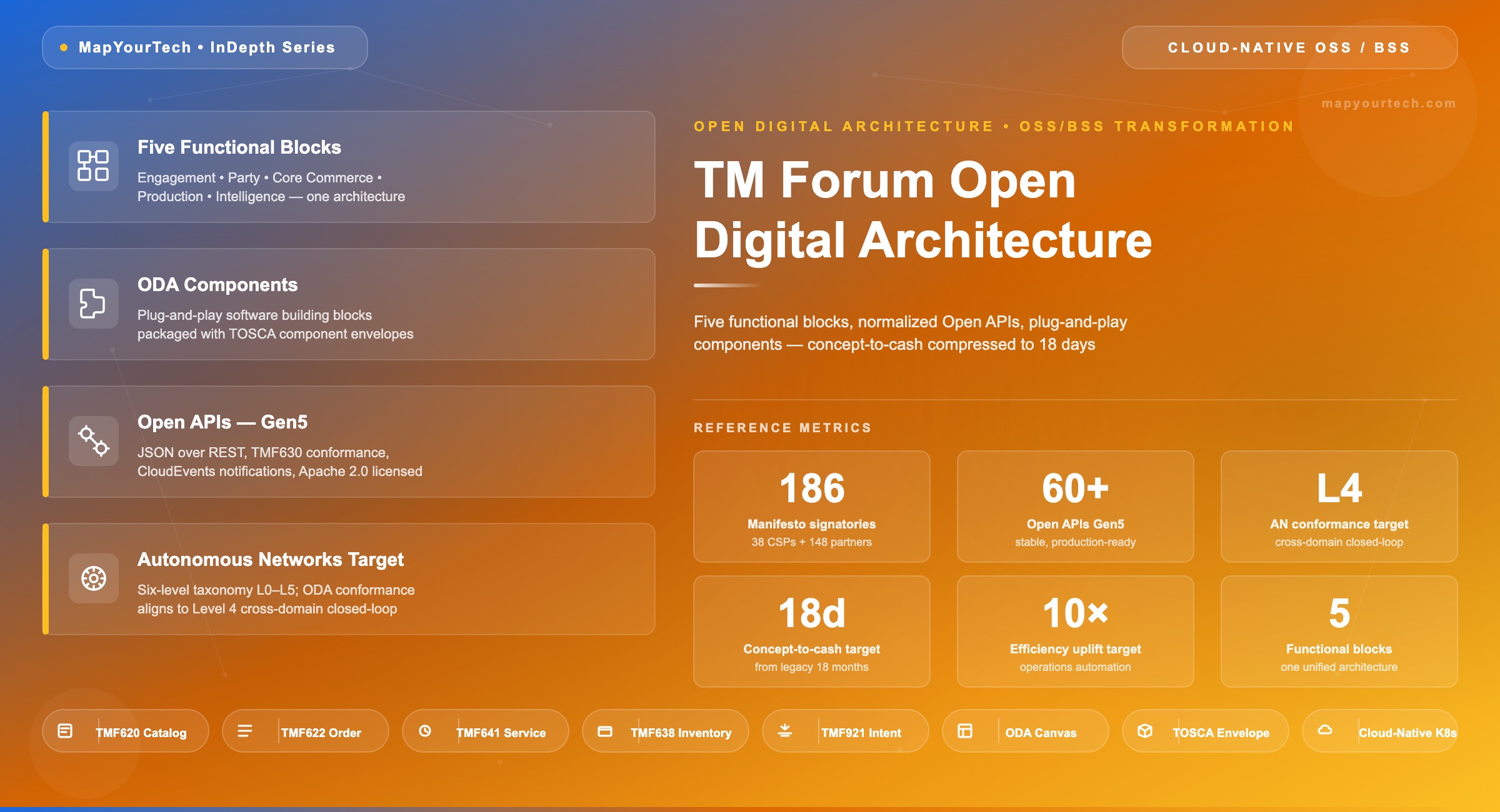
TM Forum Open Digital Architecture
Functional blocks, design principles, ODA Components, the Canvas model, and the migration path from siloed OSS/BSS to a unified, cloud-native operations platform.
1. Introduction
TM Forum launched the Open Digital Architecture (ODA) in February 2018 as a direct response to an operational failure that every major communications service provider (CSP) was experiencing: five or more independent software stacks, each managing one line of business, each exposing its services in a different way, none capable of producing a single consolidated customer bill or a single consistent view of network resources. The problem was not a lack of software. It was too much of it, deployed in incompatible silos.
ODA defines a target architecture that replaces traditional Operations Support Systems and Business Support Systems — the OSS/BSS split that has structured telecom software for three decades — with a single, component-based, API-driven platform. Its five functional domains, five core principles, and a defined software component model give CSPs a specific engineering target rather than an aspiration. As of 2026, 186 companies have signed the ODA Manifesto — 38 communications service providers that commit to requiring ODA conformance in relevant RFPs, plus 148 technology partners that commit to building products consistent with the ODA component definitions — and TM Forum reports more than 2,200 ODA asset downloads over a twelve-month period.
This article covers the architecture end-to-end: the structural problem ODA was built to fix, the five functional blocks it defines, how the ODA Canvas provides a cloud-native runtime for ODA Components, how TM Forum's Gen5 Open APIs create interoperability at the component boundary, and how operators are executing the migration from legacy systems. Where relevant, the article draws on TM Forum's published Frameworx standards, the ODA Functional Architecture specification, and publicly reported operator deployments.
Takeaway: ODA is not a point product or a vendor platform. It is a normative architectural specification — published by TM Forum and built by operator-vendor collaboration — that defines what software components a CSP needs, how those components expose their capabilities through Open APIs, and what cloud-native runtime environment is required to deploy and manage them. It replaces the OSS/BSS dichotomy with a unified, loosely coupled functional model.
2. The Legacy OSS/BSS Problem
Legacy BSS and OSS grew separately, each serving a distinct master. BSS handled commercial functions — billing, order management, customer relationship management, product catalogs. OSS handled operational functions — network inventory, provisioning, fault management, performance monitoring. For decades, these two stacks communicated through narrow, batch-oriented interfaces, typically custom-built integration layers that transferred data nightly or through periodic synchronization jobs. A network event visible to OSS at 02:00 might not propagate to a customer-facing BSS until the following business day.
The separation created five compounding problems that accumulated as product portfolios grew from wireline voice to data, IP, mobile, and cloud services. First, each new service line triggered a new software stack: billing for wireline, a separate billing system for mobile, a third for enterprise IP services. Second, integration work consumed 30%–50% of IT project budgets at large operators, with each point-to-point connection requiring bespoke data mapping and version management. Third, end-to-end orchestration — the path from a customer's service order through the BSS to the OSS and then into network provisioning — spanned up to eight independent systems, each introducing latency, error rates, and compensating transaction complexity. Fourth, data inconsistency between systems made a single customer view structurally impossible: the billing system held one set of account attributes, the inventory system held another, and the customer portal held a third. Fifth, every software upgrade at one layer required regression testing across every connected system.
BT articulated the failure mode precisely when it found that it had five product-specific stacks — consumer, enterprise, wireline, wireless, and IP — and could not send a customer a single consolidated bill covering all their services. The billing logic that handled a widget could handle a complex wireline service, but the system had been built around product lines, not customers. The customer existed as a different record in each stack. This architecture was not a defect in engineering judgment at the time it was built. It reflected the technology constraints of the 1990s and early 2000s, when high-throughput databases and real-time distributed transactions were not economically viable. By 2015, those constraints had dissolved — cloud infrastructure, in-memory databases, containerisation, and microservices made a data-centric, real-time unified architecture technically feasible for the first time.
The cost of this architecture is not abstract. IDC's telecom software market forecast puts combined BSS/OSS spending at $48.7 billion in 2024, growing to $60.4 billion by 2029. A disproportionate share of that budget — integration maintenance, custom interface development, regression testing across heterogeneous stacks — produces no new capability. TM Forum's stated design target for ODA is to compress service launch time from 18 months to 18 days. That compression comes not from engineering faster but from removing the inter-system coordination work that currently dominates each launch.
Takeaway: The OSS/BSS split is not a software design pattern. It is an artifact of how CSP software portfolios grew incrementally, one service line at a time, without a shared data model or a common API surface. ODA treats that split as the root cause of integration debt and eliminates the distinction by grouping all operations and commercial functions under one functional architecture, with normalized APIs at every boundary.
3. From Frameworx to Open Digital Architecture
TM Forum's Frameworx suite — the Business Process Framework (eTOM), the Information Framework (SID), and the Application Framework (TAM) — defined the common language for CSP operations from the late 1990s through the 2010s. eTOM organized every telecom business process into a hierarchical map covering fulfillment, assurance, and billing. SID standardized data models for the entities CSPs manage: customers, products, services, resources, and suppliers. TAM catalogued the software applications that implement these functions and mapped them to eTOM process areas. Together, these three frameworks gave operators and vendors a shared vocabulary and a structured way to compare architectures.
Frameworx did not specify how software components should be built, deployed, or connected. eTOM describes what a CSP does, not how its software is structured. SID defines data models, not APIs. TAM maps application categories, not integration contracts. The result was that two operators could both claim full eTOM compliance while running architectures so different that a product certified on one could not be deployed in the other without months of custom integration. Frameworx created a common language, but not a common operating model.
Read the Full Analysis with Premium
The remaining 89% of this article — the design numbers, trade-offs and field guidance — is part of MapYourTech Premium, along with the full premium library, courses and professional tools.
You May Also Like
-
Free
-
September 4, 2026
-
Premium
-
September 4, 2026
-
Premium
-
September 4, 2026