
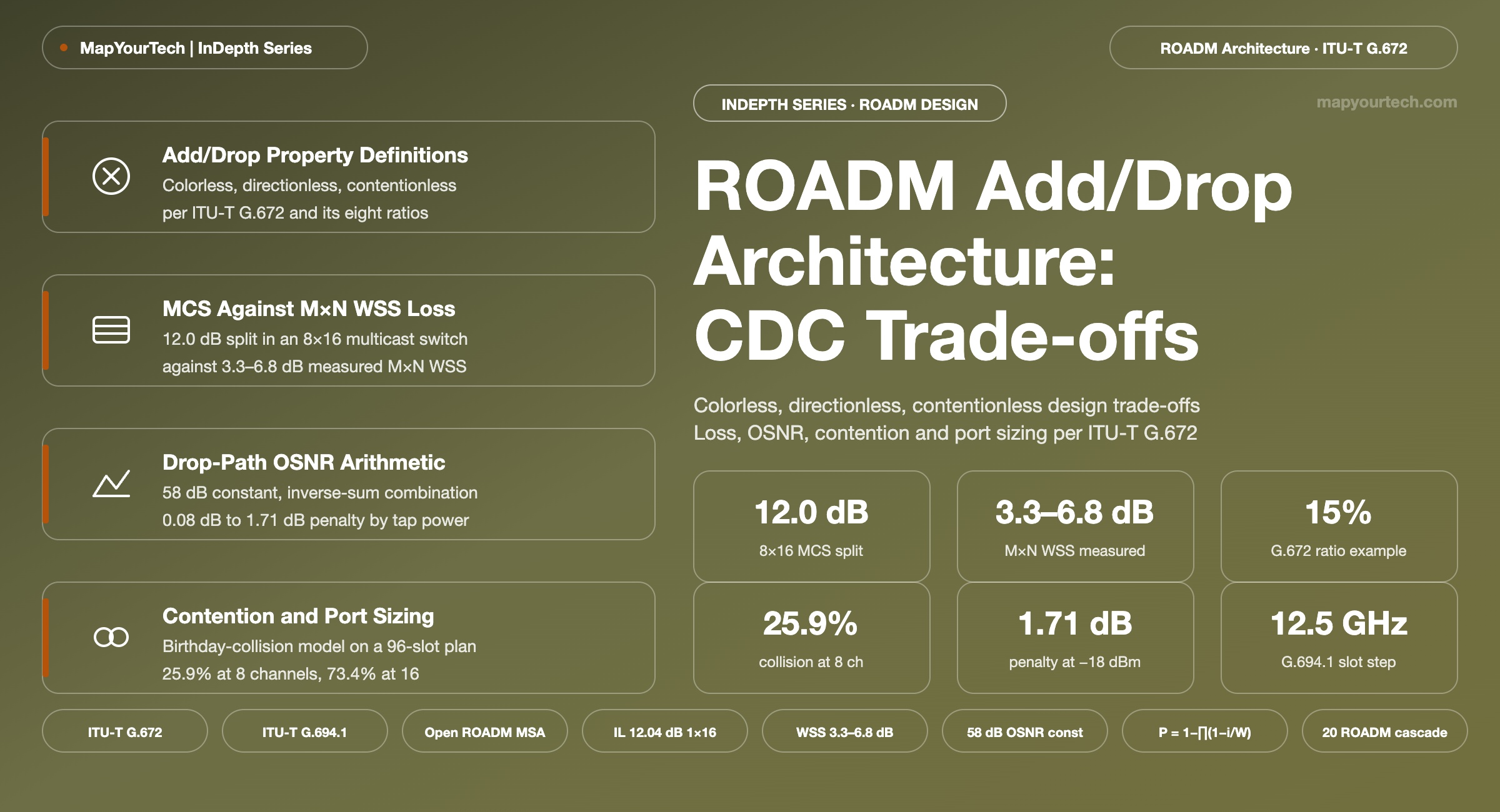
ROADM Add/Drop Architecture Choices: Colorless, Directionless, Contentionless Design Trade-offs
What each add/drop property costs in insertion loss, ports and shelf space, and where the contentionless tier earns its place in the node.
Contention is a property of the add/drop structure, not of the wavelength.
What You Will Learn
- Define colorless, directionless and contentionless local add/drop in the wording ITU-T G.672 uses, and separate each from the two properties it is routinely confused with (Section 2).
- Place the R-WADD and the R-LADD in a four-degree route-and-select node and read which device carries each of the three properties (Section 3, Fig. 3).
- Derive the 12.0 dB splitting term inside an 8×16 multicast switch and reconcile it with the approximately 14 dB the card is specified at (Section 5).
- Compute drop-path OSNR from the 58 dB reference constant and show why a 14 dB structure costs 0.09 dB at −3 dBm per channel and 2.12 dB at −18 dBm (Section 6, Table 3).
- Reproduce the ITU-T G.672 add/drop ratio arithmetic, checking 112 ports against a 742-channel node to 15% (Section 7).
- Quantify wavelength collision inside a colorless-directionless bank with the birthday-collision form, reading 25.9% at eight channels on a 96-slot plan (Section 7, Fig. 7).
- Order a turn-up sequence for an amplified add/drop bank and set the per-port targets the optical channel monitor will hold (Section 8).
- Select an add/drop tier against traffic churn, restoration policy and add/drop ratio using the criteria of Table 8 (Section 11).
1. Introduction
A wavelength selective switch routes any channel from a line input to any of its output ports, and that capability is why a reconfigurable optical add/drop multiplexer (ROADM) can be re-provisioned from a management system rather than a fiber jumper. The express path in a modern node has been solved for two decades. The part that still forces a hardware decision at design time is the local add/drop structure: the block of equipment between the degree-facing switches and the transponder ports, which decides which wavelength a given port can carry, which line directions that port can reach, and whether two ports may carry the same frequency at the same time.
Those three questions are the colorless, directionless and contentionless properties. They are independent, they are acquired separately, and each one is paid for in a different currency. Colorless operation removes a fixed filter and costs almost nothing beyond a tunable transmitter. Directionless operation adds a switching stage between the add/drop bank and every degree, so it costs insertion loss and a set of connections that scale with node degree. Contentionless operation requires that identical frequencies be handled in parallel inside the add/drop block, which is a topological requirement rather than a software one: it forces a second switching stage, and the way that second stage is built sets the loss, the port count and the shelf space of the whole structure.
The distinction matters most where the optical layer is asked to restore traffic. A path that reroutes onto a different degree after a fiber cut needs an add/drop port that can reach the new degree, and it needs to keep its frequency if the far end is to reacquire without retuning. A colorless-directionless bank grants the first and denies the second whenever the required frequency is already present in that bank. The result is a restoration attempt that fails for a reason no amount of margin will fix, because the constraint is structural.
This article works from the classification in ITU-T G.672 through the two implementation families in service today, quantifies what each costs in insertion loss and delivered optical signal-to-noise ratio (OSNR), and sets out the port-sizing and commissioning practice that follows. It covers terrestrial multi-degree nodes carrying coherent traffic; fixed submarine add/drop and filterless architectures are named where they bound the discussion but are not developed here.
2. Add/Drop Property Definitions per ITU-T G.672
Contentionless local add/drop is the property of a ROADM that lets the node add or drop more than one optical channel at the same frequency to or from different optical line ports. It is a property of the add/drop device, measured in how many same-frequency channels one structure can hold, and it is independent of both the wavelength assignment of a port and the set of directions that port can reach. ITU-T G.672 states it in exactly those terms.
The Recommendation separates three axes, and the reason the terminology causes trouble in practice is that a single vendor line card usually delivers two of the three, so the properties get discussed as one product tier rather than as three constraints. Written out as G.672 writes them:
- Colored local add/drop adds or drops a channel at one specific frequency to one specific port. Colorless local add/drop adds or drops a channel at any supported frequency to any of those ports, in a fixed-grid or a flexible-grid variant.
- Directional local add/drop adds or drops a channel to or from one specific optical line port. Directionless local add/drop adds or drops a channel to or from any optical line port.
- Contentionless local add/drop adds or drops more than one channel at the same frequency to or from different optical line ports.
The axes are not mutually exclusive, and the standard is explicit that one node can offer colored, directionless and colorless features on different sets of local ports at the same time. That is why G.672 classifies a node with eight separate add/drop ratio parameters rather than one tier label, each ratio being the count of ports carrying a given combination of features divided by the maximum node channel count.
Read the Full Analysis with Premium
The remaining 88% of this article — the design numbers, trade-offs and field guidance — is part of MapYourTech Premium, along with the full premium library, courses and professional tools.
You May Also Like
-
Free
-
September 4, 2026
-
Premium
-
September 4, 2026
-
Premium
-
September 4, 2026