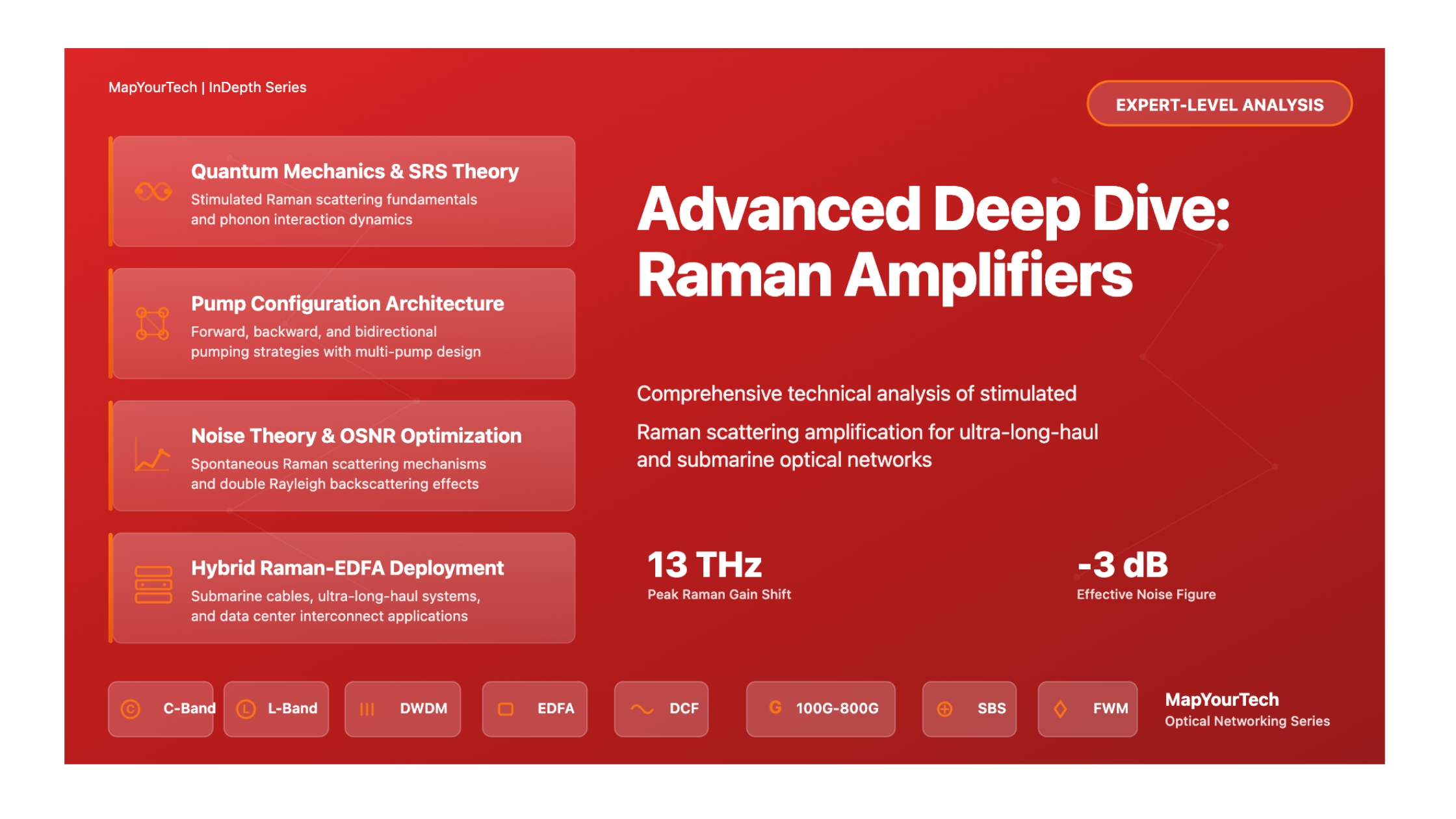

Advanced Deep Dive: Raman Amplifiers
Comprehensive Expert-Level Analysis of Stimulated Raman Scattering Amplification in Modern Optical Networks
Raman amplifiers represent a transformative technology in optical fiber communications, leveraging the quantum mechanical phenomenon of stimulated Raman scattering (SRS) to achieve distributed signal amplification directly within the transmission medium. Unlike discrete amplification technologies such as Erbium-Doped Fiber Amplifiers (EDFAs), Raman amplifiers exploit the intrinsic nonlinear optical properties of silica fibers to provide wavelength-flexible, low-noise amplification across extended transmission spans. This advanced analysis examines the fundamental quantum mechanics, architectural implementations, performance optimization strategies, and future evolution of Raman amplification technology for ultra-long-haul and submarine optical networks.
The theoretical foundation of Raman amplification rests upon the inelastic scattering of photons through interaction with optical phonons—quantized vibrational modes of the silica molecular lattice. When high-power pump photons traverse the fiber medium, they transfer energy to lower-frequency signal photons through a mediated phonon interaction, resulting in signal amplification characterized by a broad gain spectrum spanning approximately 40 THz. This distributed amplification paradigm fundamentally alters the noise accumulation dynamics compared to lumped amplification, enabling superior optical signal-to-noise ratio (OSNR) performance in cascaded multi-span architectures.
1. Advanced Quantum Mechanics & Theoretical Foundations
1.1 Quantum Mechanical Description of Stimulated Raman Scattering
The stimulated Raman scattering process originates from the third-order nonlinear susceptibility χ⁽³⁾ of the silica fiber medium. When an intense pump field at frequency ωₚ interacts with a weak signal field at frequency ωₛ, energy transfer occurs through the creation or annihilation of optical phonons with frequency Ω = ωₚ - ωₛ. The quantum mechanical treatment begins with the coupled amplitude equations derived from Maxwell's equations incorporating the nonlinear polarization response.
Where Ps and Pp represent signal and pump powers, gR is the Raman gain coefficient (≈1×10⁻¹³ m/W for silica at peak gain), Aeff is the effective mode area, and α denotes fiber attenuation.
Raman Gain Spectrum and Phonon Interaction Dynamics
The Raman gain spectrum exhibits a characteristic asymmetric profile with peak gain occurring at a Stokes shift of approximately 13.2 THz (corresponding to ~100 nm wavelength separation for 1550 nm signals). This frequency shift corresponds to the dominant vibrational mode of the Si-O-Si bonds in the amorphous silica structure. The gain spectrum width of approximately 5 THz at half-maximum enables broadband amplification suitable for dense wavelength division multiplexing (DWDM) systems spanning the entire C-band and L-band regions.
Read the Full Analysis with Premium
The remaining 88% of this article — the design numbers, trade-offs and field guidance — is part of MapYourTech Premium, along with the full premium library, courses and professional tools.