Generic selectors
Exact matches only
Search in title
Search in content
Post Type Selectors
Articles
lp_course
lp_lesson
Back
HomeAnalysisAdvanced Optical Transmission Systems
Advanced Optical Transmission Systems

Advanced Optical Transmission Systems

Last Updated: April 2, 2026
5 min read
98
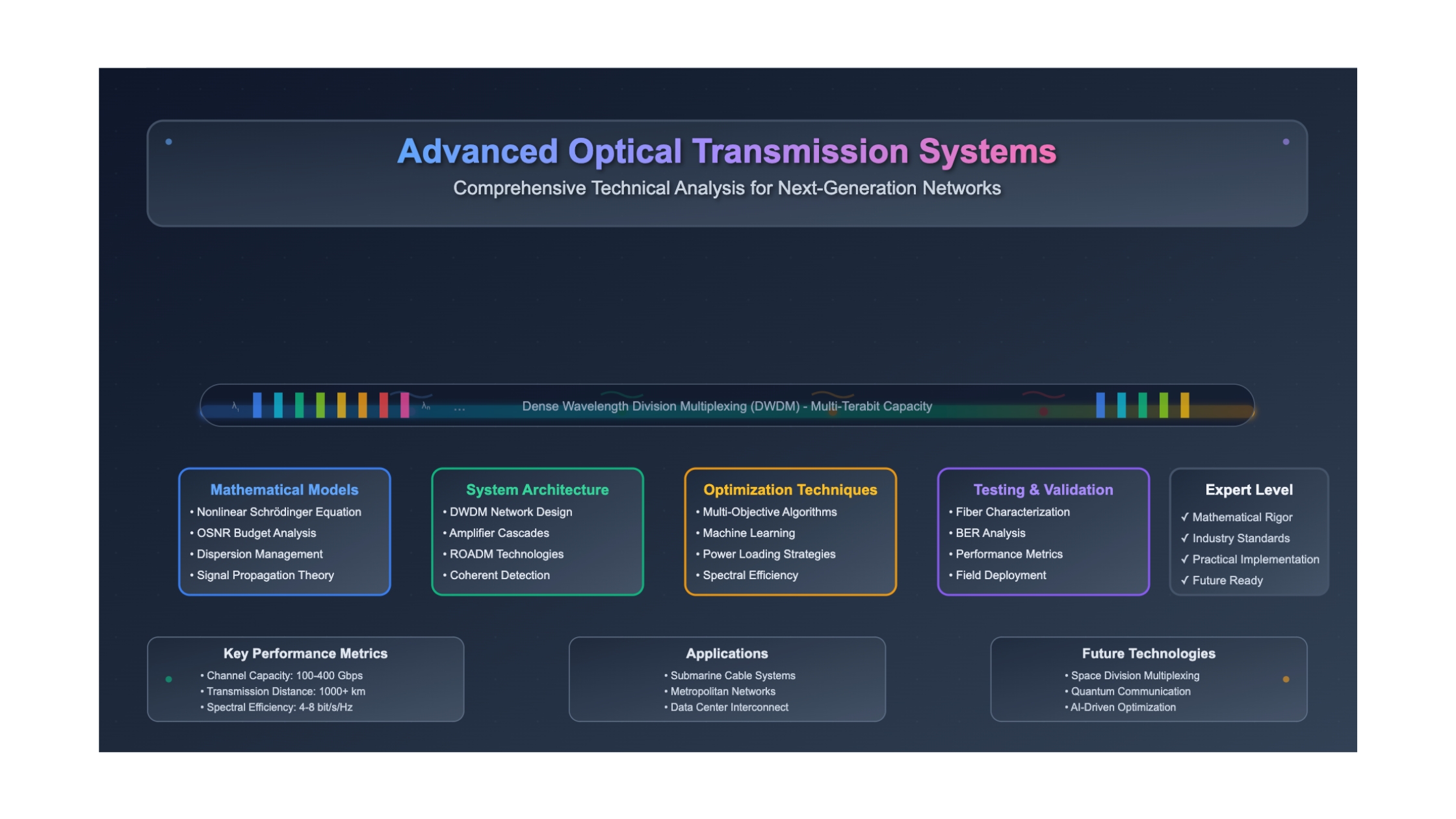
Advanced Optical Transmission Systems: Comprehensive Technical Analysis

Advanced Optical Transmission Systems

Comprehensive Technical Analysis for Next-Generation Networks

1. Executive Summary

The evolution of optical transmission systems represents one of the most significant technological advances in telecommunications infrastructure. Modern Dense Wavelength Division Multiplexing (DWDM) systems have revolutionized long-haul communications by enabling unprecedented bandwidth capacity while maintaining signal integrity across transoceanic distances.

Key Technical Achievements: Contemporary DWDM systems achieve multi-terabit capacities with channel rates exceeding 400 Gbps, utilizing advanced modulation formats such as DP-QPSK and 16-QAM while maintaining bit error rates better than 10⁻¹² across distances exceeding 1000 km without regeneration.

1.1 System Performance Metrics

Parameter Traditional Systems Modern DWDM Next-Generation Target
Channel Capacity 2.5 Gbps 100-400 Gbps 800 Gbps - 1.6 Tbps
Channel Count 4-8 80-160 200+
Transmission Distance 80 km 1000+ km Transoceanic (>10,000 km)
OSNR Requirement 20 dB 12-16 dB 8-12 dB (with FEC)
Spectral Efficiency 0.4 bit/s/Hz 2-4 bit/s/Hz 6-10 bit/s/Hz

1.2 Critical Design Challenges

Optical Signal-to-Noise Ratio (OSNR)

Amplified Spontaneous Emission (ASE) noise accumulation in cascaded EDFA chains fundamentally limits transmission distance. OSNR degradation follows:

OSNR₀ - 10×log₁₀(N) ≥ OSNR_required

Where N represents the number of amplified spans.

Nonlinear Fiber Impairments

Power-dependent effects including Self-Phase Modulation (SPM), Cross-Phase Modulation (XPM), and Four-Wave Mixing (FWM) become dominant at launch powers exceeding +2 dBm per channel.

Chromatic Dispersion Management

Pulse broadening effects require sophisticated compensation strategies, with accumulated dispersion limits of ±800 ps/nm for 10 Gbps systems and ±50 ps/nm for 40 Gbps systems.

Polarization Mode Dispersion

Statistical impairment with maximum tolerable values of 10 ps for 10 Gbps and 2.5 ps for 40 Gbps systems, requiring real-time adaptive compensation.

Premium Article — Free 32% Preview

Read the Full Analysis with Premium

The remaining 68% of this article — the design numbers, trade-offs and field guidance — is part of MapYourTech Premium, along with the full premium library, courses and professional tools.

Instant access · Cancel anytime · 48-hour trial available
Sanjay Yadav

Optical Communications & Network Automation Expert | Author of 3 Books for Optical Engineers | Founder, MapYourTech

Optical networking engineer with nearly two decades of experience across DWDM, OTN, coherent optics, submarine systems, and cloud infrastructure. Founder of MapYourTech.

Follow on LinkedIn
Share:

You May Also Like

15 min read 6 0 Like Connector Types and Their Loss Budgets: SC, LC, MPO Skip to main content MapYourTech...
  • Free
  • July 11, 2026
16 min read 6 0 Like Cooled vs Uncooled Lasers: The Pluggable Power Trade-off Skip to main content MapYourTech |...
  • Free
  • July 11, 2026
16 min read 8 0 Like Automation Blast Radius: Scoping What a Bad Intent Can Touch Skip to main content...
  • Free
  • July 11, 2026

Course Title

Course description and key highlights

Course Content

Course Details