Generic selectors
Exact matches only
Search in title
Search in content
Post Type Selectors
Articles
lp_course
lp_lesson
Back
HomeAutomationAI in Optical Networking: Hype or Reality?
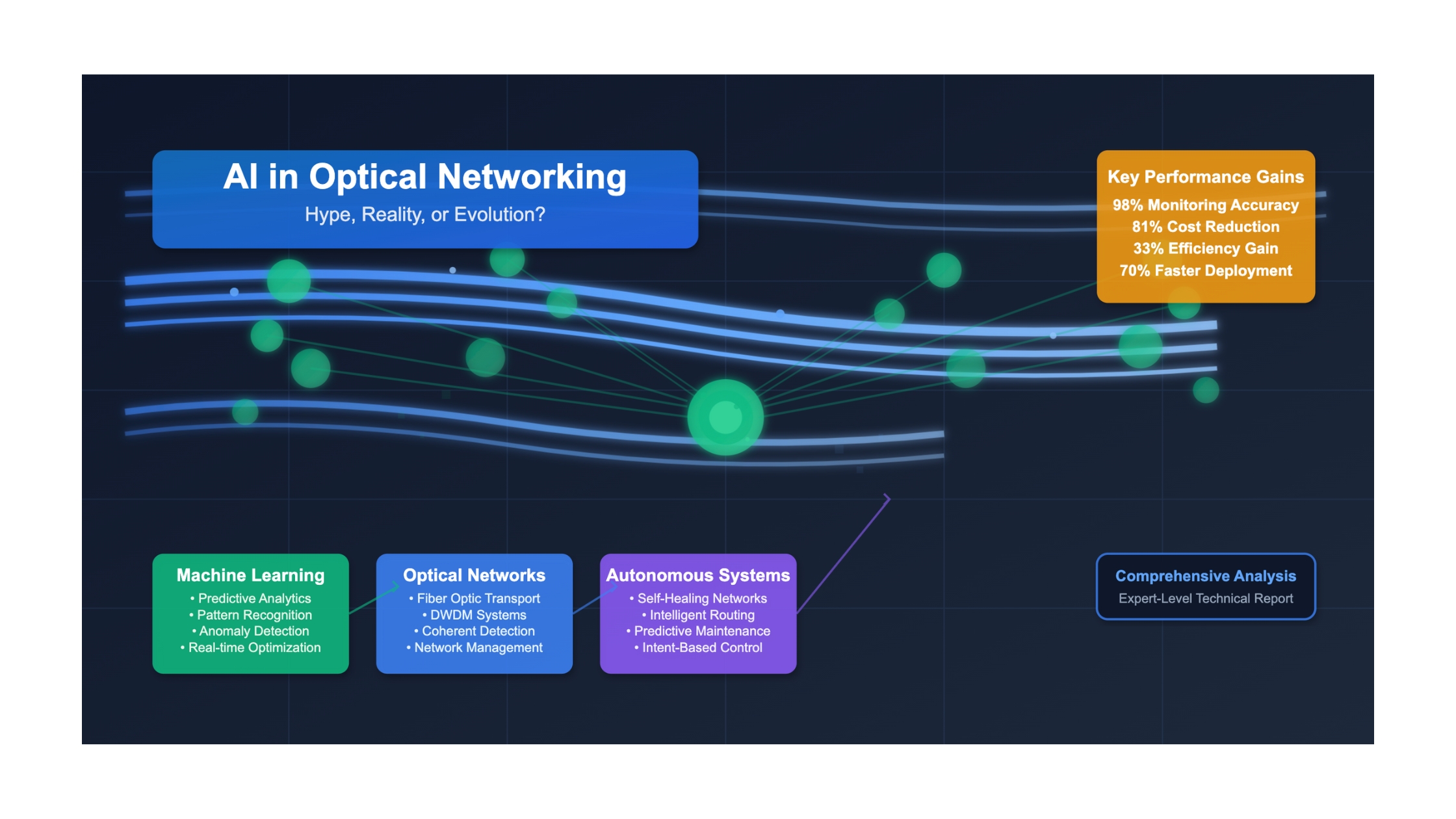
AI in Optical Networking: Hype or Reality?

AI in Optical Networking: Hype or Reality?

Last Updated: September 23, 2025
9 min read
89
AI in Optical Networking: Hype or Reality? - A Technical Analysis

AI in Optical Networking: Hype or Reality?

A Comprehensive Technical Analysis of Machine Learning Applications in Fiber-Optic Communications

Table of Contents - Complete Article

1. Executive Summary

Key Finding: AI in optical networking represents neither pure hype nor revolutionary breakthrough, but rather a 40-year evolution that has produced genuine value in specific applications while falling short of autonomous network visions.

The convergence of artificial intelligence and optical networking has reached a critical inflection point in 2025. After decades of research and development, machine learning techniques are delivering measurable improvements in fiber-optic communication systems, from predictive maintenance to real-time optimization. However, the gap between vendor marketing promises and production reality remains substantial.

$22.6B
Projected AIOps Market by 2028
98%
Accuracy in Optical Signal Monitoring
81%
Potential Cost Savings with AI Platforms
10x
More Fiber Required for AI Networks

Current State Assessment

Our analysis reveals that AI applications in optical networking exist along a maturity spectrum:

Application Domain Maturity Level Commercial Deployment ROI Evidence
Optical Performance Monitoring Production Ready Widespread Proven
Predictive Maintenance Early Deployment Selective Demonstrated
Quality of Transmission (QoT) Estimation Research/Pilot Limited Experimental
Autonomous Network Orchestration Conceptual None Theoretical

Key Insights

  • Historical Continuity: AI techniques have been present in networking since the 1980s, evolving from expert systems to modern machine learning
  • Selective Success: Current deployments show significant value in narrow, well-defined use cases rather than comprehensive automation
  • Data Quality Crisis: Up to 100% error rates in ML training data for certain network applications limit broader deployment
  • Trust Deficit: 48% of AI projects fail to reach production due to operator skepticism and validation challenges
  • Future Trajectory: Co-packaged optics and 1.6 Tbps technologies are driving the next wave of AI-enabled optical systems

2. Historical Context & Foundational Principles

Historical Fact: The first AI application in networking dates to 1980 with Digital Equipment Corporation's XCON system, which achieved 95-98% accuracy in network configuration tasks and saved $25-40 million annually.

The Four Decades of Evolution

1980-1990

Expert Systems Era

Digital Equipment Corporation's XCON system revolutionized network configuration with 2,500 production rules. AT&T Bell Labs deployed TOPAS-ES for telephone network maintenance. These deterministic systems proved effective in narrow domains but suffered from brittleness when facing unexpected inputs.

1990-2000

Statistical Transition

The 1987 AI winter forced a fundamental rethinking. Neural networks emerged through Bell Labs' backpropagation work. SNMP standardization in 1988 created the data foundation for future machine learning applications. The shift from deterministic to statistical approaches began.

2000-2010

Machine Learning Foundation

Support vector machines and decision trees handled network traffic classification by 2005. The focus shifted to handling uncertainty and dynamic network conditions. Early optical performance monitoring systems began incorporating basic pattern recognition.

2010-2020

Deep Learning Revolution

The 2015 deep learning breakthrough enabled sophisticated optical network applications. LSTMs for time-series analysis and graph neural networks for topology optimization emerged. Software-defined networking provided the programmable infrastructure needed for AI integration.

2020-2025

Production Deployment

Commercial AI platforms achieve production status. Convolutional neural networks process constellation diagrams with 100% modulation format identification accuracy. Real-time chromatic dispersion detection operates with 0.28 ps/nm RMSE accuracy. AI-driven data center architectures emerge to support training workloads.

Foundational Technologies Driving Current Capabilities

Optical Signal Processing Advances

Modern optical networks generate unprecedented amounts of data through coherent digital signal processors, enabling machine learning applications that were impossible in earlier generations:

2010 2012 2015 2018 2021 2024 2025 1 GB/s 10 GB/s 100 GB/s 1 TB/s 10 TB/s Optical Network Data Generation Rate Evolution

AI Algorithmic Maturation

The evolution from rule-based systems to modern deep learning represents a qualitative shift in capability:

Era Primary Technique Optical Applications Key Limitations
1980s-1990s Expert Systems Configuration management, basic fault diagnosis Brittleness, maintenance overhead
1990s-2000s Statistical Learning Traffic classification, anomaly detection Limited feature extraction, manual tuning
2000s-2010s Machine Learning Performance monitoring, QoT estimation Feature engineering burden, data requirements
2010s-Present Deep Learning End-to-end optimization, predictive maintenance Computational complexity, interpretability

Current State: Production Deployments vs. Marketing Claims

The contemporary landscape reveals a stark dichotomy between genuine technical achievements and inflated vendor promises. Analysis of actual deployments shows:

33%
Reduction in Network Scaling Effort (Ciena Adaptive IP)
95%
Accuracy in XCON System (1980)
7→1
Days Reduction in Service Config (Huawei NCE-T)
48%
AI Projects Failing to Reach Production

The Reality Gap

Despite technical advances, significant barriers persist:

  • Data Quality Issues: Studies document up to 100% error rates in ML training data for certain network applications
  • Trust Deficit: Network operators "generally don't fully trust AI networking's recommended actions" according to Gartner research
  • Deployment Complexity: Only 40% median network automation level across enterprises, with CLI and SNMP remaining dominant
  • Skills Shortage: 73% of networking professionals report uncertainty about their automation capabilities
Critical Insight: The most successful AI deployments focus on narrow, well-defined use cases with high-quality domain-specific data and maintain human-in-the-loop validation, rather than pursuing comprehensive automation.
AI in Optical Networking: Hype or Reality - Part 2

3. Technical Architecture & System Design

Architecture Overview: Modern AI-enabled optical networks operate through a hierarchical stack, from physical layer signal processing to network-wide orchestration, with machine learning integration at each abstraction level.

Hierarchical AI Integration Architecture

Network Orchestration Layer

Intent-based networking, policy management, multi-domain optimization

AI Technologies: Deep Reinforcement Learning, Multi-agent Systems, Large Language Models

Network Control Layer

SDN controllers, resource allocation, path computation, topology management

AI Technologies: Graph Neural Networks, Optimization Algorithms, Predictive Analytics

Network Management Layer

Performance monitoring, fault detection, configuration management, analytics

AI Technologies: Time Series Analysis, Anomaly Detection, Classification Models

Physical Layer

Optical signal processing, DSP algorithms, component control, real-time adaptation

AI Technologies: Convolutional Neural Networks, Signal Processing, Real-time Inference

Data Flow Architecture

Optical Transceivers Real-time Telemetry Network Elements SNMP, NetConf Traffic Analyzers Flow Data, Patterns Data Collection & Preprocessing • Time Series Aggregation • Data Normalization • Feature Engineering • Quality Validation • Real-time Streaming • Historical Storage ML Model Processing • CNNs for Signal Analysis • LSTMs for Time Series • GNNs for Topology • Ensemble Methods Decision Engine • Rule-based Logic • Confidence Scoring • Multi-objective Optimization • Human-in-the-loop Network Control SDN, Orchestration Alert Generation NOC, Dashboard Optimization Parameter Tuning Feedback Loop AI-Enabled Optical Network Data Flow Architecture

Component Breakdown: Critical System Elements

Component Function AI Integration Performance Metrics Standards/Protocols
Coherent DSP Digital signal processing, modulation/demodulation CNN-based impairment compensation 0.28 ps/nm RMSE accuracy ITU-T G.698.2, IEEE 802.3
Optical Monitoring Performance measurement, quality assessment LSTM time series prediction 98% OSNR monitoring accuracy ITU-T G.697, G.7710
Network Controller Path computation, resource allocation Graph neural networks Sub-second path calculation OpenFlow, NETCONF, RESTCONF
Analytics Platform Data aggregation, pattern recognition Ensemble learning methods 95%+ anomaly detection YANG models, gRPC
Orchestration Engine Service provisioning, lifecycle management Reinforcement learning agents 7→1 day service deployment TOSCA, ONF TR-512

Signal Processing Pipeline Integration

Optical Signal
Coherent Detection
Complex Samples
AI-Enhanced DSP
CNN Processing
Impairment Compensation
Feature Extraction
Constellation Analysis
Quality Metrics
ML Inference
Real-time Classification
Predictive Analytics
Network Action
Adaptive Control
Optimization

4. Core Concepts & Terminology

Premium Article — Free 20% Preview

Read the Full Analysis with Premium

The remaining 80% of this article — the design numbers, trade-offs and field guidance — is part of MapYourTech Premium, along with the full premium library, courses and professional tools.

Instant access · Cancel anytime · 48-hour trial available
Sanjay Yadav

Optical Communications & Network Automation Expert | Author of 3 Books for Optical Engineers | Founder, MapYourTech

Optical networking engineer with nearly two decades of experience across DWDM, OTN, coherent optics, submarine systems, and cloud infrastructure. Founder of MapYourTech.

Follow on LinkedIn
Share:

You May Also Like

16 min read 6 0 Like Cooled vs Uncooled Lasers: The Pluggable Power Trade-off Skip to main content MapYourTech |...
  • Free
  • July 11, 2026
16 min read 7 0 Like Automation Blast Radius: Scoping What a Bad Intent Can Touch Skip to main content...
  • Free
  • July 11, 2026
17 min read 4 0 Like ASE Channel Loading: Running a Line System Full From Day One Skip to main...
  • Free
  • July 11, 2026

Course Title

Course description and key highlights

Course Content

Course Details