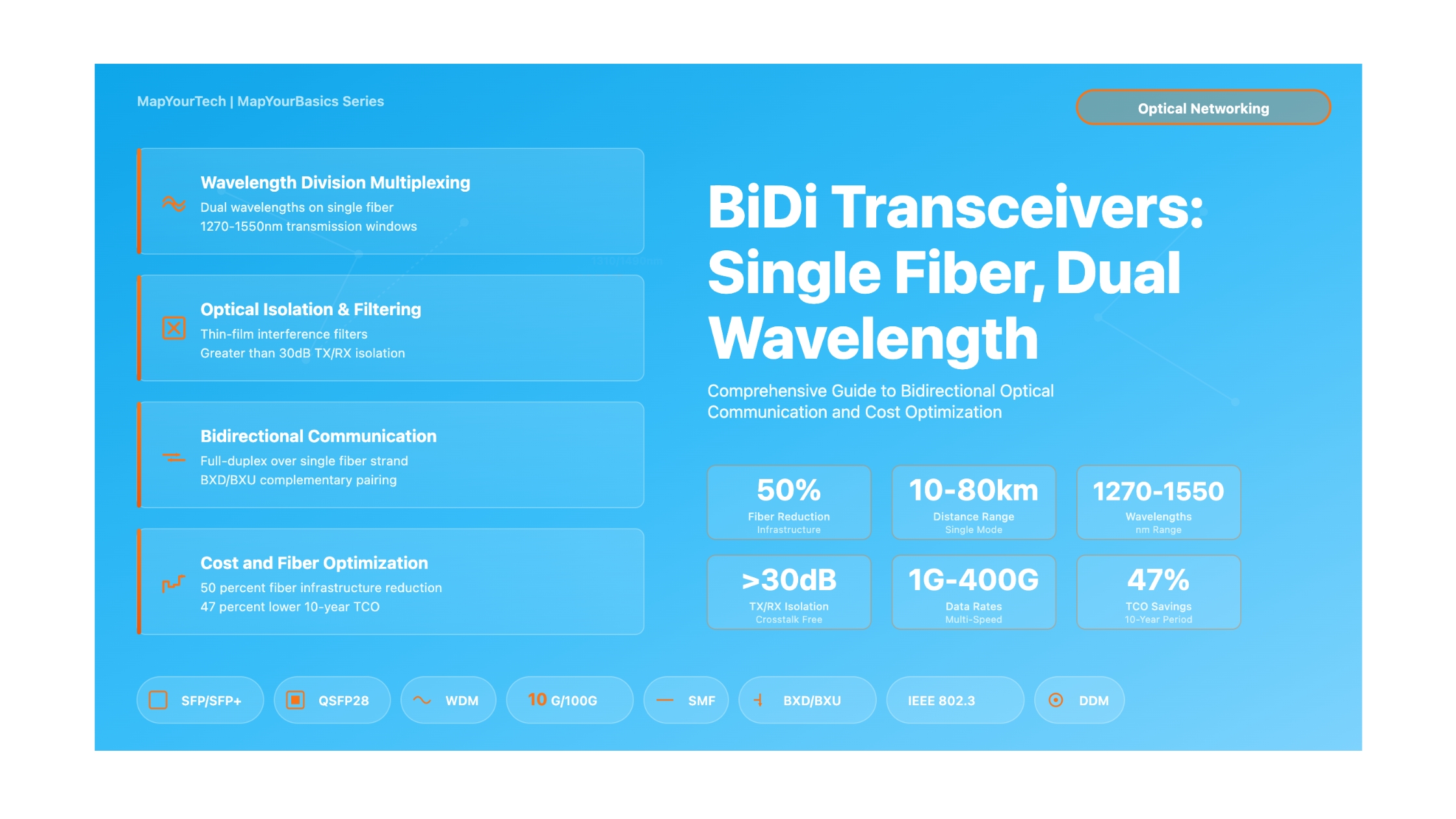

BiDi Transceivers: Single Fiber, Dual Wavelength Communication
Comprehensive Guide to Bidirectional Optical Transmission Technology, Cost Optimization, and Deployment Best Practices
Introduction
In the modern landscape of optical networking, efficient use of fiber infrastructure has become increasingly critical as bandwidth demands continue to grow exponentially. Bidirectional (BiDi) transceivers represent a transformative technology that enables full-duplex communication over a single optical fiber strand by using different wavelengths for transmit and receive directions. This approach effectively doubles the capacity of existing fiber installations while reducing both capital and operational expenses.
Traditional optical communication systems require separate fiber strands for transmit and receive functions, consuming two fibers per link. BiDi technology challenges this conventional architecture by using Wavelength Division Multiplexing (WDM) principles to achieve bidirectional communication on a single fiber. By carefully selecting non-overlapping wavelength pairs—such as 1270nm/1330nm or 1490nm/1550nm—BiDi transceivers eliminate optical interference between transmitted and received signals while maintaining signal integrity across various distances.
The importance of BiDi technology extends beyond simple fiber conservation. Network operators face several critical challenges: limited fiber availability in metropolitan areas, high costs of fiber installation, space constraints in cable ducts and conduits, and pressure to reduce total cost of ownership. BiDi transceivers address all these concerns simultaneously while maintaining compatibility with industry standards and ensuring reliable performance across distances ranging from 10 kilometers to 80 kilometers or more.
Why BiDi Technology is Important
BiDi transceivers provide network operators with a powerful tool for optimizing fiber infrastructure utilization. By enabling single-fiber operation, they reduce fiber consumption by 50%, lower installation costs, minimize space requirements in dense cable environments, and simplify network architectures. This technology is particularly valuable in scenarios where fiber resources are limited, expensive to deploy, or physically constrained.
This comprehensive guide examines BiDi transceiver technology from multiple perspectives: fundamental operating principles, technical architecture, wavelength management strategies, performance characteristics, deployment best practices, cost-benefit analysis, and future evolution. Whether you are a network engineer evaluating BiDi solutions, a network architect designing new installations, or a technical professional seeking to understand this technology, this article provides the detailed information needed to make informed decisions about BiDi transceiver deployment.
1. Historical Evolution and Industry Context
1.1 Origins of Bidirectional Optical Communication
The concept of bidirectional transmission over single optical fibers emerged in the late 1980s as optical networking technology matured. Early implementations focused primarily on short-reach applications and utilized simple wavelength separation schemes. The initial drivers for BiDi technology development were pragmatic: fiber scarcity in densely populated urban areas, high costs of trenching and cable installation, and the need to maximize return on infrastructure investments.
The first generation of BiDi systems operated at relatively low data rates (155 Mbps to 622 Mbps) and used widely separated wavelength pairs to minimize crosstalk and ensure adequate optical isolation. These early systems demonstrated the viability of the bidirectional approach but were limited by component technology, particularly the availability of cost-effective optical filters and wavelength-specific lasers and photodetectors.
1.2 Standardization and Commercial Adoption
The introduction of Gigabit Ethernet in the late 1990s marked a significant milestone for BiDi technology. The IEEE 802.3ah standard (Ethernet in the First Mile) included specifications for bidirectional transmission, establishing technical parameters and interoperability requirements. This standardization accelerated commercial adoption by ensuring multi-vendor compatibility and providing network operators with procurement confidence.
Subsequent standards development focused on higher-speed variants. The 10 Gigabit Ethernet specifications included BiDi options, and more recently, 25G, 40G, and 100G BiDi solutions have entered the market. Each generation has benefited from advances in optical component technology, including improved laser stability, more selective optical filters, and better receiver sensitivity. These improvements have extended reach capabilities while maintaining or reducing costs.
1.3 Market Evolution and Current Trends
BiDi transceivers have evolved from niche products serving specific applications to mainstream solutions deployed across diverse network segments. Current market dynamics reflect several trends: increasing adoption in data center interconnect applications, widespread deployment in access and metropolitan networks, growing use in 5G mobile backhaul networks, and expanding applications in enterprise campus networks.
The technology has also matured in terms of form factors. BiDi transceivers are now available in SFP, SFP+, QSFP28, and QSFP-DD formats, supporting data rates from 1 Gbps to 400 Gbps. This broad portfolio enables BiDi deployment across virtually all network tiers, from access edges to core transport networks. Looking ahead, emerging applications such as coherent BiDi systems for long-haul transmission and integrated photonics implementations promise to further expand the technology's capabilities and applications.
Figure 1: BiDi Technology Evolution Timeline
2. Fundamental Operating Principles
2.1 Wavelength Division Multiplexing Foundation
BiDi transceivers rely on Wavelength Division Multiplexing (WDM) technology to achieve bidirectional communication over a single fiber. WDM exploits the fundamental property that different wavelengths of light can propagate through the same optical fiber simultaneously without interfering with each other, provided adequate wavelength separation is maintained. In BiDi applications, two specific wavelengths are selected—one for transmission in each direction—creating two independent optical channels on a single physical medium.
The key to successful BiDi operation lies in wavelength isolation. Each transceiver must efficiently separate its receive wavelength from its transmit wavelength while maintaining high optical quality for both signals. This separation is accomplished using optical filters, typically implemented as thin-film filters or wavelength-selective coatings integrated within the transceiver optical subassembly. These filters must exhibit steep roll-off characteristics to maximize isolation while minimizing insertion loss for the desired wavelengths.
2.2 Wavelength Pair Selection
BiDi systems use complementary wavelength pairs, where each end of the link transmits on one wavelength and receives on the other. Common wavelength pairs include 1270nm/1330nm for shorter-reach applications (up to 40km) and 1490nm/1550nm for longer-reach deployments (up to 80km or more). The choice of wavelength pair depends on several factors: required transmission distance, fiber type and quality, chromatic dispersion characteristics, and available component technology.
The 1270nm/1330nm pair offers several advantages for metropolitan and access applications. The 60nm wavelength separation provides adequate isolation with standard optical filters while maintaining compatibility with standard single-mode fiber. However, chromatic dispersion at 1270nm is higher than at longer wavelengths, which can limit uncompensated transmission distances at higher data rates. The 1490nm/1550nm pair addresses this limitation by operating in the low-dispersion window of standard fiber, enabling longer reach without electronic or optical dispersion compensation.
Figure 2: BiDi Transceiver Wavelength Separation Architecture
2.3 Optical Isolation and Crosstalk Prevention
Maintaining adequate isolation between transmitted and received signals is critical for BiDi system performance. Insufficient isolation allows transmitted optical power to leak into the receiver path, creating crosstalk that degrades receiver sensitivity and increases bit error rates. BiDi transceivers typically achieve isolation levels of 30 dB to 40 dB or higher through a combination of wavelength-selective filtering and careful optical path design.
The primary isolation mechanism is the wavelength-selective filter, often implemented as a thin-film interference filter deposited on optical glass substrates. These filters exhibit wavelength-dependent transmission characteristics, passing the desired wavelength with minimal loss (typically less than 0.5 dB insertion loss) while strongly attenuating adjacent wavelengths. The filter's roll-off characteristic—how rapidly transmission changes with wavelength—determines the minimum usable wavelength spacing for a given isolation requirement.
Key Isolation Requirements
- Minimum wavelength separation of 60nm for standard filter technology ensures adequate isolation without requiring extremely selective filters
- Filter insertion loss should be minimized (typically under 0.5 dB) to preserve optical power budget and maximize transmission distance
- Isolation specifications must account for worst-case conditions including temperature variations, aging effects, and manufacturing tolerances
- Receiver dynamic range must accommodate both the desired signal and any residual crosstalk from the local transmitter
- Proper connector cleanliness and fiber handling practices are essential to prevent reflection-induced crosstalk
2.4 BiDi Transceiver Types and Designations
BiDi transceivers are designated using a standardized naming convention that indicates their wavelength configuration. The two primary designations are BXD (BiDi Downstream) and BXU (BiDi Upstream), which specify the wavelength assignment for each direction. Understanding these designations is essential for proper transceiver pairing and link configuration.
BXD transceivers transmit at the longer wavelength and receive at the shorter wavelength within a pair. For example, a 1310nm/1490nm BXD transceiver transmits at 1490nm and receives at 1310nm. Conversely, BXU transceivers transmit at the shorter wavelength and receive at the longer wavelength—a 1310nm/1490nm BXU transmits at 1310nm and receives at 1490nm. This complementary pairing ensures that each link end transmits on the wavelength that the opposite end expects to receive.
| Wavelength Pair | BXD Configuration | BXU Configuration | Typical Applications | Max Distance |
|---|---|---|---|---|
| 1270nm / 1330nm | TX: 1330nm / RX: 1270nm | TX: 1270nm / RX: 1330nm | 10G Ethernet, Metro Access | 10-40km |
| 1310nm / 1490nm | TX: 1490nm / RX: 1310nm | TX: 1310nm / RX: 1490nm | Gigabit Ethernet, PON | 20-60km |
| 1310nm / 1550nm | TX: 1550nm / RX: 1310nm | TX: 1310nm / RX: 1550nm | Long-Reach Metro, DWDM | 40-80km |
| 1490nm / 1550nm | TX: 1550nm / RX: 1490nm | TX: 1490nm / RX: 1550nm | Extended Reach, PON | 60-80km |
BiDi transceivers must be correctly paired to function. Installing two BXD or two BXU transceivers on opposite ends of a link will result in complete communication failure, as both ends will be transmitting and receiving on the same wavelengths. Always verify transceiver types before installation and maintain clear documentation of wavelength assignments in network diagrams and configuration databases.
3. Technical Architecture and Component Design
3.1 Optical Subassembly Architecture
The optical subassembly (OSA) represents the heart of a BiDi transceiver, integrating the transmitter laser, receiver photodetector, and wavelength-selective optical components into a compact, hermetically sealed package. The OSA must accomplish several complex functions simultaneously: launch transmitted optical power efficiently into the fiber, couple received optical power to the photodetector, provide wavelength separation between transmit and receive paths, maintain optical alignment under temperature variations and mechanical stress, and minimize reflections and parasitic optical coupling.
Modern BiDi OSA designs typically use one of two architectural approaches: the coaxial design or the separate-port design. Coaxial designs integrate all optical functions around a single fiber interface, using a wavelength-selective filter positioned between the fiber and the optoelectronic components. This approach minimizes size and simplifies fiber connection but requires precise alignment and high-performance filters. Separate-port designs use distinct optical paths for transmit and receive functions, combining them at the fiber interface through a WDM coupler. This approach can provide better isolation but may be larger and more complex.
3.2 Laser Transmitter Design
BiDi transceivers typically employ Distributed Feedback (DFB) lasers for optical transmission. DFB lasers offer several advantages critical for BiDi applications: narrow spectral linewidth (typically less than 1nm), stable wavelength operation over temperature variations, high side-mode suppression ratio (ensuring minimal power at undesired wavelengths), and compatibility with direct modulation at data rates up to 25 Gbps or higher.
The laser must be precisely wavelength-controlled to match the designated BiDi wavelength specification. Wavelength accuracy is typically within ±3nm to ±7nm of the nominal wavelength, depending on the specific standard and application requirements. Temperature variations affect laser wavelength—typically causing approximately 0.1nm wavelength shift per degree Celsius—so temperature control or compensation mechanisms may be required for temperature-sensitive applications or wider operating temperature ranges.
3.3 Receiver Photodetector Design
The receiver section uses a PIN photodiode optimized for the receive wavelength. Receiver sensitivity—the minimum optical power required to achieve a specified bit error rate—is a critical performance parameter that directly impacts maximum transmission distance. Modern BiDi receivers typically achieve sensitivities of -18 dBm to -28 dBm, depending on data rate and reach requirements.
The receiver must also provide adequate overload margin to handle the received signal power range without saturation. This requirement is particularly challenging in BiDi applications because the receiver must reject strong local transmit optical power while maintaining sensitivity for weak received signals from the distant end. Receiver dynamic range—the ratio between maximum and minimum receivable power—typically exceeds 20 dB for robust operation across varying fiber lengths and conditions.
Figure 3: BiDi Optical Subassembly Internal Architecture
3.4 Power Budget Calculations
Understanding power budget is essential for BiDi link design. The power budget represents the difference between minimum transmitted optical power and maximum receiver sensitivity, accounting for all losses in the optical path including fiber attenuation, connector losses, splice losses, and system margins for aging and temperature variations.
BiDi Link Power Budget Calculation
Power Budget = PTX - PRX_sens - Lfiber - Lconnectors - Margin

Where:
PTX           = Minimum transmit power (dBm)
PRX_sens      = Receiver sensitivity (dBm) // at specified BER
Lfiber        = Fiber attenuation (dB) // typically 0.2-0.25 dB/km at 1310nm, 0.18-0.22 dB/km at 1550nm
Lconnectors   = Connector pair loss (dB) // typically 0.5 dB per pair
Margin          = System margin (dB) // typically 3 dB minimum

Example: 10GBase-BXD 40km Link Budget
PTX           = 0 dBm           // minimum transmit power
PRX_sens      = -24 dBm        // at 10.3 Gbps, BER < 10^-12
Lfiber        = 40 km × 0.22 dB/km = 8.8 dB
Lconnectors   = 2 pairs × 0.5 dB = 1.0 dB
Margin          = 3 dB

Available Budget = 0 - (-24) = 24 dB
Used Budget     = 8.8 + 1.0 + 3 = 12.8 dB
Remaining Margin = 24 - 12.8 = 11.2 dB // adequate for 40km link

Design Guideline: Maintain at least 3 dB total system margin
This accounts for: component aging, temperature effects, fiber degradation
3.5 Digital Diagnostic Monitoring (DDM)
Modern BiDi transceivers incorporate Digital Diagnostic Monitoring (DDM) functionality, also known as Digital Optical Monitoring (DOM), specified in the SFF-8472 Multi-Source Agreement. DDM provides real-time visibility into transceiver operating parameters through the management interface, enabling proactive network monitoring and troubleshooting.
DDM capabilities typically include monitoring of transmit optical power, receive optical power, laser bias current, supply voltage, and internal temperature. These parameters are accessible via the I2C interface using standardized register addresses and data formats. Threshold values can be configured to generate alarms or warnings when parameters exceed normal operating ranges, providing early indication of potential failures or degraded performance.
DDM Parameters for BiDi Monitoring
TX Power Monitoring: Indicates transmitted optical power in dBm. Useful for detecting laser degradation or driver circuit problems. Normal range varies by transceiver specification but typically falls within ±2 dB of nominal.
RX Power Monitoring: Shows received optical power in dBm. Essential for link budget verification and fiber fault detection. Sudden drops indicate fiber breaks or connector problems; gradual decreases may indicate dirt accumulation or connector degradation.
Temperature Monitoring: Reports transceiver internal temperature. Important for identifying cooling problems or excessive environmental temperatures that may affect performance or reduce component lifetime.
Bias Current Monitoring: Measures laser diode bias current. Increases over time indicate laser aging; sudden changes may indicate impending laser failure. Typical values range from 20-80 mA depending on laser type and power level.
4. Implementation Strategies and Deployment Scenarios
4.1 Network Architecture Considerations
BiDi transceivers excel in network scenarios where fiber resources are constrained or expensive to deploy. Common deployment scenarios include metropolitan area networks where fiber duct space is limited, campus networks requiring point-to-point links across buildings, data center interconnect applications with limited fiber availability, mobile backhaul networks with fiber scarcity, and access networks serving business customers or residential subscribers.
When planning BiDi deployments, network architects must consider several factors. First, evaluate existing fiber infrastructure to identify opportunities for single-fiber operation. Second, assess distance requirements to select appropriate BiDi variants with adequate reach. Third, consider future capacity needs and whether BiDi constraints align with growth plans. Fourth, verify equipment compatibility and availability of spares for maintenance. Finally, document wavelength assignments and transceiver types thoroughly to prevent configuration errors during installation or maintenance.
4.2 Migration from Dual-Fiber to BiDi
Organizations with existing dual-fiber infrastructure can migrate to BiDi technology to free fiber capacity for new services or network expansion. Migration strategies vary based on network criticality, available maintenance windows, and specific deployment requirements. The most common approaches include parallel migration (installing BiDi links on spare fibers before cutting over production traffic), staged migration (converting links incrementally during scheduled maintenance windows), and opportunistic migration (converting links as equipment is refreshed for other reasons).
Successful migration requires careful planning. Begin by inventorying existing fiber infrastructure and identifying links suitable for BiDi conversion. Create detailed migration plans including specific transceiver models, wavelength assignments, testing procedures, and rollback procedures. Conduct thorough testing on non-production links before converting critical circuits. Maintain clear documentation of new BiDi wavelength assignments and transceiver types at each site. Ensure operational staff understand BiDi technology and transceiver pairing requirements to avoid future misconfigurations.
4.3 Hybrid Network Architectures
Many networks benefit from hybrid architectures that combine BiDi and traditional dual-fiber links based on specific link requirements. This approach allows optimization at the individual link level, using BiDi where fiber is constrained and dual-fiber where performance or redundancy requirements dictate. Hybrid deployments are particularly common in metro networks, where some links face severe fiber constraints while others have adequate fiber availability.
Designing hybrid networks requires systematic evaluation of each link segment. Consider using BiDi for point-to-point links with limited fiber availability, access aggregation rings where fiber conservation is valuable, and inter-building connections in campus environments. Retain dual-fiber operation for critical backbone links requiring maximum performance and redundancy, high-capacity trunk links where fiber resources are adequate, and links where future capacity requirements may exceed BiDi capabilities. Document hybrid architecture decisions clearly to guide future planning and troubleshooting efforts.
| Deployment Scenario | Fiber Savings | Typical Distance | Common Data Rates | Key Considerations |
|---|---|---|---|---|
| Metro Access | 50% fiber reduction | 10-40km | 1G, 10G | Dense urban fiber constraints |
| Campus Interconnect | 50% fiber reduction | 2-15km | 1G, 10G, 25G | Building-to-building links |
| Data Center Interconnect | 50% fiber reduction | 5-80km | 10G, 25G, 100G | Limited fiber between facilities |
| Mobile Backhaul | 50% fiber reduction | 5-40km | 1G, 10G | Cell site fiber scarcity |
| Enterprise WAN | 50% fiber reduction | 10-60km | 1G, 10G | Leased fiber cost optimization |
| PON Feeder Links | 50% fiber reduction | 10-20km | 1G, 10G | Access network aggregation |
4.4 Installation and Testing Procedures
Proper installation procedures are essential for BiDi system reliability. Unlike dual-fiber systems where transceiver mismatch typically results in one-way communication, BiDi mismatches cause complete link failure. This characteristic demands rigorous installation practices and verification procedures. Key installation steps include verifying transceiver wavelength assignments before installation, confirming BXD/BXU pairing across link ends, cleaning fiber connectors thoroughly before mating, measuring optical power levels post-installation, verifying bi-directional traffic flow, and documenting configurations in network management systems.
Fiber cleanliness is particularly critical for BiDi systems because contamination affects both transmit and receive paths on the single fiber. A dirty connector can simultaneously degrade transmitted power and increase receiver noise floor, compounding performance impacts. Best practices include inspecting all connectors with fiber microscopes before mating, using lint-free cleaners and appropriate cleaning procedures, protecting unused connector ports with dust caps, and re-cleaning connectors if initial power measurements are unsatisfactory. Never assume connectors are clean simply because they are new or freshly removed from packaging.
Installing mismatched transceiver pairs (two BXD or two BXU units) is the most common BiDi installation error, resulting in complete link failure. Other frequent mistakes include failing to clean fiber connectors adequately, ignoring power budget calculations before deployment, mixing different wavelength pairs across a link, not documenting wavelength assignments for future reference, assuming all "BiDi" transceivers are interchangeable, and neglecting to verify DDM readings post-installation.
5. Performance Characteristics and Cost Optimization
5.1 Performance Comparison: BiDi vs. Dual-Fiber
BiDi transceivers deliver performance comparable to dual-fiber solutions for most applications, with some trade-offs that network designers must understand. In terms of bit error rate, signal quality, and latency, BiDi and dual-fiber implementations perform identically when properly deployed within their specified reach limits. However, BiDi systems introduce additional optical components (wavelength filters) in the signal path, which contribute approximately 0.5 dB to 1.0 dB additional insertion loss compared to dual-fiber systems. This modest penalty is rarely significant given typical power budget margins.
Chromatic dispersion characteristics differ slightly between BiDi wavelength pairs, particularly when comparing 1270nm and 1550nm performance. The 1270nm wavelength experiences approximately 50% more chromatic dispersion than 1550nm for identical fiber lengths. This difference can limit uncompensated reach for 10 Gbps and higher data rates. For example, 10 Gigabit Ethernet specifies 10km reach for 1310nm wavelengths but can achieve 40km or more at 1550nm using similar transceiver technology. BiDi systems using mixed wavelength pairs must accommodate the worst-case dispersion characteristic.
Figure 4: Cost Comparison - BiDi vs. Dual-Fiber Deployment
5.2 Total Cost of Ownership Analysis
BiDi technology delivers significant cost advantages across multiple dimensions. The most obvious benefit is fiber infrastructure savings—reducing fiber consumption by 50% either frees existing fiber for additional services or reduces the quantity of fiber that must be installed in new deployments. In metropolitan areas where fiber installation costs can exceed $100,000 per route mile, this represents substantial capital savings.
Less obvious but equally important are space-related savings. Fiber cables with fewer strands occupy less conduit space, potentially allowing network builds in locations where duct space is fully allocated. Smaller cables also ease handling during installation, reducing labor costs. In data centers, reducing fiber count decreases cable tray congestion and improves airflow management. These secondary benefits often provide significant value beyond the direct fiber cost savings.
5.3 Economics of Different Reach Categories
BiDi transceivers are available in multiple reach categories, typically including 10km, 20km, 40km, 60km, and 80km variants. Understanding the economics of each category helps optimize purchasing decisions. Short-reach transceivers (10-20km) offer the lowest cost per unit, typically within 10-20% of equivalent dual-fiber transceiver prices. Mid-reach units (40km) command modest premiums, generally 20-40% above dual-fiber equivalents. Long-reach transceivers (60-80km) may carry premiums of 50% or more, though they still provide excellent value considering eliminated fiber costs.
When evaluating reach categories, consider both current link lengths and potential future requirements. Deploying 40km transceivers for current 15km links provides headroom for network evolution, service rerouting, or temporary path extensions during maintenance. The incremental cost premium is usually modest compared to the operational complexity and downtime associated with later transceiver upgrades. Conversely, specifying 80km transceivers for all links regardless of distance wastes capital unless fiber quality or future requirements justify the investment.
| Cost Category | Traditional Dual-Fiber | BiDi Single-Fiber | Savings Percentage |
|---|---|---|---|
| Transceiver Pair | $200-400 (baseline) | $240-480 (10-20% premium) | Initial premium offset by other savings |
| Fiber Installation (per km) | $50,000-100,000 | $25,000-50,000 | 50% reduction in fiber count |
| Cable Duct Space | Full allocation | 50% of original | Frees capacity for growth |
| Patch Panel Ports | 2 ports per link | 1 port per link | 50% reduction in port count |
| Cable Management | Standard complexity | Simplified (fewer cables) | 10-15% labor reduction |
| 10-Year TCO (10km link) | $60,000-120,000 | $30,000-65,000 | 40-50% total savings |
5.4 Scalability and Future-Proofing
When evaluating BiDi technology for long-term deployments, consider scalability implications. BiDi inherently consumes the fiber's entire wavelength spectrum for a single bidirectional circuit. This contrasts with dense wavelength division multiplexing (DWDM) approaches that can multiplex dozens or hundreds of wavelengths on a single fiber. For applications requiring maximum fiber utilization, DWDM may provide better long-term scalability despite higher initial complexity and cost.
However, BiDi and DWDM are not mutually exclusive. Emerging solutions combine BiDi transceivers with DWDM technology, using BiDi operation for individual wavelength channels within a larger DWDM system. This hybrid approach preserves BiDi's simplicity at the individual channel level while achieving DWDM's capacity multiplication benefits. Such solutions are particularly attractive for metro and long-haul applications where both fiber conservation and high capacity are required.
Cost Optimization Strategies
- Deploy BiDi for new fiber builds to minimize infrastructure costs from the start, potentially halving fiber installation expenses
- Implement BiDi in fiber-constrained locations to avoid expensive fiber augmentation projects or capacity constraints
- Use freed fiber capacity for redundant paths, new services, or future growth rather than treating it as unused surplus
- Standardize on specific BiDi variants to simplify spare parts inventory, reduce procurement complexity, and streamline operational procedures
- Consider total lifecycle costs including installation, operation, and maintenance rather than focusing solely on transceiver acquisition prices
- Evaluate bulk purchasing opportunities for larger deployments to negotiate volume discounts with equipment vendors
- Plan for staged deployment to spread capital costs while capturing fiber savings incrementally across the network
6. Challenges, Limitations, and Solutions
6.1 Technical Limitations
Despite their advantages, BiDi transceivers face certain limitations that network designers must acknowledge. The primary technical constraint is wavelength-dependent performance characteristics. Because BiDi systems use asymmetric wavelength pairs, the two transmission directions may exhibit different chromatic dispersion, attenuation, and nonlinear effects. This asymmetry can complicate link budget calculations and may limit maximum reach for the worse-performing wavelength.
Another limitation involves fiber fault localization. In dual-fiber systems, an optical time-domain reflectometer (OTDR) can independently characterize each fiber direction, identifying breaks, splices, and connector quality. BiDi systems present challenges for OTDR measurements because the measurement wavelength must differ from both transmission wavelengths to avoid interfering with live traffic. Some OTDR instruments include special BiDi measurement modes, but characterizing both directions requires swapping measurement equipment or using specialized multi-wavelength OTDRs.
6.2 Operational Challenges
BiDi technology introduces operational complexity related to transceiver management and configuration. The requirement to correctly pair BXD and BXU transceivers at opposite link ends creates opportunities for configuration errors, particularly during emergency replacements or rapid deployments. Unlike dual-fiber transceivers, which are typically interchangeable at either link end, BiDi transceivers are direction-specific and must be installed at the correct location.
Managing spare parts inventory also becomes more complex. Organizations must stock both BXD and BXU variants of each transceiver type, potentially doubling inventory requirements compared to dual-fiber deployments. This challenge is mitigated by clear documentation practices and strategic inventory management, but it represents a real operational consideration for network operators.
Best Practices for Operational Excellence
Clear Labeling: Label all BiDi transceivers and ports with wavelength assignments and BXD/BXU designation. Use color-coded labels or standardized naming schemes to minimize confusion during maintenance.
Documentation: Maintain comprehensive documentation of BiDi deployments including site-specific transceiver types, wavelength assignments, and link distances. Update documentation immediately when configurations change.
Training: Ensure technical staff understand BiDi technology fundamentals, transceiver pairing requirements, and troubleshooting procedures. Include BiDi-specific topics in onboarding and continuing education programs.
Standardization: Where possible, standardize on specific BiDi models and wavelength pairs to reduce variety in inventory and simplify operational procedures.
6.3 Troubleshooting Common Issues
When BiDi links fail or perform poorly, systematic troubleshooting procedures help identify root causes efficiently. The most common BiDi-specific issues include transceiver mismatch, where mismatched pairs cause complete link failure with no light received at either end; dirty connectors, which affect both directions simultaneously; wavelength drift, where laser wavelength shifts outside specifications due to temperature or aging; and filter degradation, where optical filter performance declines over time.
Effective troubleshooting begins with verifying basic configurations: confirm transceiver types match link documentation, check that BXD and BXU are properly paired, inspect connectors for contamination or damage, and measure optical power levels in both directions. If basic checks pass, progress to advanced diagnostics: review DDM data for transmit power, receive power, and temperature anomalies; test with known-good spare transceivers; measure fiber characteristics with OTDR if available; and verify no recent environmental changes affecting transceiver or fiber.
6.4 Solutions and Mitigation Strategies
Many BiDi challenges can be addressed through proactive measures and best practices. For transceiver management, implement strict labeling standards and maintain detailed documentation in network management systems. Consider using color-coded or distinctive labels for BXD versus BXU units to enable visual identification. Some organizations assign specific wavelength pairs to network tiers or regions, simplifying identification and reducing errors.
Inventory management challenges are mitigated by strategic stocking policies. Maintain balanced quantities of BXD and BXU transceivers based on deployment statistics. Use vendor agreements for rapid replacement access to reduce on-site inventory requirements. Consider stocking complete BiDi pairs rather than individual transceivers to ensure correct pairing during emergency repairs.
BiDi transceivers exhibit different failure modes than dual-fiber systems. Most critically, component failures in BiDi units affect both transmission directions simultaneously, potentially causing complete bidirectional outage rather than the partial failures sometimes seen with dual-fiber systems. This characteristic emphasizes the importance of having spare BiDi pairs available and implementing rapid replacement procedures for critical circuits.
7. Future Trends and Technology Evolution
7.1 Higher Data Rates and Advanced Modulation
BiDi technology continues evolving to support higher data rates demanded by emerging applications. Current development focuses on 100 Gbps and 400 Gbps BiDi solutions using advanced modulation formats including PAM4 (4-level pulse amplitude modulation) and coherent detection techniques. These higher-rate systems maintain the fundamental BiDi principle of single-fiber operation while dramatically increasing capacity.
PAM4 modulation, which encodes two bits per symbol rather than one, enables doubling of data rates without proportionally increasing optical bandwidth requirements. This approach is particularly valuable for BiDi applications where wavelength spacing constraints limit available optical spectrum. Several vendors have introduced 100G BiDi transceivers using PAM4 modulation on established wavelength pairs such as 1270nm/1330nm, demonstrating the viability of this approach for metro and data center applications.
7.2 Coherent BiDi Systems
Coherent optical transmission technology, traditionally reserved for long-haul networks, is being adapted for BiDi applications. Coherent BiDi transceivers use sophisticated digital signal processing to extract amplitude, phase, and polarization information from received optical signals, enabling operation at lower optical signal-to-noise ratios and extending achievable reach significantly beyond conventional intensity-modulated direct-detection systems.
Early coherent BiDi implementations target metro regional networks with reach requirements of 80 kilometers to several hundred kilometers. These systems combine the fiber efficiency of BiDi architecture with the performance advantages of coherent detection, enabling high-capacity single-fiber links across distances previously requiring DWDM with multiple wavelengths. As coherent transceiver costs decline and integration improves, coherent BiDi may become cost-effective for increasingly shorter distances.
7.3 Integrated Photonics and Silicon Photonics
Silicon photonics technology promises to revolutionize BiDi transceiver design by integrating multiple optical functions on a single silicon chip. This integration enables dramatic size reductions, power consumption improvements, and cost reductions through high-volume semiconductor manufacturing processes. Silicon photonic BiDi transceivers under development integrate the laser source, modulator, wavelength filter, and photodetector on common substrates, eliminating many discrete components and alignment steps required in conventional designs.
The impact of silicon photonics extends beyond transceiver miniaturization. Integrated designs enable new form factors such as co-packaged optics, where optical transceivers are integrated directly into switch silicon packages, eliminating electrical interconnects between switching chips and optical transceivers. This integration reduces power consumption, latency, and footprint while improving reliability. BiDi operation fits naturally into co-packaged optics architectures by minimizing required fiber connections.
7.4 Standards Development and Industry Alignment
Ongoing standards development ensures BiDi technology continues evolving to meet emerging requirements. The IEEE 802.3 Ethernet Working Group actively develops specifications for higher-speed BiDi Ethernet variants. The ITU-T Study Group 15 addresses BiDi technologies for access networks including PON (Passive Optical Network) systems. The Optical Internetworking Forum (OIF) develops implementation agreements for BiDi transceivers at various data rates and reaches, ensuring multi-vendor interoperability.
Industry alignment around standardized wavelength pairs, form factors, and electrical interfaces provides confidence for long-term BiDi deployments. As standards mature and vendor ecosystems strengthen, BiDi technology becomes increasingly mainstream rather than a specialized niche solution. This evolution benefits network operators through expanded product availability, competitive pricing, and assurance of long-term support.
Emerging BiDi Applications
5G Transport: BiDi transceivers are becoming standard solutions for 5G mobile network transport, particularly for connecting remote radio units to baseband processing equipment. The combination of fiber efficiency and adequate capacity aligns well with 5G fronthaul requirements.
Edge Computing: As edge computing infrastructure proliferates, BiDi provides cost-effective connectivity between distributed edge nodes and aggregation points, optimizing fiber utilization in diverse geographic deployments.
Submarine Systems: Research explores applying BiDi principles to submarine cable systems, where fiber count directly impacts system cost and cable laying complexity. Advanced coherent BiDi could enable single-fiber submarine spans for specific applications.
Free-Space Optics: BiDi wavelength management techniques inform free-space optical communication system designs, enabling bidirectional optical links through open air for building-to-building connectivity.
8. Conclusion and Recommendations
BiDi transceivers represent a mature, proven technology that delivers substantial value through efficient fiber utilization. By enabling bidirectional communication over single fiber strands, BiDi reduces fiber infrastructure costs, conserves valuable fiber resources, simplifies network architectures, and maintains performance comparable to traditional dual-fiber implementations. These advantages make BiDi particularly attractive for metro networks, campus deployments, data center interconnects, and access applications where fiber availability or cost constraints are significant factors.
Successful BiDi deployment requires understanding both the technology's capabilities and its limitations. Network designers must carefully evaluate link distances, capacity requirements, and operational considerations when selecting BiDi solutions. Proper wavelength pair selection, accurate transceiver pairing, thorough installation procedures, and comprehensive documentation are essential for reliable long-term operation. Organizations that invest in staff training and establish clear operational procedures realize the full benefits of BiDi technology while minimizing potential complications.
Looking forward, BiDi technology continues evolving through higher data rates, advanced modulation formats, coherent detection techniques, and integrated photonics implementations. These developments expand BiDi's applicability to increasingly demanding applications while maintaining backward compatibility with established deployments. The combination of continued innovation and strong industry standardization ensures BiDi remains a relevant, valuable technology for years to come.
Strategic Recommendations
- Evaluate BiDi technology for all new fiber deployments where 50% fiber reduction provides meaningful value, particularly in metro and access networks
- Develop comprehensive BiDi deployment standards covering transceiver selection, labeling conventions, documentation requirements, and operational procedures
- Implement robust training programs ensuring technical staff understand BiDi fundamentals, pairing requirements, and troubleshooting methodologies
- Establish strategic vendor relationships ensuring access to consistent BiDi product lines, technical support, and rapid spare parts availability
- Consider hybrid architectures combining BiDi and dual-fiber based on specific link requirements rather than adopting uniform approaches
- Monitor emerging BiDi technologies including higher data rates and coherent implementations that may provide migration paths for capacity growth
- Maintain detailed records of BiDi deployments including wavelength assignments, transceiver locations, and link characteristics to support ongoing operations
BiDi transceivers exemplify how targeted technology innovation can address practical network challenges through elegant engineering solutions. By combining established WDM principles with transceiver integration and cost optimization, BiDi technology has earned its place as a fundamental tool in the network engineer's toolkit. Organizations that understand and effectively deploy BiDi technology gain concrete advantages in network flexibility, cost efficiency, and operational simplicity—benefits that compound over the infrastructure lifecycle.
References and Further Reading
- IEEE 802.3ah – Ethernet in the First Mile, including BiDi Specifications
- IEEE 802.3ba – 40 Gb/s and 100 Gb/s Ethernet, BiDi Variants
- ITU-T G.652 – Characteristics of Single-Mode Optical Fiber and Cable
- ITU-T G.695 – Optical Interfaces for Coarse Wavelength Division Multiplexing Applications
- SFF-8472 – Digital Diagnostic Monitoring Interface for Optical Transceivers
- OIF Implementation Agreements – Various BiDi Transceiver Specifications
- SFF-8024 – Transceiver Management Interface (including BiDi Extensions)
- FluxLight Technical Documentation – BiDi SFP and SFP+ Specifications
- Various Vendor Application Notes on BiDi Deployment and Best Practices
- Industry Journals and Conference Papers on WDM-PON and BiDi Technologies
- Sanjay Yadav, "Optical Network Communications: An Engineer's Perspective" – Bridge the Gap Between Theory and Practice in Optical Networking
Note: This guide is based on industry standards, best practices, and real-world implementation experiences. Specific implementations may vary based on equipment vendors, network topology, and regulatory requirements. Always consult with qualified network engineers and follow vendor documentation for actual deployments.
Feedback Welcome: If you have any suggestions, corrections, or improvements to propose, please feel free to write to us at [email protected]