
PAM4 Modulation Explained: From NRZ to Multi-Level Signaling
A comprehensive technical exploration of 4-level pulse amplitude modulation, comparing it with binary NRZ signaling, examining signal-to-noise ratio implications, and analyzing its critical role in enabling 400G/800G optical networks
1 Abstract & Executive Overview
The exponential growth in global data traffic driven by cloud computing, 5G networks, streaming services, and artificial intelligence applications has created an urgent need for higher-capacity optical transmission systems. As network operators and data center architects push beyond 100 Gigabit per second (Gb/s) per wavelength towards 400 Gb/s and 800 Gb/s, traditional binary non-return-to-zero (NRZ) modulation faces fundamental physical limitations. The migration to 4-level pulse amplitude modulation (PAM4) represents one of the most significant paradigm shifts in optical networking technology in the past decade.
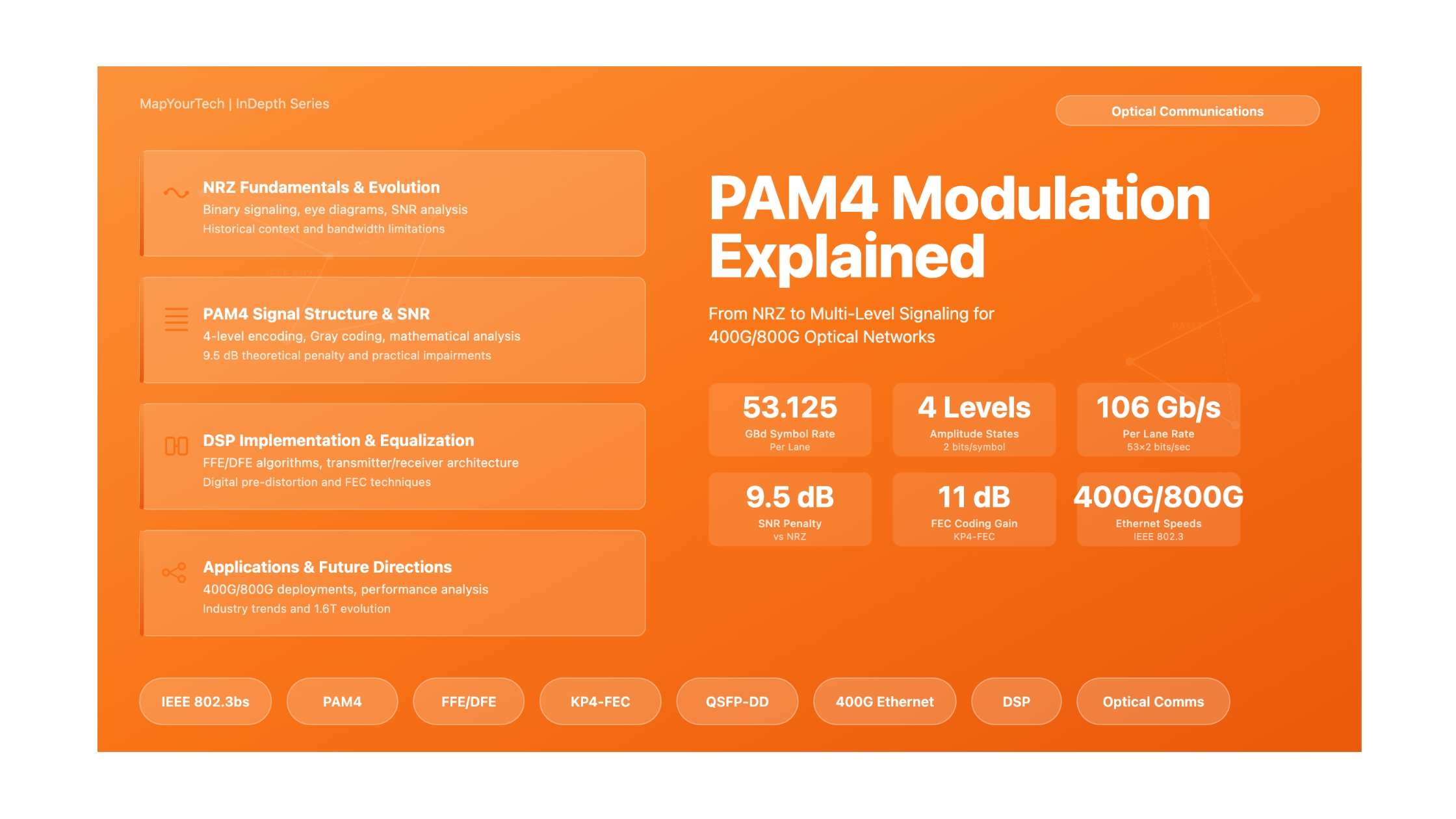
PAM4 modulation encodes two bits of information per symbol by transmitting optical signals at four distinct power levels, effectively doubling the data rate compared to NRZ at the same symbol rate (baud rate). This advancement enables optical transceivers to achieve 100 Gb/s per lane at 53.125 Gbaud, which scales to 400 Gb/s aggregate throughput using four wavelengths or four parallel lanes. The transition from NRZ to PAM4 has become critical for IEEE 802.3bs 400GBASE standards and next-generation data center interconnects.
However, this increased spectral efficiency comes with significant engineering challenges. PAM4 signals exhibit reduced signal-to-noise ratio (SNR) requirements approximately 9.5 dB higher than equivalent NRZ systems, demanding more sophisticated digital signal processing (DSP), forward error correction (FEC), and equalization techniques. The three intermediate signal levels in PAM4 are more susceptible to noise, chromatic dispersion, polarization mode dispersion (PMD), and nonlinear optical effects compared to the binary levels in NRZ.
This comprehensive technical article provides an exhaustive examination of PAM4 modulation technology, covering theoretical foundations, practical implementation considerations, performance analysis, and real-world deployment scenarios. We analyze the mathematical principles underlying multi-level signaling, quantify the SNR penalties associated with PAM4, examine DSP architectures for PAM4 generation and detection, and explore the trade-offs network engineers face when designing 400G and 800G optical systems.
Key Insight: PAM4 represents a fundamental shift from traditional binary optical signaling to multi-level amplitude modulation, enabling higher data rates within the same electrical and optical bandwidth constraints. Understanding PAM4 is essential for engineers working on next-generation data center interconnects, metro networks, and long-haul transmission systems operating at 400 Gb/s and beyond.
The article is structured to serve multiple audiences: graduate students seeking theoretical understanding, early-career engineers implementing PAM4 systems, and senior architects making technology selection decisions. Each section builds progressively from fundamental concepts to advanced implementation details, supported by mathematical derivations, industry data, and practical examples from deployed 400G networks.
2 Introduction & Historical Context
2.1 The Evolution of Optical Modulation Formats
Optical communication systems have evolved through several generations of modulation formats, each addressing specific technological and economic constraints. The first commercial fiber optic systems in the 1980s used simple on-off keying (OOK) at megabit data rates, where the presence or absence of light represented binary 1 or 0. As systems scaled to gigabit rates through the 1990s and 2000s, NRZ became the dominant modulation format for optical transceivers operating at 1 Gb/s, 10 Gb/s, and eventually 25 Gb/s per lane.
NRZ modulation transmits binary data by directly modulating the optical carrier between two discrete power levels. The signal voltage transitions directly from the low level (representing binary 0) to the high level (representing binary 1) without returning to zero voltage between consecutive 1 bits. This simplicity made NRZ ideal for short-reach applications where signal impairments were minimal and cost-effective implementation was paramount.
The critical inflection point occurred around 2015 when the optical networking industry recognized that scaling NRZ beyond 28 Gb/s per lane would face insurmountable challenges. These challenges stemmed from three fundamental limitations:
- Bandwidth Constraints: Electrical components (drivers, modulators, photodetectors, transimpedance amplifiers) become increasingly expensive and power-hungry as bandwidth requirements increase. Operating at 56 Gb/s NRZ would require approximately 28 GHz of electrical bandwidth, pushing against the practical limits of silicon and III-V semiconductor technologies.
- Chromatic Dispersion Penalties: Higher baud rates lead to narrower optical pulses, making signals more susceptible to chromatic dispersion effects in single-mode fiber. At 56 Gbaud, the dispersion tolerance would be severely limited, restricting reach to impractically short distances for many applications.
- Cost and Power Scaling: The exponential increase in DSP complexity, power consumption, and component costs at higher NRZ baud rates would make 400G systems economically unviable for widespread deployment.
These limitations catalyzed the optical networking industry's investigation of multi-level modulation formats that could double or quadruple data rates without proportionally increasing baud rates. PAM4, which had been used successfully in copper-based electrical interconnects, emerged as the leading candidate for next-generation optical systems.
2.2 Why PAM4? The Economic and Technical Drivers
The adoption of PAM4 modulation was driven by a convergence of technical requirements and economic realities facing data center operators and network service providers. Several key factors influenced the industry's transition to PAM4:
Data Center Traffic Growth: Hyperscale data centers operated by companies like Google, Amazon, Microsoft, and Facebook experienced compound annual growth rates (CAGR) exceeding 30% in east-west traffic between servers. Machine learning workloads, distributed storage systems, and microservices architectures demanded higher-bandwidth interconnects between top-of-rack switches and spine switches. The 100G QSFP28 interfaces that dominated data centers in 2016-2018 quickly became inadequate for these traffic patterns.
5G Fronthaul and Backhaul Requirements: The rollout of 5G wireless networks created massive bandwidth requirements for cell site fronthaul connections using Common Public Radio Interface (CPRI) and enhanced CPRI (eCPRI). A single 5G massive MIMO base station with 64 antenna elements can generate over 150 Gb/s of fronthaul traffic, necessitating efficient 400G optical transport solutions.
Read the Full Analysis with Premium
The remaining 89% of this article — the design numbers, trade-offs and field guidance — is part of MapYourTech Premium, along with the full premium library, courses and professional tools.