
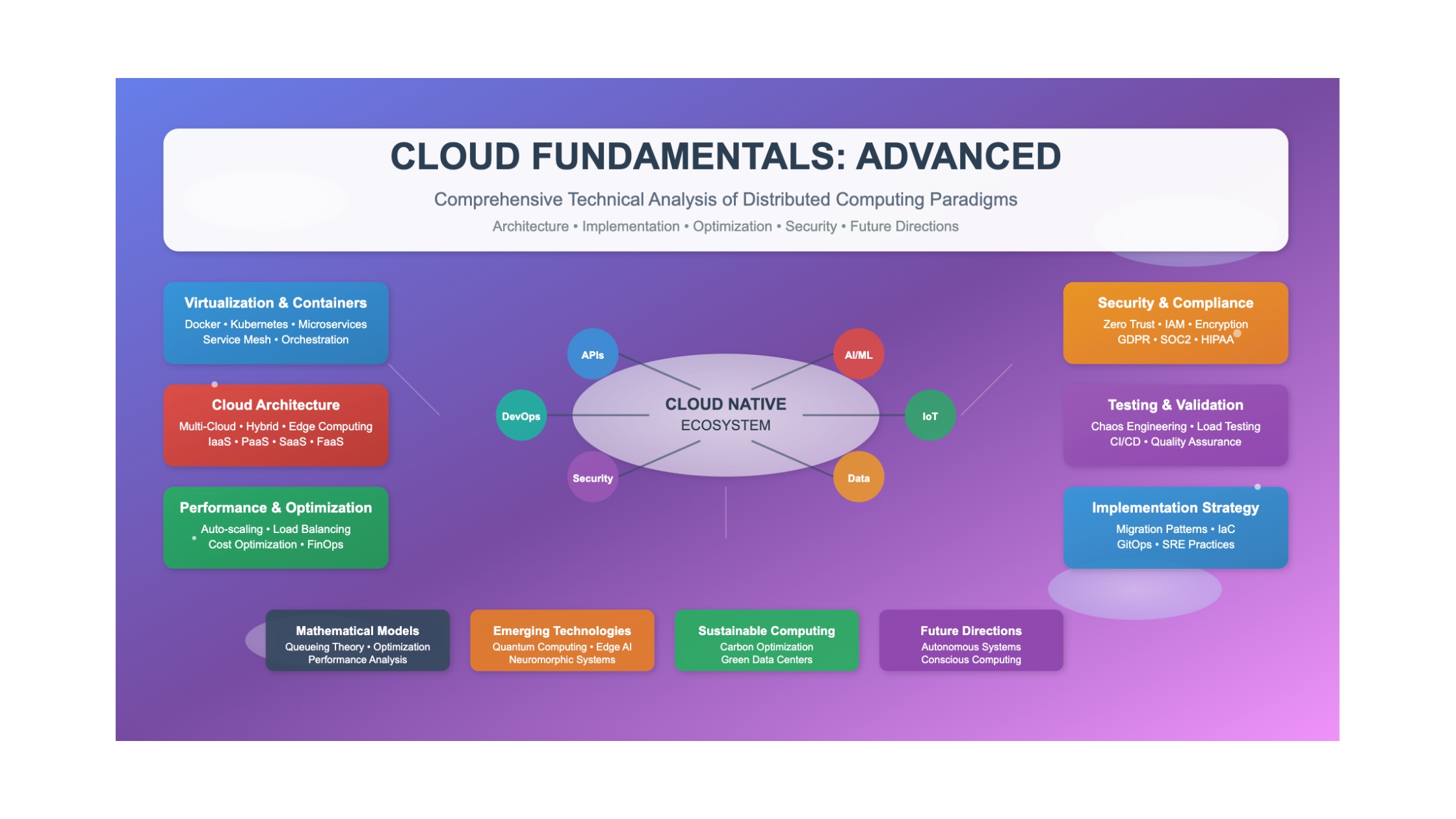
Cloud Fundamentals
Executive Summary
Key Findings & Implications
Cloud computing represents the most significant paradigm shift in distributed systems since the advent of the internet. This comprehensive analysis examines the theoretical foundations, architectural principles, and practical implementations that define modern cloud infrastructure.
Definition and Scope
Cloud computing is a distributed computing paradigm that provides ubiquitous, convenient, on-demand network access to a shared pool of configurable computing resources (networks, servers, storage, applications, and services) that can be rapidly provisioned and released with minimal management effort or service provider interaction.
Core Value Propositions
Economic Efficiency
Capital expenditure reduction of 20-50% through operational expenditure models, enabling organizations to transform fixed costs into variable costs aligned with actual usage patterns.
Elasticity & Scalability
Dynamic resource allocation with horizontal and vertical scaling capabilities, supporting demand fluctuations from baseline to 1000x peak loads within minutes.
Global Accessibility
Geographic distribution across 200+ data centers worldwide, enabling sub-50ms latency for 95% of global internet users through edge computing architectures.
Innovation Acceleration
Deployment time reduction from months to minutes, enabling rapid prototyping, continuous integration, and accelerated time-to-market for digital products.
Service Model Classification
| Service Model | Abstraction Level | Control Granularity | Primary Use Cases | Market Share (2024) |
|---|---|---|---|---|
| Infrastructure as a Service (IaaS) | Hardware Virtualization | Operating System Level | Migration, Custom Environments | 32% |
| Platform as a Service (PaaS) | Runtime Environment | Application Level | Development, Microservices | 28% |
| Software as a Service (SaaS) | Complete Application | Configuration Level | End-user Applications | 40% |
2025 Market Dynamics & Emerging Trends
Generative AI Integration
Large Language Models (LLMs) embedded in 85% of cloud services. GPU-optimized instances with NVIDIA H100 and AMD MI300 accelerators enable real-time AI inference at scale.
Quantum Computing as a Service
IBM Quantum Network, Google Quantum AI, and AWS Braket provide quantum processing units (QPUs) with 1000+ qubits for cryptography, optimization, and simulation workloads.
Sustainable Cloud Computing
Carbon-neutral commitments drive 40% reduction in energy consumption through liquid cooling, renewable energy, and AI-optimized workload placement algorithms.
Edge-Native Architecture
5G and satellite networks enable ultra-low latency applications with edge computing nodes processing 70% of IoT data locally before cloud transmission.
Future Trajectory (2025-2030)
Neuromorphic Computing: Intel Loihi and IBM TrueNorth chips reduce AI inference energy consumption by 80% while enabling real-time learning and adaptation in edge devices.
Quantum-Safe Security: Post-quantum cryptography algorithms (CRYSTALS-Kyber, CRYSTALS-Dilithium) become standard as quantum computers threaten current encryption methods.
Digital Twins at Scale: Real-time digital replicas of entire cities, supply chains, and ecosystems enable predictive governance and optimization with sub-millisecond synchronization.
Critical Success Factors
Reliability: Service Level Agreements (SLAs) typically guarantee 99.9% to 99.99% uptime through redundant architectures, automated failover mechanisms, and disaster recovery protocols.
Performance: Network latency optimization through content delivery networks (CDNs), edge computing, and intelligent traffic routing ensures optimal user experience across global deployments.
2025 Strategic Implications
| Technology Trend | Market Impact | Implementation Timeline | Investment Priority |
|---|---|---|---|
| AI-Native Cloud Services | $500B market by 2028 | 2025-2027 | Critical |
| Quantum Computing Integration | Cryptography disruption | 2025-2030 | Strategic |
| Sustainable Computing | Regulatory compliance | 2025-2026 | Essential |
| Edge-Cloud Continuum | IoT ecosystem enablement | 2025-2028 | High |
Historical Context & Foundational Principles
Evolution Timeline
Theoretical Foundations
Distributed Systems Principles
Cloud computing builds upon fundamental distributed systems concepts established by pioneers like Leslie Lamport, Barbara Liskov, and Eric Brewer. The CAP Theorem (Consistency, Availability, Partition tolerance) provides the theoretical framework for understanding trade-offs in distributed data systems.
Virtualization Technologies
The theoretical foundation of cloud computing rests on virtualization abstraction layers. Hypervisor technology, pioneered by IBM in the 1960s and modernized by VMware in the 1990s, enables resource multiplexing and isolation essential for multi-tenant cloud environments.
Read the Full Analysis with Premium
The remaining 89% of this article — the design numbers, trade-offs and field guidance — is part of MapYourTech Premium, along with the full premium library, courses and professional tools.
You May Also Like
-
Free
-
September 4, 2026
-
Premium
-
September 4, 2026
-
Premium
-
September 4, 2026