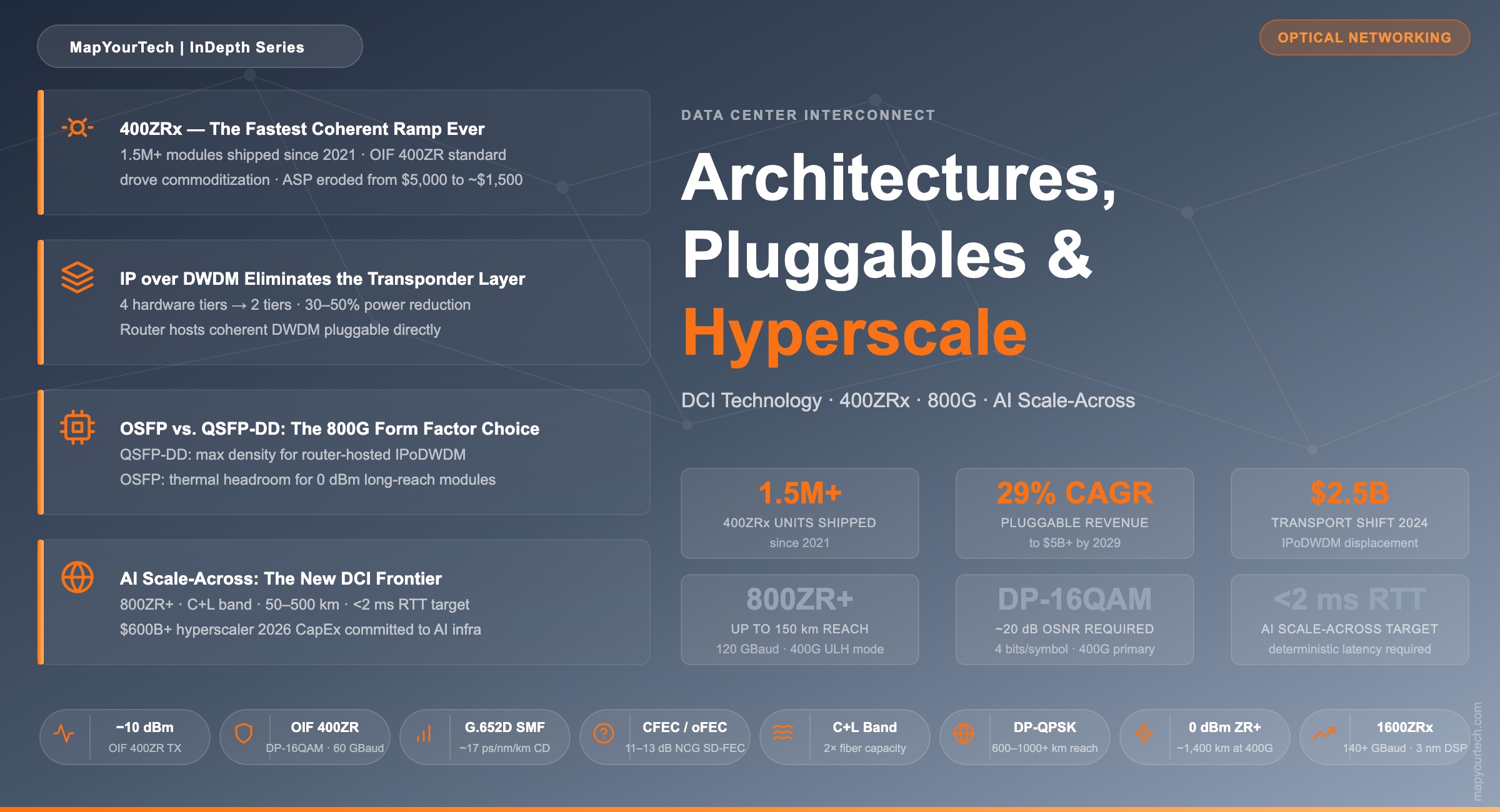

Data Center Interconnect:
Architectures, Pluggables, and the Hyperscale Playbook
A comprehensive technical guide to DCI technology — from short-reach intra-campus links to long-haul coherent transport, the 400ZRx revolution, pluggable transponders, the 800G form factor debate, and what AI-driven scale-across interconnect demands from optical networks.
1. Introduction
Data center interconnect — universally abbreviated as DCI — describes the optical transport layer that ties discrete data center facilities into a cohesive operational unit. Whether that fabric spans two buildings on the same campus 500 meters apart or bridges geographically dispersed hyperscale campuses separated by hundreds of kilometers, the underlying challenge is identical: move enormous volumes of data reliably, at the lowest possible cost per bit, with the power and space efficiency that modern infrastructure demands.
For most of networking history, DCI was simply a special case of metro or long-haul transport — solved with dedicated transponder shelves, proprietary embedded optics, and traditional network management stacks. That model served its purpose when traffic volumes were measured in tens of gigabits and when data centers were islands rather than nodes in a distributed compute fabric. Neither of those conditions holds today.
The transformation of DCI into its own distinct technology category began around 2015, driven by a convergence of forces: the exponential growth in east-west traffic between data centers belonging to the same cloud operator, the emergence of coherent Digital Signal Processing (DSP) silicon compact enough to fit in a pluggable module, and the deliberate market strategy of hyperscalers who recognized that disaggregating optics from transport chassis would deliver the same cost leverage they had achieved in compute and storage. The result was the 400ZR standard — and a restructuring of the entire optical hardware industry that followed in its wake.
As of 2026, the DCI market has entered its second major transformation. The 400G pluggable era is maturing toward commoditization. 800G coherent pluggables are actively shipping. AI workloads are generating interconnect requirements that differ qualitatively from cloud storage and web traffic — deterministic latency, synchronization across hundreds of kilometers, and bandwidth densities that strain the capacity of conventional metro DWDM architectures. This article provides a comprehensive technical examination of where DCI technology stands today and where it is headed.
2. DCI Landscape and Historical Context
2.1 From General Transport to Purpose-Built DCI
Before dedicated DCI architectures emerged, cloud operators and internet content providers used conventional optical transport systems — large chassis platforms built for carrier-grade reliability, rich OAM capabilities, and multi-decade operational lifetimes. These systems were optimized for carrier business models: revenue per wavelength, service-level agreements with external customers, support for diverse client interfaces including TDM. They were not optimized for the operational model of a hyperscaler data center team that thinks in terms of fleet refresh cycles, datacenter-fabric cost per port, and agile deployment timelines measured in weeks rather than years.
The decisive shift came when hyperscalers recognized that metro DCI — connecting availability zones within the same city or region at distances typically under 100 kilometers — did not require the full feature set of carrier transport. What it required was maximum capacity per watt, maximum port density per rack unit, and the ability to procure optics competitively rather than from a captive vendor bundle. This drove the development of what became known as compact modular hardware — a first step in disaggregation — followed by the more radical disaggregation of the optical interface itself.
2.2 The DCI Distance Taxonomy
DCI applications span a wide range of distances, each with distinct technical requirements. Understanding this taxonomy is essential because the choice of technology — form factor, modulation format, amplification scheme, and transport architecture — is primarily driven by the distance category.
| Distance Category | Typical Range | Primary Use Case | Technology Preference | Reach Class |
|---|---|---|---|---|
| Intra-campus | Up to 500 m | Building-to-building within same campus | Direct attach cable, PAM4 IM-DD | VSR |
| Campus DCI | 500 m – 2 km | Multiple buildings, same operator campus | PAM4 DR/FR transceivers, IM-DD | SR/MR |
| Metro DCI | 2 – 100 km | Availability zone interconnect, in-city fabric | 400ZR, 400ZR+, 800ZRx coherent | MR/LR |
| Regional DCI | 100 – 600 km | Multi-city cloud region, peering exchange | 400ZR+ 0dBm, 800ZR+, coherent transport | ELR |
| Long-haul DCI | 600 km+ | Cross-country, scale-across AI fabrics | Coherent transport, C+L band, amplified | ULR |
Table 1: DCI Distance Taxonomy — Technology selection is primarily determined by reach category. Modulation format, output power, and amplification requirements vary significantly across segments.
2.3 Traffic Drivers and Growth Forces
DCI traffic growth is not uniform. The dominant drivers have shifted over time, and as of 2026 the mix is approximately: cloud storage replication and backup (historically the largest component), application-layer east-west traffic for distributed microservices and content delivery, AI training data movement and checkpoint synchronization, and the newer category of AI inference load balancing across geographically distributed accelerator clusters.
The power implications of this traffic growth are profound. According to industry data, global yearly power demand for data centers is projected to grow 3.5 times by 2030, with approximately 31 GW of additional AI capacity added per year. Hyperscale rack power densities, currently capped around 50 kW for air-cooled deployments, are expected to climb well beyond 100 kW and potentially into the hundreds of kilowatts as liquid cooling and new power architectures become standard. Every watt consumed by optical transport inside or between these facilities is a watt that cannot be applied to compute — creating relentless pressure on power efficiency in DCI optics.
3. DCI Architecture Taxonomy
3.1 Four Fundamental Architecture Models
DCI deployments across all operator categories can be grouped into four fundamental architecture models. These are not mutually exclusive — a single operator may deploy multiple models across different distance categories or network tiers — but each model embodies a distinct philosophy about where intelligence resides, how capacity is provisioned, and what operational complexity is acceptable.
Read the Full Analysis with Premium
The remaining 89% of this article — the design numbers, trade-offs and field guidance — is part of MapYourTech Premium, along with the full premium library, courses and professional tools.