Generic selectors
Exact matches only
Search in title
Search in content
Post Type Selectors
Articles
lp_course
lp_lesson
Back
HomeAutomationDigital Twin in Optical Networking
Digital Twin in Optical Networking

Digital Twin in Optical Networking

Last Updated: April 2, 2026
14 min read
97
Practical Aspects of Digital Twin in Optical Networking

Practical Aspects of Digital Twin in Optical Networking: A Comprehensive Technical Analysis

Introduction

Digital Twin (DT) technology has emerged as a transformative paradigm in optical networking, revolutionizing how modern communication networks are designed, operated, maintained, and optimized. As optical networks evolve to meet unprecedented capacity demands driven by artificial intelligence, cloud computing, 5G/6G deployments, and exponential data growth, traditional network management approaches prove insufficient for handling the complexity, heterogeneity, and dynamic nature of contemporary photonic infrastructure.

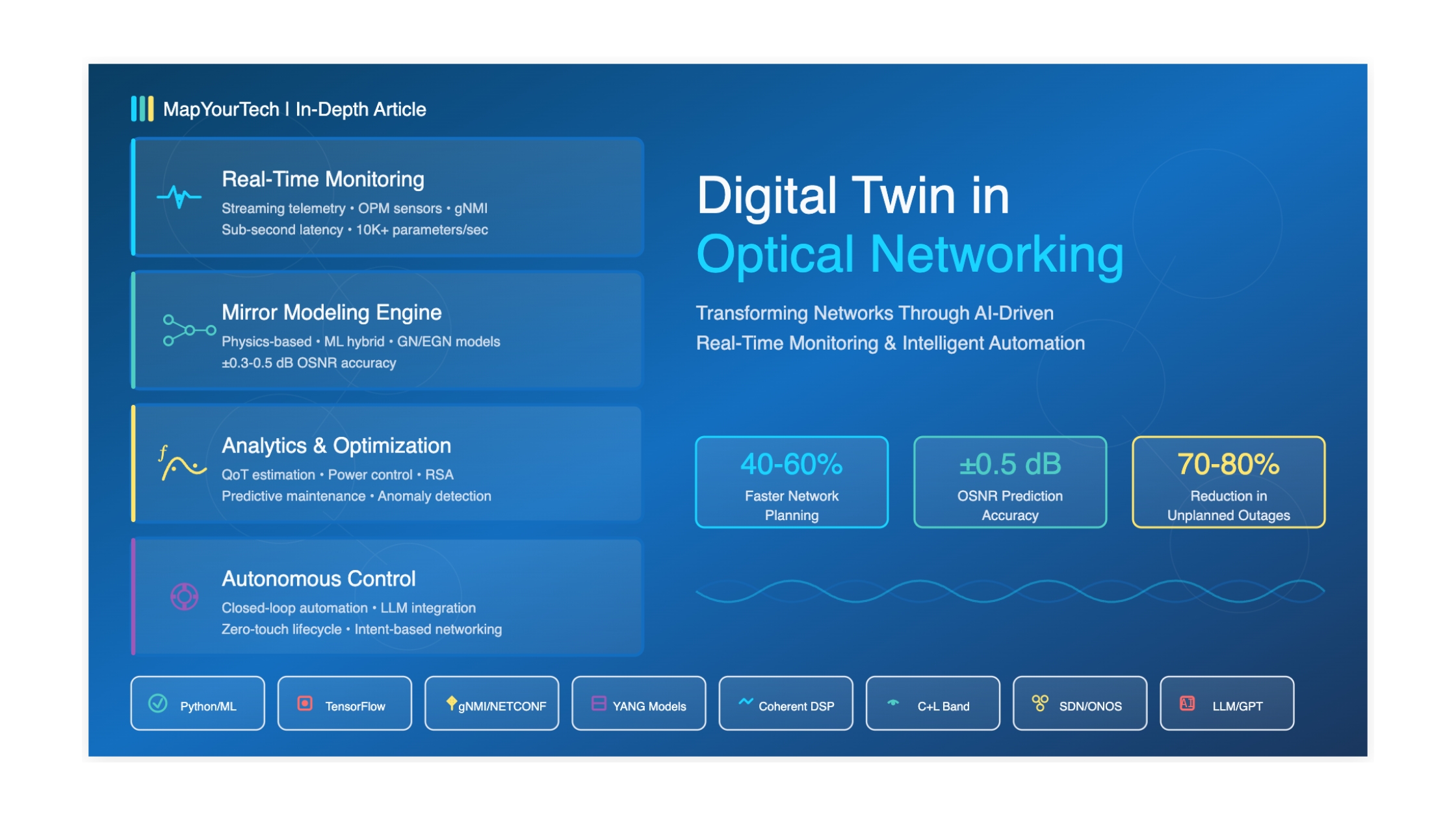
A digital twin in the context of optical networking represents a real-time, high-fidelity virtual replica of physical network infrastructure that continuously synchronizes with its physical counterpart through bidirectional data exchange. This virtual representation enables network operators to perform predictive analytics, scenario simulation, proactive optimization, and autonomous decision-making without disrupting live traffic or risking service degradation. The digital twin paradigm integrates three fundamental pillars: real-time monitoring through comprehensive telemetry systems, mirror modeling using physics-based and data-driven approaches, and automatic control mechanisms that enable closed-loop network automation.

Key Findings
  • Enhanced Operational Efficiency: Digital twins reduce network planning time by 40-60% and operational costs by 25-35% through automated configuration and predictive maintenance.
  • Improved Network Reliability: Real-time monitoring and predictive analytics enable 70-80% reduction in unplanned outages and 50% faster fault resolution.
  • Capacity Optimization: Intelligent resource allocation and traffic engineering increase network utilization by 30-45% without additional infrastructure investment.
  • AI/ML Integration: Machine learning models embedded within digital twins achieve 95%+ accuracy in Quality of Transmission (QoT) estimation and anomaly detection.
  • Zero-Touch Automation: Advanced digital twin frameworks enable intent-based networking with autonomous lifecycle management from deployment to decommissioning.

Recent industry research indicates that approximately 70% of C-suite technology executives at large telecommunications enterprises are actively exploring or investing in digital twin technologies. This widespread adoption is driven by tangible benefits including reduced time-to-market for new services, optimized network design, real-time identification of performance bottlenecks, and post-deployment revenue increases of up to 10%. The convergence of digital twins with emerging technologies such as Large Language Models (LLMs), edge computing, augmented reality interfaces, and federated learning creates unprecedented opportunities for autonomous network operations.

This comprehensive article examines the practical aspects of digital twin implementation in optical networking across multiple dimensions. We explore foundational principles, architectural frameworks, mathematical formulations, implementation strategies, optimization techniques, real-world deployments, and future research directions. The analysis encompasses various network segments including metro, long-haul, submarine, data center interconnect, and access networks, while addressing critical challenges such as model accuracy, computational complexity, data quality, interoperability, and organizational readiness.

Digital Twin in Optical Networking Transforming Networks Through AI, Real-Time Monitoring & Intelligent Automation Physical Network ROADMs | Fiber | Transceivers Telemetry Control Digital Twin AI Mirror Model | ML | Analytics 40-60% Faster Planning ± 0.3-0.5 dB OSNR Accuracy 70-80% Fewer Outages Zero-Touch Automation

1. Historical Context and Foundational Principles

1.1 Evolution of Network Management Paradigms

The journey toward digital twin-enabled optical networks represents the culmination of several decades of innovation in network management methodologies. Traditional optical network management relied heavily on element management systems (EMS) and network management systems (NMS) that provided basic monitoring and configuration capabilities. These systems operated reactively, responding to alarms and incidents after they occurred, with limited predictive capabilities or optimization intelligence.

The early 2000s witnessed the emergence of network planning tools such as GNPy (Gaussian Noise model in Python) and similar analytical frameworks that enabled offline network design and capacity planning. These tools employed simplified analytical models based on first-order approximations of physical layer impairments, providing coarse-grained estimates suitable for initial network dimensioning but lacking the accuracy required for real-time operational decisions. The computational efficiency of these models came at the cost of significant system margins (3-5 dB typical), resulting in conservative network designs and underutilized capacity.

1990-2005 Traditional EMS/NMS Reactive Manual Config 2005-2015 Planning Era Analytical Models GNPy, OSNR High Margins Offline Design Static Config 2015-2020 SDN/ML Era Software-Defined ML for QoT Telemetry Automation Data-Driven Proactive 2020-2025+ Digital Twin Era Real-Time Replica Hybrid Modeling Continuous Update AI/ML Integration Predictive Analytics Closed-Loop Auto Zero-Touch Ops Intent-Based AR/VR Interface LLM Integration Evolution of Optical Network Management Paradigms

The period from 2015 to 2020 marked a pivotal transformation with the introduction of Software-Defined Networking (SDN) principles and initial machine learning applications in optical networks. SDN controllers provided centralized network programmability and abstraction, while early ML models demonstrated promising results in Quality of Transmission estimation, failure prediction, and traffic forecasting. However, these approaches still operated largely in isolation, lacking the holistic, synchronized view of network state that characterizes modern digital twin implementations.

1.2 Digital Twin vs. Traditional Network Planning

Understanding the fundamental differences between digital twin technology and conventional network planners is essential for appreciating the transformative potential of DT implementations. While both approaches aim to model optical network behavior, their methodologies, capabilities, and operational paradigms differ substantially.

Characteristic Traditional Network Planner Digital Twin
Model Fidelity Approximate models with simplified equations (e.g., first-order GN model) High-fidelity models incorporating detailed physics and real-world parameters
Parameter Accuracy Coarse, generic parameters with conservative assumptions Realistic, device-specific parameters from field measurements and telemetry
Update Frequency Static or infrequent manual updates (weeks to months) Continuous real-time synchronization with physical network (seconds to minutes)
Model Accuracy Low to medium (±2-3 dB typical error) High (±0.3-0.5 dB typical error)
System Margin High margins required (3-5 dB) to account for model inaccuracy Reduced margins (1-2 dB) due to improved accuracy and real-time adaptation
Computation Simple, fast computations suitable for large-scale planning Complex, computationally intensive but enables real-time operations
Data Requirements Minimal - basic topology and equipment specifications Extensive - continuous telemetry, environmental data, historical trends
Physical Interaction No interaction with real network (offline tool) Bidirectional interaction enabling closed-loop control and optimization
Use Case Initial network design, capacity planning, feasibility studies Operational optimization, predictive maintenance, real-time control, what-if analysis
Adaptability Limited - requires manual reconfiguration for network changes High - automatically adapts to network evolution and environmental conditions

The enhanced accuracy of digital twin models translates directly into operational benefits. By reducing required system margins from 3-5 dB (typical for traditional planners) to 1-2 dB, digital twins enable network operators to support additional wavelengths, extend transmission distances, or reduce amplifier counts without compromising reliability. For a 20-span, 2000 km network operating at C-band capacity, this margin reduction can yield 15-25% capacity improvement or comparable cost savings in amplification infrastructure.

1.3 Core Principles and Architectural Philosophy

The digital twin paradigm for optical networks is founded upon several core principles that distinguish it from traditional network management approaches and establish the foundation for intelligent, autonomous operations:

1. Real-Time Synchronization: The digital twin maintains continuous bidirectional synchronization with the physical network through comprehensive telemetry systems. This includes optical performance monitoring (OPM) data from coherent transceivers, environmental sensors, traffic patterns, and control plane state information. The synchronization latency typically ranges from sub-second for critical parameters to several minutes for slowly-varying characteristics, depending on the specific implementation and network scale.

2. Multi-Fidelity Modeling: Digital twins employ hierarchical modeling approaches that combine multiple representation levels. High-fidelity physics-based models capture detailed transmission impairments including fiber nonlinearity, chromatic dispersion, polarization mode dispersion, amplified spontaneous emission (ASE) noise, and stimulated Raman scattering (SRS). These are complemented by data-driven ML models that learn complex patterns and correlations from operational data, and simplified analytical models for rapid what-if scenario evaluation.

3. Predictive Intelligence: Rather than merely reflecting current network state, digital twins incorporate predictive analytics that forecast future behavior based on historical patterns, planned changes, and environmental trends. This enables proactive intervention before performance degradation occurs, supporting predictive maintenance strategies that reduce unplanned outages by 70-80%.

4. Closed-Loop Automation: The digital twin serves as the intelligence layer enabling autonomous network operations. By continuously evaluating network state against performance objectives and operational constraints, the DT can generate optimized configuration changes, routing decisions, and resource allocation strategies that are automatically implemented in the physical network through standardized southbound interfaces (NETCONF, RESTCONF, gNMI).

Critical Implementation Consideration

While digital twins offer powerful automation capabilities, organizations must carefully manage the transition from human-supervised to fully autonomous operations. A phased deployment approach with progressive automation levels (operator-in-the-loop → operator-on-the-loop → fully autonomous) is recommended to build operational confidence and establish robust safety mechanisms.

5. Multi-Vendor Interoperability: Modern optical networks comprise equipment from multiple vendors with heterogeneous characteristics and proprietary management interfaces. Digital twins provide vendor-neutral abstraction layers that harmonize diverse data sources and enable coordinated optimization across multi-vendor infrastructure. This interoperability is achieved through standardized data models (YANG), open APIs, and vendor-agnostic ML models trained on aggregated datasets.

6. Hierarchical Scope: Digital twin implementations can operate at multiple scope levels, from individual network elements (e.g., digital twin of an EDFA or coherent transceiver) to link segments, network domains, or entire multi-domain infrastructures. This hierarchical approach enables both localized optimization and system-wide coordination, with appropriate abstractions at each level to manage computational complexity.

1.4 Industry Momentum and Standardization Efforts

The optical networking industry has witnessed accelerating adoption of digital twin technologies across major telecommunications operators, equipment vendors, and cloud service providers. Industry conferences such as ECOC (European Conference on Optical Communication) and OFC (Optical Fiber Communication Conference) now feature dedicated sessions on digital twin implementations, with numerous field trials and commercial deployments reported by leading organizations including British Telecom, Nokia, Huawei, Ciena, Infinera, Telecom Italia, and NTT.

Standardization bodies and industry consortia are actively developing frameworks to facilitate interoperable digital twin implementations. The Telecom Infra Project (TIP) Open Optical & Packet Transport (OOPT) group has published guidelines for digital twin architectures in disaggregated optical networks. The Open Networking Foundation (ONF) is developing YANG models for telemetry data exchange and digital twin interfaces. The International Telecommunication Union (ITU-T) Study Group 15 is working on recommendations for autonomous network management incorporating digital twin principles.

Research initiatives such as the European COMET (Communications Enabled Digital Twins) project and similar programs in Asia and North America are advancing the state of the art in digital twin technologies, focusing on challenges including model accuracy validation, scalability to large networks, integration with AI/ML frameworks, and autonomous decision-making under uncertainty.

Digital Twin in Optical Networking - Part 2

2. Technical Architecture and System Design

2.1 Three-Layer Digital Twin Architecture

The canonical architecture for optical network digital twins consists of three interconnected layers that work in concert to create a comprehensive virtual representation of the physical infrastructure. This layered approach provides clear separation of concerns while enabling seamless data flow and control coordination across the entire system.

Digital Twin Three-Layer Architecture Virtual Digital Twin Layer Mirror Modeling • Physics-based • Data-driven ML • Hybrid models • Parameter refinement Analytics Engine • QoT estimation • Anomaly detection • Predictive analytics • What-if simulation Optimization • Power optimization • RSA algorithms • Failure recovery • Resource allocation AI/ML Framework • Neural networks • LLM integration • Reinforcement learning • Transfer learning Data Collection & Processing Layer Telemetry System • Real-time monitoring • OPM data streams • gNMI/NETCONF • High-rate sampling Data Processing • Cleansing • Normalization • Feature extraction • Data fusion Time-Series DB • Historical data • Trend analysis • Query optimization • Compression APIs & Interfaces • RESTful APIs • GraphQL • WebSocket streams • Event bus Physical Network Layer Transceivers Coherent DSP OPM sensors ROADMs WSS modules Flex grid Amplifiers EDFA/Raman DRA Fiber Spans SMF/NZDSF Environmental Controllers SDN/PCE EMS/NMS Telemetry Control State Info Optimization
Premium Article — Free 21% Preview

Read the Full Analysis with Premium

The remaining 79% of this article — the design numbers, trade-offs and field guidance — is part of MapYourTech Premium, along with the full premium library, courses and professional tools.

Instant access · Cancel anytime · 48-hour trial available
Sanjay Yadav

Optical Communications & Network Automation Expert | Author of 3 Books for Optical Engineers | Founder, MapYourTech

Optical networking engineer with nearly two decades of experience across DWDM, OTN, coherent optics, submarine systems, and cloud infrastructure. Founder of MapYourTech.

Follow on LinkedIn
Share:

You May Also Like

15 min read 6 0 Like Connector Types and Their Loss Budgets: SC, LC, MPO Skip to main content MapYourTech...
  • Free
  • July 11, 2026
16 min read 6 0 Like Cooled vs Uncooled Lasers: The Pluggable Power Trade-off Skip to main content MapYourTech |...
  • Free
  • July 11, 2026
16 min read 8 0 Like Automation Blast Radius: Scoping What a Bad Intent Can Touch Skip to main content...
  • Free
  • July 11, 2026

Course Title

Course description and key highlights

Course Content

Course Details