
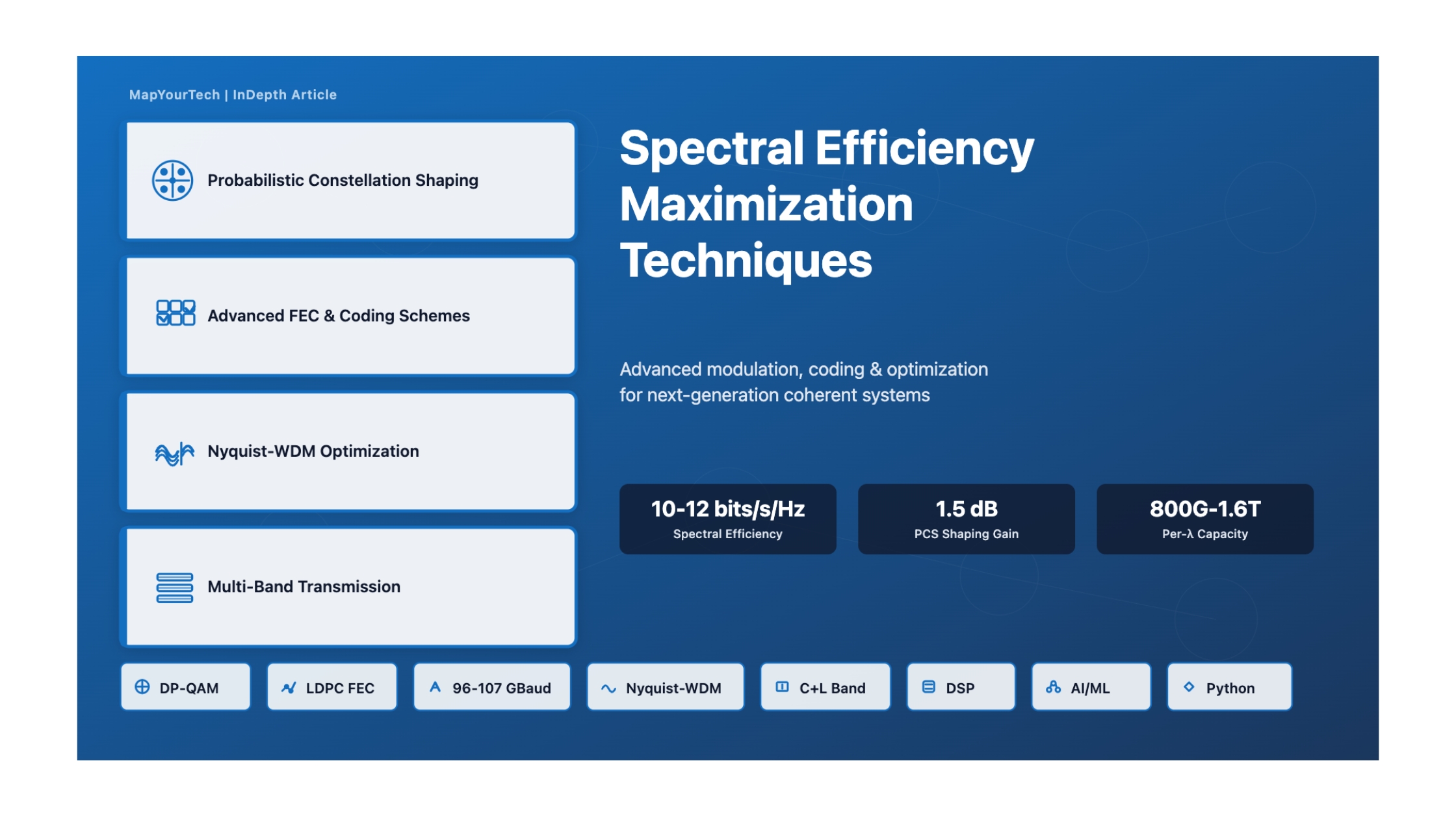
Spectral Efficiency Maximization Techniques
Advanced Methodologies for High-Capacity Optical Communication Systems
1. Executive Summary
Spectral efficiency maximization represents a critical frontier in modern optical communication systems, driving the evolution from traditional 10 Gbps networks to contemporary 800 Gbps and emerging 1.6 Tbps transmission systems. This comprehensive technical analysis examines the fundamental principles, advanced techniques, and practical implementations that enable optimal utilization of the finite electromagnetic spectrum available for fiber-optic communications.
Spectral efficiency, formally defined as the information capacity per unit bandwidth measured in bits per second per Hertz (bit/s/Hz), has witnessed remarkable advancement through the convergence of sophisticated modulation formats, coherent detection technologies, digital signal processing algorithms, and wavelength division multiplexing architectures. Recent research demonstrates spectral efficiencies reaching 11 bit/s/Hz in laboratory settings using 128-QAM OFDM-WDM configurations, while commercial deployments typically achieve 2-7 bit/s/Hz depending on reach requirements and system constraints.
Key Findings
- Modern coherent detection systems enable spectral efficiencies 4-6 times greater than traditional intensity modulation direct detection (IMDD) approaches
- Advanced modulation formats (16-QAM, 64-QAM) coupled with polarization division multiplexing achieve data rates exceeding 400 Gbps per wavelength
- Dynamic metasurface antennas and STAR-RIS technologies represent emerging paradigms for spectral efficiency optimization in integrated sensing and communication systems
- Shannon capacity limits impose fundamental constraints, with practical systems operating at 50-80% of theoretical maximum efficiency due to implementation impairments
- Machine learning and deep reinforcement learning algorithms show promise for real-time spectral efficiency optimization in complex multi-user MIMO environments
Critical Implications
The transition to higher spectral efficiency systems fundamentally alters network economics, reducing cost-per-bit while simultaneously introducing technical challenges in OSNR requirements, nonlinear impairment tolerance, and digital signal processing complexity. Current 5G deployments and anticipated 6G networks demand spectral efficiencies approaching theoretical limits, necessitating innovative approaches including:
- Hybrid amplification architectures combining Raman and EDFA technologies
- Probabilistic constellation shaping for enhanced sensitivity
- Multi-dimensional coding schemes exploiting space, time, frequency, and polarization domains
- Reconfigurable intelligent surfaces enabling 360-degree coverage optimization
2. Historical Context & Foundational Principles
2.1 Evolution of Spectral Efficiency Paradigms
The journey toward spectral efficiency maximization in optical communications traces its origins to Claude Shannon's seminal 1948 work establishing fundamental capacity limits for communication channels. Shannon's capacity theorem, expressed as C = B log₂(1 + SNR), where C represents channel capacity, B denotes bandwidth, and SNR signifies signal-to-noise ratio, established theoretical boundaries that continue to guide contemporary system design.
| Era | Technology | Spectral Efficiency | Data Rate | Key Innovation |
|---|---|---|---|---|
| 1980s-1990s | OOK-IMDD | 0.4-0.8 bit/s/Hz | 155 Mbps - 2.5 Gbps | Single-mode fiber, EDFAs |
| 1995-2005 | WDM-IMDD | 0.4-0.8 bit/s/Hz per channel | 10 Gbps per wavelength | Dense WDM, dispersion management |
| 2005-2012 | DPSK Direct Detection | 1.0-1.4 bit/s/Hz | 40-107 Gbps | Phase modulation, polarization multiplexing |
| 2008-2018 | Coherent PDM-QPSK | 2.0-2.5 bit/s/Hz | 100-200 Gbps | Digital coherent detection, DSP |
| 2015-2020 | PDM-16QAM | 4.0-6.0 bit/s/Hz | 200-400 Gbps | Higher-order modulation, advanced FEC |
| 2020-Present | PDM-64QAM/Nyquist | 6.0-11.0 bit/s/Hz | 400-800+ Gbps | Probabilistic shaping, AI/ML optimization |
| 2025-Future | Spatial Multiplexing/6G | 8.0-15.0 bit/s/Hz (projected) | 1.6+ Tbps | Multi-core fiber, OAM, RIS technologies |
2.2 Pioneering Contributions
The theoretical foundations for spectral efficiency maximization emerged from multiple disciplines. Following Shannon's capacity theorem, Richard Hamming's error-correction codes (1950) and Andrew Viterbi's maximum likelihood decoding (1967) provided essential tools for approaching channel capacity limits. In optical communications, Charles Kao's groundbreaking work on low-loss optical fiber transmission (1966) and subsequent Nobel Prize recognition established the physical infrastructure enabling high-capacity systems.
Read the Full Analysis with Premium
The remaining 89% of this article — the design numbers, trade-offs and field guidance — is part of MapYourTech Premium, along with the full premium library, courses and professional tools.
You May Also Like
-
Free
-
August 22, 2026

-
Premium
-
August 22, 2026
-
Premium
-
August 22, 2026