
Global Optical Fiber Communication Engineering Roles: A Comprehensive Analysis
An in-depth examination of engineering career paths, technical competencies, and market dynamics across product vendors, service providers, and hyperscale operators
Introduction
The optical fiber communications industry represents one of the most technically demanding and strategically important sectors in modern telecommunications infrastructure. As global data traffic continues its exponential growth—driven by cloud computing, artificial intelligence workloads, streaming services, and emerging 5G/6G networks—the engineers who design, deploy, and maintain optical transport systems occupy increasingly critical positions within both equipment vendors and network operators.
However, the optical engineering profession is far from monolithic. The daily responsibilities, required technical competencies, career trajectories, and compensation structures vary dramatically depending on whether an engineer works for an equipment manufacturer (such as Ciena, Nokia, Infinera, or Ribbon Communications), a traditional telecommunications service provider (such as AT&T, Verizon, Vodafone, or Airtel), or a hyperscale cloud operator (such as Amazon Web Services, Meta, Google, or Microsoft). These three employer categories represent fundamentally different business models, operational priorities, and engineering cultures that shape every aspect of an optical engineer's professional experience.
At equipment vendors, optical engineers function as product developers and system architects, pushing the boundaries of coherent transmission technology, digital signal processing algorithms, and photonic integration. Their work centers on maximizing spectral efficiency, extending transmission reach, and reducing power consumption in transponders, amplifiers, and reconfigurable optical add-drop multiplexers (ROADMs). Success metrics include patent filings, standards body contributions, and delivering competitive advantage through proprietary intellectual property.
At service providers, optical engineers serve as network planners, deployment specialists, and operations experts responsible for translating equipment capabilities into scalable, reliable connectivity infrastructure. They design network topologies, manage multi-vendor procurement, execute fiber builds, and maintain service-level agreements across vast geographic footprints. Their concerns span from submarine cable landing stations to metro fiber rings, from DWDM channel planning to protection switching architectures.
At hyperscalers, optical engineers represent a hybrid discipline combining traditional optical networking expertise with software engineering practices borrowed from site reliability engineering (SRE) culture. They automate network operations, develop custom hardware specifications, manage vendor relationships as technical equals, and operate optical infrastructure at unprecedented scale—often supporting thousands of data centers connected by proprietary long-haul and subsea cable systems.
About This Guide: This comprehensive analysis is designed to help aspiring and early-career professionals understand the diverse landscape of optical networking careers worldwide. The roles, responsibilities, compensation ranges, and experience requirements outlined here represent general industry trends and may vary significantly based on geographic location, company size, specific employer, and individual qualifications.
Connect & Learn: If you need additional guidance, have specific questions about optical networking careers, or would like personalized advice on your career path, feel free to reach out to me on LinkedIn and drop me a message. While I may take some time to respond due to other commitments, I am committed to helping professionals grow in this field. — Sanjay Yadav, Founder, MapYourTech
The Evolution of Optical Engineering Specializations
The optical engineering profession has undergone substantial transformation over the past two decades. In the early 2000s, the industry was dominated by legacy SONET/SDH systems operating at 2.5 Gbps and 10 Gbps, with relatively straightforward on-off keying modulation and limited digital signal processing. Engineers required deep understanding of optical physics—chromatic dispersion, polarization mode dispersion, fiber nonlinearities—but software skills were largely optional.
The introduction of coherent detection in commercial systems around 2010 fundamentally altered the discipline. Suddenly, optical transmission became as much a software problem as a hardware problem. Digital signal processing (DSP) engineers with expertise in adaptive equalization, carrier phase recovery, and forward error correction became essential. The convergence of optics and digital communications theory created new specializations and raised the bar for technical depth.
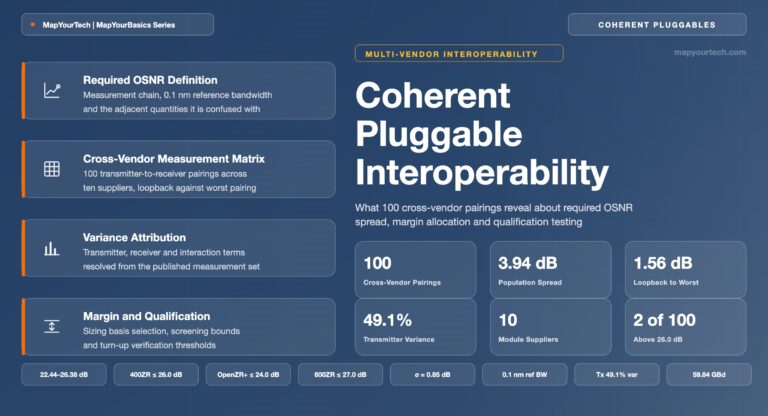
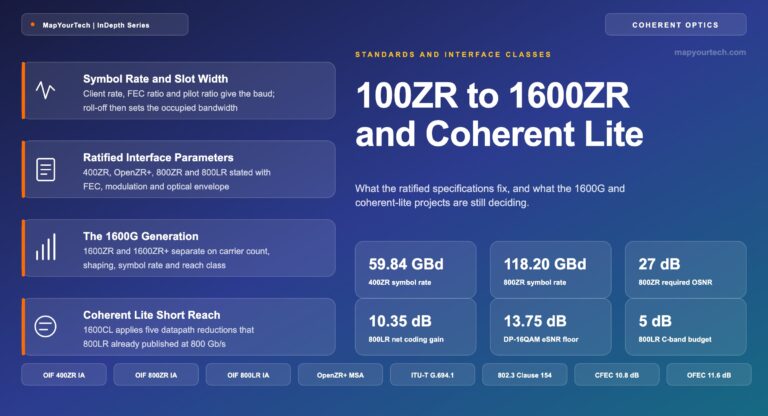
More recently, the disaggregation movement—separating optical line systems from terminal equipment, promoted by initiatives like the Telecom Infra Project (TIP) and Open Compute Project (OCP)—has created additional role categories. Engineers must now understand not only how individual systems work but how to integrate components from multiple vendors into functional networks. The rise of coherent pluggables (400ZR, 800ZR+) further blurs traditional boundaries between IP routing and optical transport layers.
Simultaneously, the software-defined networking (SDN) paradigm has transformed network operations. Traditional command-line interface (CLI) configuration is giving way to automated provisioning through NETCONF/YANG models, RESTful APIs, and infrastructure-as-code practices. Optical engineers increasingly require proficiency in Python, Go, or similar languages to remain competitive in operational roles.
Understanding the Employer Ecosystem
Before examining specific role categories, it is essential to understand the structural differences between employer types, as these fundamentally shape engineering responsibilities and career development paths.
Equipment Vendors operate on a product development and sales model. Their revenue derives from selling optical transport equipment—transponders, amplifiers, ROADMs, network management systems—to service providers and enterprises. Engineering organizations are structured around product lines, with teams responsible for specific platforms or technology domains. Career progression typically follows technical individual contributor tracks (Engineer → Senior Engineer → Principal Engineer → Distinguished Engineer) or transitions into product management. The culture emphasizes deep technical specialization, intellectual property development, and competitive differentiation through innovation.
Service Providers generate revenue by selling connectivity services to end customers—enterprises, consumers, other carriers. They purchase equipment from multiple vendors and integrate it into operational networks. Engineering organizations are structured around network layers (optical transport, IP/MPLS, access) and geographic regions. Career progression often involves moving between technical and management tracks, with senior engineers evolving into architects or transitioning to engineering management. The culture emphasizes operational excellence, multi-vendor integration, and meeting service-level commitments.
Hyperscalers operate data center infrastructure supporting cloud services, social media platforms, or e-commerce marketplaces. Their optical networks primarily serve internal traffic between data centers rather than external customers. Engineering organizations blend traditional network operations with software engineering practices, often treating optical infrastructure as software-controlled resources. Career progression follows both technical and management paths but maintains stronger emphasis on coding skills and automation capabilities. The culture emphasizes scalability, automation, and operational efficiency.
Figure 1: The optical engineering profession spans three distinct employer categories, each with fundamentally different business models, technical priorities, and engineering cultures that shape career trajectories and skill requirements.
Equipment Vendor Engineering Roles: Architecture, Design, and Validation
Equipment manufacturers—the companies that design and build optical transport systems—represent the research and development nucleus of the optical networking industry. These organizations employ engineers across multiple specializations to transform fundamental photonics and communications theory into commercially viable products capable of transmitting hundreds of gigabits per second over thousands of kilometers of fiber. The engineering roles at vendors like Ciena, Nokia, Infinera, Ribbon Communications, and Huawei span from abstract system architecture to concrete hardware implementation, from mathematical DSP algorithm development to rigorous laboratory validation testing.
Understanding vendor engineering roles requires appreciating the product development lifecycle that structures these organizations. A typical optical system project begins with system architects defining high-level specifications and technology choices based on market requirements and physical constraints. Design engineers then translate these specifications into detailed component designs, circuit schematics, and optical layouts. DSP engineers develop the signal processing algorithms that enable coherent detection and impairment compensation. Finally, SVT/PV engineers validate that the integrated system meets all specifications through comprehensive testing before manufacturing release.
This section provides comprehensive analysis of each major engineering role category at equipment vendors, examining responsibilities, required technical depth, typical career trajectories, and how these positions differ from their counterparts at network operators.
The Optical System Architect: Strategic Technology Leadership
The Optical System Architect represents the apex of technical leadership in optical product development. This role functions at the intersection of advanced photonics theory, digital signal processing, systems engineering, and business strategy. Unlike network architects at service providers who design how to connect cities with fiber, system architects at vendors design the equipment itself—defining what modulation formats the transponder supports, how the DSP compensates for fiber impairments, what forward error correction codes to implement, and ultimately what transmission performance the system can achieve.
Strategic Responsibilities and System Definition
The primary responsibility of an Optical System Architect is translating market requirements into feasible technical architectures. When a vendor decides to develop a next-generation coherent transponder—whether targeting 400 Gbps, 800 Gbps, or 1.6 Tbps per wavelength—the architect must determine the fundamental design choices that will define the product's capabilities and limitations for its entire commercial lifetime.
Consider the development of a 400G coherent transponder as a concrete example. The architect begins with the target: transmit 400 Gbps over a specified distance (perhaps 80 km for metro applications or 2,000 km for long-haul). The fundamental question becomes: what combination of baud rate, modulation format, and FEC overhead achieves this goal while meeting power consumption, cost, and form factor constraints?
The architect might evaluate several architectural approaches:
- Conservative approach: 64 GBaud symbol rate with DP-16QAM modulation (4 bits per symbol per polarization = 512 Gbps raw) and 21% overhead FEC, yielding 400G net. This provides robust OSNR tolerance but requires moderate DSP complexity.
- Aggressive approach: 90 GBaud with DP-QPSK modulation (2 bits per symbol per polarization = 360 Gbps raw) and lower FEC overhead. This maximizes reach but requires cutting-edge ADC technology and sophisticated timing recovery algorithms.
- Flexible approach: Programmable DSP supporting multiple baud rates and modulation formats, allowing field adaptation to actual link conditions. This maximizes market applicability but increases silicon complexity and power consumption.
Each choice cascades through the entire system design. The baud rate selection determines analog bandwidth requirements for the coherent front-end components—lasers, modulators, photodetectors. The modulation format impacts required linearity specifications for these components and sets OSNR requirements. The FEC choice affects latency, which matters for certain applications. The architect must balance all these interacting constraints while considering manufacturing costs, technology maturity, and competitive positioning.
System architects spend substantial effort on link budget modeling—predicting whether a given system architecture can close the optical power budget over the intended transmission distance. A simplified link budget calculation might proceed as follows:
Transmitter Power: +3 dBm
Fiber Loss: 0.2 dB/km × 2000 km = -40 dB
Amplifier Gain/Spacing: Compensates fiber loss
ROADM/Connector Losses: -15 dB
Required OSNR (for DP-16QAM): 18 dB (in 0.1 nm)
ASE Noise Accumulation: Function of amplifier count and NF
Margin Required: 3 dB for aging and variations
The architect iterates this calculation across multiple link scenarios (metro, regional, long-haul, submarine) to define the system's operating envelope. Modern architects use sophisticated simulation tools like VPIphotonics or OptiSystem to model nonlinear fiber effects, polarization effects, and transceiver imperfections that simple linear budgets cannot capture.
Standards Body Leadership and Industry Engagement
Senior optical architects at major vendors typically participate actively in industry standards development. Organizations like the Optical Internetworking Forum (OIF), IEEE, ITU-T, and more recently the Open Compute Project (OCP) and Telecom Infra Project (TIP) define interoperability standards that shape product requirements.
For example, the 400ZR and 400ZR+ standards emerged from OIF working groups where vendor architects collaborated to define interoperable coherent QSFP-DD pluggable modules. An architect participating in such standardization efforts must balance their employer's competitive interests (protecting proprietary advantages) with industry collaboration needs (ensuring broad adoption of standards that expand the total market).
This standards work carries both technical and strategic dimensions. Technically, architects debate modulation formats, FEC code selection, and management interface definitions. Strategically, they work to ensure standards align with their company's technology roadmap and manufacturing capabilities. Success in standards leadership can determine whether a vendor's technology becomes industry-standard or remains a proprietary niche.
Read the Full Analysis with Premium
The remaining 89% of this article — the design numbers, trade-offs and field guidance — is part of MapYourTech Premium, along with the full premium library, courses and professional tools.