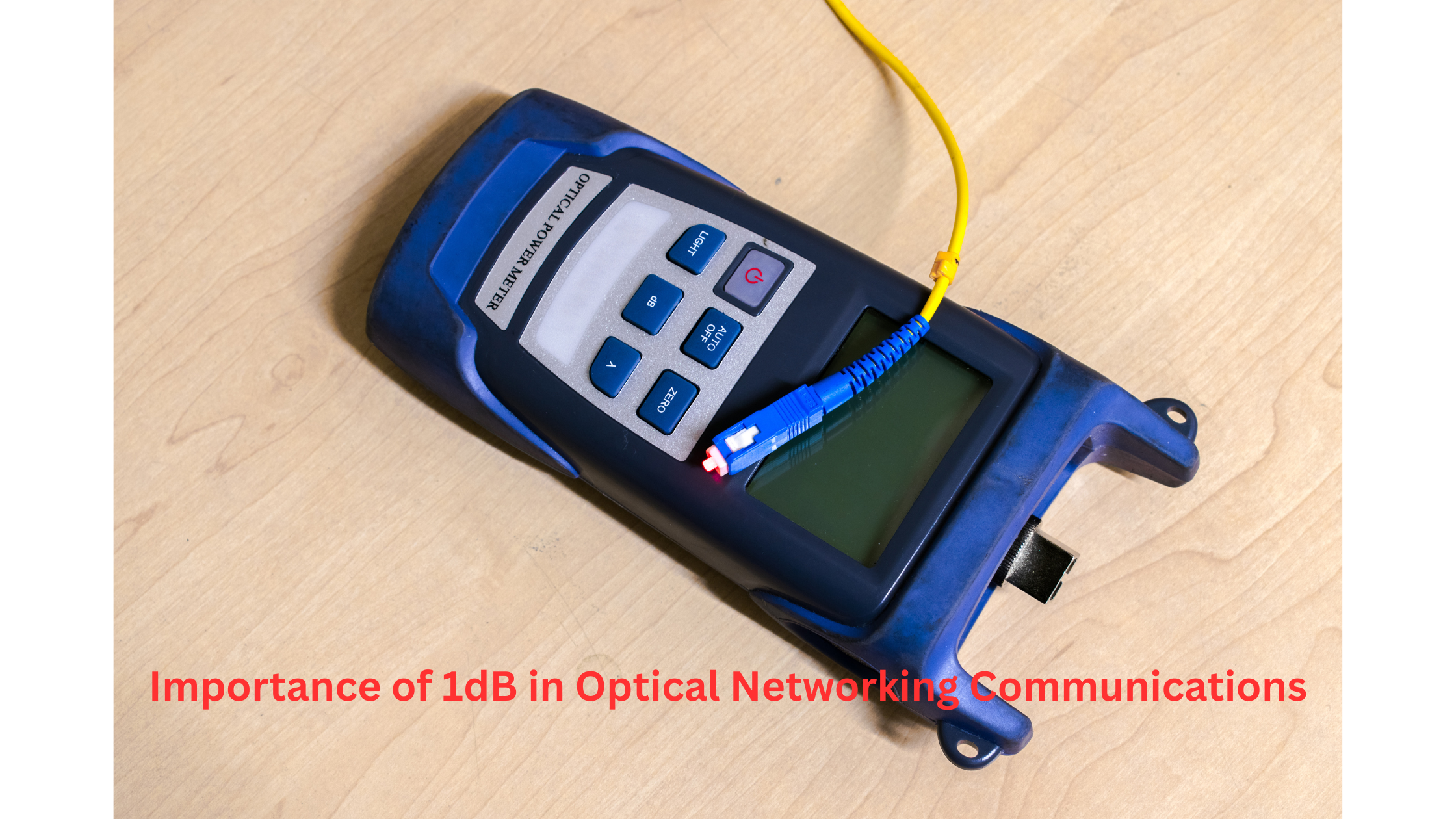
Why 1 dB Defines
Optical Networks
A comprehensive technical analysis of the decibel's role in optical communications — from mathematical foundations through economic impact — with a live interactive system calculator and dynamic visualizations.
1. Introduction
2. Mathematical and Physical Foundation
2.1 Defining the Decibel
The decibel (dB) is a logarithmic unit expressing the ratio between two power values. In optical networking it quantifies changes in optical power, signal-to-noise ratio, and transmission parameters. Because gains and losses across cascaded components simply add rather than multiply, the logarithmic scale is ideal for multi-span system analysis — compressing a dynamic range spanning milliwatts to femtowatts into manageable integers.
Power Ratio — Fundamental DefinitiondB = 10 × log10( P2 / P1 )Where: P₁ = reference power (W or mW) P₂ = measured power (W or mW)
2.2 The Precise Meaning of 1 dB
Derivation — 1 dB Power RatioP₂ / P₁ = 100.1 ≈ 1.259 1 dB gain → signal is +25.9% stronger 1 dB loss → signal is −20.6% weaker (1 / 1.259 ≈ 0.794)
A 1 dB change corresponds to a power ratio of 1.259:1. The asymmetry matters: a 1 dB gain does not simply undo a 1 dB loss in linear terms. Gaining then losing 1 dB leaves the system 0.6% below the original power — negligible in isolation but significant when repeated across dozens of components.
2.3 The Additive Nature of Decibels
The most practical property of decibels is that cascaded effects add algebraically. When a signal passes through multiple elements, the total change is the sum of all individual contributions in dB — making link budget analysis tractable for complex multi-span systems.
Cascaded SystemdBtotal = dB1 + dB2 + ... + dBn
Fiber span 0.20 dB/km × 80 km = 20 dB loss · Two connectors 0.5 dB each = 1 dB loss · ROADM 5 dB loss · EDFA 15 dB gain
ResultdBtotal = −20 − 1 − 5 + 15 = −11 dB → 7.9% of input power remains- 1 dB = 100.1 ≈ 1.259:1 power ratio — 25.9% increase or 20.6% decrease depending on direction.
- Decibels add across cascaded elements, making link budget analysis tractable for complex multi-span systems.
- The logarithmic scale compresses milliwatt-to-femtowatt dynamic ranges into manageable integers.
3. Live System Impact Calculator
Move any slider to instantly update all results and charts. No button click is needed — every adjustment recalculates the full system in real time. Select a preset scenario to pre-populate all parameters, or dial in your own values.
4. 1 dB in Optical Component Specifications
Across optical hardware, 1 dB frequently defines the boundary between acceptable and unacceptable performance. Component datasheets, acceptance test procedures, and installation standards all reference 1 dB as a key threshold because a 25.9% power difference is large enough to affect system-level behaviour while remaining achievable through careful design.
| Component | 1 dB Specification | Technical Significance | Typical Range | Economic Impact |
|---|---|---|---|---|
| Optical Fiber | Loss coefficient (dB/km) | Defines max unamplifed reach; every 0.01 dB/km reduction extends span ~4–5% | G.652D: 0.18–0.20 dB/km; G.654 ultralow: 0.15–0.17 dB/km | ±$500–800/km; can eliminate $50,000+ amplifier sites |
| Optical Connectors | Insertion loss max: 1 dB | Exceeding 1 dB triggers rework; indicates poor polish or damaged end-face | APC: 0.2–0.3 dB; UPC: 0.3–0.5 dB; factory: 0.1–0.2 dB | $15–25 premium per pair for low-loss grade |
| Fusion Splices | Accepted ≤0.1 dB; 1 dB triggers rework | Repair events add 0.2–1.0 dB cumulatively; each 1 dB equals a decade of aging margin | Lab: 0.02–0.05 dB; field same fiber: 0.05–0.10 dB | $50–100 labor per rework |
| PON Splitters | Excess insertion loss beyond split ratio | 1 dB difference between 1:32 and 1:64 split affects subscriber capacity by 50% | Standard: 0.3–0.7 dB; premium: 0.2–0.3 dB | $50–150 premium; can double served subscriber density |
| DWDM Filters | 1 dB passband width (nm) | Spectral width where insertion loss ≤1 dB; limits max symbol rate | 100 GHz: 0.6–0.8 nm; 50 GHz: 0.3–0.4 nm | $200–800 premium; enables 25% higher baud rate |
| EDFA Gain Flatness | Peak-to-peak ≤1 dB across C-band | Uneven gain accumulates; 1 dB improvement can add 30–50 usable channels | Premium: ±0.3 dB; gain-flattened: ±0.5 dB; standard: ±0.75 dB | $1,000–5,000 premium per amplifier |
| EDFA Noise Figure | 1 dB NF improvement | Improves OSNR by 1 dB per span; extends reach 20–25%; enables higher modulation | Standard: 4.5–5.5 dB; low-noise: 3.5–4.5 dB; Raman: −1 to +1 dB effective | $3,000–8,000 premium; can eliminate $250,000+ regeneration sites |
| ROADMs (WSS) | Path-to-path uniformity ≤1 dB | Limits cascadable node count and route flexibility | Premium: 0.3–0.5 dB; standard: 0.8–1.2 dB | $5,000–15,000 premium; extends cascade from 8 to 12–14 nodes |
| Dispersion Compensation | Insertion loss per 100 ps/nm compensation | Each 1 dB reduction extends reach 4–5% | DCF-based: 3–5 dB; FBG-based: 2–3 dB; premium: 1–2 dB | $500–2,000 premium for lower-loss modules |
| Coherent Modulators | E-O 1 dB bandwidth (GHz) | Each 1 dB bandwidth extension enables ~10–15% higher symbol rate | Standard: 30–35 GHz; premium: 40–50 GHz | $1,000–3,000 premium for extended bandwidth |
5. Impact on Optical Network Performance
5.1 Bit Error Rate
The most direct consequence of a 1 dB OSNR change is on bit error rate. The relationship is exponential — a 1 dB improvement reduces BER by a factor of 2–3, while a 1 dB degradation can double or triple it. This sensitivity becomes decisive when operating near FEC correction thresholds.
BER vs OSNR — Approximate RelationshipBER ≈ ½ × erfc( √OSNRlinear ) Linewidth-OSNR penalty products for 1 dB OSNR penalty: DP-QPSK: Δf × Ts ≈ 4×10⁻⁴ DP-16QAM: Δf × Ts ≈ 1×10⁻⁴ DP-64QAM: Δf × Ts ≈ 4×10⁻⁵
A 100G DP-QPSK system operating at 14 dB OSNR with pre-FEC BER of ~1×10⁻⁶ experiences a 1 dB OSNR degradation from connector aging, moving to 13 dB. Pre-FEC BER shifts to approximately 3×10⁻⁶. This forces migration from 7% overhead hard-decision FEC to 20% overhead enhanced soft-decision FEC, reducing effective payload throughput by roughly 13%. The economic cost of that single degraded decibel is not just performance risk — it is lost capacity.
5.2 System Reach
In amplified long-haul systems, achievable transmission distance is directly tied to the OSNR budget. The reach impact of 1 dB scales with modulation order — higher-order formats operate closer to their OSNR limits and therefore show greater sensitivity.
10G OOK — Direct Detection
100G DP-QPSK — Coherent
200G DP-16QAM — Coherent
400G DP-64QAM — Coherent
5.3 System Margin
Network designers allocate available OSNR margin across multiple impairment categories. In a typical long-haul design carrying 5–7 dB of total margin, each 1 dB represents 15–20% of the entire budget. Understanding how this margin is spent is essential for making sound engineering decisions.
Typical Margin Allocation — Long-Haul
Total system margin: 5–7 dB
- Component aging at end of life: 1.0–1.5 dB
- Cable repair splices: 0.5–1.0 dB
- Temperature-induced variation: 0.5–1.0 dB
- Polarization effects (PMD): 0.5 dB
- Nonlinear penalties (XPM, FWM): 1.0–2.0 dB
- Unallocated reserve: 1.0–1.5 dB
What 1 dB Represents in This Budget
- 15–20% of total system margin
- Equivalent to 2–3 cable repair events
- Approximately 8–10 years of component aging
- Full allocation for temperature-induced variation
- Half of the nonlinear impairment budget
- Can be the tipping point between pass and fail at end of life
Always retain at least 1 dB of unallocated margin beyond all known impairments. This provides protection against measurement uncertainty, unexpected degradation, and future route changes — without meaningfully increasing system cost. Experienced planners call this the 1 dB reserve rule.
- 1 dB OSNR change moves BER by 2–3×; higher-order formats show steeper response.
- Reach impact ranges from 15% (DP-QPSK) to 30% (DP-64QAM) per 1 dB change.
- In a 5–7 dB margin budget, 1 dB equals 15–20% — equivalent to a full decade of aging allowance.
6. 1 dB Across Network Types
6.1 Submarine Optical Networks
Submarine systems magnify the value of 1 dB because the environment is inaccessible, every repeater requires costly deep-sea installation, and system lifetimes exceed 25 years. A trans-Pacific cable system carrying $300–500 million in capital depends on every available decibel of performance headroom.
| Parameter | Impact of 1 dB Improvement | Economic Benefit |
|---|---|---|
| Repeater Spacing | 16–20 km greater span (≈20% increase) | ~$750,000 savings per 500 km (one fewer repeater) |
| System Capacity | 25–30% increase via higher modulation | $10–50 million additional revenue over 25-year lifetime |
| Cable Repair Events | Each repair adds 0.5–1.0 dB cumulative loss | $500,000–2,000,000 per repair vessel deployment |
| System Lifetime | 1 dB margin reserve extends usable life 3–5 years | Defers $100+ million cable replacement by 20–25% |
| End-of-Life BER | 1 dB buffer prevents FEC margin collapse as components age | Avoids unplanned outages and SLA penalties on critical routes |
— Chief Technology Officer, Major Submarine Cable Operator
6.2 Terrestrial Long-Haul Networks
In terrestrial long-haul networks spanning hundreds or thousands of kilometres through multiple nodes, 1 dB determines whether electrical regeneration is required, whether capacity upgrades are feasible on existing plant, and how long installed fibre can sustain planned traffic growth. Engineers regularly identify 1 dB opportunity points — aging connectors, suboptimal amplifier configurations, or fibre sections with slightly elevated loss — where a targeted $10,000–30,000 intervention defers capacity expansion costing $500,000 or more.
- Regeneration avoidance: A 1 dB improvement can extend reach 15–20%, potentially eliminating an electrical regeneration site at $250,000–500,000 plus ongoing colocation and power costs.
- Capacity upgrade enablement: A 1 dB margin gain can allow migration from 100G DP-QPSK to 200G DP-16QAM on qualifying routes, doubling wavelength capacity without additional line equipment.
- Fibre type selection: Premium fibre at 0.18 dB/km versus standard at 0.20 dB/km provides approximately 1 dB advantage over a 500 km route, often justifying the 15–20% higher deployment cost.
- Seasonal and environmental variation: Temperature-induced loss on exposed aerial plant can approach 1 dB between summer and winter extremes, requiring explicit margin allocation during design.
6.3 Metro and Access Networks
In metro and passive optical network (PON) applications, 1 dB has equally concrete value in a different form. The most impactful scenario is split ratio expansion: a 1 dB improvement in PON link budget can enable moving from a 1:32 to a 1:64 split ratio on the same infrastructure, doubling the number of subscribers served per port.
| Scenario | Impact of 1 dB | Business Result |
|---|---|---|
| PON Split Ratio | Enables 1:32 → 1:64 upgrade on same infrastructure | Up to 50% more subscribers from same port; significant CAPEX avoidance |
| Access Reach Extension | 3–5 km additional coverage distance | Can eliminate a remote terminal node at $80,000–120,000 |
| CWDM to DWDM Migration | 1 dB additional margin enables denser channel spacing | 8 channels to 40 channels — 5× capacity increase on existing fibre |
| Metro ROADM Cascade | 1 dB lower node insertion loss | Extends cascadable count from 8 to 12–14 nodes without extra amplification |
| Bend-Insensitive Fibre | ~1 dB advantage in high-density installations | Reduced truck rolls; essential for multi-dwelling unit deployments |
7. The Economic Value of 1 dB
7.1 Capital Expenditure Impact
7.2 Operational Expenditure Impact
| Operational Factor | Impact of 1 dB Improvement | Annual OPEX Savings |
|---|---|---|
| Power Consumption | 10–15% reduction in amplification requirements per site | $5,000–10,000 per 100 km route |
| Maintenance Frequency | Increased margin reduces emergency dispatch requirements | $15,000–25,000 per 100 km route |
| System Reliability | Fewer service-affecting events; reduced SLA exposure | $20,000–50,000 in avoided penalties |
| Network Upgrade Deferral | Extends system lifetime by 2–3 years | $50,000–100,000 per 100 km (amortized) |
| Service Turn-Up Efficiency | Reduced path optimization labor during provisioning | $10,000–20,000 per year |
7.3 Return on Investment
A major carrier upgraded from standard to premium amplifiers with 1 dB better noise figure across a 10,000 km backbone. The 10-year financial analysis:
- Additional CAPEX: $1.2 million ($3,000 premium × 400 amplifiers)
- CAPEX savings from avoided regeneration: $4.5 million (15 sites × $300,000 each)
- Annual OPEX savings: $850,000 (power, maintenance, reliability)
- Network capacity increase: 25% via modulation format upgrade across backbone
- Net Present Value over 10 years (8% discount rate): $12.7 million
- ROI: 960% over 10 years. Payback period: 9 months.
This example demonstrates why operators make premium amplifier investments: the 1 dB difference is not a marginal specification — it is a capital allocation decision with highly measurable returns.
8. Implementation Strategies
8.1 Component-Level Approaches
| Component | Strategy | Complexity | Cost Premium |
|---|---|---|---|
| Optical Fiber | Ultralow-loss fiber (0.15–0.17 dB/km vs. 0.18–0.20 dB/km); larger effective area to reduce nonlinear penalties | Low — drop-in at deployment time | 15–20% |
| Connectors and Splices | Premium factory-polished APC connectors; splice quality program with rework thresholds at 0.05 dB | Low | 30–50% |
| EDFA Amplifiers | Optimized pump configuration; two-stage design with reduced mid-stage loss; gain-flattening filters | Medium | 20–30% |
| WDM Filters | Advanced thin-film deposition for wider 1 dB passband; enables higher baud rates with less filter penalty | High | 40–60% |
| Coherent Transceivers | Probabilistic constellation shaping (PCS) provides 1–2 dB effective OSNR gain at same hardware cost; enhanced soft-decision FEC | Medium — DSP and firmware | 10–20% |
| ROADMs | Lower-loss switching fabric; WSS with improved port-to-port uniformity; minimizing passive optical path count per node | High | 20–40% |
8.2 System-Level Strategies
- Raman amplification: Distributed Raman can improve effective OSNR by 2–6 dB compared to lumped EDFA-only designs by providing gain close to the signal source, substantially reducing the first-span noise contribution.
- DSP-based nonlinearity compensation: Digital backpropagation and perturbation-based algorithms recover approximately 1 dB of nonlinear OSNR penalty on heavily loaded multi-channel systems.
- Probabilistic constellation shaping (PCS): Adapting symbol probabilities to a non-uniform distribution that approaches Shannon capacity provides 1–2 dB of effective coding gain without hardware changes — one of the highest-value 1 dB improvements available today.
- Dynamic per-channel power optimization: Closed-loop control based on measured OSNR per channel rather than worst-case planning assumptions typically recovers 0.5–1.0 dB of effective system margin.
- Periodic 1 dB audits: Measure per-span OSNR using optical performance monitoring, compare against the design baseline, and flag spans showing more than 0.3 dB deviation for proactive maintenance before service impact occurs.
9. Future Directions
Several emerging technologies are changing how 1 dB improvements are achieved, measured, and leveraged. As systems approach Shannon capacity limits on conventional single-mode fibre, the marginal value of each decibel increases — making the engineering economics of 1 dB more important over time, not less.
Machine Learning — Predictive OSNR Management
ML-based optical performance prediction identifies gradual margin erosion before it crosses service thresholds, enabling proactive maintenance that preserves 0.5–1.0 dB of effective system margin that would otherwise be consumed by undetected degradation.
Hollow-Core Fibre
Air-guided propagation reduces the nonlinear refractive index by approximately 100× relative to silica. This delivers 2–3 dB effective OSNR improvement on long spans where nonlinear impairments currently dominate the performance limit.
Phase-Sensitive Amplification
Phase-sensitive optical amplifiers can approach a theoretical 0 dB noise figure, compared to the 3 dB quantum limit for conventional phase-insensitive amplifiers. This represents a fundamental breakthrough that would redefine long-haul system economics.
Silicon Photonics Integration
Advances in silicon nitride waveguide technology are reducing coupling and interconnection losses within coherent transceiver chips, enabling more complex optical processing at lower insertion loss and supporting baud rates beyond 100 GBaud.
Adaptive DSP and Neuromorphic Processing
Real-time adaptive nonlinearity compensation architectures enable recovery of approximately 1.5 dB of effective OSNR in nonlinear-limited regimes, with processing complexity scaling more favourably than traditional digital backpropagation methods.
Margin as a Service
Carriers are beginning to define service tiers by OSNR margin allocation: standard service at 2 dB margin, premium at 3 dB, and mission-critical at 4 dB with the highest availability guarantees. This transforms 1 dB from an engineering constraint into a billable, tradeable quantity.
10. Conclusion
The significance of 1 dB in optical networking extends far beyond its mathematical definition as a 25.9% change in power. Across every network type and application domain, this unit functions as a precision lever whose consequences multiply through system economics, service quality, and long-term infrastructure value.
At the physical layer, 1 dB in OSNR changes BER by factors of 2–3, can force FEC overhead escalation that reduces payload throughput by more than 10%, and determines whether higher-order modulation formats are viable on a given route. At the infrastructure level, 1 dB in amplifier noise figure can eliminate regeneration sites costing $250,000–500,000, extend submarine repeater spacing by 16–20 km, and defer cable replacement by several years. At the business level, systematic 1 dB improvements routinely deliver ROI exceeding 500% over a 10-year horizon.
As coherent systems evolve toward 800G and beyond — operating with tighter margins and less room for suboptimal performance — the engineers, architects, and operators who master the art and science of 1 dB management will consistently outperform those who treat the decibel as a passive measurement unit rather than an active engineering resource.
- 1 dB = 100.1 ≈ 1.259:1 power ratio; additive across cascaded optical elements.
- 1 dB OSNR improvement reduces BER by 2–3× and extends reach by 15–30% depending on modulation.
- In a 5–7 dB margin budget, 1 dB represents 15–20% — equivalent to a decade of aging allowance.
- ROI from targeted 1 dB improvements routinely exceeds 500% over 10 years at backbone scale.
- Hollow-core fibre, phase-sensitive amplification, and PCS offer the most promising paths to the next generation of 1 dB improvements.
Glossary
References
Note: This guide is based on industry standards, best practices, and real-world implementation experience. Values vary based on equipment type, network topology, and regulatory requirements. Consult qualified network engineers for actual deployments.
Feedback Welcome: [email protected]
Related Articles on MapYourTech