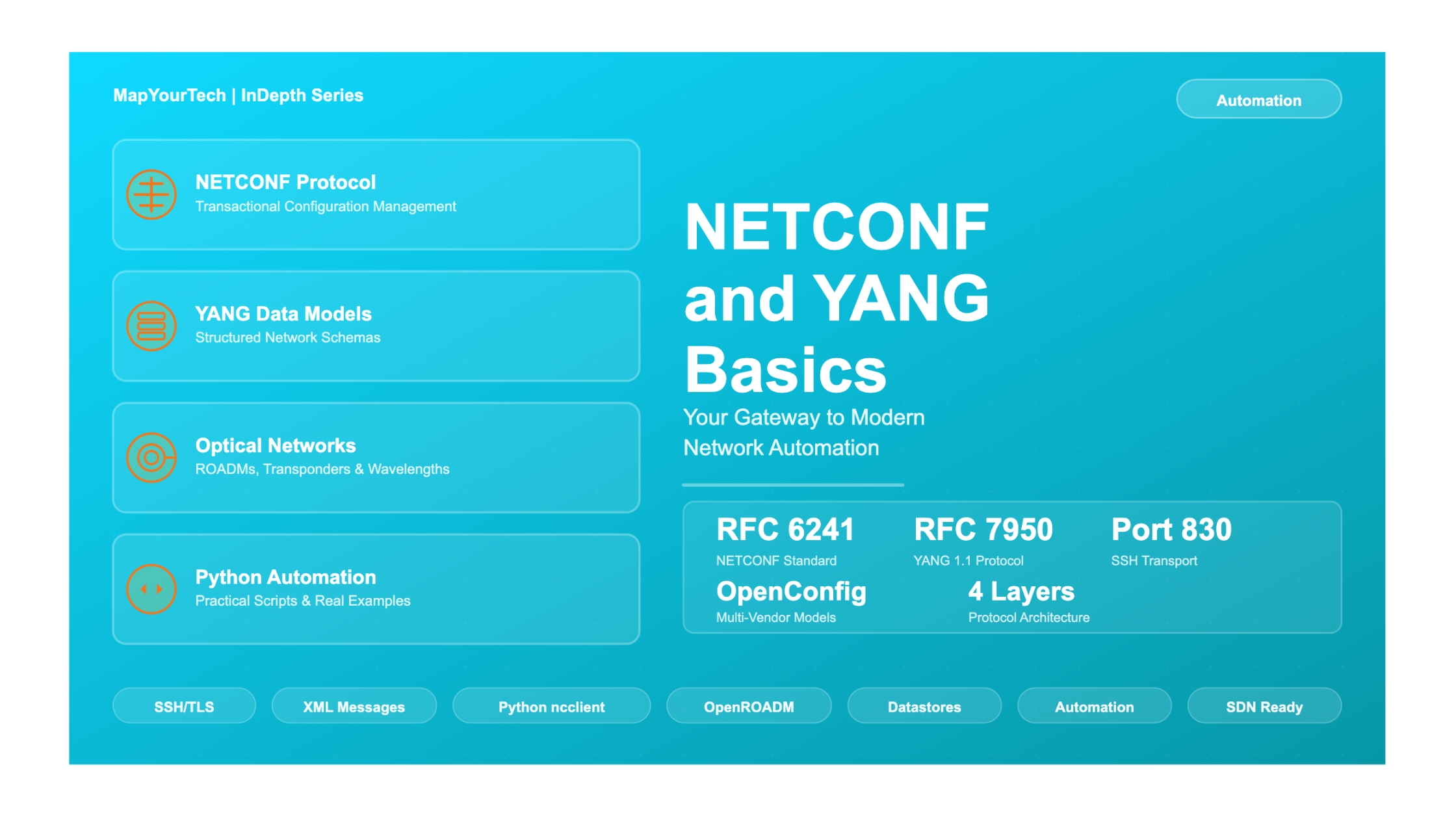

NETCONF and YANG Basics: Your Gateway to Modern Optical Network Automation
Introduction
This article is written based on my personal experience throughout my career, and my intention is to help friends and colleagues in understanding the basics and getting a glimpse of automation in the networking world. I want you to feel motivated and not get scared by the jargons used for automation.
In my terms: Automation is not replacing jobs but enabling you to live life more efficiently and with freedom. It is just an act of kindness by technology to give back to its users and the creators.
The scale with which networking communication devices and their usage are increasing means we need substantial network bandwidth and automation in place to operate, configure, predict, and manage it. To have a more robust, scalable, and reliable network, we need vendor-agnostic and low-latency automation that can help the network grow.
For years, optical network engineers have relied on command-line interfaces accessed through SSH or Telnet sessions to configure and manage network devices. We've all been there – typing commands manually, copying and pasting configuration snippets, and hoping that a typo doesn't bring down a critical link carrying terabits of traffic. While this approach worked for smaller networks, it simply cannot scale to meet the demands of modern hyperscale data centers, metro networks, and long-haul optical systems.
The evolution from CLI-based manual configuration to modern, programmable network management represents one of the most significant transformations in optical networking. At the heart of this transformation are two technologies that work hand-in-hand: NETCONF (Network Configuration Protocol) and YANG (Yet Another Next Generation data modeling language). These technologies form the foundation of model-driven network management, enabling automation at scale while maintaining security, reliability, and multi-vendor interoperability.
This comprehensive guide will walk you through everything you need to know about NETCONF and YANG, from fundamental concepts to practical implementation. Whether you're an optical engineer looking to start your automation journey or an experienced professional wanting to deepen your understanding, this article will provide you with actionable knowledge and real-world insights.
Why Automation is Needed in Optical Networks
Before diving into the technical details, let's understand why automation has become essential in modern optical networks. Here are some compelling reasons why every optical network engineer should embrace automation:
Simplify Your Life
Automation makes your life simpler and more cheerful by eliminating monotonous and boring pieces of work. Instead of manually configuring hundreds of wavelengths across multiple ROADMs, you can define the desired state once and let automation handle the rest.
Enable Creativity
When automation handles routine tasks, you get time to think about something more creative. You can focus on network design, optimization strategies, and innovative solutions rather than repetitive configuration tasks.
Work From Anywhere
Automation gives you more flexibility as it can be enabled or operated from remote places. You're no longer tied to a terminal in the network operations center – you can manage your optical network from anywhere with proper security controls.
Work-Life Balance
You can spend more time with your loved ones. Automated systems can handle routine maintenance windows, alarm monitoring, and performance optimization, giving you back your evenings and weekends.
Build Confidence
Automation gives you a sense of security and confidence. When you can validate configurations before deployment, rollback changes automatically, and maintain consistent state across your network, you sleep better at night.
Career Growth
Automation skills can lead you to successful entrepreneurship or advanced career opportunities. The demand for engineers who can bridge optical networking expertise with automation capabilities continues to grow exponentially.
What Can You Automate in Optical Networks?
Almost everything you do in your routine job as a network engineer can eventually be automated. Here are practical examples specific to optical networks:
Device Logins and Configurations: Automate the process of connecting to transponders, ROADMs, and optical amplifiers, then pushing configurations based on templates or service requirements. No more manual CLI sessions for routine changes.
Metrics Polling and Performance Monitoring: Continuously collect optical power levels, OSNR, pre-FEC and post-FEC BER, chromatic dispersion, and other critical parameters from your optical devices. Streaming telemetry provides real-time visibility into network health.
Network Management Customization: Build customized management workflows that fit your operational processes. Integrate optical network management with your existing OSS/BSS systems through standard APIs.
Encryption Key Rotation: Automate security operations including encryption key management and rotation for optical layer encryption systems, ensuring continuous security without manual intervention.
Capacity Monitoring and Planning: Automatically track spectrum utilization, predict when additional capacity will be needed, and even trigger network augmentation workflows based on defined thresholds.
Fault Alarming and Correlation: Implement intelligent alarm management that correlates faults across multiple network layers, filters nuisance alarms, and provides root cause analysis.
Link Routing and Restoration: Enable automated protection switching, dynamic restoration path calculation, and traffic engineering based on real-time network conditions.
Network Self-Healing: Implement closed-loop automation that detects degrading optical performance, identifies the root cause, and automatically takes corrective action before service impact occurs.
Reporting and Analytics: Generate automated reports on network performance, capacity utilization, SLA compliance, and more. Transform raw telemetry data into actionable business intelligence.
Key Insight
This is just an idea of what's possible. Whatever you are doing in your routine job as a network engineer, almost everything can be automated. The key is to start small – identify one repetitive task that consumes your time, automate it, and build from there.
1. The Evolution of Network Management: From CLI to Model-Driven Automation
To truly appreciate NETCONF and YANG, we need to understand the journey from traditional network management to modern programmable networks. This evolution reflects the industry's response to growing network complexity and the limitations of legacy management approaches.
The CLI Era: Manual Configuration and Screen Scraping
In the early days of optical networking, and even today in many networks, the Command Line Interface reigns supreme. Engineers connect to devices via Telnet or SSH and type commands to configure interfaces, set optical parameters, and retrieve operational status. While this approach is human-friendly – we can read and understand the commands and output – it presents significant challenges for automation.
The primary problem with CLI-based automation is that it requires "screen scraping" – parsing unstructured text output to extract meaningful information. A minor change in the formatting of a show command's output, introduced in a new software version, can break countless scripts that depend on that specific format. The data is unstructured, requiring complex regular expressions or text parsers to extract meaningful information. Furthermore, every vendor's CLI is different, forcing engineers to write and maintain separate parsers for each platform. This approach does not scale and is a constant source of maintenance overhead and operational risk.
SNMP: The First Step Toward Standardization
The Simple Network Management Protocol (SNMP) emerged as an attempt to standardize network monitoring. SNMP uses Management Information Bases (MIBs) – hierarchical data structures that define what information a device can expose. While SNMP solved some problems, it introduced others. The protocol was designed primarily for monitoring rather than configuration, making it read-biased. Polling-based collection creates significant overhead at scale, and SNMPv1/v2c security was weak. Most critically for modern automation, SNMP lacks transactional semantics and robust error handling.
For optical networks specifically, SNMP could retrieve optical power readings, alarm states, and inventory information, but configuring wavelengths, setting modulation formats, or programming ROADM cross-connects remained CLI-based operations. The industry needed something better.
2. NETCONF Fundamentals: The Modern Configuration Protocol
NETCONF (Network Configuration Protocol), defined in RFC 6241, represents a fundamental shift in how we manage network devices. Unlike CLI, which was designed for human interaction, NETCONF is designed from the ground up for machine-to-machine communication while maintaining human readability when needed. Unlike SNMP, which evolved from monitoring requirements, NETCONF focuses on configuration management with transaction support.
The NETCONF Architecture: Four Layers Working Together
NETCONF is architected in four distinct layers, each serving a specific purpose. This clean separation of concerns is one of NETCONF's greatest strengths.
Layer 1: Secure Transport
The foundation of NETCONF is a secure, reliable transport layer. While the protocol supports multiple transports, SSH (defined in RFC 6242) is by far the most common, using port 830. TLS is also supported for certificate-based authentication scenarios, using port 6513. This layer provides encryption, authentication, integrity, and confidentiality – essential requirements for managing production optical networks carrying sensitive traffic.
The use of SSH means that NETCONF benefits from well-established key management infrastructure. Organizations can use the same authentication mechanisms – passwords, public keys, RADIUS, TACACS+ – that they already use for CLI access, easing operational adoption.
Layer 2: Messages
NETCONF messages are encoded in XML (eXtensible Markup Language), a structured, human-readable format that machines can also parse reliably. Each NETCONF operation is framed as an RPC (Remote Procedure Call) request from the client, with the server returning an RPC reply. Messages are delineated using special markers, allowing multiple requests and responses to be sent over a single persistent session.
XML might seem verbose compared to JSON or binary protocols, but it provides several advantages: built-in schema validation through XSD, strong tooling support, namespace handling for multi-vendor environments, and native XPATH support for targeting specific configuration elements. For example, you can request just the configuration of interface "1/1/c1" rather than retrieving the entire device configuration.
Layer 3: Operations
The Operations layer defines what you can actually do with NETCONF. The protocol specifies a set of standard RPC operations that every NETCONF server must support. These operations form the vocabulary of network automation:
Standard NETCONF Operations
<get> – Retrieve running configuration and device state data. This is your "show" equivalent, but with structured output.
<get-config> – Retrieve configuration from a specific datastore (running, candidate, or startup). Unlike <get>, this operation retrieves only configuration data, not operational state.
<edit-config> – Modify the configuration in a target datastore. This is the workhorse operation for making configuration changes. It supports multiple operation modes: merge (add or update), replace (replace existing), create (must not exist), delete (must exist), and remove (delete if exists).
<copy-config> – Copy an entire configuration from one datastore to another, or from/to a URL (for backup/restore operations).
<delete-config> – Delete a configuration datastore (typically startup or candidate, never running).
<lock> and <unlock> – Acquire or release an exclusive lock on a datastore, preventing other clients from making changes during critical operations.
<commit> – Apply changes from the candidate datastore to the running configuration. This operation is at the heart of NETCONF's transactional capabilities.
<validate> – Validate a configuration before committing it, catching errors before they impact the running network.
Many NETCONF servers also support capability-based extensions. For example, the "confirmed commit" capability allows you to commit a configuration with an automatic rollback timer – if you don't confirm the change within a specified period, the device automatically reverts to the previous configuration. This is invaluable when making changes that might disconnect you from the device.
Layer 4: Content
The Content layer is where YANG data models come into play. YANG defines the structure and semantics of the configuration and state data being manipulated. Without YANG, NETCONF would just be a generic RPC protocol with no understanding of what optical power, wavelength, or ROADM cross-connect actually means. YANG provides that semantic layer, and we'll explore it in depth in the next section.
NETCONF Datastores: The Secret to Transactional Configuration
One of NETCONF's most powerful features is its datastore model. Rather than directly modifying the running configuration (like CLI commands do), NETCONF allows you to stage changes in a separate "candidate" datastore, validate them, and then commit atomically. This eliminates the risk of partial configuration failures that plague CLI-based automation.
The three primary datastores are:
Running Datastore: This is the active configuration currently controlling the device. Changes to the running datastore take effect immediately. Every NETCONF-capable device must support a running datastore.
Candidate Datastore: This is a staging area where you can build up a complete configuration change across multiple edit-config operations without affecting the running device. Only when you issue a commit operation does the candidate configuration get applied to running. If validation fails or any part of the commit cannot be applied, the entire operation is rolled back, leaving the running configuration unchanged. Support for candidate datastore is optional but highly recommended.
Startup Datastore: This contains the configuration that will be loaded when the device boots. Not all devices maintain a separate startup configuration, but when present, you can use it to prepare configurations that should take effect on the next reboot. This is particularly useful for optical transponders and ROADM controllers that require maintenance windows for software upgrades.
Real-World NETCONF Example: Configuring an Optical Channel
Let's look at a practical example of using NETCONF to configure a wavelength on an optical transponder. This example uses the OpenConfig data model, which we'll explain more fully in the YANG section.
# Python example using ncclient library
from ncclient import manager
import xml.etree.ElementTree as ET

# Connect to optical transponder
with manager.connect(
    host='192.168.1.100',
    port=830,
    username='netconf-user',
    password='secure-password',
    hostkey_verify=False
) as m:

    # Configuration payload for optical channel
    config = '''
    <config xmlns="urn:ietf:params:xml:ns:netconf:base:1.0">
      <components xmlns="http://openconfig.net/yang/platform">
        <component>
          <name>optical-channel-1-1</name>
          <optical-channel xmlns="http://openconfig.net/yang/terminal-device">
            <config>
              <frequency>196100000</frequency>
              <target-output-power>0.0</target-output-power>
              <operational-mode>1</operational-mode>
            </config>
          </optical-channel>
        </component>
      </components>
    </config>
    '''

    # Lock candidate datastore
    m.lock(target='candidate')

    # Edit configuration (set wavelength to 1529.16nm, 0dBm output)
    m.edit_config(target='candidate', config=config)

    # Validate before committing
    m.validate(source='candidate')

    # Commit changes to running config
    m.commit()

    # Unlock datastore
    m.unlock(target='candidate')

    print("Optical channel configured successfully!")
This example demonstrates the complete workflow: connect securely over SSH to port 830, lock the candidate datastore to prevent concurrent modifications, push the configuration change, validate it, commit to running configuration, and finally unlock. If any step fails, we can catch the error and take appropriate action, such as discarding the candidate changes and unlocking.
3. YANG: The Data Modeling Language for Networks
NETCONF provides the "how" – the protocol mechanics for configuration management. YANG provides the "what" – the definition of exactly what can be configured and monitored on a network device. Think of YANG as the schema or blueprint that describes all the data structures, their relationships, constraints, and semantics.
Why YANG Matters: The Blueprint for Your Network
To understand YANG's importance, consider this analogy: if you were building a database application, you wouldn't just send random SQL queries hoping they work. You would first define a database schema that specifies what tables exist, what columns each table has, what data types each column accepts, and what constraints apply. YANG provides exactly this for network devices.
A YANG model clearly defines the structure of data, the data type for each piece of information, constraints and relationships, and a clear distinction between configuration data (read/write) and state data (read-only). By using YANG, the network's data model becomes standardized and machine-readable, eliminating the ambiguity of text-based CLIs.
YANG Building Blocks: Containers, Lists, and Leaves
YANG models are composed of several fundamental constructs that work together to describe network device data:
Modules and Namespaces: Every YANG model is defined in a module, which has a unique namespace identifier. This prevents naming conflicts when devices support multiple models from different vendors or standards bodies. For example, OpenConfig uses namespaces like "http://openconfig.net/yang/terminal-device" while vendor-native models use their own namespaces.
Containers: Containers group related configuration elements together. They're analogous to directories in a filesystem or structs in programming. For example, an "interfaces" container would hold all interface-related configuration. Containers can be nested to create hierarchies.
Lists: Lists define repeated elements identified by one or more keys. Each instance in the list is uniquely identified by its key values. For example, a list of interfaces would have each interface identified by its name key. Lists are similar to database tables – the key is like the primary key, and other elements are like columns.
Leafs: Leafs are individual data values. Each leaf has a specific data type (integer, string, boolean, enumeration, etc.), units, range constraints, default values, and a human-readable description. For example, a leaf might represent the target output power of an optical channel, defined as a decimal64 with units of dBm and a range of -20.0 to +2.0.
Leaf-Lists: Leaf-lists are arrays of simple values, like a list of IP addresses or wavelengths.
// Example YANG module fragment for optical channel
module openconfig-terminal-device {
  namespace "http://openconfig.net/yang/terminal-device";
  prefix "oc-opt-term";

  container terminal-device {
    description "Top-level container for optical transponder";

    container logical-channels {
      description "Logical channels for signal transport";

      list channel {
        key "index";
        description "List of logical channels";

        leaf index {
          type uint32;
          description "Unique identifier for this channel";
        }

        leaf admin-state {
          type enumeration {
            enum ENABLED;
            enum DISABLED;
            enum MAINT;
          }
          default ENABLED;
          description "Administrative state of the channel";
        }

        leaf frequency {
          type uint64;
          units "MHz";
          description "Center frequency in MHz (ITU grid)";
        }

        leaf target-output-power {
          type decimal64 {
            fraction-digits 2;
            range "-20.0..2.0";
          }
          units "dBm";
          description "Target optical output power";
        }
      }
    }
  }
}
Configuration vs. State Data: A Critical Distinction
One of YANG's most important design principles is the clear separation between configuration data (config true) and operational state data (config false). This distinction addresses a fundamental problem with traditional SNMP MIBs, where configuration intent was mixed with operational status, making it difficult to distinguish "what you want" from "what actually is."
Configuration Data (config true): This represents the desired state – what you want the device to do. For an optical channel, configuration data includes target frequency, target output power, modulation format, and admin state. Configuration data is writable through edit-config operations.
State Data (config false): This represents the actual operational status – what the device is actually doing. For an optical channel, state data includes current measured output power, received input power, chromatic dispersion, OSNR, and FEC statistics. State data is read-only and retrieved through get operations.
This separation enables several important capabilities. You can compare intended configuration against actual state to detect discrepancies. You can retrieve only configuration for backup purposes or only state for monitoring, reducing data transfer. You can validate proposed configurations without worrying about read-only fields, and automation systems can clearly understand which data they control versus which data they simply observe.
YANG Model Families: OpenConfig, OpenROADM, IETF, and Native
The YANG ecosystem includes multiple families of models, each serving different purposes and developed by different communities. Understanding these families helps you choose the right models for your automation goals.
OpenConfig Models
OpenConfig is a collaborative effort between network operators including Google, Microsoft, AT&T, and others to create vendor-neutral, operationally-focused YANG models. OpenConfig prioritizes the 80% of functionality that 80% of operators need, focusing on consistency and multi-vendor interoperability rather than exposing every possible knob.
Key optical transport models include openconfig-terminal-device for transponders and muxponders, openconfig-optical-amplifier for EDFAs and Raman amplifiers, openconfig-wavelength-router for ROADM configuration, openconfig-optical-attenuator for VOAs, and openconfig-transport-line-protection for optical protection switching.
OpenConfig models typically use separate config and state containers rather than YANG's config true/false annotation, making the distinction even more explicit in the data tree structure.
OpenROADM MSA Models
The OpenROADM Multi-Source Agreement defines comprehensive models specifically for optical disaggregated networks. These models cover device models for ROADMs, transponders, and pluggables, network models for topology representation and service paths, and service models for optical circuit provisioning.
OpenROADM models are particularly strong in DWDM and flex-grid ROADM capabilities, supporting colorless/directionless/contentionless architectures. The OpenROADM GitHub repository maintains up-to-date models that major optical vendors support.
IETF Models
The Internet Engineering Task Force develops standards-track YANG models through its various working groups. The CCAMP (Common Control and Measurement Plane) working group focuses on optical transport, producing models for OTN topology, WSON (Wavelength Switched Optical Networks), flexi-grid networks, and optical impairment-aware path computation.
IETF models tend to be comprehensive and formally standardized, but they can take years to reach maturity due to the consensus-based standards process. They're particularly valuable for inter-domain and inter-controller communication.
Vendor-Native Models
Every major optical equipment vendor provides their own YANG models that expose the full capabilities of their platforms. Native models typically offer the most complete feature coverage for a specific vendor's equipment, including advanced and proprietary features not covered by standard models.
The downside of native models is that they require vendor-specific automation code. If you have a multi-vendor environment, you might need to write separate logic for each vendor's native models, partially negating the benefits of model-driven automation.
Best practice is to use OpenConfig models where they provide adequate functionality, as they maximize multi-vendor interoperability. Fall back to vendor-native models only when you need advanced features not covered by OpenConfig. Avoid mixing multiple model families for the same functionality within a single device to prevent conflicts.
4. Practical Implementation: Getting Started with NETCONF and YANG
Understanding the concepts is one thing; implementing them in your network is another. This section provides practical guidance on getting started with NETCONF and YANG automation in your optical network environment.
Building Your Automation Toolkit
To begin working with NETCONF and YANG, you'll need some tools. The good news is that most of these are freely available. Here's what I personally recommend based on my experience:
Python: Python is the most popular language for network automation, and for good reason. It has excellent libraries for NETCONF, XML processing, and general network programming. The ncclient library provides a high-quality Python API for NETCONF operations. Install it with: pip install ncclient
YANG Tools: pyang is an essential tool for working with YANG models. It can validate YANG modules, generate tree representations showing the model structure, convert between YANG and other formats, and generate sample XML/JSON instance documents. Install with: pip install pyang
XML Libraries: Python's built-in xml.etree.ElementTree is sufficient for most tasks, but lxml provides more features and better XPath support for complex queries.
Development Environment: Use a proper IDE or text editor with Python support. VS Code, PyCharm, or Sublime Text are all excellent choices. VS Code with the Python and YANG extensions provides syntax highlighting and validation for both Python and YANG files.
SSH/Telnet Tools: While you're moving to automation, you'll still need CLI access for troubleshooting. Keep your favorite SSH client (PuTTY, SecureCRT, iTerm2) handy.
Your First NETCONF Script: Reading Device Configuration
Let's start with something simple: connecting to a device and retrieving its configuration. This script demonstrates the basic pattern you'll use repeatedly.
#!/usr/bin/env python3
# first_netconf_script.py - Read device configuration

from ncclient import manager
import xml.dom.minidom

# Device connection parameters
DEVICE = {
    'host': '192.168.1.100',
    'port': 830,
    'username': 'admin',
    'password': 'admin123',
    'hostkey_verify': False  # In production, always verify host keys!
}

def get_device_config():
    """Connect to device and retrieve running configuration"""

    print("Connecting to device...")

    # Establish NETCONF session
    with manager.connect(**DEVICE) as m:
        print(f"Connected! Session ID: {m.session_id}")
        print(f"Server capabilities: {len(m.server_capabilities)} total")

        # Retrieve running configuration
        print("\\nRetrieving running configuration...")
        config = m.get_config(source='running')

        # Pretty-print the XML
        config_xml = xml.dom.minidom.parseString(config.xml)
        print(config_xml.toprettyxml(indent="  "))

        # You can also filter to specific paths using XPath
        # filter = '''
        # <filter xmlns="urn:ietf:params:xml:ns:netconf:base:1.0">
        #   <interfaces xmlns="urn:ietf:params:xml:ns:yang:ietf-interfaces"/>
        # </filter>
        # '''
        # config = m.get_config(source='running', filter=filter)

if __name__ == "__main__":
    try:
        get_device_config()
    except Exception as e:
        print(f"Error: {e}")
A More Complex Example: Automated Wavelength Provisioning
Now let's look at a more realistic automation scenario: provisioning multiple wavelengths across an optical network. This example uses the candidate datastore for safe, transactional configuration.
#!/usr/bin/env python3
# wavelength_provisioning.py - Automated optical channel setup

from ncclient import manager, operations
import logging

# Set up logging to see what's happening
logging.basicConfig(level=logging.INFO)

# Wavelength plan: channel name, frequency (MHz), target power (dBm)
WAVELENGTH_PLAN = [
    {'name': 'och-1', 'frequency': 191350000, 'power': -1.0},  # 1563.86nm
    {'name': 'och-2', 'frequency': 191550000, 'power': -1.0},  # 1562.23nm
    {'name': 'och-3', 'frequency': 191750000, 'power': -1.0},  # 1560.61nm
]

def build_optical_channel_config(channel):
    """Build XML configuration for a single optical channel"""
    return f'''
    <config xmlns="urn:ietf:params:xml:ns:netconf:base:1.0">
      <components xmlns="http://openconfig.net/yang/platform">
        <component>
          <name>{channel['name']}</name>
          <config>
            <name>{channel['name']}</name>
          </config>
          <optical-channel xmlns="http://openconfig.net/yang/terminal-device">
            <config>
              <frequency>{channel['frequency']}</frequency>
              <target-output-power>{channel['power']}</target-output-power>
              <operational-mode>1</operational-mode>
              <line-port>PORT-1</line-port>
            </config>
          </optical-channel>
        </component>
      </components>
    </config>
    '''

def provision_wavelengths(device_params, wavelengths):
    """Provision multiple wavelengths using candidate datastore"""

    with manager.connect(**device_params) as m:
        print(f"Connected to {device_params['host']}")

        # Check if candidate datastore is supported
        if ':candidate' not in m.server_capabilities:
            print("Error: Device does not support candidate datastore")
            return False

        try:
            # Lock candidate datastore to prevent concurrent changes
            print("Locking candidate datastore...")
            m.lock(target='candidate')

            # Provision each wavelength
            for channel in wavelengths:
                print(f"Configuring {channel['name']} at {channel['frequency']} MHz...")
                config = build_optical_channel_config(channel)
                m.edit_config(
                    target='candidate',
                    config=config,
                    default_operation='merge'
                )

            # Validate the configuration before committing
            print("Validating configuration...")
            m.validate(source='candidate')

            # Commit changes to running configuration
            print("Committing configuration to running...")
            m.commit()

            print(f"Successfully provisioned {len(wavelengths)} wavelengths!")
            return True

        except operations.rpc.RPCError as e:
            print(f"NETCONF RPC Error: {e}")
            print("Rolling back changes...")
            return False

        finally:
            # Always unlock, even if there was an error
            try:
                m.unlock(target='candidate')
                print("Candidate datastore unlocked")
            except:
                pass

# Device connection parameters
DEVICE = {
    'host': 'optical-transponder.example.com',
    'port': 830,
    'username': 'netconf-automation',
    'password': 'secure-password-here',
    'hostkey_verify': True,
    'timeout': 60
}

if __name__ == "__main__":
    success = provision_wavelengths(DEVICE, WAVELENGTH_PLAN)
    if success:
        print("Wavelength provisioning completed successfully")
    else:
        print("Wavelength provisioning failed")
This example demonstrates several important practices: using the candidate datastore for safe staging, locking to prevent concurrent modifications, validating before committing to catch errors early, proper error handling with try/except/finally, and always unlocking even if operations fail. This pattern forms the foundation of robust, production-quality network automation.
5. Why NETCONF and YANG Win: Comparison with Legacy Approaches
To truly appreciate what NETCONF and YANG bring to optical network automation, let's directly compare them with the legacy approaches we've all struggled with. This comparison isn't theoretical – these are real operational benefits I've experienced firsthand.
| Aspect | CLI/Screen-Scraping | SNMP | NETCONF + YANG |
|---|---|---|---|
| Data Structure | Unstructured text requiring regex parsing | Structured MIBs but read-biased | Hierarchical YANG models with clear semantics |
| Configuration | Command-by-command, prone to partial failures | Limited SET operations, weak error handling | Transactional with atomic commit and rollback |
| Validation | None – errors discovered after execution | Basic type checking only | Schema validation before commit |
| Multi-Vendor | Every vendor has unique CLI syntax | Standard MIBs but limited coverage | Vendor-neutral models (OpenConfig, OpenROADM) |
| Security | SSH/Telnet with basic authentication | Weak community strings (v1/v2c), better in v3 | SSH/TLS with strong authentication and encryption |
| Error Handling | Parse text output for success/failure | Simple error codes, limited context | Structured error responses with detailed info |
| Atomicity | None – multi-command changes can partially fail | Per-variable SET operations | Complete or none – all changes succeed or rollback |
| Config vs State | Mixed together in command output | No clear distinction | Explicit separation in YANG models |
| Change Tracking | Manual logging of commands executed | No built-in tracking | Candidate datastore shows pending changes |
| Scalability | Limited – breaks with software changes | Polling overhead at scale | Designed for automation at scale |
The benefits compound when you consider operational workflows. With CLI automation, changing 100 optical channels might require 100 separate SSH sessions, each executing multiple commands, with no guarantee of consistency if one fails partway through. With SNMP, you'd need to SET multiple OIDs per channel, hoping nothing breaks. With NETCONF and YANG, you build a complete configuration in the candidate datastore, validate it holistically, and commit everything atomically. If any channel's configuration is invalid, nothing changes.
6. Real-World Use Cases in Optical Networks
Theory and examples are valuable, but let's examine how NETCONF and YANG solve actual operational challenges in production optical networks. These use cases come from real deployments.
Use Case 1: Multi-Vendor ROADM Network Automation
A major service provider operates a metro network with ROADMs from three vendors: Ciena, Nokia, and Infinera. Previously, each vendor's equipment was managed through its proprietary EMS (Element Management System), requiring operations staff to learn three different interfaces and making end-to-end service provisioning a manual, multi-system process.
Solution: By implementing OpenROADM YANG models and NETCONF across all three vendors' equipment, the operator deployed a unified SDN controller that abstracts vendor differences. The controller exposes T-API (Transport API) northbound interfaces to the OSS/BSS layer.
Results: Service provisioning time reduced from 4-6 hours (manual coordination across multiple systems) to under 15 minutes (automated end-to-end), operational staff requirements reduced by 40% as engineers no longer need vendor-specific training, configuration errors dropped by 85% due to validation before commit, and the operator gained ability to quickly integrate new vendors using standard models.
Use Case 2: Coherent Transponder Lifecycle Management
A hyperscaler data center operator manages thousands of coherent optical transceivers for data center interconnect. Manual configuration of modulation formats, FEC settings, and output power for each transceiver consumes significant engineering time and introduces human error.
Solution: Using OpenConfig terminal-device models via NETCONF, they developed automated workflows for transceiver commissioning based on link distance and required capacity, automated lifecycle management including testing, activation, and decommissioning, dynamic optimization of modulation format based on measured OSNR, and automated firmware updates with rollback capability.
Results: Transceiver commissioning time reduced from 30 minutes per unit to under 2 minutes, configuration errors eliminated through template-based automation, optimized modulation formats increased average link capacity by 18%, and firmware update cycle time reduced from weeks to days.
Use Case 3: Proactive Network Maintenance Through Telemetry
An interexchange carrier identified that many optical link failures could be predicted hours or days in advance by monitoring trends in pre-FEC bit error rate, chromatic dispersion, OSNR, and laser bias current. However, SNMP polling of thousands of optical parameters created significant management traffic and didn't provide real-time visibility.
Solution: They implemented gNMI (gRPC Network Management Interface) streaming telemetry, which uses YANG models but provides push-based delivery rather than polling. The system streams optical performance data every 10 seconds, feeds the data to a machine learning platform for anomaly detection, automatically creates maintenance tickets when degradation trends are detected, and correlates alarms across multiple devices to identify root causes.
Results: Management network traffic reduced by 70% versus SNMP polling, mean time to detect (MTTD) issues decreased from hours to minutes, proactive repair prevented 60% of link failures from causing service impact, and false-positive alarms reduced by 80% through ML-based correlation.
7. Common Challenges and How to Overcome Them
Implementing NETCONF and YANG in production optical networks isn't without challenges. Here are the most common obstacles I've encountered and practical solutions based on real experience.
Challenge 1: Legacy Device Support
The Problem: Your network includes older optical equipment that doesn't support NETCONF or YANG. You can't replace everything overnight, but you need to start automating.
Solutions: Implement a gradual migration strategy. For new deployments, mandate NETCONF/YANG support in procurement requirements. For existing equipment, use a translation layer – develop a proxy service that exposes YANG models but translates to the device's native CLI or SNMP. Start with the devices that change most frequently or cause the most operational pain. Use NETCONF-capable devices as "automation anchors" in each network domain, managing adjacent legacy devices through the anchor's automation capabilities.
Challenge 2: YANG Model Fragmentation
The Problem: Even vendors claiming "NETCONF/YANG support" may implement different models or different versions of OpenConfig, leading to integration challenges.
Solutions: Standardize on specific model versions in your requirements. For example, specify "OpenConfig terminal-device v1.9.2 or later" in RFPs. Test interoperability before deployment using vendor equipment in a lab environment. Build abstraction layers in your automation that handle minor model variations. Actively participate in OpenConfig and OpenROADM working groups to influence future model development toward your operational requirements.
Challenge 3: Skills Gap in Operations Teams
The Problem: Your optical engineers are experts in DWDM physics and ROADM operation but may not have strong programming skills. NETCONF and YANG require understanding XML, YANG syntax, and automation scripting.
Solutions: Start with training programs combining optical networking context with automation basics. Use the Automation Pyramid approach: Level 1 (Template Users) – Engineers use pre-built scripts with simple parameter changes; Level 2 (Script Modifiers) – Engineers modify existing automation for new scenarios; Level 3 (Automation Developers) – Engineers create new automation from scratch. Pair optical experts with automation developers initially, gradually transferring skills. Create an internal automation library with well-documented examples specific to your network. Remember: You don't need to be a programmer to use automation – start by learning to use existing tools effectively.
Challenge 4: Performance and Scale
The Problem: NETCONF operations can be slower than CLI for bulk operations, and XML parsing adds overhead. Some worry about managing thousands of devices.
Solutions: Use parallel operations – NETCONF sessions are independent, so you can manage multiple devices simultaneously using threading or asyncio. Implement caching for YANG models and device capabilities to avoid retrieving them repeatedly. Use targeted filtering in get operations rather than retrieving entire configurations. For very large scale deployments (10,000+ devices), consider hierarchical controller architectures where domain controllers manage device groups. Monitor NETCONF session performance and tune timeouts appropriately for your network conditions.
8. The Future: Where NETCONF, YANG, and Optical Networking Are Heading
The NETCONF/YANG ecosystem continues to evolve rapidly. Understanding upcoming trends helps you make strategic decisions about automation investments. Based on current industry developments, here's where things are heading:
Intent-Based Networking for Optical Transport
The next generation of optical network automation moves from imperative commands to declarative intent. Rather than specifying "configure wavelength 1550.12nm on port 1/1/c1 with 16QAM modulation," you express intent: "establish 400G connectivity between sites A and B with less than 2ms latency and carrier-grade availability." Intent-based systems use YANG models at a higher abstraction level, automatically translating intent into device-level configurations, continuously validating that the network state matches the declared intent, and self-healing when deviations are detected.
IETF's L2SM (RFC 8466) and L3SM (RFC 8299) service models represent early intent-based approaches. Future optical-specific intent models will incorporate physical layer constraints like OSNR budgets, dispersion compensation, and spectrum planning.
AI/ML Integration with Streaming Telemetry
Modern optical networks generate massive telemetry data streams – optical power, pre-FEC/post-FEC BER, chromatic dispersion, PMD, OSNR, and more, from thousands of channels. This data, when combined with AI/ML capabilities, enables predictive operations including quality of transmission estimation, anomaly detection, automated root cause analysis, and capacity planning.
gNMI streaming telemetry, which uses YANG models but delivers data via gRPC, is becoming the standard for high-frequency optical performance monitoring. The combination of YANG-modeled data structures with ML platforms enables sophisticated analytics while maintaining vendor-neutral data semantics.
Digital Twins for Optical Networks
Network digital twins – virtual replicas synchronized with physical networks – are emerging as powerful tools for testing and optimization. NETCONF/YANG provides the foundation by enabling automated synchronization of configuration and state data from physical devices to the twin, validation of proposed configuration changes in the twin before applying to production, simulation of failure scenarios and restoration strategies, and "what-if" analysis for capacity expansion and traffic engineering.
Digital twins require high-fidelity telemetry and accurate YANG models – exactly what modern NETCONF-enabled optical equipment provides.
Enhanced Security Through ZTA and SASE
Zero Trust Architecture and Secure Access Service Edge are influencing optical network management security. Future NETCONF implementations will incorporate more sophisticated authentication (multi-factor, certificate-based), fine-grained role-based access control defined in YANG models, encrypted management traffic with TLS 1.3 or DTLS, security telemetry for anomaly detection, and integration with enterprise identity management systems.
NETCONF's security capabilities far exceed legacy CLI or SNMP, positioning it well for these evolving security requirements.
Open Optical & Disaggregation
The Telecom Infra Project's Open Optical & Packet Transport (OOPT) initiative and similar efforts are driving optical network disaggregation – separating hardware, operating systems, and control planes. NETCONF and standardized YANG models (OpenConfig, OpenROADM) are essential enablers of this trend, allowing operators to mix components from different vendors while maintaining unified management.
As optical networks become more software-defined and disaggregated, NETCONF/YANG skills become even more critical. The future optical engineer is as comfortable with Python and YANG models as with DWDM physics.
Conclusion: Your Journey Begins Now
We've covered a lot of ground in this comprehensive guide – from the historical evolution of network management to the technical details of NETCONF's four-layer architecture, from YANG's data modeling principles to practical Python automation examples, from real-world use cases to future trends in optical network automation.
But here's the most important message: You can do this. Automation is not some magical art reserved for programmers. It's a skill that any optical network engineer can learn, and it will make your professional life significantly better. Remember the core principle I shared at the beginning: Automation is not replacing jobs but enabling you to live life more efficiently and with freedom.
Start small. Pick one repetitive task that consumes your time – maybe provisioning wavelengths, collecting optical power readings, or backing up device configurations. Write a simple script to automate just that one task. When it works, you'll experience the satisfaction of making the network work for you rather than you working for the network. Then build on that success. Automate another task. Share your scripts with colleagues. Learn from others. Join automation communities.
The journey from manual CLI operations to modern programmable optical networks isn't instantaneous. It's a gradual evolution that happens one automation script, one YANG model, one NETCONF session at a time. But with each step, your network becomes more reliable, your operations become more efficient, and your career opportunities expand.
The tools are available. The standards are mature. The vendor support is growing. The community is welcoming. All that's missing is your decision to begin. So open up that Python editor, install ncclient, connect to a device, and retrieve your first NETCONF configuration. That's where your automation journey starts.
Think that you can do it – because you absolutely can.
Key Takeaways
NETCONF provides transactional configuration management: Unlike CLI, NETCONF's candidate datastore and atomic commit operations ensure that complex configuration changes either completely succeed or completely fail, eliminating partial configuration states.
YANG models create vendor-neutral automation: By standardizing data structures, YANG models like OpenConfig and OpenROADM enable multi-vendor optical network automation without writing vendor-specific code for each platform.
The clear separation between configuration and state data: YANG's explicit distinction between intended configuration (config true) and operational state (config false) simplifies monitoring, validation, and reconciliation workflows.
Start simple and iterate: You don't need to automate everything at once. Begin with one high-value, repetitive task, prove the concept, and gradually expand your automation coverage based on operational priorities.
The future is programmable networks: As optical networks evolve toward disaggregation, SDN, and intent-based management, NETCONF and YANG skills become essential rather than optional for optical network engineers.
References
[1] IETF RFC 6241 – Network Configuration Protocol (NETCONF)
[2] IETF RFC 6242 – Using the NETCONF Protocol over Secure Shell (SSH)
[3] IETF RFC 7950 – The YANG 1.1 Data Modeling Language
[4] IETF RFC 8040 – RESTCONF Protocol
[5] OpenConfig – Vendor-Neutral Network Configuration Models
[6] OpenROADM MSA – Multi-Source Agreement for Open ROADM Networks
[7] ONF T-API – Transport API Specification for SDN Controllers
[8] Ciena and BT Group Multi-Vendor Interoperability Demonstration, August 2024
[9] IETF CCAMP Working Group – Common Control and Measurement Plane
[10] Sanjay Yadav, "Optical Network Communications: An Engineer's Perspective" – Bridge the Gap Between Theory and Practice in Optical Networking
Developed by MapYourTech Team
For educational purposes in Optical Networking Communications TechnologiesNote: This guide is based on industry standards, best practices, and real-world implementation experiences. Specific implementations may vary based on equipment vendors, network topology, and regulatory requirements. Always consult with qualified network engineers and follow vendor documentation for actual deployments.
Feedback Welcome: If you have any suggestions, corrections, or improvements to propose, please feel free to write to us at [email protected]