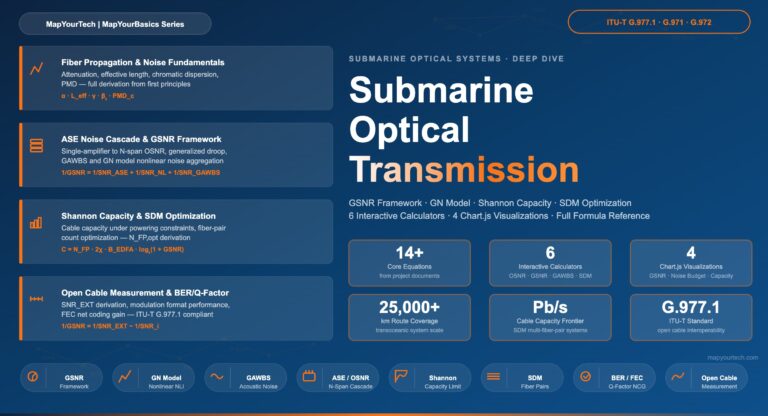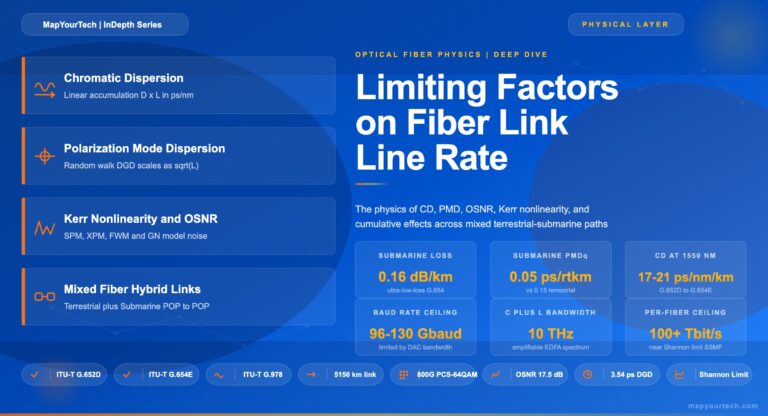

Nonlinear Effects in High-Capacity Submarine Fiber Systems
A Comprehensive Analysis of Self-Phase Modulation, Cross-Phase Modulation, and Four-Wave Mixing in Transoceanic Optical Networks
1.1 Introduction
The relentless growth of global data traffic demands ever-increasing transmission capacity in submarine fiber optic systems, which form the backbone of intercontinental telecommunications. Modern submarine cables routinely carry aggregate capacities exceeding 200 Tb/s over distances of 10,000 kilometers or more, connecting continents and enabling the digital economy. However, as system designers push toward higher spectral efficiencies and launch powers to maximize capacity and reach, nonlinear optical effects in the transmission fiber become increasingly significant constraints on system performance.
Among the various physical phenomena that limit the performance of high-capacity submarine systems, third-order nonlinear effects—specifically Self-Phase Modulation (SPM), Cross-Phase Modulation (XPM), and Four-Wave Mixing (FWM)—represent critical design considerations. These effects arise from the intensity-dependent refractive index of silica glass, mathematically described by the nonlinear refractive index coefficient n2. Unlike linear impairments such as chromatic dispersion and attenuation, which can be compensated through well-established techniques, nonlinear effects introduce signal distortions that accumulate coherently over long transmission distances and interact with dispersion in complex ways.
The challenge is particularly acute in submarine systems compared to terrestrial networks. Submarine cables cannot be accessed for maintenance or regeneration except at landing points, necessitating extremely robust designs with margins for 25-year operational lifetimes. The long unrepeated spans between optical amplifiers (typically 40-100 km) require higher launch powers to maintain acceptable optical signal-to-noise ratios (OSNR), which in turn exacerbates nonlinear effects. Furthermore, the fully loaded Dense Wavelength Division Multiplexing (DWDM) nature of submarine systems—often carrying 100 or more channels simultaneously—creates interchannel nonlinear interactions that do not exist in single-channel systems.
1.1.1 The Kerr Effect and Third-Order Susceptibility
The root cause of SPM, XPM, and FWM lies in the third-order nonlinear susceptibility χ(3) of the silica glass that comprises optical fibers. When intense optical fields propagate through the fiber core, the polarization response of the material becomes nonlinear, leading to an intensity-dependent refractive index. This phenomenon, known as the optical Kerr effect, can be expressed mathematically as a nonlinear contribution to the material polarization vector.
Nonlinear Polarization in Optical Fibers
The total polarization of the fiber material consists of linear and nonlinear components:
P = PL + PNL = ε0 χ(1) · E + χ(3) · EEE
Where:
• ε0 = vacuum permittivity (8.854 × 10⁻¹² F/m)
• χ(1) = first-order susceptibility tensor (linear response)
• χ(3) = third-order susceptibility tensor (nonlinear response)
• E = electric field vector
Note: The second-order susceptibility χ(2) vanishes in silica glass due to its centrosymmetric molecular structure.
The significance of the third-order term becomes apparent when we consider that optical power levels in submarine systems can reach +20 dBm or higher per channel at the amplifier output. At these power levels, even the small nonlinear coefficient of silica glass (n2 ≈ 2.6 × 10⁻²⁰ m2/W at 1550 nm) produces measurable phase shifts and intensity-dependent effects that accumulate over thousands of kilometers.
1.1.2 Historical Context and Evolution
The study of nonlinear effects in optical fibers dates back to the early days of optical communications in the 1970s. Initial single-wavelength systems operating at relatively low data rates (tens of Mb/s) were primarily limited by linear effects such as attenuation and dispersion. However, as system capacities increased through the introduction of Wavelength Division Multiplexing (WDM) in the 1990s and subsequent evolution to DWDM with 50 GHz or 100 GHz channel spacing, nonlinear effects emerged as significant performance constraints.
The first transatlantic submarine cable system, TAT-8, deployed in 1988, operated at 280 Mb/s using a single wavelength. Modern systems such as MAREA (deployed in 2018) and 2Africa (under deployment) achieve aggregate capacities exceeding 200 Tb/s using advanced coherent modulation formats and spatial division multiplexing techniques. This represents a capacity increase of nearly one million times over three decades. Such dramatic capacity growth has been enabled by sophisticated techniques to manage and mitigate nonlinear effects, including optimized fiber designs, digital signal processing algorithms, and advanced modulation formats.
Evolution of Submarine Cable Capacity
The capacity growth in submarine systems reflects continuous innovation in managing nonlinear effects. Early systems avoided nonlinearity through low launch powers and single-wavelength operation. Modern systems actively manage nonlinear interactions through digital nonlinearity compensation, optimized fiber parameters (large effective area, low nonlinear coefficients), and sophisticated modulation formats that are more resilient to nonlinear distortions. The introduction of coherent detection with Digital Signal Processing (DSP) in the late 2000s represented a watershed moment, enabling real-time compensation of both linear and nonlinear impairments that were previously insurmountable.
1.1.3 Scope and Organization
This comprehensive analysis examines the physical origins, mathematical descriptions, system impacts, and mitigation strategies for SPM, XPM, and FWM in high-capacity submarine optical systems. The treatment combines theoretical rigor with practical engineering insights, drawing on both peer-reviewed research and real-world deployment experience. We focus specifically on the unique challenges posed by submarine environments, including ultra-long distances, high channel counts, and the requirement for exceptional reliability over multi-decade operational lifetimes.
The analysis progresses from fundamental physics to practical system design considerations. We begin by establishing the theoretical framework that governs nonlinear propagation in optical fibers, including the nonlinear Schrödinger equation and its various simplifications applicable to different system regimes. Subsequently, we examine each nonlinear effect in detail, analyzing its physical mechanism, mathematical description, impact on system performance, and interaction with other impairments. The treatment includes detailed case studies of deployed submarine systems, performance analyses using industry-standard metrics, and discussion of emerging mitigation techniques including machine learning-based nonlinearity compensation.
Read the Full Analysis with Premium
The remaining 88% of this article — the design numbers, trade-offs and field guidance — is part of MapYourTech Premium, along with the full premium library, courses and professional tools.