
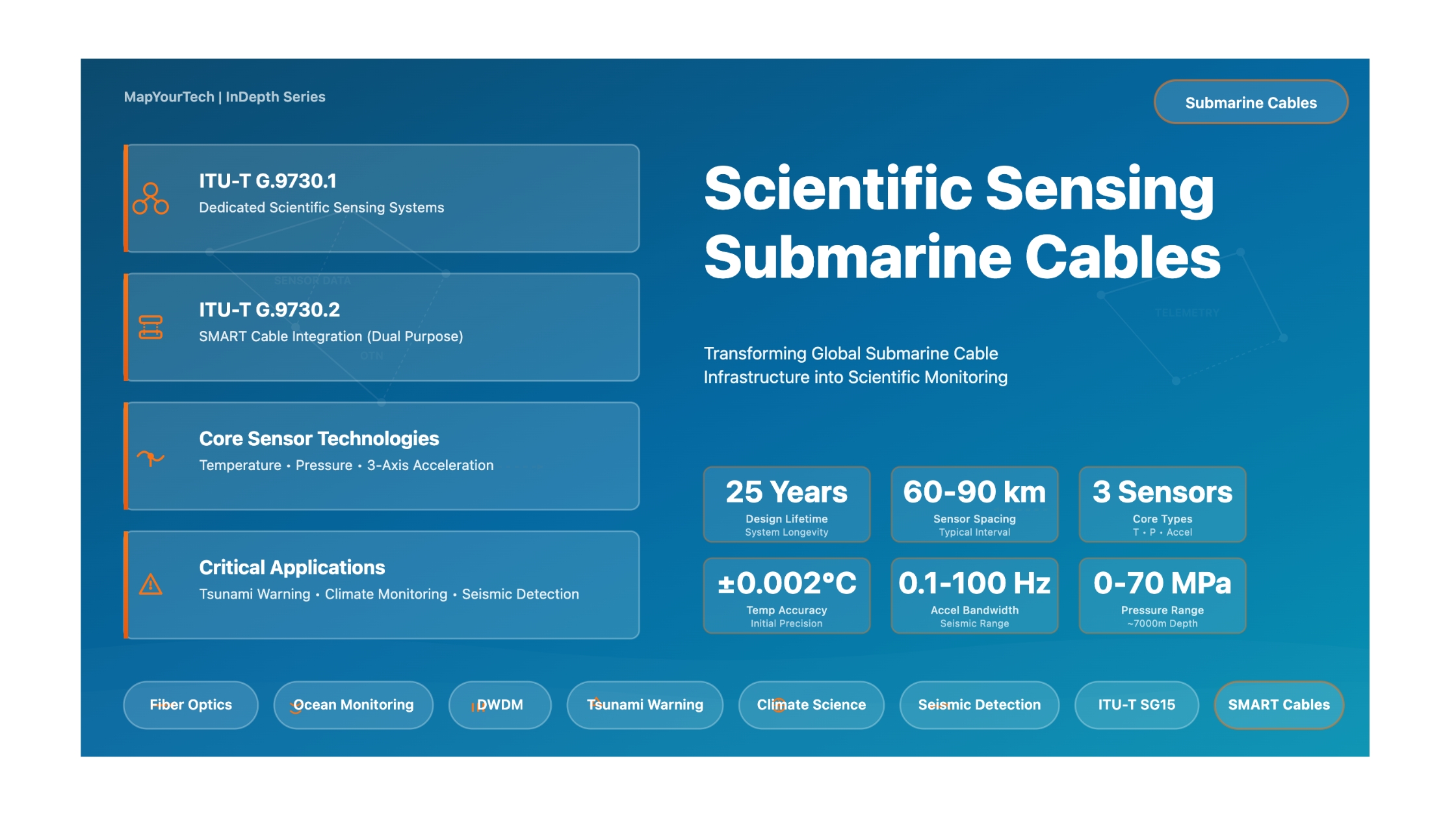
ITU-T G.9730.1 & G.9730.2: Scientific Sensing Submarine Cables
Transforming Global Submarine Cable Infrastructure into a Distributed Scientific Monitoring Network for Climate Observation and Disaster Warning
Introduction
Submarine fiber optic cables form the backbone of global telecommunications, carrying over 99% of intercontinental internet traffic. As of 01/2026, more than 550 active submarine cable systems span approximately 1.4 million kilometers across the world's ocean floors, connecting continents and enabling the digital economy. However, these cables represent far more than mere data highways. They traverse some of the most scientifically significant yet poorly monitored regions of our planet, the deep ocean basins that cover over 70% of Earth's surface.
The deep ocean remains one of the least understood environments on Earth. While we have detailed maps of Mars and the Moon, more than 80% of the ocean floor remains unmapped and unexplored. This knowledge gap has serious consequences for climate science, disaster preparedness, and our understanding of Earth systems. Ocean temperature changes drive weather patterns and climate trends, seismic activity on the seafloor can trigger devastating tsunamis, and ocean dynamics influence everything from sea level rise to marine ecosystems.
Recognizing this opportunity, the International Telecommunication Union (ITU) approved two groundbreaking recommendations in August 2024: ITU-T G.9730.1 (Dedicated scientific sensing submarine cable system) and ITU-T G.9730.2 (Scientific monitoring and reliable telecommunication submarine cable systems). These standards establish the technical framework for transforming submarine telecommunications infrastructure into a global distributed sensor network, capable of monitoring ocean conditions, detecting seismic events, and providing early warning of natural disasters.
This approach offers a unique solution to a long-standing problem. Traditional oceanographic monitoring relies on research vessels, autonomous buoys, and satellite measurements, all of which are expensive to deploy and maintain, particularly in remote ocean regions. A single oceanographic buoy can cost hundreds of thousands of dollars and requires regular servicing. By leveraging existing submarine cable infrastructure and incorporating sensors into new cable deployments, we can create a persistent, high-resolution monitoring network at a fraction of the cost of dedicated systems.
The scope of these new ITU-T recommendations extends beyond simple sensing capabilities. They address the complete system architecture, from sensor specifications and power requirements to data communication protocols and integration with existing telecommunications systems. G.9730.1 covers dedicated scientific sensing cables where monitoring is the primary function, while G.9730.2 addresses SMART (Scientific Monitoring And Reliable Telecommunication) cables that combine both telecommunications and sensing capabilities without compromising either function.
This article provides an in-depth examination of both recommendations, exploring their technical requirements, system architectures, implementation challenges, and the potential impact on climate science and disaster preparedness. We will analyze the sensor technologies, power feeding strategies, data communication methods, and reliability requirements that make these systems viable. For engineers designing the next generation of submarine cable systems, policymakers considering infrastructure investments, and scientists seeking to expand ocean monitoring capabilities, understanding these standards is essential for realizing the vision of a globally connected ocean observing network.
1. Historical Evolution and Context
1.1 From Pure Telecommunications to Dual-Purpose Infrastructure
The concept of using submarine cables for scientific monitoring is not entirely new, but it has evolved significantly over the past two decades. Early experiments in the 1990s and early 2000s demonstrated that telecommunication fibers could detect seismic activity through changes in signal propagation. Researchers discovered that earthquakes and ocean bottom pressure variations caused measurable strain in the fibers, which could be detected using sensitive interferometric techniques.
In 2010, a seminal paper by You in the journal Nature proposed harnessing telecommunications cables for science, arguing that the global submarine cable network represented an untapped resource for ocean and Earth observation. This sparked interest from the scientific community, leading to several pilot projects. The HFAST (Hawaii Scientific and Forensic ATlas) experiment in 2008 successfully used a 6,400 km submarine cable to detect earthquakes on the other side of the Pacific Ocean, demonstrating the potential of fiber-optic sensing for seismology.
The 2011 Tohoku earthquake and tsunami in Japan served as a catalyst for more serious consideration of submarine cables for disaster warning. The tsunami caused over 18,000 deaths and demonstrated critical gaps in ocean-based early warning systems. While coastal tide gauges and the Deep-ocean Assessment and Reporting of Tsunamis (DART) buoy network provided some warning capability, vast stretches of the Pacific Ocean remained unmonitored. The disaster highlighted the need for dense, persistent monitoring infrastructure that submarine cables could provide.
In 2012, the SMART Cables initiative was launched as a joint task force among the ITU, World Meteorological Organization (WMO), and the Intergovernmental Oceanographic Commission (IOC) of UNESCO. This collaborative effort brought together telecommunications experts, oceanographers, seismologists, and climate scientists to develop practical approaches for integrating scientific sensors into commercial submarine cable systems. The task force worked on technical specifications, business models, and policy frameworks to make SMART cables a reality.
Several demonstration projects paved the way for the 2024 ITU-T recommendations. The CAM (Continent Azores Madeira Islands) cable ring, deployed in 2020, incorporated scientific sensors for earthquake and tsunami monitoring in the Atlantic Ocean. The project demonstrated the feasibility of including temperature, pressure, and acceleration sensors in repeater housings without compromising telecommunications performance. Data from the CAM system has been successfully used to detect seismic events and monitor ocean conditions, validating the SMART cable concept.
Parallel developments in fiber sensing technology also contributed to the evolution. Distributed Acoustic Sensing (DAS) and Distributed Temperature Sensing (DTS) technologies matured significantly between 2010 and 2025. These techniques allow the fiber itself to act as a continuous sensor along its entire length, detecting vibrations, temperature changes, and strain without requiring discrete sensor packages. While DAS and DTS are complementary to the point-sensor approach specified in G.9730.1 and G.9730.2, they demonstrate the versatility of fiber optic cables for environmental monitoring.
The SMART Cables Vision
The Science Monitoring And Reliable Telecommunications (SMART) Cables initiative envisions a global network of submarine cables equipped with environmental sensors. The goal is to create a persistent ocean observing system that provides:
• Real-time data on ocean temperature, pressure, and seismic activity
• Early warning capability for tsunamis and earthquakes
• Long-term climate monitoring data from poorly observed ocean regions
• Enhanced cable security through advanced monitoring capabilities
• Cost-effective ocean observation by leveraging telecommunications infrastructure
Read the Full Analysis with Premium
The remaining 89% of this article — the design numbers, trade-offs and field guidance — is part of MapYourTech Premium, along with the full premium library, courses and professional tools.
Course Title
Course description and key highlights