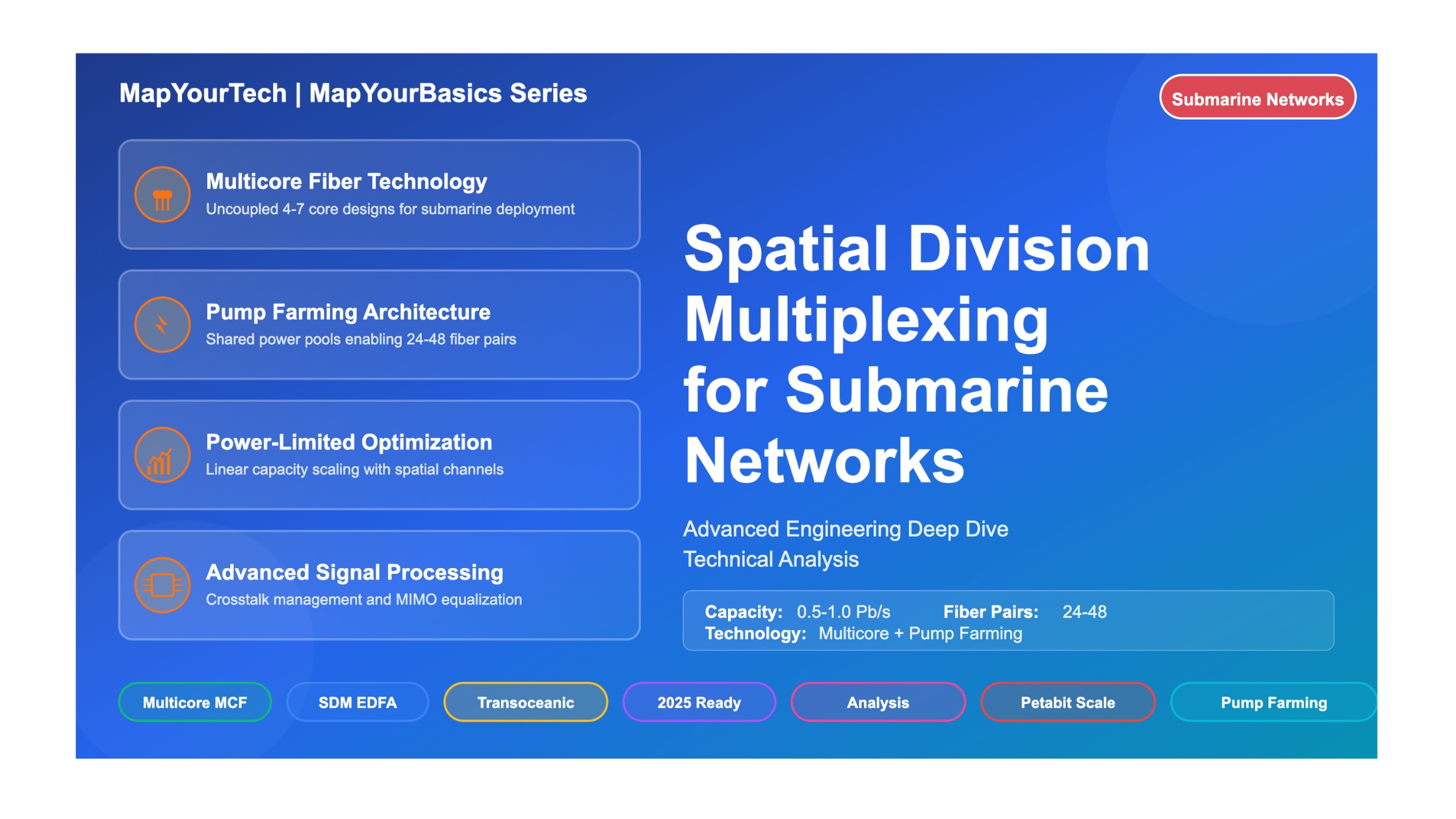

Spatial Division Multiplexing (SDM) for Submarine Networks
Introduction
The exponential growth of global internet traffic, driven by cloud computing, streaming services, social media, and emerging artificial intelligence applications, has pushed submarine cable systems to their capacity limits. Traditional approaches to increasing fiber capacity through higher-order modulation formats and spectral efficiency improvements are rapidly approaching fundamental Shannon limits. As the industry faces projected capacity requirements exceeding multiple petabits per second per cable by 2030, Spatial Division Multiplexing (SDM) has emerged not as an incremental improvement, but as a transformative paradigm shift in submarine optical network architecture.
SDM represents a fundamental departure from the decades-long strategy of maximizing capacity per individual fiber pair. Instead, it optimizes total cable capacity under fixed electrical power and physical constraints by dramatically increasing spatial parallelism. This approach relaxes fiber design constraints, operates in less nonlinear regimes, and introduces revolutionary technologies such as pump farming, multicore fibers, and advanced MIMO DSP techniques. The evolution from 2-4 fiber pairs in traditional systems to 24-48 fiber pairs (and equivalent cores) in modern SDM deployments marks one of the most significant architectural transitions in submarine telecommunications history.
This deep dive examines the advanced engineering principles, system architectures, mathematical foundations, and practical implementation challenges of SDM in submarine networks. We explore the physics of multicore and few-mode fibers, the intricacies of pump farming technology, MIMO DSP requirements, intercore crosstalk management, and the techno-economic factors driving adoption. Our analysis targets senior network architects, submarine system designers, and optical engineers seeking comprehensive understanding of this technology that is reshaping transoceanic connectivity.
1. Historical Context & Evolution of SDM
1.1 Genesis of Spatial Division Multiplexing
The concept of spatial division multiplexing in optical communications was first proposed in 1979 by Iano et al. with the introduction of multicore optical fiber, followed by Berdagué and Facq's 1982 work on mode division multiplexing. However, for nearly three decades, these concepts remained largely academic curiosities. The telecommunications industry's focus during the 1990s and 2000s centered on exploiting the λ-dimension through wavelength division multiplexing (WDM) and the polarization dimension, as single-mode fiber technology proved remarkably capable of meeting capacity demands in a cost-effective manner.
The submarine cable industry, in particular, had established a stable pattern of deploying 2-4 fiber pairs per cable, with capacity growth achieved through advances in modulation formats, forward error correction, and spectral efficiency. The advent of erbium-doped fiber amplifiers (EDFAs) in the early 1990s, followed by coherent detection technology around 2008, enabled successive generations of submarine systems to push fiber pair capacity from megabits to terabits per second without fundamentally altering cable architecture.
1.2 The Capacity Crunch and Paradigm Shift
By the mid-2010s, multiple factors converged to trigger a fundamental reassessment of submarine network architecture. First, spectral efficiency improvements were asymptotically approaching Shannon capacity limits, with advanced modulation formats like 64-QAM and probabilistic constellation shaping yielding diminishing returns. Second, global IP traffic growth accelerated from 25-30% CAGR to 30-40% annually, driven by video streaming, cloud services, and hyperscale data center interconnection. Third, content providers and cloud hyperscalers emerged as major cable investors, demanding unprecedented capacity at continuously declining cost per bit.
The critical insight driving SDM adoption was recognition that optimizing cable capacity under fixed electrical power constraints required a multidimensional approach. Rather than maximizing capacity per fiber pair through higher launch powers (increasing nonlinear impairments) and larger effective areas (limiting manufacturability), the industry pivoted toward massive spatial parallelism with individually less-capable but collectively more-efficient optical paths.
1.3 Technological Enablers
Several key technological breakthroughs made SDM commercially viable for submarine deployment. Pump farming technology, introduced in the late 2010s, decoupled the relationship between repeater electrical power and individual EDFA optical pump power. This allowed power-efficient operation with increased fiber pair counts by sharing pools of pump lasers across multiple fiber pairs through optical couplers. Advances in fiber manufacturing enabled consistent production of fibers with reduced effective areas (80-110 μm²) and controlled coating diameters (200-250 μm), essential for accommodating higher fiber counts within existing cable designs. Progress in digital signal processing allowed operation in lower OSNR regimes while maintaining acceptable Q-factors through sophisticated equalization and error correction.
Key Takeaways: Historical Evolution
- SDM emerged from 40+ years of research but became commercially relevant only when spectral efficiency approached theoretical limits
- The paradigm shifted from maximizing per-fiber capacity to optimizing total cable capacity under power constraints
- Pump farming technology was the critical enabler, allowing efficient power distribution across many fiber pairs
- Modern SDM systems achieve 10-20× capacity increase over traditional architectures through spatial parallelism
2. Core Technical Principles & Fundamentals
2.1 The Shannon Limit and Spatial Dimension
The fundamental capacity of an optical fiber is governed by the Shannon-Hartley theorem, modified for the nonlinear optical channel. For a single mode with additive Gaussian noise, the achievable spectral efficiency is approximately given by:
Shannon Capacity for Nonlinear Optical Channel
SE = log₂(1 + SNR) ≈ log₂(1 + P_signal/(P_ASE + P_NLI))

Where:
  SE        = Spectral Efficiency (bits/s/Hz)
  SNR       = Signal-to-Noise Ratio (linear)
  P_signal  = Signal power per channel (W)
  P_ASE     = Amplified spontaneous emission noise (W)
  P_NLI     = Nonlinear interference noise (W)

For submarine systems with fixed power P_total:
  C_total = N_spatial × B × log₂(1 + P_total/(N_spatial × P_noise))

Key insight: Total capacity scales with N_spatial (number of spatial channels)
while per-channel capacity decreases logarithmically
The critical observation is that cable capacity scales linearly with the number of spatial channels (fiber pairs or cores), but only logarithmically with per-channel SNR. In a power-limited submarine system, this means distributing fixed optical power across N spatial channels yields higher total capacity than concentrating power in fewer channels operating at higher per-channel capacity. This mathematical foundation underpins the entire SDM strategy.
2.2 Spatial Multiplexing Approaches
SDM encompasses three primary technical approaches, each with distinct characteristics and implementation requirements. Single-Core Fiber Multiplexing increases the number of traditional single-mode fibers within the cable, leveraging proven fiber and amplifier technology with minimal system complexity. This approach dominated early SDM deployments, scaling from 4-8 to 24 fiber pairs in transoceanic systems. Multicore Fiber (MCF) integrates multiple cores within a single fiber cladding, multiplying spatial channels without proportionally increasing cable diameter. Uncoupled MCF designs minimize intercore crosstalk through careful core spacing and require individual amplification per core, while coupled MCF acts more like few-mode fiber requiring MIMO processing. Few-Mode Fiber (FMF) supports propagation of multiple spatial modes (LP₀₁, LP₁₁, LP₂₁, etc.), each carrying independent information streams. FMF requires strong MIMO DSP to handle mode coupling and is generally considered less mature for submarine applications than uncoupled MCF.
2.3 Fiber Design Trade-offs in SDM
SDM systems introduce fundamental design trade-offs distinct from traditional submarine cables. The most significant is the relationship between effective area (A_eff), nonlinear tolerance, and fiber count. Traditional submarine fibers employed large effective areas (125-150 μm²) to minimize nonlinear impairments at high launch powers (typically >+20 dBm per channel). SDM systems, operating with distributed power across many spatial channels, can utilize smaller effective areas (80-110 μm²) since per-channel launch powers are reduced to +10 to +15 dBm. This enables higher fiber counts within fixed cable diameters.
The fiber attenuation coefficient becomes more critical in SDM architectures. A reduction from 0.150 dB/km to 0.155 dB/km, negligible in traditional systems, significantly impacts SDM system reach due to the linear scaling with fiber count. Pure silica core (PSC) fibers with attenuation near 0.145 dB/km at 1550 nm are increasingly deployed in SDM systems. Coating diameter reduction from 250 μm to 200 μm allows 20-30% more fibers in existing cable tubes, but requires careful management of microbending losses and mechanical reliability.
2.4 Power-Limited System Optimization
Submarine systems face unique electrical power constraints absent in terrestrial networks. Power feeding equipment (PFE) at shore stations provides DC power (typically 10-18 kV) to all repeaters in series along the cable. Total available power is limited by cable conductor resistance, operating voltage constraints, and joule heating. The optimization problem becomes: maximize total cable capacity C_total subject to fixed electrical power P_elec and system length L.
The solution involves operating at lower per-channel spectral efficiencies (2-3 b/s/Hz) with higher spatial parallelism, rather than pushing to maximum spectral efficiency (6-8 b/s/Hz) with fewer channels. This places systems in the "linear regime" where nonlinear interference is minimal, simplifying DSP requirements and improving system margin. The optimal operating point typically occurs at OSNR values of 12-15 dB for transoceanic distances, significantly lower than the 18-22 dB common in traditional systems.
Key Takeaways: Core Principles
- Cable capacity scales linearly with spatial channels but logarithmically with per-channel SNR under power constraints
- Uncoupled multicore fiber represents the most mature SDM technology for submarine deployment
- Reduced effective area fibers (80-110 μm²) enable higher fiber density while maintaining acceptable nonlinearity
- Optimal SDM systems operate at moderate spectral efficiencies (2-3 b/s/Hz) with massive parallelism (24-48 channels)
- Power-limited optimization drives design toward linear transmission regime, simplifying DSP and improving margins
3. Advanced System Architecture & Design
3.1 Pump Farming Technology
Pump farming represents the most critical innovation enabling practical SDM submarine systems. Traditional repeater architecture dedicates pump lasers to specific fiber pairs, creating tight coupling between electrical power availability and individual EDFA performance. A repeater with N fiber pairs requires 2N to 4N pump lasers (depending on redundancy scheme), with each pump laser consuming 500-800 mW of electrical power. For a 24 fiber-pair system at 60 km repeater spacing over 10,000 km, this implies ~167 repeaters × 96 pumps × 600 mW ≈ 9.6 MW total electrical consumption—exceeding available shore power by orders of magnitude.
Pump farming breaks this coupling through optical power pooling. A pool of M pump lasers (where M < 2N) is cross-connected to N fiber pairs through two-stage optical fiber couplers. Each EDFA receives pump power from multiple pumps, and each pump contributes to multiple EDFAs. The topology provides N+M redundancy: the system tolerates M-1 pump failures before any fiber pair loses service. This dramatically reduces electrical power consumption while increasing reliability.
The mathematical optimization of pump farming involves balancing pump count M against target OSNR, reliability requirements, and electrical power budget. For a transoceanic system with target OSNR of 13 dB per fiber pair and span loss of 12 dB, each EDFA requires approximately 200-250 mW of 980 nm pump power. With pump laser wallplug efficiency of 40-50%, this translates to 400-500 mW electrical power per EDFA. Pump farming allows M = 1.5N to 1.8N (rather than 2N to 4N), reducing total electrical consumption by 40-60% while maintaining or improving redundancy compared to traditional architectures.
3.2 Multicore Fiber EDFA Architectures
Amplification of multicore fibers introduces unique challenges absent in single-core systems. Each core must be individually pumped to achieve target gain, but the spatial arrangement within the common cladding enables novel pumping schemes. Core-pumped MC-EDFA fan-outs the individual cores to separate erbium-doped fibers, each with dedicated 980 nm and/or 1480 nm pump coupling. This approach is most compatible with existing single-core EDFA technology and pump farming schemes. Fan-in/fan-out devices introduce insertion loss (typically 0.5-1.0 dB) but provide isolation between cores and flexibility in pump allocation.
Cladding-pumped MC-EDFA employs high-power multimode pump lasers coupled into the fiber cladding, which is doped with erbium. This enables collective amplification of all cores simultaneously with reduced component count. Double-clad multicore erbium-doped fiber with octagonal or D-shaped cladding enhances pump absorption. Cladding pumping offers potential space and power advantages but faces challenges in achieving uniform gain across all cores and managing higher pump powers (several watts) in the constrained submarine repeater environment.
3.3 Crosstalk Management in Multicore Systems
Intercore crosstalk (ICXT) represents the fundamental impairment unique to multicore fibers. Power couples between cores through evanescent field overlap, with coupling strength exponentially dependent on core-to-core spacing. Uncoupled MCF designs target crosstalk levels below -40 dB per 100 km at 1550 nm, requiring core spacing of 35-45 μm for standard 125 μm cladding diameter.
Intercore Crosstalk Power Coupling
XT = (h/Δβ)² × [1 - cos(Δβ × L)]

Where:
  XT   = Intercore crosstalk (linear)
  h    = Coupling coefficient (km⁻¹)
  Δβ   = Propagation constant difference
  L    = Fiber length (km)

Coupling coefficient approximation:
  h ≈ (2π/λ) × (MFD/2) × exp(-Λ × d)

Where:
  λ     = Wavelength (nm)
  MFD   = Mode field diameter (μm)
  Λ     = Decay constant (~0.4 μm⁻¹)
  d     = Core-to-core spacing (μm)

Target: XT < -40 dB/100km → d > 35 μm for MFD = 9.5 μm
Random perturbations along the fiber (microbending, twisting, temperature variations) cause Δβ fluctuations that modulate crosstalk. The statistical behavior of accumulated crosstalk follows a chi-squared distribution. System designers must account for both mean crosstalk and worst-case realizations when establishing OSNR budgets. For submarine deployments spanning 10,000+ km, maintaining XT below -35 dB at the receiver is critical to avoid SNR degradation beyond acceptable limits.
3.4 System-Level Design Optimization
SDM submarine system design involves multidimensional optimization across fiber parameters (A_eff, attenuation, coating diameter), amplifier configuration (pump count, pumping scheme, repeater spacing), and transmission parameters (launch power, spectral efficiency, wavelength allocation). The design space is constrained by electrical power budget P_elec, cable diameter D_cable, target reach L, and required capacity C.
Recent analyses indicate optimal configurations for transoceanic systems (8,000-12,000 km) converge on 24-32 equivalent fiber pair counts (including multicore equivalents), repeater spacing of 60-80 km, per-channel launch power of +12 to +14 dBm, and target spectral efficiency of 2.5-3.5 b/s/Hz. These parameters yield total cable capacities of 0.5-1.0 Pb/s while remaining within 15-18 kW electrical power budgets. Future systems employing 4-core or 7-core multicore fibers could achieve 1.5-2.0 Pb/s by 2027-2030.
Key Takeaways: Advanced Architecture
- Pump farming reduces electrical power consumption by 40-60% while improving redundancy compared to dedicated pumping
- Core-pumped multicore EDFAs offer better compatibility with existing technology; cladding pumping promises higher integration
- Intercore crosstalk must remain below -40 dB/100km, requiring core spacing >35 μm in uncoupled MCF designs
- Optimal SDM systems balance fiber count, repeater spacing, and spectral efficiency to maximize capacity under power constraints
- Modern SDM architectures achieve 0.5-1.0 Pb/s per cable, with 2+ Pb/s feasible through multicore integration by 2030
4. Mathematical Models & Performance Analysis
4.1 Nonlinear Impairment Modeling
The Gaussian Noise (GN) model provides an accurate framework for predicting nonlinear interference in SDM submarine systems. The total noise power spectral density experienced by a channel includes ASE noise from amplifiers and nonlinear interference (NLI) from fiber propagation. For a given channel i carrying power P_i, the NLI can be expressed in closed form for quasi-linear systems:
Gaussian Noise Model for NLI
P_NLI = η × P_ch³ × L_eff × N_spans

Where:
  P_NLI    = Nonlinear interference power (W)
  η        = Nonlinear coefficient (W⁻²)
  P_ch     = Channel power (W)
  L_eff    = Effective length per span (km)
  N_spans  = Number of spans

Nonlinear coefficient:
  η = (8/27) × (γ²/α) × (BW_ch / BW_ref)²

Where:
  γ      = Nonlinear parameter = (2πn₂)/(λA_eff)
  α      = Fiber attenuation (Np/km)
  BW_ch  = Channel bandwidth (GHz)
  BW_ref = Reference bandwidth (GHz)

For SDM systems with A_eff = 85 μm²:
  γ ≈ 1.45 W⁻¹km⁻¹ (vs. 0.78 W⁻¹km⁻¹ for A_eff = 150 μm²)
The critical insight for SDM systems is the cubic dependence of NLI on channel power. By operating at reduced per-channel powers (+12 dBm vs. +20 dBm in traditional systems), NLI power decreases by a factor of (10^0.8)³ ≈ 25. This dramatic reduction allows operation with smaller A_eff without penalty, enabling higher fiber counts. The SNR in quasi-linear SDM systems is dominated by ASE noise rather than nonlinearity, simplifying system design and improving tolerance to OSNR variations.
4.2 System Reach and Capacity Scaling Laws
The relationship between system reach, capacity, and fiber count in power-limited SDM systems follows predictable scaling laws. For a fixed electrical power budget P_elec and target Q-factor (typically 8-10 dB for soft-decision FEC with 20-25% overhead), the achievable capacity-distance product exhibits characteristic behavior:
SDM Capacity Scaling Laws
Capacity-Distance Product:
C × L ≈ K × N_spatial × log₂(1 + OSNR_target)

Where:
  C         = Total cable capacity (Tb/s)
  L         = System reach (km)
  K         = System constant (~50-80)
  N_spatial = Number of spatial channels (FPs or cores)
  OSNR_target = Required OSNR (linear)

Power constraint imposes:
OSNR_target ≈ P_elec / (N_spatial × k)

Where k includes amplifier efficiency and span loss factors

Optimal fiber count for max capacity:
N_optimal ≈ P_elec / (k × OSNR_min × ln(2))

Example for P_elec = 16 kW, L = 10,000 km:
  N_optimal ≈ 32-40 equivalent fiber pairs
  C_max ≈ 0.8-1.2 Pb/s
These scaling laws reveal that capacity grows sublinearly with available power (due to logarithmic SNR-capacity relationship) but linearly with spatial dimension count. This explains why modern submarine systems favor SDM: adding spatial channels provides more capacity benefit than increasing power to existing channels. The optimal fiber count typically falls in the range of 30-50 for transoceanic systems under current power technology constraints.
4.3 MIMO DSP for Coupled Systems
Coupled multicore or few-mode fiber systems require multiple-input multiple-output (MIMO) digital signal processing to recover signals from mode-mixed channels. The received signal vector r(t) relates to transmitted signal vector s(t) through a time-varying channel matrix H(t) and additive noise n(t):
MIMO Channel Model
r(t) = H(t) ⊗ s(t) + n(t)

Where:
  r(t)  = Received signal vector (M×1)
  s(t)  = Transmitted signal vector (M×1)
  H(t)  = Channel impulse response matrix (M×M)
  n(t)  = Noise vector
  ⊗     = Convolution operator
  M     = Number of modes or cores

MIMO equalizer computes:
ŝ(t) = W(t) ⊗ r(t)

Where W(t) is the equalizer filter matrix

Computational complexity scales as:
Complexity ~ M² × N_taps × Symbol_rate

For M=6 modes, N_taps=50, Symbol_rate=64 GBaud:
  Complexity ≈ 115,200 GMACs (multiply-accumulates per second)
MIMO DSP complexity grows quadratically with mode count, presenting significant power consumption challenges for DSP ASICs. This is a primary reason why uncoupled multicore fibers (requiring no MIMO processing) are favored for submarine deployments where power efficiency is paramount. Nevertheless, continued advances in CMOS technology and specialized DSP architectures may eventually make coupled-core or few-mode systems viable for specific submarine applications.
4.4 Mode-Dependent Loss and Differential Mode Delay
Few-mode fiber systems must contend with mode-dependent loss (MDL) arising from non-uniform coupling to fiber modes through connectors, splices, and components. MDL accumulates randomly along the link, with statistical distribution of eigenvalue spreads following Wishart ensemble theory. Mean MDL penalty on system capacity can be approximated:
MDL Capacity Penalty
C_penalty ≈ -10 × log₁₀(1 + (MDL_dB/10) × N_modes)

Where:
  C_penalty  = Capacity reduction (%)
  MDL_dB     = Mean mode-dependent loss (dB)
  N_modes    = Number of propagating modes

Example: MDL = 3 dB, N_modes = 6
  C_penalty ≈ -25% capacity loss

Submarine systems require MDL < 1 dB for acceptable performance
Differential mode delay (DMD) between LP modes creates additional equalization burden. DMD typically ranges from 1-10 ps/km in carefully designed few-mode fibers. Over transoceanic distances (10,000 km), this translates to 10-100 ns total DMD, requiring MIMO equalizer memory depths of hundreds to thousands of taps. The resulting DSP power consumption and complexity further challenges the viability of FMF for submarine applications compared to uncoupled MCF.
Key Takeaways: Mathematical Models
- Gaussian Noise model accurately predicts NLI in SDM systems; cubic power dependence drives operation at reduced launch powers
- Capacity-distance product scales linearly with spatial channel count but logarithmically with per-channel OSNR
- Optimal fiber count for power-limited systems typically falls between 30-50 equivalent pairs for transoceanic reach
- MIMO DSP complexity scales as M² with mode count, presenting significant power consumption challenges
- MDL and DMD in few-mode systems impose stringent component requirements not present in uncoupled multicore designs
5. Implementation Challenges & Practical Solutions
5.1 Cable Mechanical Design Constraints
Accommodating 24-48 fibers within submarine cable structures presents significant mechanical engineering challenges. Standard lightweight (LW) cables employed in deep-water deployments (up to 8,000 m depth) have inner tube diameters of approximately 8-12 mm. Fitting 24 fiber pairs with 200 μm coatings requires careful helical lay patterns and optimized packing geometries to prevent excessive bend-induced losses and ensure long-term mechanical reliability.
Multicore fiber offers advantages in this domain. A 4-core fiber effectively provides 4 fiber pairs worth of capacity in the space of a single fiber, potentially allowing 96 equivalent fiber pairs (24 × 4-core fibers) within existing cable designs. However, MCF cables require modified manufacturing processes to maintain core alignment during cabling operations. Fiber twist rates, lay angles, and tension profiles must be carefully controlled to preserve the rotational orientation of multicore fibers and minimize additional losses at fan-out points.
5.2 Splicing and Connectivity
Field splicing of multicore fibers introduces operational complexities absent in traditional systems. Core-to-core alignment requires active alignment techniques using specialized fusion splicers capable of imaging individual cores. Misalignment by even 0.5 μm can introduce 0.2-0.4 dB splice loss per core. At-sea cable repair operations must account for longer splice times and more sophisticated equipment. Industry is developing standardized MCF splice procedures and training protocols to enable widespread deployment.
Fan-in/fan-out (FIFO) devices connecting MCF to single-core amplifiers and terminal equipment represent critical components. Current FIFO implementations achieve insertion losses of 0.5-1.0 dB per core, with crosstalk below -50 dB. Hermetically sealed, pressure-resistant FIFO assemblies suitable for repeater housing integration have been demonstrated but require continued development for mass production and cost reduction.
5.3 Power Feeding Equipment Evolution
The massive increase in repeater pump laser count (from 8-16 in traditional systems to 60-80 in SDM systems) drives evolution of power feeding equipment (PFE) at shore stations. Modern PFE must deliver 15-18 kV at currents sufficient to supply all repeaters in series. For a 10,000 km system with 160 repeaters consuming 40-50 W each, total power demand approaches 6-8 kW at the last repeater, requiring voltage drops of 10-12 kV along the cable conductor.
Conductor sizing represents a critical trade-off. Larger cross-sectional areas reduce resistive losses but increase cable diameter, weight, and material cost. Current-generation SDM systems employ copper conductors with resistivity of 1.3-1.5 Ω/km, balanced against mechanical strength requirements. Future systems may explore aluminum conductor cores (resistivity ~2.5 Ω/km) with higher ampacity-to-weight ratios, though aluminum introduces challenges in shore-end grounding and electrochemistry.
5.4 Thermal Management in Repeaters
SDM repeater housings must dissipate 40-50 W of heat in sealed enclosures at ocean floor temperatures of 2-4°C. Traditional convective cooling relies on housing surface area and thermal conductivity to the surrounding seawater. The increased pump laser count and associated electronics (pump drivers, supervisory circuits, FIFO temperature stabilization) generate localized hot spots that must be managed through careful thermal design.
Pump laser efficiency improvements (from 40% to 50-55% wallplug efficiency with advanced quantum well designs) directly reduce thermal dissipation. Compact micro-assembly EDFA modules, where pump lasers, isolators, couplers, and erbium-doped fiber are integrated in sub-cubic-inch packages, improve thermal coupling and reduce parasitic losses. These modules, developed specifically for SDM applications, demonstrate 30-40% volume reduction compared to discrete-component implementations.
5.5 System Monitoring and Management
Managing 24-48 fiber pairs introduces operational complexity in fault localization, performance monitoring, and configuration management. Each fiber pair requires individual OTDR monitoring for fault detection, performance characterization through pilot tone or coherent detection, and remote control of variable optical attenuators (VOAs) or gain equalizers. The supervisory channel bandwidth and complexity scale with fiber pair count.
Advanced telemetry systems multiplex supervisory data from all fiber pairs onto shared control channels, reducing overhead. Automatic gain control (AGC) algorithms adaptively adjust EDFA pump currents based on measured output powers, compensating for fiber aging, temperature variations, and component drift. Machine learning techniques are being explored for predictive maintenance, using historical telemetry data to forecast component failures before service impact.
Key Takeaways: Implementation Challenges
- Cable mechanical design must accommodate 24-48 fibers while maintaining bend performance and long-term reliability
- Multicore fiber splicing requires active alignment and specialized equipment, increasing repair operation complexity
- Power feeding equipment must deliver 15-18 kV to support 60-80 pump lasers per repeater across transoceanic distances
- Thermal management becomes critical with 40-50W dissipation in sealed repeater housings at 2-4°C ambient
- System monitoring and management complexity scales with fiber pair count, requiring sophisticated telemetry and control
6. Techno-Economic Analysis & Industry Adoption
6.1 Cost Structure Evolution
The cost per bit economics of submarine cables have driven industry adoption of SDM technology. Traditional optimization focused on maximizing capacity per fiber pair, accepting high per-pair costs. SDM inverts this model, distributing capacity across many lower-capacity-per-pair channels with reduced per-channel costs. The total cable system cost comprises wet plant (cable, repeaters, branching units), dry plant (terminal equipment, transponders), marine operations (survey, laying, burial), and project management.
Wet plant costs scale sublinearly with fiber pair count due to shared infrastructure (cable armor, conductors, housing pressure vessels, power feeding) and pump farming efficiency. Industry analyses indicate a 24-fiber-pair SDM system costs approximately 1.4-1.6× a traditional 8-fiber-pair system, while delivering 3-4× the capacity. This translates to 50-60% reduction in cost per bit. Dry plant costs exhibit different scaling: transponder costs decrease with advancing CMOS technology (Moore's Law) and volume production, offsetting increased transponder count.
6.2 Multicore Fiber Cost Premium Analysis
Multicore fiber introduces a cost premium over single-core fiber due to manufacturing complexity, lower production volumes, and specialized preform fabrication. Current MCF costs approximately 2-3× single-core fiber on a per-meter basis. However, system-level economic analysis reveals that for MCF to be cost-competitive, the fiber cost premium need not reach parity with single-core fiber.
| System Configuration | Fiber Type | Equiv. Fiber Pairs | Fiber Cost Premium | System Cost Index | Cost per Tb/s |
|---|---|---|---|---|---|
| Baseline Traditional | Single-core | 8 | 1.0× | 1.00 | 1.00 |
| SDM Single-Core | Single-core | 24 | 1.0× | 1.45 | 0.48 |
| SDM with 2-Core MCF | 2-core (12 fibers) | 24 | 2.0× | 1.35 | 0.45 |
| SDM with 4-Core MCF | 4-core (12 fibers) | 48 | 2.5× | 1.55 | 0.26 |
| Advanced SDM MCF | 7-core (12 fibers) | 84 | 3.0× | 1.75 | 0.17 |
The analysis reveals that MCF systems achieve lower cost per bit than single-core SDM even with 2-3× fiber cost premium, due to savings in repeater count, cable volume, and marine operations. A 4-core MCF system delivering 48 equivalent fiber pairs costs ~7% more than a 24-pair single-core system in total installed cost, but provides 2× the capacity—resulting in ~50% cost-per-bit advantage. The economic crossover point occurs when MCF cost premium exceeds ~3.5× single-core fiber, well above current differentials.
6.3 Deployed Systems and Field Results
Commercial SDM submarine system deployments accelerated beginning in 2020-2021. Representative systems include: 2Africa (45,000 km circumnavigating Africa, 24 fiber pairs, 16 Tb/s per pair, total 384 Tb/s, RFS 2024), PLCN (Pacific Light Cable Network, 12,800 km transpacific, 6 fiber pairs with C+L amplification equivalent to 12 C-band pairs, 144 Tb/s, RFS 2022), Medusa (8,760 km Mediterranean, 24 fiber pairs, 20 Tb/s per pair, 480 Tb/s, RFS 2024), and Apricot (Singapore-Japan-Philippines-US, 12 fiber pairs, 20 Tb/s per pair, 240 Tb/s, RFS 2024).
The first multicore fiber submarine cable trial was completed by NEC, OCC, and Sumitomo in 2021, demonstrating 4-core uncoupled fiber in SC500-series LW cable with 17 mm outer diameter. Google and NEC subsequently announced deployment of 2-core MCF in the Taiwan-Philippines-US cable system, representing the first commercial transoceanic MCF system. Field results confirm laboratory predictions: intercore crosstalk remains below -40 dB over deployed spans, fan-out insertion losses of 0.5-0.8 dB per core, and no degradation of core performance compared to single-core baseline.
6.4 Future Capacity Projections
Industry roadmaps project submarine cable capacity growth continuing at 30-40% CAGR through 2030, driven primarily by SDM scaling. The evolution pathway includes: Current (2024-2025): 24-32 single-core fiber pairs, 0.5-0.8 Pb/s per cable; Near-term (2025-2027): 2-core and 4-core MCF deployment, 1.0-1.5 Pb/s per cable; Mid-term (2027-2030): 7-core MCF and C+L amplification, 2.0-3.0 Pb/s per cable; Long-term (2030+): Coupled-core MCF with MIMO, hollow-core fiber, advanced spatial modes, potentially 5+ Pb/s per cable.
The transition to multi-petabit cables will require continued advances in all technology domains: fiber manufacturing scalability, pump farming efficiency, compact repeater integration, DSP power efficiency, and marine installation capabilities. Economic viability remains the ultimate driver; SDM technology must demonstrate sustained cost-per-bit reduction to justify increased system complexity.
Key Takeaways: Techno-Economics & Adoption
- SDM systems achieve 50-60% cost per bit reduction compared to traditional architectures through shared infrastructure
- Multicore fiber can accept 2-3× cost premium over single-core and remain economically favorable due to system-level savings
- Multiple transoceanic SDM systems deployed 2022-2024 demonstrate commercial viability and field reliability
- First multicore submarine cable (Taiwan-Philippines-US) validates MCF technology for long-haul applications
- Industry roadmap projects 2-3 Pb/s cables by 2030 through 4-7 core MCF integration and C+L amplification
7. Future Directions & Research Frontiers
7.1 Hollow-Core Fiber for Submarine Systems
Hollow-core fiber (HCF) technology represents a potentially transformative direction for future SDM submarine systems. By guiding light through air or vacuum rather than silica glass, HCF offers theoretical attenuation limits below 0.1 dB/km (compared to 0.142 dB/km Rayleigh scattering limit in solid-core fiber) and ~30% lower propagation delay due to reduced refractive index. For transoceanic systems, attenuation reduction from 0.150 to 0.100 dB/km enables 50% longer repeater spacing or equivalently 50% more optical power budget for increased capacity.
Challenges for HCF submarine deployment include achieving and maintaining vacuum or low-pressure gas fill over cable lifetime under pressure cycling, developing compatible splicing techniques that preserve hollow-core integrity, and scaling HCF manufacturing to production volumes. Current laboratory demonstrations show HCF with 0.174 dB/km loss at 1550 nm over 10+ km lengths. The pathway to submarine-grade HCF with <0.130 dB/km requires several years of research, but potential benefits justify continued investment.
7.2 Software-Defined Reconfigurable SDM Networks
Future submarine networks will likely incorporate reconfigurable optical add-drop multiplexing (ROADM) functionality at branching units and cable landing stations, enabling dynamic capacity allocation across fiber pairs and wavelengths. Combined with SDM, this creates software-defined spatial-spectral networks where capacity can be provisioned on-demand. Core-selective switches (CSS) for multicore fibers enable routing individual cores to different destinations, providing unprecedented flexibility.
Research challenges include developing low-loss, low-crosstalk CSS suitable for submarine power budgets (target insertion loss <2 dB per core), integrating CSS into branching unit housings with appropriate thermal and pressure ratings, and developing control plane protocols that coordinate spatial, spectral, and temporal resource allocation. Initial terrestrial demonstrations of core-selective branching units have been reported; submarine qualification requires several technology generations.
7.3 AI-Optimized System Design
The multidimensional optimization space of SDM submarine systems (fiber count, core count, pump allocation, launch power per channel, spectral allocation, modulation format per channel) exceeds human capacity for exhaustive analysis. Machine learning techniques, particularly reinforcement learning and evolutionary algorithms, offer pathways to discover optimal configurations. Neural networks trained on transmission experiment data can predict system performance more accurately than analytical models, accounting for subtle effects missed by theory.
AI/ML applications in SDM submarine networks include: design optimization (automated exploration of parameter space to maximize capacity under constraints), adaptive operation (real-time adjustment of launch powers, modulation formats, and pump currents based on measured conditions), predictive maintenance (anomaly detection and failure forecasting from telemetry streams), and fault localization (rapid identification of impairment sources using distributed sensor data). Integration of AI into submarine systems must account for limited shore-to-repeater communication bandwidth and latency constraints.
7.4 Quantum and Classical Co-Existence
Quantum key distribution (QKD) for secure communications may eventually integrate into SDM submarine cables, either through dedicated cores in multicore fibers or through spectral allocation within existing fibers. QKD requires ultra-low-noise transmission with single-photon sensitivity, fundamentally incompatible with high-power DWDM channels on the same fiber. Multicore architectures offer isolation: classical channels on most cores with one or two cores dedicated to quantum transmission.
Technical challenges include managing intercore crosstalk at quantum-relevant levels (<-80 dB), developing single-photon detectors and quantum repeaters (or entanglement distribution) suitable for submarine environmental conditions, and establishing quantum protocols that function over 10,000+ km with available link budgets. Near-term deployments will likely connect cable landing stations with quantum secured links over terrestrial last-mile, while long-term research targets end-to-end quantum secured transoceanic connectivity.
7.5 Ultra-High Core Count Fibers
Research laboratories have demonstrated multicore fibers with up to 19 cores and few-mode multicore fibers (FM-MCF) combining spatial multiplexing approaches. A 19-core fiber with dual-polarization on each core effectively provides 38 spatial channels in a single 125 μm cladding, though intercore crosstalk management becomes extremely challenging. Coupled-core MCF with strong MIMO processing could potentially achieve 50-100 spatial modes per fiber, but requires revolutionary advances in DSP power efficiency.
The practical limit for uncoupled core count in standard cladding diameter appears to be 7-12 cores given crosstalk constraints and manufacturability. Future systems may explore larger cladding diameters (200-300 μm) to accommodate more cores with maintained spacing, though this requires co-development of compatible cable structures, connectors, and coupling optics. The techno-economic optimum likely lies at 4-7 cores for the next generation, with evolution to higher counts contingent on production cost reduction and market capacity demands.
Key Takeaways: Future Directions
- Hollow-core fiber offers potential attenuation <0.1 dB/km and reduced latency but requires significant development for submarine qualification
- Software-defined SDM networks with core-selective switching will enable dynamic capacity provisioning across spatial and spectral dimensions
- AI/ML techniques will optimize design, enable adaptive operation, and provide predictive maintenance for complex SDM systems
- Quantum communications may co-exist with classical channels in multicore submarine cables with dedicated quantum cores
- Ultra-high core count fibers (19+ cores) face crosstalk challenges; practical sweet spot appears to be 4-7 cores for near-term deployment
Conclusion
Spatial Division Multiplexing represents a fundamental architectural transformation in submarine optical networks, shifting the industry from fiber-centric to cable-centric capacity optimization. By exploiting spatial parallelism through increased fiber pair counts and multicore fiber integration, SDM systems achieve multi-petabit cable capacities while operating in power-efficient, less-nonlinear regimes. The enabling technologies—pump farming, reduced effective area fibers, uncoupled multicore fibers, and advanced DSP—have matured from laboratory concepts to commercial deployment over the past decade.
The mathematical foundations reveal that cable capacity scales linearly with spatial channel count but only logarithmically with per-channel SNR under power constraints, providing clear impetus for massive parallelism. Practical implementations balance fiber count, effective area, amplifier efficiency, and system reach to maximize capacity within electrical power and mechanical constraints. Current-generation SDM systems deployed 2022-2025 demonstrate 0.5-1.0 Pb/s capacities over transoceanic distances, with roadmaps projecting 2-3 Pb/s by 2030 through multicore fiber integration.
Remaining challenges include scaling multicore fiber production to commodity volumes and costs, developing submarine-qualified core-selective switching for network flexibility, advancing AI-optimized design and operation methodologies, and exploring revolutionary technologies like hollow-core fiber. The economic case for SDM is compelling: 50-60% cost per bit reduction compared to traditional architectures, with multicore fiber systems providing additional advantages despite fiber cost premiums.
As global data traffic continues exponential growth driven by AI, immersive media, and ubiquitous connectivity, submarine networks must evolve correspondingly. SDM technology provides the pathway to sustained capacity scaling for the next decade and beyond, ensuring that transoceanic cables remain the indispensable foundation of global internet infrastructure. For network architects and system designers, deep understanding of SDM principles, trade-offs, and implementation strategies has become essential to delivering next-generation submarine connectivity.
References & Further Reading
Standards and Technical References
[1] ITU-T Recommendation G.654 – Characteristics of a cut-off shifted single-mode optical fibre and cable, 2016.
[2] ITU-T Recommendation G.975 – Forward error correction for submarine systems, 2000.
[3] Essiambre, R.-J., et al., "Capacity limits of optical fiber networks," Journal of Lightwave Technology, vol. 28, no. 4, pp. 662-701, 2010.
[4] Li, G., et al., "Space-division multiplexing: The next frontier in optical communication," Advances in Optics and Photonics, vol. 6, no. 4, pp. 413-487, 2014.
[5] Dar, R., et al., "Cost-optimized submarine cables using massive spatial parallelism," Journal of Lightwave Technology, vol. 36, no. 18, pp. 3855-3865, 2018.
[6] Downie, J.D., et al., "Examining the case for multicore fibres in submarine cable systems based on fibre count limits," IEEE Journal of Selected Topics in Quantum Electronics, vol. 26, no. 4, 2020.
[7] Nakamura, K., et al., "World's first demonstration of GEN2-SDM with cabled multi-core fiber and multi-core EDFA in a real-time transmission experiment," Proc. SubOptic 2023, Bangkok, 2023.
[8] Mateo, E.F., "Multi-core-fiber submarine systems," Journal of Optical Communications and Networking, vol. 16, no. 11, pp. H1-H8, 2024.
Industry Resources
Undersea Fiber Communication Systems (2025 Edition) – Comprehensive submarine cable engineering reference covering SDM architectures, pump farming, and multicore technologies.
Sanjay Yadav, "Optical Network Communications: An Engineer's Perspective" – Bridge the Gap Between Theory and Practice in Optical Networking.
SubOptic Conference Proceedings – Biennial conference proceedings (2019, 2022, 2025) containing latest industry developments in SDM submarine systems.
Submarine Telecoms Forum – Industry news, analysis, and deployment tracking for submarine cable systems worldwide.
Note: This guide is based on industry standards, peer-reviewed research, and real-world submarine system implementations through 2025. Specific design parameters may vary based on equipment vendors, route topology, regulatory requirements, and operational constraints. Always consult with qualified submarine system engineers and follow manufacturer documentation for actual deployments.