37 min read

Practical Insight for Global Optical Engineer Roles and Responsibilities
A Comprehensive Visual Guide to Career Paths, Technical Competencies, and Industry Dynamics in Optical Fiber Communications Engineering
Introduction
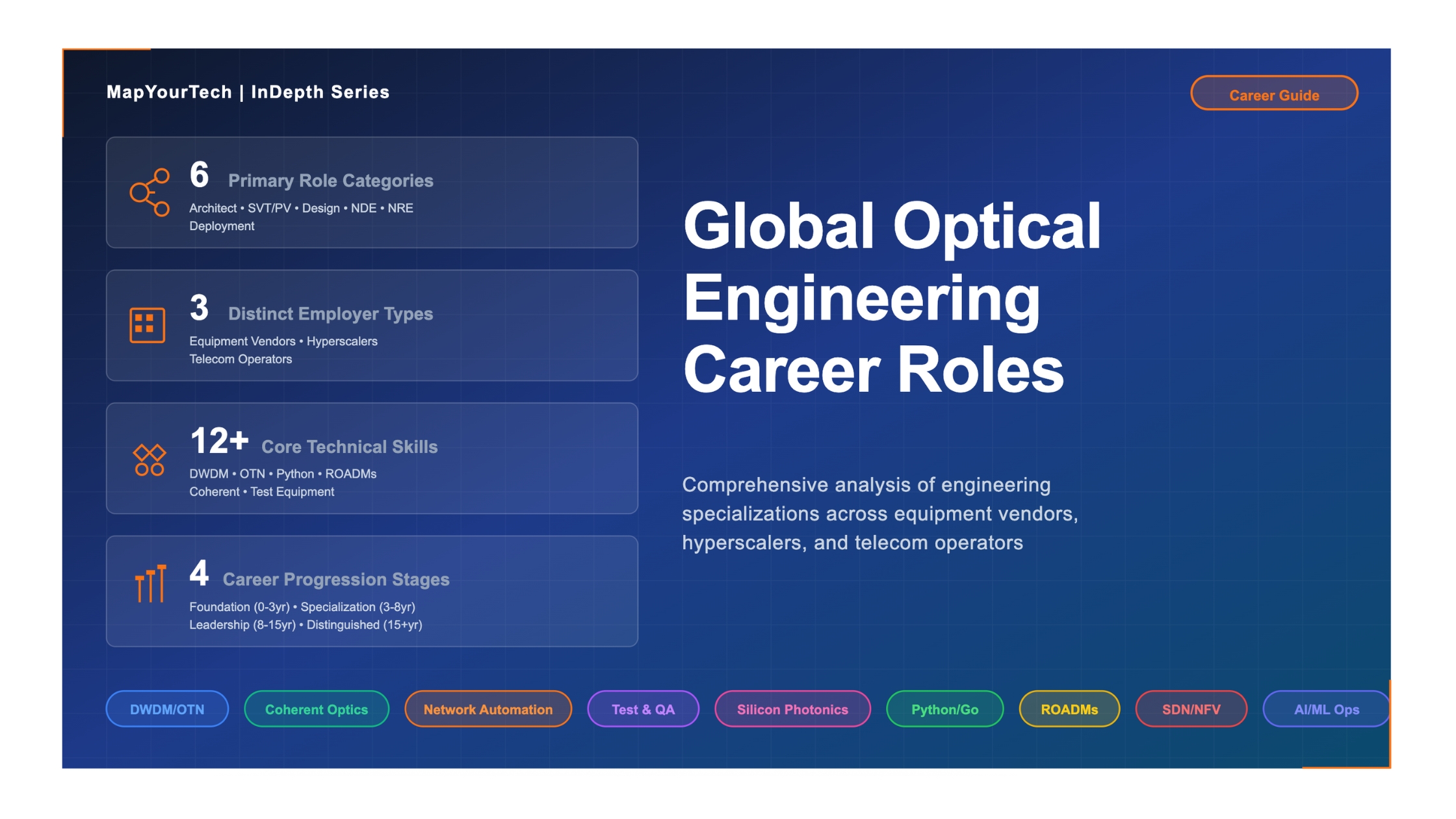
The global optical communications industry represents the critical infrastructure enabling modern digital connectivity, supporting data transmission rates exceeding 400 Gbps per wavelength across submarine cables spanning thousands of kilometers and terrestrial networks interconnecting billions of devices. Within this sophisticated ecosystem, optical engineers occupy diverse specialized roles that vary dramatically based on employer type, technical focus, and operational scope.
The optical engineering profession encompasses six primary role categories: Optical System Architects who define product roadmaps and technology strategies, System Verification Test (SVT) engineers who validate hardware performance through rigorous testing, Optical Design Engineers who develop component-level and network-level solutions, Network Design Engineers (NDE) who plan large-scale network topology and capacity, Network Reliability Engineers (NRE) who ensure operational excellence through automation and monitoring, and specialized roles in submarine cable systems that combine optical expertise with marine operations.
Understanding these role distinctions is essential for career planning, as the technical skills, day-to-day responsibilities, compensation structures, and advancement trajectories differ substantially. An Optical DSP Engineer at a coherent transponder vendor like Ciena develops complex forward error correction algorithms in MATLAB and validates DSP ASIC implementations—work requiring advanced mathematics and signal processing expertise. In contrast, an NRE at a hyperscaler like AWS automates optical network provisioning using Python and Terraform, managing thousands of DWDM systems across global regions—work emphasizing software development and operational scale over component-level physics.
About This Guide: This comprehensive analysis is designed to help aspiring and early-career professionals understand the diverse landscape of optical networking careers worldwide. The roles, responsibilities, compensation ranges, and experience requirements outlined here represent general industry trends and may vary significantly based on geographic location, company size, specific employer, and individual qualifications.
Connect & Learn: If you need additional guidance, have specific questions about optical networking careers, or would like personalized advice on your career path, feel free to reach out to me on LinkedIn and drop me a message. While I may take some time to respond due to other commitments, I am committed to helping professionals grow in this field. — Sanjay Yadav, Founder, MapYourTech
This comprehensive guide provides expert-level analysis of optical engineering roles across the industry, synthesizing information from actual job postings in on internet, technical standards documentation, and industry salary surveys. The analysis examines how product vendors, hyperscale cloud providers, and traditional telecommunications operators define these positions differently, which technical competencies command premium compensation, and how emerging technologies like AI-driven network optimization and silicon photonics integration are reshaping skill requirements.
Figure 1: Global Optical Engineering Career Ecosystem
Three distinct employer categories with characteristic roles and technical focus areas
Key Insight: The fundamental career choice in optical engineering is not just the role title, but the employer type. A "Network Engineer" at Ciena performs fundamentally different work—focused on product validation and customer deployments—compared to a "Network Engineer" at AWS, who automates massive-scale optical backbone operations using software development practices. Compensation, required skills, and career progression all vary accordingly.
Product Vendor Roles: Deep Technical Expertise and Innovation
Equipment vendors like Ciena, Nokia, Ribbon Communications, and Infinera design and manufacture the optical transmission systems, transponders, ROADMs, and amplifiers that form the physical infrastructure of global telecommunications networks. Engineering roles at these companies emphasize profound expertise in specific product families, deep understanding of optical physics and DSP algorithms, and the ability to innovate at the component and system level.
Optical System Architect: Defining the Technical Vision
The Optical System Architect represents the apex of technical leadership within product vendors. These senior engineers define the architecture and specifications for next-generation optical transport systems, making decisions that shape multi-year product roadmaps. At Nokia, a Senior Optical Line System Architect leads the design of cutting-edge DWDM optical communication systems, working across systems engineering, software development, and product management teams to set the technical vision. Responsibilities include developing comprehensive optical system architectures that account for fiber transmission characteristics including chromatic dispersion, polarization mode dispersion, and fiber nonlinearities, defining control frameworks for optical line systems, and demonstrating new transmission technologies to key customers.
The role requires mastery of link budget engineering—calculating achievable transmission distances for various modulation formats (QPSK, 16QAM, 64QAM) across different fiber types (G.652 standard single-mode, G.655 non-zero dispersion-shifted, G.654 ultra-low loss). Architects must understand the trade-offs between spectral efficiency and OSNR requirements, determining optimal configurations for submarine, long-haul terrestrial, and metro deployment scenarios. They utilize sophisticated simulation tools like VPItransmissionMaker, OptiSystem, or proprietary MATLAB environments to model nonlinear effects including self-phase modulation (SPM), cross-phase modulation (XPM), and four-wave mixing (FWM).
Modern Optical Architects also navigate the industry's shift toward disaggregation and open optical networking. Through initiatives like the Open Compute Project (OCP) and Telecom Infra Project (TIP), hyperscalers are driving requirements for Open Line Systems (O-OLS) that separate the optical line layer from terminal equipment. Architects at vendors must now design systems supporting multi-vendor interoperability, defining optical specifications (power levels, OSNR floors, dispersion tolerance) that enable third-party transponders to operate over their line infrastructure.
Compensation for Optical System Architects typically ranges from $168,000 to $225,000 annually in the United States, with total compensation including equity potentially exceeding $250,000 at publicly traded companies. The role requires a Master's degree or PhD in Optical Engineering, Physics, or Electrical Engineering with 10-15 years of progressive experience. Industry participation through standards bodies like IEEE, ITU-T, and OIF is often expected.
SVT/PV Engineer: Gatekeepers of Product Quality
System Verification Test (SVT) and Product Verification (PV) engineers occupy a critical position in the product development lifecycle, validating that optical systems meet their specifications through comprehensive testing protocols. At Ciena, SVT/PV Engineers develop feature and solution test strategies for Packet Optical Transport products, validating telecommunications network use cases and product capabilities before commercial release.
The validation lifecycle follows a structured progression: Engineering Validation Testing (EVT) confirms design feasibility using prototype hardware, Design Validation Testing (DVT) verifies production-representative units meet specifications, and Production Validation Testing (PVT) qualifies the manufacturing process for volume production. Optical-specific validation involves characterizing lasers, modulators, and receivers across temperature ranges (-40°C to +85°C), vibration profiles, and operational stress conditions including elevated humidity and power cycling.
Technical competencies center on test automation. Ciena specifically requires TCL and Python scripting proficiency for automated test execution using optical spectrum analyzers (OSA), bit error rate testers (BERT), and chromatic/polarization mode dispersion testing equipment. Engineers must understand optical impairment simulation, injecting calibrated amounts of noise, dispersion, and polarization rotation to stress the system's DSP algorithms and verify forward error correction (FEC) thresholds.
Contemporary SVT engineers increasingly work with software-defined networking (SDN) controllers and NETCONF/YANG data models, validating that optical systems respond correctly to programmatic configuration changes and telemetry streaming. This requires understanding both the optical physical layer and modern network automation frameworks.
SVT/PV engineering positions typically require a Bachelor's degree in Electrical Engineering or Telecommunications with 6+ years of hands-on testing experience. Compensation ranges from $98,000 to $145,000 for mid-level engineers, with senior positions reaching $160,000-$180,000. Certifications from test equipment vendors (EXFO, VIAVI, Keysight) validate practical competency and enhance career advancement prospects.
Optical DSP Engineer: Mathematical Mastery of Signal Processing
The proliferation of coherent optical systems beyond 100 Gbps has created intense demand for Optical DSP Engineers who develop the digital signal processing algorithms enabling high-capacity transmission. These engineers work at the intersection of optical physics, communications theory, and ASIC design, creating the mathematical frameworks that compensate for fiber impairments and recover data from heavily degraded optical signals.
Core responsibilities include developing algorithms for chromatic dispersion (CD) compensation using finite impulse response (FIR) filters that reverse pulse spreading caused by wavelength-dependent propagation velocities, polarization mode dispersion (PMD) compensation through adaptive butterfly equalizers tracking rapid polarization state rotation, and carrier phase recovery algorithms estimating and removing phase noise introduced by laser linewidth and nonlinear phase shifts.
A critical sub-domain is Forward Error Correction (FEC) code design. Modern optical systems employ soft-decision FEC codes like Low-Density Parity-Check (LDPC) codes that provide coding gains of 11-12 dB, allowing systems to operate at raw bit error rates (BER) of 10^-2 while delivering error-free performance at 10^-15. DSP engineers optimize these codes for the specific characteristics of optical channels, balancing correction capability against latency and power consumption.
The role demands fluency in MATLAB for algorithm prototyping, C/C++ for high-performance implementation, and hardware description languages (Verilog/VHDL) for collaborating with ASIC design teams on fixed-point arithmetic optimization. Engineers must understand the constraints of ASIC implementation—power budgets often limited to 25-50 watts for a complete coherent DSP chain—driving algorithmic choices toward computationally efficient solutions.
Optical DSP engineers are among the most sought-after and highest-compensated roles in optical networking, reflecting the scarcity of talent combining advanced mathematics, communications theory, and practical implementation experience. Starting compensation for new graduates with PhD degrees begins around $120,000, with experienced principal engineers commanding $175,000-$210,000 base salaries plus significant equity compensation at companies like Ciena, Infinera, and Acacia/Cisco.
Figure 2: Product Vendor Role Competency Matrix
Required expertise levels across technical domains for vendor engineering roles
Trend Alert: Silicon photonics integration is rapidly emerging as a specialized competency commanding premium compensation. Nokia, Intel, and numerous startups are integrating optical functions onto silicon chips, reducing costs and enabling new system architectures. Engineers with photonic integrated circuit (PIC) expertise—combining semiconductor fab knowledge with optical design—represent less than 5% of the current optical engineering workforce but are seeing 25-30% salary premiums over traditional discrete component designers.
Hyperscaler Roles: Scale, Automation, and Software-Defined Operations
Hyperscale cloud providers including AWS, Meta (Facebook), Google, and Microsoft operate optical networks at unprecedented scale—tens of thousands of wavelengths across hundreds of data centers globally—driving fundamentally different engineering role requirements compared to traditional employers. These companies emphasize software development skills, multi-vendor operations, and the ability to influence vendor roadmaps through technical requirements and custom system specifications.
Network Development Engineer (NDE): Building Global Optical Infrastructure
At hyperscalers, the Network Development Engineer role represents the primary career path for optical engineers, though the title deliberately avoids "optical" to reflect the hybrid IP-optical skill requirements. AWS's Optical Network Development Engineer designs, builds, and rolls out the company's global DWDM networks, continuously scaling capacity to meet exponential traffic growth from cloud services. Unlike product vendor roles focused on single-platform expertise, hyperscaler NDEs work across multiple vendor technologies—Ciena, Nokia, Infinera, and increasingly custom transponder platforms developed internally.
Key responsibilities include creating and refining operational processes through automation, working with software teams on network controller development, evaluating new optical hardware from vendors through formal RFI/RFP processes and lab trials, implementing zero-touch provisioning systems that deploy DWDM circuits programmatically without manual configuration, and reviewing/implementing network changes while maintaining service-level objectives (SLOs) for capacity and availability.
The role requires hybrid technical competencies spanning both optical domain knowledge and software engineering practices. AWS specifically requires 8+ years of experience with optical transceivers and IEEE standards like 400ZR, 4+ years developing test automation scripts, and 1+ years of Python proficiency for network automation. The NDE must understand optical phenomena (OSNR margins, dispersion tolerance, nonlinear effects) sufficiently to evaluate vendor claims and debug field issues, while also implementing infrastructure-as-code workflows using tools like Terraform and Ansible.
Compensation at hyperscalers significantly exceeds traditional employer levels. AWS offers $134,000-$232,000 total compensation for senior NDE positions including base salary, annual bonus, and restricted stock units (RSUs). At Meta and Google, total compensation packages for experienced optical network engineers routinely exceed $250,000-$280,000, reflecting both general technology sector premiums and the scarcity of engineers combining optical networking with software development capabilities.
Network Reliability Engineer (NRE): SRE Principles Applied to Optical Networks
The Network Reliability Engineer role imports Site Reliability Engineering (SRE) practices from software systems into optical network operations. Oracle Cloud Infrastructure's Senior Network Reliability Engineer for Circuit Operations serves as an escalation point within the global network operations center for optical transport layer issues, coordinating rapid response to fiber cuts, equipment failures, and capacity constraints across a worldwide backbone.
NRE responsibilities center on eliminating operational toil through automation. This includes building telemetry pipelines that stream optical performance metrics (pre-FEC bit error rates, laser temperatures, optical power levels) to time-series databases like InfluxDB or Prometheus, developing anomaly detection systems using machine learning algorithms to identify degrading transponders weeks before failure, creating automated remediation workflows that reroute traffic around failed equipment without human intervention, and implementing chaos engineering practices—deliberately injecting failures to validate network resilience mechanisms.
The technical toolkit differs markedly from traditional NOC engineers. NREs primarily write code in Python, Go, or Rust rather than using network device CLIs. They implement APIs and gRPC interfaces to optical systems rather than relying on SNMP polling. They deploy monitoring using observability platforms (Grafana, Kibana, Splunk) rather than traditional element management systems. This software-centric approach enables operational scale: a small NRE team can manage 10,000+ optical line systems through robust automation, a ratio impossible with manual operations.
Senior NRE positions at hyperscalers require 10+ years of network operations experience combined with demonstrated software development competency. Compensation mirrors NDE levels, with total packages at $175,000-$260,000 reflecting the dual expertise requirement. The role offers technical career progression into Principal/Staff NRE positions or transition into network architecture roles defining future optical infrastructure.
Optical Deployment Engineer: Field Implementation at Scale
Meta's Network Engineer for Optical Deployment manages rollout of one of the world's largest private optical networks, including ultra-long-haul terrestrial links connecting North American data centers, regional metro networks within geographic areas, and subsea cable systems like 2Africa (circumnavigating the African continent) and Marea (transatlantic). Unlike vendor field engineers deploying customer sites, hyperscaler deployment engineers execute thousands of circuit turn-ups annually as part of continuous network expansion.
Responsibilities include creating detailed engineering design packages for new network builds documenting fiber routing, equipment placement, power budgets, and protection schemes, leading technical aspects of network migration projects moving traffic from legacy to new systems without service disruption, coordinating with equipment vendors during hardware acceptance testing and troubleshooting issues in newly deployed fiber circuits, and maintaining standards for optical network documentation ensuring consistency across global deployments.
The role bridges network planning and field operations, requiring both theoretical knowledge of optical system design and practical experience with fiber splicing, OTDR testing, and optical power meter measurements. Hyperscaler deployment engineers often travel 20-30% of time to cable landing stations, data center sites, and vendor facilities during equipment qualification testing.
Compensation for optical deployment roles at hyperscalers ranges from $125,000-$190,000 for mid-level positions, with senior positions exceeding $200,000. The role provides excellent exposure to massive-scale network design and operations, creating pathways into network architecture or reliability engineering positions.
Figure 3: Hyperscaler Optical Engineering Career Progression
Typical advancement trajectory with skill evolution and compensation bands
Hyperscaler Differentiator: Unlike traditional telecoms where optical roles often silo into "planning" versus "operations," hyperscalers expect engineers to span the full lifecycle. An NDE at AWS both designs capacity expansions AND writes the Python code to deploy those configurations automatically AND participates in incident response when systems fail. This end-to-end responsibility drives the requirement for both optical domain expertise and software development competency.
Traditional Telecom & Service Provider Roles
Traditional telecommunications operators including AT&T, Verizon, BT, Vodafone, and emerging market providers like Airtel and Jio represent the middle ground between equipment vendors and hyperscalers. These companies operate large-scale networks serving millions of subscribers but typically emphasize service delivery, multi-vendor operations, and regulatory compliance over the bleeding-edge technology development characteristic of vendors or the massive-scale automation of hyperscalers.
Transmission Planning Engineer: Strategic Network Architecture
Transmission Planning Engineers at traditional telecoms define the reference architecture for operator networks, setting standards for how optical transport infrastructure supports mobile access (4G/5G), enterprise connectivity, and residential broadband services. At Airtel Africa, this role validates and approves local operating companies' network expansion plans to ensure alignment with overall design strategy, budget constraints, and capacity forecasts.
Key responsibilities include developing multi-year technology roadmaps determining when to migrate from legacy SDH/SONET to modern OTN/DWDM systems, vendor selection and management through formal RFI/RFP processes evaluating equipment from multiple suppliers (Ciena, Nokia, Huawei, local vendors), topology optimization balancing capital expenditure against network resilience and future capacity growth, and subsea cable strategy for international connectivity coordinating with cable consortiums and landing station operators.
The role requires broad technology knowledge spanning legacy systems (PDH, SDH, SONET) still present in existing networks, modern optical transport (DWDM, OTN, ROADM), IP/MPLS networking for converged packet-optical architectures, and microwave radio systems for backhaul in areas lacking fiber infrastructure. Multi-vendor proficiency is essential—transmission planners must understand the capabilities and limitations of equipment from 5-7 different suppliers to make informed technology selections.
Compensation for transmission planning positions varies significantly by geography. In North America, senior planners earn $110,000-$155,000 annually. In Europe, compensation ranges from £55,000-£85,000 (approximately $70,000-$110,000). In India and emerging markets, salaries of ₹8-15 lakh ($10,000-$18,000) reflect different cost structures but also represent solid middle-class compensation locally.
Transport Engineer: Multi-Vendor Operations Excellence
Transport Engineers at service providers handle day-to-day network operations, service provisioning, and troubleshooting across multi-vendor optical infrastructure. Verizon's Telecom Transport Engineer provides end-to-end technical oversight for transport network expansion supporting 4G/5G deployments and C-Band spectrum implementation, develops RFPs for fiber providers managing bid cycles for dark fiber and lit services, creates business cases for route expansions analyzing traffic forecasts and capital requirements, and executes fiber contracts negotiating terms with fiber infrastructure providers.
The role emphasizes operational breadth over single-vendor depth. Transport engineers must configure equipment from Cisco, Ciena, and Nokia/ALU, understand CWDM/DWDM optical transport principles without necessarily having designed systems from scratch, coordinate with IP network teams for router-to-optical integration, and manage vendor support relationships escalating issues through technical assistance centers (TACs).
Career progression typically follows technician → transport engineer → senior engineer → manager paths, with compensation ranging from $58,000-$95,000 for mid-level positions and $95,000-$140,000 for senior roles. The work-life balance often exceeds vendor and hyperscaler positions, with more predictable schedules and less frequent travel.
Network Automation Engineer: SDN and Orchestration
Forward-looking telecoms like Vodafone are creating Network Automation Engineer positions to modernize operations through software-defined networking (SDN) and zero-touch provisioning. Vodafone's role focuses on increasing automation across transmission networks, defining SDN architecture and integration strategies, driving vendors' automation roadmaps requiring support for NETCONF/YANG and modern APIs, and implementing multi-vendor orchestration across Cisco, Nokia, Juniper, Huawei, Ciena, and others.
This role represents the convergence of traditional optical networking with modern DevOps practices. Required skills include Python for automation scripting, Ansible/Terraform for infrastructure-as-code implementations, understanding of YANG data models and NETCONF protocol, familiarity with CI/CD pipelines and version control (Git), and knowledge of optical transport fundamentals to intelligently automate network configurations.
Network automation positions command premium compensation relative to traditional transport roles, reflecting the scarcity of engineers combining networking and software development skills. Salaries range from $95,000-$140,000 at North American telecoms and £60,000-£95,000 at European operators, with strong growth prospects as automation initiatives expand.
Comprehensive Role Comparison Across Employer Types
The following analysis directly compares how optical engineering roles differ across the three primary employer categories, providing clear guidance for career planning decisions.
| Dimension | Product Vendors | Hyperscalers | Traditional Telecoms |
|---|---|---|---|
| Primary Focus | Product development, innovation, customer deployments | Massive-scale operations, automation, cost-per-bit optimization | Service delivery, network lifecycle, regulatory compliance |
| Technical Depth | Deep single-vendor platform expertise, component-level knowledge | Broad multi-vendor operations, custom system integration | Multi-vendor proficiency, hybrid legacy/modern systems |
| Software Skills | Often beneficial but not mandatory (except DSP roles) | Required: Python/Go, automation frameworks, CI/CD | Increasingly important: Python, Ansible, orchestration |
| Innovation Mode | Technology push: R&D-driven new capabilities | "Work backwards" from operational needs to vendor requirements | Standards adoption: Proven technologies at scale |
| Typical Scale | Individual system deployments, customer-specific configurations | Thousands of DWDM systems, hundreds of data centers globally | Regional/national networks, millions of subscribers |
| Vendor Relationship | Build and sell products, define roadmaps | Manage vendors, influence specifications, develop custom systems | Purchase and integrate equipment, manage support contracts |
| Career Path | Technician → Engineer → Senior → Principal → Architect (10-15 years) | Junior NDE → NDE → Senior NDE → Principal/Staff (8-12 years) | Technician → Engineer → Senior → Manager (12-18 years) |
| Work-Life Balance | Moderate; project deadlines, customer escalations | Challenging; 24/7 on-call, incident response, rapid pace | Generally better; more predictable schedules |
| Travel Requirements | Moderate to High (20-40%) for field roles | Moderate (15-30%) for deployment engineers | Low to Moderate (10-25%) depending on region |
| Compensation (US) | $98K-$225K+ for engineering roles | $175K-$350K+ total comp including equity | $70K-$170K depending on seniority |
Figure 4: Global Compensation Analysis by Role and Geography
Annual compensation ranges (USD equivalent) across major markets
Purchasing Power Context: Direct salary comparisons across geographies can be misleading without considering cost of living. While Indian optical engineers earn significantly less in absolute terms ($10K-$20K), local purchasing power and lower living costs mean this represents solid middle-class compensation. A $15,000 salary in Bangalore provides lifestyle comparable to $50,000-$60,000 in many US cities when accounting for housing, food, and transportation costs.
Emerging Technology Trends Reshaping Optical Engineering Roles
Four major technology trends are fundamentally transforming optical engineering skill requirements and creating new specialized career opportunities for engineers who position themselves appropriately.
Emerging Technology Adoption Timeline & Career Impact
Key technologies transforming optical engineering with adoption phases and salary premiums
1. Coherent Pluggable Optics: 400ZR/800ZR+ Revolution
The miniaturization of coherent optical technology into pluggable form factors (QSFP-DD, OSFP) represents the most disruptive trend in optical networking since the coherent revolution itself. Traditional discrete transponders consuming 150-250 watts are being replaced by module solutions like 400ZR consuming 15 watts, enabling direct DWDM integration into IP routers and eliminating separate optical transport layers.
This convergence creates demand for hybrid engineers understanding both Layer 1 (optical physics) and Layer 3 (IP routing). Network architects must now design IP-over-DWDM architectures optimizing the trade-offs between pluggable reach limitations (80-120km for 400ZR) and traditional transponder capabilities (2000km+ for advanced coherent). Engineers proficient in both domains—understanding OSPF/BGP routing AND optical dispersion compensation—command significant premiums in the job market.
Meta's deployment of ZR technology across its Express Backbone network reduced power consumption by 80-90% compared to standalone transponders, driving industry-wide adoption. The OIF 400ZR standard and emerging 800ZR+ specifications (targeting 800Gbps in pluggable form factors) represent areas where early technical expertise creates significant career advantages.
2. AI/ML Integration: From Reactive to Predictive Operations
Machine learning algorithms are transforming optical network operations from reactive troubleshooting to predictive maintenance and autonomous optimization. Hyperscalers and forward-thinking telecoms deploy ML models that analyze streaming telemetry data (pre-FEC error rates, optical power levels, temperature trends) to predict equipment failures weeks before they occur, automatically adjust launch powers to compensate for fiber aging, detect slow degradation patterns invisible to threshold-based alarms, and optimize routing decisions based on real-time fiber quality metrics.
This creates new role categories combining optical domain expertise with data science capabilities. "Optical Data Scientists" or "Network ML Engineers" positions are emerging at companies like AWS and Google, requiring Python proficiency, familiarity with ML frameworks (TensorFlow, PyTorch, scikit-learn), understanding of time-series analysis for telemetry data, and optical networking knowledge sufficient to engineer meaningful features for ML models.
Current job postings explicitly mention "AI-driven network optimization" and "ML algorithms for optical performance," representing less than 3% of optical engineering positions today but growing rapidly. Engineers developing expertise in this intersection can expect 20-35% compensation premiums over traditional optical roles.
3. Open Optical Networking: Disaggregation and Multi-Vendor Integration
Initiatives like the Telecom Infra Project (TIP) and Open Compute Project (OCP) are driving disaggregation of optical systems—separating terminal equipment from optical line infrastructure and enabling multi-vendor interoperability. Open Line Systems (O-OLS) allow operators to mix transponders from different vendors over common line infrastructure, breaking the traditional single-vendor lock-in model.
This trend creates demand for "Optical Integration Engineers" who specialize in making multi-vendor systems work together. Required competencies include understanding vendor-neutral specifications (OpenROADM, OpenConfig), proficiency with software-defined control planes independent of vendor implementations, knowledge of optical performance validation across vendor boundaries, and experience debugging interoperability issues in heterogeneous systems.
Service providers and hyperscalers investing in open optical architectures require engineers capable of this systems integration work. These positions typically require 5-8 years of optical experience combined with software engineering skills, commanding compensation in the $140,000-$195,000 range reflecting the specialized expertise.
4. Silicon Photonics: Semiconductor-Scale Optical Integration
Silicon photonics technology integrates optical functions—modulators, waveguides, detectors—onto silicon chips using semiconductor fabrication processes. Companies like Nokia, Intel, Cisco, and numerous startups are transitioning from discrete optical components to photonic integrated circuits (PICs), dramatically reducing costs and enabling new system architectures.
This creates specialized career opportunities requiring cross-domain expertise spanning semiconductor physics and fabrication processes, optical waveguide design and simulation, packaging and fiber coupling techniques, and high-speed analog/RF circuit design. Silicon photonics engineers are among the scarcest and highest-paid specialists in optical networking, with typical compensation exceeding $160,000-$210,000 for experienced engineers and principal roles reaching $220,000-$280,000.
Academic programs specifically addressing silicon photonics remain rare, creating opportunities for engineers who develop expertise through industry experience, research collaborations, or specialized training programs.
Strategic Career Development Framework
Successful optical engineering careers require strategic skill development, continuous learning, and tactical positioning relative to industry trends. The following framework synthesizes guidance for engineers at different career stages.
Foundation Building: Entry-Level (0-3 Years)
Educational Requirements: A Bachelor's degree in Electrical Engineering, Physics, Optical Engineering, or Computer Science provides the foundation. Sixty percent of optical engineers hold bachelor's degrees, 22% have master's degrees, 11% doctorates, and 4% associate degrees. For product vendor R&D roles (DSP Engineer, Optical Architect), Master's or PhD degrees become increasingly important, while service provider operational roles accept bachelor's degrees with relevant experience.
Essential Certifications: Vendor-neutral certifications validate competencies that might otherwise require years to demonstrate. The CONA (Certified Optical Network Associate) provides a 5-day intensive introduction to DWDM fundamentals, fiber optics, passive components, and optical amplifiers, establishing credibility for entry-level candidates. The CFOT (Certified Fiber Optic Technician) from the Fiber Optic Association validates hands-on skills with fiber handling, connectorization, and testing—valuable for field-oriented roles.
Critical Early Skills: Focus on DWDM/OTN fundamentals understanding the basics of wavelength multiplexing and optical transport framing, test equipment proficiency operating OSAs, OTDRs, power meters, and BERTs, single vendor platform expertise achieving deep knowledge of at least one major platform (Ciena 6500, Nokia 1830, etc.), and Python scripting fundamentals enabling basic automation even if not required initially.
Strategic Positioning: Entry-level engineers should target employers offering structured training programs and mentorship. Product vendors like Ciena and Nokia typically provide comprehensive onboarding covering optical fundamentals, platform specifics, and customer interaction skills. Hyperscalers offer rotational programs exposing engineers to multiple network domains. Choose first positions emphasizing skill development over immediate compensation maximization.
Certification & Skill Development Timeline
Strategic certifications and skills to acquire at each career stage
Specialization Phase: Mid-Career (3-8 Years)
Advanced Certifications: The CONE (Certified Optical Network Engineer) certification represents advanced competency in 40/100Gbps+ coherent systems, DSP principles, and ROADM architectures, requiring CONA as prerequisite. Vendor-specific certifications gain importance: Nokia's ONC (Optical Network Consultant) program or Ciena's optical communications certification demonstrate platform expertise valued by service providers deploying those systems.
Specialization Decision: Mid-career represents the critical branching point. Engineers must choose between depth (single domain mastery) and breadth (multi-domain proficiency). Depth paths include Optical DSP specialization developing FEC algorithms and carrier recovery techniques, silicon photonics focus on PIC design and integration, or subsea systems expertise in transoceanic cable operations. Breadth paths emphasize multi-vendor operational proficiency, IP-optical convergence skills, or network automation and SDN.
Software Skills Development: Regardless of specialization, Python proficiency transitions from beneficial to essential during mid-career. Engineers should develop capabilities in test automation using pytest and unittest frameworks, network automation with Netmiko, NAPALM, and Ansible, data analysis using pandas and matplotlib for telemetry analysis, and API integration working with REST APIs and NETCONF/YANG.
Strategic Moves: Mid-career engineers should seek roles offering exposure to larger-scale systems and increasing responsibility. Transitions between employer types become strategic: moving from vendor to hyperscaler expands operational perspective, while hyperscaler-to-vendor transitions provide product development experience. International assignments accelerate career growth through exposure to different market dynamics and technologies.
Leadership Transition: Senior Level (8+ Years)
Technical Leadership Development: Senior engineers must transition from individual contribution to technical leadership, influencing direction for teams or product lines. This requires developing architecture skills defining system-level designs and technology strategies, mentorship capabilities growing junior engineering talent, cross-functional collaboration working effectively with product management, sales, and operations, and standards participation contributing to IEEE, ITU-T, or industry forum specifications.
Strategic Certifications: Industry-recognized credentials like the CCNP Service Provider certification, JNCIP (Juniper Networks Certified Internet Professional), or AWS Certified Advanced Networking demonstrate breadth beyond optical domain. Professional Engineer (PE) licensure, while uncommon in optical networking, adds credibility for certain roles particularly in regulated industries or consulting.
Career Track Selection: Senior engineers face the classic technical-versus-management fork. The technical track progresses through Senior Engineer → Principal Engineer → Distinguished Engineer/Fellow, maintaining deep technical focus while expanding scope and influence. The management track moves through Engineering Manager → Director → Vice President, shifting emphasis toward people management, budget, and strategic planning. Some companies offer hybrid "Technical Manager" roles combining team leadership with continued hands-on technical work.
Compensation Optimization: Senior-level compensation negotiation becomes sophisticated. Beyond base salary, equity compensation (RSUs, stock options) can represent 30-50% of total package at public companies. Hyperscalers typically offer higher total compensation but with significant equity risk, while established vendors provide more stable compensation structures. Understanding total compensation components—base, bonus, equity, benefits—is essential for accurate role comparison.
Practical Guidance for Career Transitions and Skill Development
Transitioning Between Employer Types
Vendor → Hyperscaler Transition: Engineers moving from product vendors to hyperscalers must emphasize operational scale perspective, software development competencies, and multi-vendor thinking over single-platform expertise. Prepare for behavioral interview questions focused on handling ambiguity, working in fast-paced environments, and demonstrating customer obsession. Technical interviews typically involve system design problems, coding exercises (Python, data structures), and scenario-based troubleshooting. The transition offers significant compensation upside—typically 40-80% total comp increase—but demands adaptation to 24/7 on-call responsibility and rapid operational tempo.
Hyperscaler → Vendor Transition: Moving from hyperscaler to vendor roles can be strategic for engineers seeking to influence product design rather than operate existing systems. Emphasize understanding of customer operational needs at massive scale, requirements for automation and programmatic interfaces, and experience with multi-vendor environments creating competitive insights. Compensation may decrease in absolute terms but often includes better work-life balance and more predictable schedules. Target vendor roles in product management, customer engineering, or strategic customer teams where hyperscale operational experience is most valued.
Either → Telecom Transition: Traditional telecoms offer stable career paths with better work-life balance than hyperscalers and less travel than vendor field roles. Transitions from either direction succeed when emphasizing operational maturity, multi-vendor proficiency, and service delivery focus. Compensation typically falls between vendors and hyperscalers but includes pension benefits, union protections (in some markets), and career longevity opportunities. International opportunities are often more accessible at global telecoms (Vodafone, Orange, Telefónica) compared to US-centric hyperscalers.
Continuing Education and Skill Acquisition
Formal Education Paths: Part-time Master's programs in Optical Engineering, Electrical Engineering, or Computer Science allow working professionals to advance degrees while employed. Georgia Tech's Online Master of Science in Computer Science (OMSCS) offers relevant coursework in networks and distributed systems at $7,000 total cost. Stanford's online graduate certificates in Optical Engineering provide specialized training without full degree commitment. Employer tuition reimbursement programs typically cover $5,000-$10,000 annually—substantial support for continuing education.
Industry Conferences and Networking: Attending OFC (Optical Fiber Communications) Conference, ECOC (European Conference on Optical Communication), or SubOptic (submarine cables) provides exposure to cutting-edge research, industry trends, and networking opportunities. Many employers sponsor conference attendance and membership in professional societies like SPIE or OSA (Optica). Active participation—presenting papers, organizing sessions, serving on committees—accelerates career visibility and advancement.
Online Learning Resources: Coursera offers specializations in quantum optics, photonics, and computer networking from leading universities. LinkedIn Learning provides practical courses on Python, network automation, and data analysis. YouTube channels like MapYourTech offer free optical networking tutorials. The Light Brigade and FiberGuide Industries provide vendor-neutral training in fiber optics and optical networking. Structured self-study combined with hands-on practice in lab or simulation environments can substitute for formal coursework particularly for operational roles.
Geographic Considerations and Relocation Strategies
Primary Optical Engineering Hubs: Ottawa, Canada remains the global center for optical R&D, hosting major engineering centers for Nokia, Ciena, Infinera, and Ribbon. Silicon Valley (San Francisco Bay Area) and Seattle concentrate hyperscaler optical roles at Meta, Google, AWS, and Microsoft headquarters. Research Triangle Park (North Carolina) and Dallas-Fort Worth host significant vendor operations. European hubs include Munich (Nokia, Adva), Paris (Alcatel-Lucent legacy), and London (BT, telecoms). Asian centers concentrate in Bangalore and Gurgaon (India), Singapore, Tokyo, and Shenzhen.
Relocation Compensation: Employers typically provide relocation packages for experienced engineers including household goods shipment ($5,000-$15,000), temporary housing (30-90 days), travel costs for house-hunting trips, and sometimes home sale assistance or loss-on-sale reimbursement. International relocations may include visa sponsorship, cultural training, language instruction, and spousal job search support. These benefits are often negotiable particularly for senior or hard-to-fill positions.
Remote Work Considerations: The optical engineering field historically required physical presence for lab work, customer sites, or network operations centers. Post-pandemic, hybrid models have emerged: many planning, architecture, and software development tasks can be performed remotely while hands-on deployment, testing, and troubleshooting require on-site presence. Fully remote optical engineering positions remain uncommon (less than 15% of postings) but are increasing particularly for automation-focused roles. Remote compensation typically adjusts for local cost of living rather than matching hub-city salaries.
Interactive Career Path Decision Flowchart
Choosing between Product Vendors, Hyperscalers, and Traditional Telecoms can be complex. This flowchart helps you identify your optimal path based on your skills, preferences, and career priorities. Start at the top and follow the YES/NO paths to discover which employer type best matches your profile.
- Begin at the "START HERE" box at the top
- Answer each question honestly about your current skills and preferences
- Follow the YES (blue) or NO (red) paths accordingly
- Your result is guidance, not absolute - many engineers transition between paths
Key Takeaways from the Decision Flowchart
- Programming skills are the primary differentiator: Strong coding ability opens hyperscaler paths with 40-80% higher compensation
- Work-life balance vs compensation trade-off: Hyperscalers offer maximum pay but require on-call rotations and fast-paced culture
- Depth vs breadth decision: Product vendors reward deep platform expertise; telecoms value multi-vendor operational breadth
- Career transitions are common: Many engineers start at vendors for training, then move to hyperscalers for compensation
- No path is inherently better: The "right" choice depends on your personal priorities, skills, and life stage
Conclusion: Strategic Career Navigation in Optical Engineering
The global optical engineering profession encompasses diverse specializations with fundamentally different requirements, compensation structures, and career trajectories depending on employer type and geographic location. The six primary role categories—Optical System Architect, SVT/PV Engineer, Optical Design Engineer, Network Design Engineer, Network Reliability Engineer, and specialized submarine systems roles—each serve distinct functions in the optical communications ecosystem from component innovation through massive-scale network operations.
Three key insights emerge from this comprehensive analysis. First, employer type matters more than role title for understanding day-to-day work and skill requirements. A "Network Engineer" at Ciena validates product features and deploys customer networks using deep platform expertise, while a "Network Engineer" at AWS automates global optical backbone operations using Python and infrastructure-as-code practices. Second, the field is undergoing rapid transformation driven by coherent pluggable optics (400ZR/800ZR+), AI/ML integration for predictive operations, open optical networking disaggregation, and silicon photonics integration. Engineers who develop expertise in these emerging areas position themselves for significant career advantages and compensation premiums of 20-35% over traditional specializations. Third, software development competencies have transitioned from optional to essential even for traditionally hardware-focused roles. Python proficiency, automation frameworks, and modern DevOps practices now represent baseline expectations at hyperscalers and increasingly at progressive telecoms and vendors.
For engineers navigating career decisions, matching personal strengths and interests to employer type is paramount. Those energized by deep technical specialization in specific systems and product innovation should target equipment vendors where compensation ranges from $98,000-$225,000 for engineering roles with potential for distinguished engineer positions exceeding $250,000. Those preferring operational variety, massive-scale challenges, and software-centric work should pursue hyperscaler opportunities where total compensation packages routinely reach $175,000-$350,000 including equity but demand 24/7 responsibility and rapid operational tempo. Those seeking work-life balance with solid compensation and stable career progression should consider traditional telecoms offering $70,000-$170,000 with superior benefits and predictable schedules.
The optical networking industry continues offering strong career opportunities as global bandwidth demand grows exponentially, driven by AI workloads, cloud computing expansion, 5G/6G deployments, and streaming media consumption. Infrastructure investment creates engineering positions across all employer types and geographic regions. Engineers who combine optical fundamentals with software skills, maintain continuous learning through certifications and conference participation, and strategically navigate career transitions between employer types position themselves for sustained success in this essential infrastructure domain that quite literally enables global digital connectivity through the transmission of light across continents and oceans.
References and Further Reading
[1] Coursera, "What Is Optical Engineering? (+ How to Become an Optical Engineer)," 2025
[2] Zippia, "Optical Engineer Job Outlook And Growth In The US [2025]"
[3] Light Brigade, "How to Build Your Career as an Optical Network Engineer," 2023
[4] IEEE Standards Association, "Standards in Optical Communications"
[5] ITU-T Recommendations G.652, G.655, G.654, G.709 (OTN), G.698.2 (DWDM)
[6] OIF (Optical Internetworking Forum), "400ZR Implementation Agreement"
[7] Telecom Infra Project (TIP), "Open Optical & Packet Transport Project Group"
[8] Open Compute Project (OCP), "Open Optical Networking"
[9] Nokia, Ciena, Infinera, AWS, Meta - Public career pages and job descriptions
[10] Glassdoor, Indeed, LinkedIn - Salary data and job market analysis (2025)
[11] Sanjay Yadav, "Optical Network Communications: An Engineer's Perspective" – MapYourTech
Developed by MapYourTech Team
For educational purposes in optical networking and telecommunications systems
Note: This guide is based on industry standards, best practices, and real-world implementation experiences as of 2025. Specific implementations may vary based on equipment vendors, network topology, and regulatory requirements. Salary information represents typical ranges and may vary significantly based on experience, location, company size, and individual negotiation. Always consult with qualified career advisors and conduct thorough research when making career decisions.
Unlock Premium Content
Join over 400K+ optical network professionals worldwide. Access premium courses, advanced engineering tools, and exclusive industry insights.
Already have an account? Log in here