
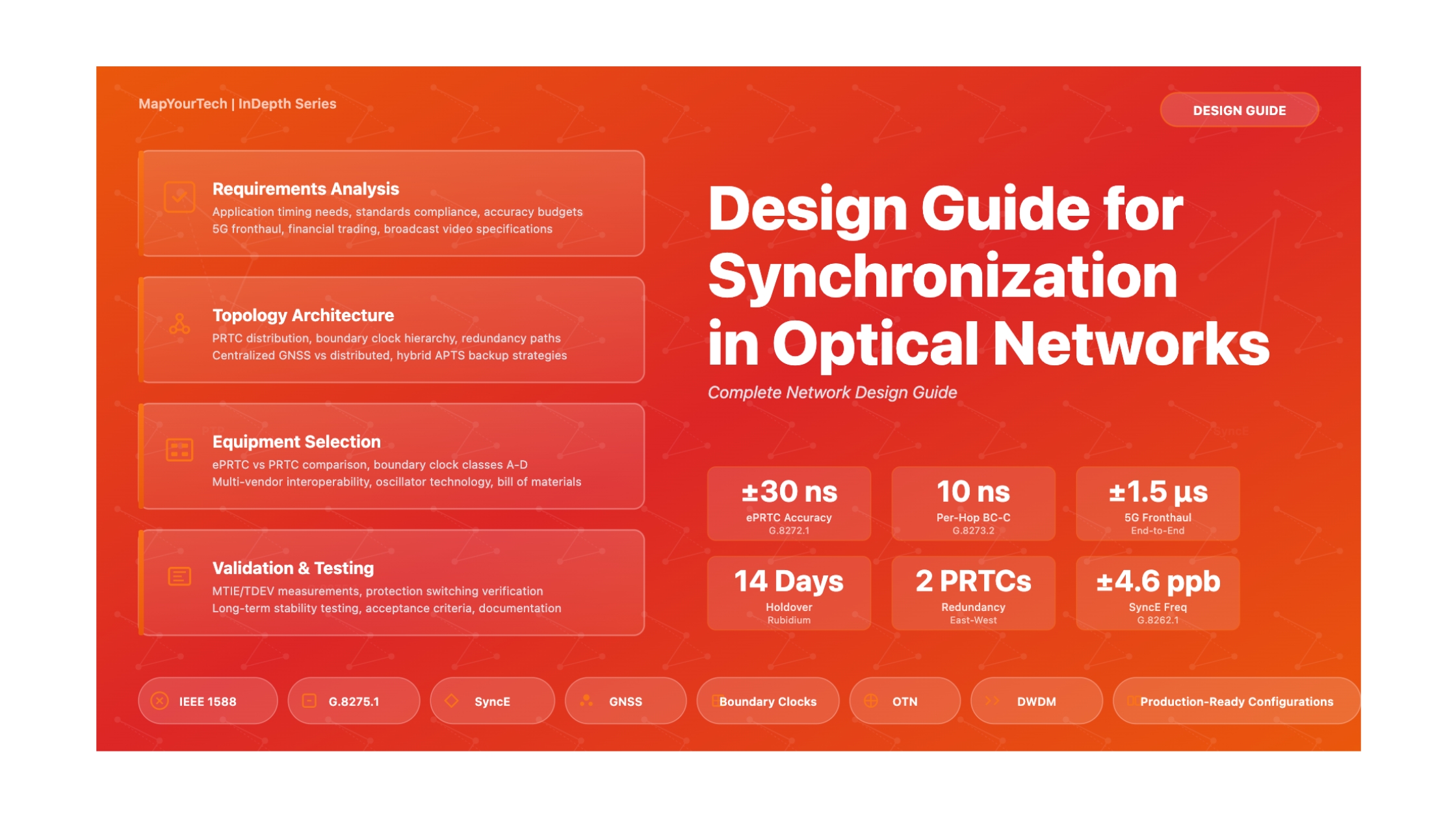
Design Guide for Synchronization in Optical Networks
A comprehensive engineering framework for designing, implementing, and validating timing and synchronization infrastructure in modern optical transport networks
Introduction
Network synchronization forms the foundational timing infrastructure that enables modern telecommunications services to function reliably. In optical networks carrying everything from mobile traffic to financial transactions, precise timing distribution ensures that transmitted bits arrive at their destination with the correct frequency, phase, and time-of-day alignment. Without proper synchronization, services experience errors ranging from subtle performance degradation to complete communication failure.
The evolution from legacy TDM-based synchronization to packet-based timing methods has fundamentally changed how network designers approach synchronization architecture. Where traditional SDH networks distributed timing through the physical layer automatically, today's packet-switched optical networks require explicit engineering of timing paths using protocols like Precision Time Protocol and Synchronous Ethernet. This design guide provides the complete engineering framework needed to architect, implement, and validate synchronization infrastructure that meets the stringent requirements of 5G networks, financial services, and other timing-critical applications.
Design Guide Scope: This guide covers complete network synchronization design from initial requirements analysis through final validation. The focus is on practical engineering decisions for deploying timing infrastructure in optical transport networks serving mobile backhaul, data center interconnect, and enterprise applications. Both greenfield deployments and brownfield upgrades are addressed, with specific attention to the ITU-T G.827x and IEEE 1588 standards that govern modern telecom synchronization.
1. Design Requirements and Standards Compliance
The first phase of any synchronization network design involves translating application requirements into specific timing performance targets and identifying which standards govern the deployment. Different applications impose dramatically different synchronization requirements. Understanding these requirements in detail prevents both over-engineering (wasting capital) and under-engineering (failing to meet service level agreements).
1.1 Application Timing Requirements Analysis
Network synchronization requirements flow directly from the services being carried. Mobile networks present the most demanding requirements due to the physics of radio transmission, particularly for Time Division Duplex technologies where base stations must coordinate transmission timing across cell sites to prevent interference. Financial trading applications require timestamping accuracy sufficient to prove transaction ordering for regulatory compliance. Broadcast video needs phase alignment to avoid visible artifacts when mixing multiple camera feeds.
5G Network Timing Requirements
5G networks using Time Division Duplex impose the strictest timing requirements in commercial telecommunications. The fundamental driver is the need for base stations to coordinate uplink and downlink transmission windows without interference between cells.
| Network Segment | Frequency Accuracy | Absolute Phase | Relative Phase (Cluster) | Required Profile |
|---|---|---|---|---|
| Fronthaul (DU-RU) | ±50 ppb | ≤±1.5 μs to UTC | ≤130 ns between RUs | G.8275.1 + SyncE |
| Midhaul (CU-DU) | ±50 ppb | ≤±1.5 μs to UTC | Not specified | G.8275.1 or G.8275.2 |
| Backhaul (Core) | ±50 ppb | ≤±10 μs to UTC | Not specified | G.8275.2 acceptable |
| 4G LTE FDD | ±50 ppb | ≤±10 μs to UTC | Not applicable | SyncE or PTP G.8265.1 |
| 4G LTE TDD | ±50 ppb | ≤±1.5 μs to UTC | Not specified | PTP + SyncE |
The 130 nanosecond relative phase requirement between cooperating radio units represents the tightest constraint and drives the need for Class C or Class D boundary clocks with enhanced EEC oscillators throughout the fronthaul path.
Figure 1: 5G Network Synchronization Architecture showing hierarchical timing distribution from dual ePRTCs through boundary clock tiers to radio units
Financial Trading and MiFID II Compliance
European financial regulations mandate strict timestamping accuracy for transaction reporting. The requirements vary based on trading venue latency characteristics.
| Trading Type | Accuracy to UTC | Timestamp Granularity | Typical Solution |
|---|---|---|---|
| High-frequency trading (≤500 μs latency) | ≤100 μs | 1 μs | PTP with GNSS + Hardware timestamping |
| Algorithmic trading | ≤100 μs | 1 μs | PTP with GNSS + Hardware timestamping |
| Voice traded / Non-HFT | ≤1 second | 1 second | NTP acceptable |
Hardware timestamping at the network interface card level is mandatory for microsecond-accuracy requirements. Software-based timestamping introduces variable delays from operating system scheduling that prevent compliance.
Broadcast Video SMPTE ST 2059 Requirements
Professional broadcast facilities using IP-based video production require phase synchronization between cameras, mixers, and recording equipment to prevent frame tearing and audio/video sync issues.
| Parameter | Specification | Notes |
|---|---|---|
| Profile | SMPTE ST 2059-2 | PTP profile for professional broadcast |
| Accuracy between slaves | ≤1 μs | Prevents visible artifacts in mixed sources |
| Transport | IPv4 multicast | UDP ports 319/320 |
| Epoch | January 1, 1970 TAI | SMPTE Epoch differs from Unix time |
| Application | IP-based production | Replacing legacy genlock (black burst) |
1.2 ITU-T Standards Framework
The International Telecommunication Union Telecommunication Standardization Sector publishes the definitive standards for telecom synchronization. Understanding the ITU-T G.82xx series is mandatory for any serious synchronization design work. These standards define clock performance requirements, network architecture patterns, and testing methods that vendors implement in their equipment.
ITU-T G.826x Frequency Synchronization Standards
| Standard | Latest Version | Purpose | Key Specification |
|---|---|---|---|
| G.811 | 1997 | Primary Reference Clock (PRC) | ±1×10-11 frequency accuracy |
| G.812 | 2004 | Synchronization Slave Clocks (SSU) | Type I and Type II specifications |
| G.813 | 2003 | Synchronization Equipment Clock (SEC) | Network element clocks |
| G.8261 | 2019 | Timing aspects in packet networks | Architecture and requirements |
| G.8262 | 2024 | Synchronous Equipment Clock (EEC) | SyncE frequency clock requirements |
| G.8262.1 | 2025 | Enhanced EEC (eEEC) | Improved holdover for 5G applications |
| G.8263 | 2017 | Packet-Based Equipment Clock | Clock recovery from PTP/NTP packets |
| G.8264 | 2017 + Amd 2024 | ESMC Protocol | SyncE messaging channel for QL distribution |
The G.8262.1 enhanced EEC standard published in November 2025 represents the latest development in frequency synchronization, providing improved holdover performance specifically for 5G fronthaul applications where brief GNSS outages cannot be tolerated.
ITU-T G.827x Phase and Time Synchronization Standards
| Standard | Latest Version | Purpose | Key Application |
|---|---|---|---|
| G.8271 | 2020 | Network Time Limits | ≤1.5 μs max absolute time error target |
| G.8271.1 | 2022 | Network limits for T-BC and T-TSC | Per-hop time error budgets |
| G.8271.2 | 2021 | Network limits for T-TC | Transparent clock requirements |
| G.8272 | 2025 | PRTC Requirements | Class A: ±100 ns; Class B: ±40 ns to UTC |
| G.8272.1 | 2024 | Enhanced PRTC (ePRTC) | ±30 ns to UTC, 14-day holdover capability |
| G.8273.2 | 2023 + Amd 2024 | T-BC and T-TSC Specifications | Class A through Class D boundary clocks |
| G.8273.3 | 2020 + Amd 2024 | Transparent Clock (T-TC) | Residence time correction specifications |
| G.8273.4 | 2024 | Partial Timing Support | APTS and PTS clock specifications |
| G.8275 | 2025 (Amendment 2) | PTP Telecom Profile Architecture | Framework for G.8275.1 and G.8275.2 |
| G.8275.1 | 2022 + Amd 2024 | PTP Full Timing Support Profile | Layer 2 multicast, SyncE required, mandatory for 5G TDD fronthaul |
| G.8275.2 | 2024 (Amendment 2) | PTP Partial Timing Support Profile | IPv4/IPv6 unicast, flexible deployment across mixed networks |
G.8275.1 is mandatory for 5G TDD fronthaul deployments because it requires all network nodes to support PTP as boundary or transparent clocks plus SyncE for frequency assistance. G.8275.2 permits deployment across networks with non-PTP-aware elements, making it suitable for partial timing support scenarios and gradual migration paths.
1.3 IEEE and IETF Standards
While ITU-T defines telecom-specific profiles and requirements, the underlying synchronization protocols come from IEEE and IETF standards bodies. IEEE 1588 defines the Precision Time Protocol itself, while IETF RFCs govern Network Time Protocol and related security mechanisms.
IEEE 1588 PTP Standards Evolution
| Version | Publication | Key Features | Status |
|---|---|---|---|
| IEEE 1588-2002 (PTPv1) | 2002 | Original precision time protocol | Obsolete, not used |
| IEEE 1588-2008 (PTPv2) | 2008 | Major revision, still widely deployed | Active in legacy systems |
| IEEE 1588-2019 (PTPv2.1) | 2020 | Security TLVs, High Accuracy Profile, asymmetry calibration | Current standard |
| IEEE 1588g-2022 | 2022 | Terminology update (master/slave → timeTransmitter/timeReceiver) | Active amendment |
| IEEE 1588a-2023 | 2023 | BMCA enhancements for multi-vendor environments | Active amendment |
| IEEE 1588e-2024 | 2024 | MIB and YANG management modules | Active amendment |
Read the Full Analysis with Premium
The remaining 89% of this article — the design numbers, trade-offs and field guidance — is part of MapYourTech Premium, along with the full premium library, courses and professional tools.
You May Also Like

-
Free
-
August 22, 2026

-
Premium
-
August 22, 2026
-
Premium
-
August 22, 2026