Quantum Key Distribution for Optical Networks
A Comprehensive Research-Grade Technical Analysis
Abstract
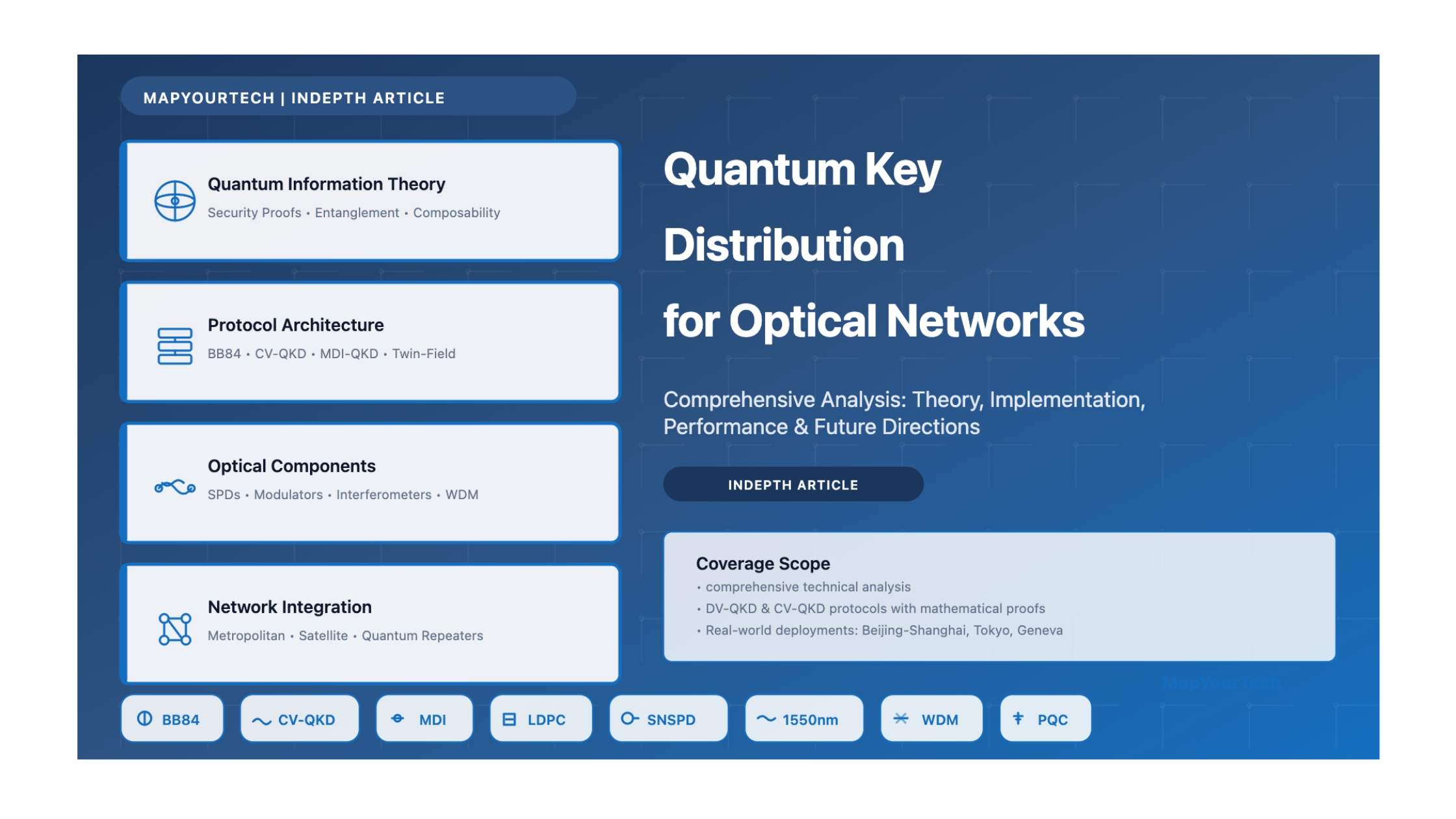
Quantum Key Distribution (QKD) represents a paradigm shift in secure communications for optical fiber networks, leveraging fundamental principles of quantum mechanics to achieve information-theoretic security. This comprehensive research article examines the evolution of QKD from theoretical foundations in 1984 to commercial deployment at terabit-per-second data rates in 2025. We analyze the complete spectrum of QKD technologies, including discrete variable (DV-QKD) protocols such as BB84 and E91, continuous variable (CV-QKD) implementations using coherent state encoding, and emerging measurement-device-independent (MDI-QKD) architectures.
The article provides rigorous mathematical treatment of key generation rates, error correction mechanisms, privacy amplification algorithms, and security proofs under realistic channel conditions. We examine practical implementations including single-photon sources, weak coherent pulse systems with decoy states, entangled photon pair generation, and advanced detection technologies featuring superconducting nanowire single-photon detectors (SNSPDs) and avalanche photodiodes (APDs). Distance limitations imposed by fiber attenuation and detector efficiency are analyzed through the TGW and PLOB bounds, with solutions explored through trusted node architectures, quantum repeaters, and satellite-based QKD systems.
Performance benchmarking reveals secure key rates ranging from 10 kbps over 100 km metropolitan links to 12 Mbps in back-to-back configurations, with recent breakthroughs achieving 33.4 Tbps classical data multiplexed with quantum key generation over 80 km single-mode fiber. Integration challenges with existing dense wavelength division multiplexing (DWDM) infrastructure are examined, including co-propagation strategies that separate quantum signals in C-band from classical traffic in O-band. The convergence of QKD with post-quantum cryptography (PQC) is analyzed, demonstrating hybrid architectures where ML-KEM (FIPS 203) provides algorithmic protection complementing physics-based key distribution.
Case studies document operational QKD networks including the 2000 km Beijing-Shanghai backbone with 32 trusted nodes, metropolitan area networks (Q-MANs) in Europe, United States, China, and Japan, and data center interconnect (DCI) deployments between Equinix facilities in London. Market analysis projects quantum encryption growth from $480 million (2024) to $2.63 billion (2030) at 32.6% CAGR, driven by "harvest now, decrypt later" threats and approaching quantum computing capabilities. Standards development by ETSI, ITU-T, ISO/IEC, and NIST is examined, with particular focus on the world's first QKD Protection Profile (ETSI GS QKD 016) and REST-based key delivery APIs (ETSI GS QKD 014).
Keywords: Quantum Key Distribution, BB84 Protocol, Continuous Variable QKD, Optical Fiber Networks, Information-Theoretic Security, Post-Quantum Cryptography, Photon Number Splitting Attack, Decoy State Method, DWDM Integration, Secure Key Rate
Executive Summary
Key Findings
- Technology Maturity: QKD has transitioned from laboratory curiosity to commercial reality, with operational networks spanning 2000+ kilometers and commercial systems from vendors including ID Quantique, Toshiba, and LuxQuanta achieving 100 km reach over lit fiber.
- Security Foundation: Unlike computational security based on mathematical complexity, QKD offers information-theoretic security rooted in quantum mechanical principles—the observer effect and no-cloning theorem ensure any eavesdropping attempt inevitably disturbs the quantum channel and triggers immediate detection.
- Performance Metrics: Secure key generation rates span six orders of magnitude: 10 kbps at 100 km for DV-QKD systems, 12 Mbps in back-to-back CV-QKD configurations at 20 GHz clock rates, and 80 kbps over 20 km fiber with 1 MHz pulse rates demonstrate the technology's versatility.
- Integration Breakthrough: March 2025 KDDI Research and Toshiba demonstration multiplexing 33.4 Tbps classical data with QKD secret keys over single 80 km fiber eliminates dedicated dark fiber requirements, reducing deployment costs by separating C-band quantum signals from O-band classical traffic.
- Distance Limitations: Fiber-based QKD remains constrained to 100-300 km without trusted intermediate nodes due to photon loss and detector limitations, though satellite-based systems achieved 12,900 km QKD between South Africa and China, transferring >1 million quantum-secure bits per orbit.
Quantum Key Distribution represents the convergence of quantum physics, optical communications, and cryptography to address the most fundamental challenge in secure communications: key distribution. Traditional public-key cryptography, including RSA and elliptic curve systems, faces existential threat from quantum computers capable of executing Shor's algorithm to factor large integers in polynomial time. The National Security Agency estimates cryptographically relevant quantum computers (CRQCs) capable of breaking current encryption will emerge between 2030-2035, with adversaries already harvesting encrypted traffic for future decryption—the "harvest now, decrypt later" attack vector.
QKD eliminates this vulnerability by distributing symmetric encryption keys through quantum mechanical means rather than mathematical algorithms. The BB84 protocol, proposed by Bennett and Brassard in 1984, encodes information in four non-orthogonal quantum states using single-photon pulses. An eavesdropper (Eve) attempting to measure these quantum states must choose a measurement basis without knowing Alice's encoding basis—by Heisenberg's uncertainty principle, measurement in the wrong basis disturbs the quantum state. Alice and Bob detect this disturbance by comparing a subset of their transmitted bits over an authenticated classical channel; if the quantum bit error rate (QBER) exceeds security thresholds (typically 11% for BB84), they abort the protocol and discard potentially compromised keys.
Modern QKD implementations have evolved significantly beyond original single-photon sources. Practical systems employ weak coherent laser sources with decoy state protocols to mitigate photon number splitting (PNS) attacks, where adversaries exploit multi-photon emissions to obtain key information without triggering error thresholds. The decoy state method, proposed by Hwang (2003) and refined by Wang and Lo-Ma-Chen, transmits pulses at varying intensities—signal states for key generation and decoy states for security verification—enabling secure QKD over metropolitan distances with commercially available laser diodes.
Continuous variable QKD offers complementary advantages by encoding information in optical field quadratures rather than discrete photon states. CV-QKD employs homodyne or heterodyne detection with standard photodiodes, achieving raw key rates of 50 MHz to 100 MHz—substantially exceeding DV-QKD's photon-counting detector limitations. However, CV-QKD exhibits reduced tolerance to channel loss, historically limited by the 3 dB loss threshold though reverse reconciliation and postselection techniques have surpassed this boundary. The Technical University of Denmark's April 2024 demonstration achieved 100 km continuous variable QKD over existing Internet infrastructure, validating CV-QKD's compatibility with deployed fiber networks.
Critical Implementation Considerations
Wavelength Division Multiplexing Integration: Co-propagating quantum signals with classical DWDM traffic requires careful spectral management to prevent Raman scattering and four-wave mixing from degrading quantum channels. Toshiba's deployment with PacketLight networks demonstrated successful QKD over DWDM infrastructure by allocating quantum channels at 1310 nm while classical traffic occupies C-band wavelengths, achieving 74 km reach over long-haul links and 70 km for multiplexed systems.
Detector Technology Evolution: Superconducting nanowire single-photon detectors (SNSPDs) based on niobium-nitride offer dark count rates below 10 Hz with timing jitter of 60 ps RMS, dramatically improving system performance compared to InGaAs avalanche photodiodes. However, SNSPDs require cryogenic cooling to 2-4 Kelvin, increasing system complexity and operational costs—an acceptable trade-off for high-security government and financial applications.
Read the Full Analysis with Premium
The remaining 79% of this article — the design numbers, trade-offs and field guidance — is part of MapYourTech Premium, along with the full premium library, courses and professional tools.
Optical Communications & Network Automation Expert | Author of 3 Books for Optical Engineers | Founder, MapYourTech
Optical networking engineer with nearly two decades of experience across DWDM, OTN, coherent optics, submarine systems, and cloud infrastructure. Founder of MapYourTech. Read full bio →
Follow on LinkedInRelated Articles on MapYourTech
You May Also Like
-
Free
-
July 11, 2026
-
Free
-
July 11, 2026
-
Free
-
July 11, 2026
Course Title
Course description and key highlights