Shannon's Limits for Fiber Optics Transmission
A Comprehensive Professional Guide to Understanding Fundamental Capacity Limits of Optical Communication Systems
Table of Contents
- 1. Fundamentals and Core Concepts
- 2. Mathematical Framework
- 3. Modulation Formats and Classification
- 4. Effects and Impacts
- 5. Techniques and Solutions
- 6. Design Guidelines and Methodology
- 7. Interactive Simulators
- 8. Coherent Generations and Industry Status
- 9. Practical Applications and Case Studies
1. Introduction: Fundamentals and Core Concepts
1.1 What is Shannon's Limit?
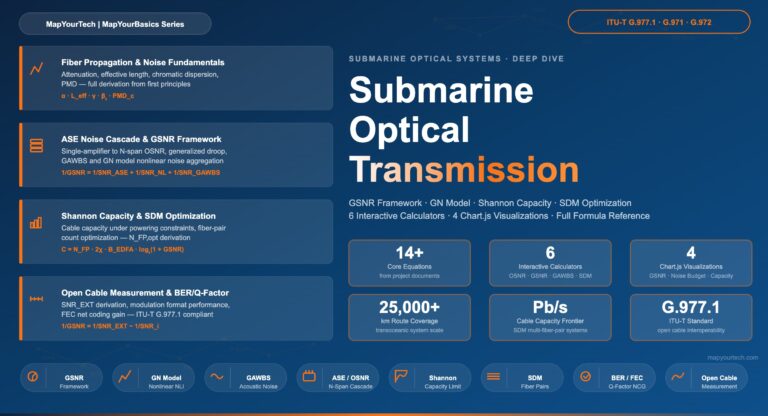
Shannon's Limit, formulated by Claude Shannon in 1948, defines the theoretical maximum data rate (capacity) for any communication channel with given bandwidth and signal-to-noise ratio. This fundamental principle establishes an absolute upper bound for error-free information transmission through noisy channels.
C = B × log₂(1 + SNR)Where: C = Channel capacity (bits/s), B = Bandwidth (Hz), SNR = Signal-to-Noise Ratio (linear scale).
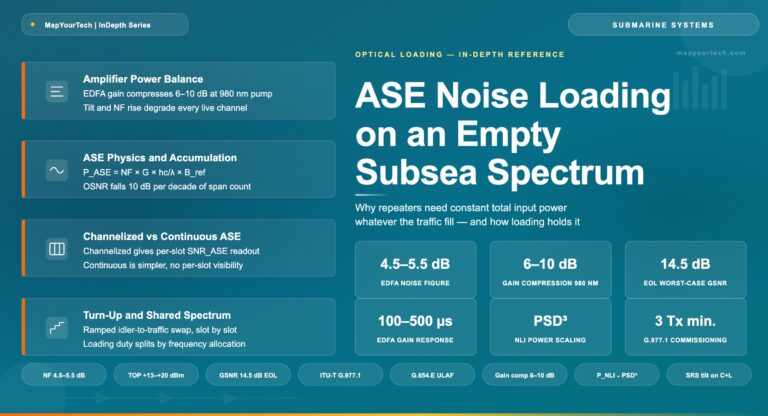
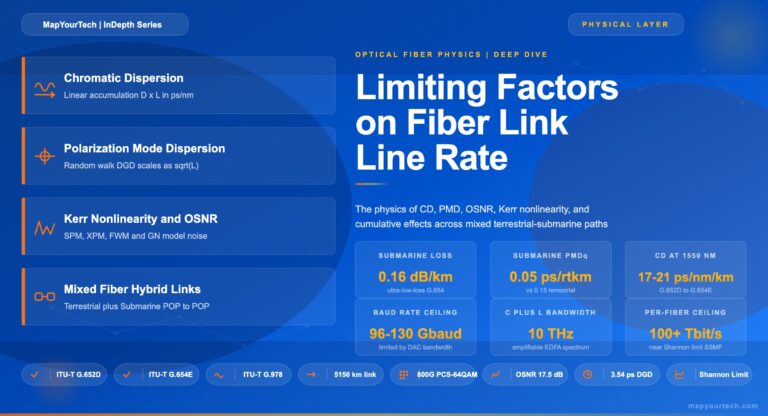
In optical fiber systems, the bandwidth B represents the usable optical spectrum. For the standard C-band, this is approximately 4.8 THz (1530-1565 nm). With both C-band and L-band (1565-1625 nm), the usable spectrum expands to approximately 9.6 THz. The newest "Super C + Super L" configurations extend this to approximately 12 THz. Meanwhile, the SNR in optical systems accounts for Amplified Spontaneous Emission (ASE) noise from optical amplifiers and nonlinear effects from the Kerr effect in fiber. For dual-polarization systems, which are standard in all modern coherent equipment, capacity effectively doubles because two independent data streams are transmitted on orthogonal polarization states.
1.2 Why Does the Limit Occur?
The Shannon Limit arises from fundamental relationships between information, bandwidth, and noise. In optical fiber systems, two sources of impairment dominate the capacity ceiling:
1.3 When Does It Matter?
Shannon's Limit becomes the primary design constraint in long-haul transmission (1,000+ km) where accumulated ASE and nonlinear interference combine to limit achievable OSNR. It is also the governing factor in high-capacity metro networks approaching full C-band utilization, data center interconnects where maximum per-fiber throughput is needed, and network planning decisions about whether to invest in more advanced signal processing or simply add more fiber or spectrum (such as expanding into L-band).
1.4 Why Is It Important?
Performance Benchmark: Modern coherent systems with probabilistic constellation shaping (PCS) and soft-decision FEC operate within 1-2 dB of the linear Shannon Limit. For undersea systems, PS-64QAM at 8 b/s/Hz is only about 0.1 dB from the AWGN Shannon limit per polarization, representing an extraordinary engineering achievement. At the system level, including all nonlinear effects, the best submarine demonstrations operate within about 30-50% of the nonlinear limit in terms of spectral efficiency gap.
Industry Direction: Recognizing that single-mode fiber capacity in the C-band is approaching its practical ceiling (approximately 40 Tb/s over transoceanic distances, or up to approximately 100 Tb/s for terrestrial spans with aggressive modulation) has redirected innovation toward three main avenues: expanding usable spectrum through C+L band or Super C+L systems, Space-Division Multiplexing (SDM) with higher fiber-pair counts or multi-core fibers, and continued DSP advances that squeeze efficiency ever closer to the theoretical bound.
2. Mathematical Framework
2.1 Spectral Efficiency
SE = 2 × log₂(1 + SNR) [bits/s/Hz]The factor of 2 accounts for dual-polarization transmission, standard in all modern coherent systems. In the SNR range relevant to undersea systems, this can be approximated with a slope of approximately 0.5 b/s/Hz per dB of SNR.
2.2 The Nonlinear Shannon Limit
The Gaussian Noise (GN) model provides a tractable framework for estimating nonlinear interference. Under this model, the total noise is the sum of ASE noise and nonlinear interference noise (NLI), both treated as additive Gaussian noise:
SNReff = P / (PASE + PNLI)

Where:
  PASE  = Nspans × G × NF × hν × B   (accumulated ASE)
  PNLI  ≈ η × P³ × Nspans(1+ε)   (nonlinear interference)

  η depends on: fiber type (γ, β₂, α, Leff), channel count, channel spacing
  ε ≈ 0 for fully incoherent accumulation; higher for partially coherent NLI
At the optimum launch power, the maximum achievable OSNR is 2/3 of the linear OSNR (a 1.76 dB penalty). This forms the "nonlinear Shannon limit" for a given link configuration.
2.3 Practical Capacity Limits
Standard Single-Mode Fiber, C-band only (approximately 4.8 THz):
Transoceanic distance (6,000-10,000 km): approximately 35-40 Tb/s maximum demonstrated capacity, with record SE of approximately 8.3 b/s/Hz.
Terrestrial long-haul (1,000-2,000 km): approximately 40-50 Tb/s achievable with modern coherent engines.
C+L band (approximately 9.6 THz): Record capacity of 71.6 Tb/s over approximately 6,960 km has been demonstrated. Super C+L band (approximately 12 THz) systems with the latest coherent engines have demonstrated 83.6 Tb/s over 1,240 km and greater than 100 Tb/s total capacity is projected for single fiber pair.
Space-Division Multiplexing: Laboratory demonstrations using multi-core fiber have reached 0.52 Pb/s over 8,830 km using 12-core fiber. Commercial SDM submarine systems with 12-16 fiber pairs are now standard, with total cable capacities of 200-300 Tb/s.
2.4 Parameter Reference
| Parameter | Symbol | Units | Typical Values |
|---|---|---|---|
| Channel Capacity | C | bits/second | 100G-1.6T per wavelength |
| C-band Bandwidth | B | Hz | approximately 4.8 THz (1530-1565 nm) |
| Super C Bandwidth | B | Hz | approximately 6 THz (1524-1572 nm) |
| C+L Bandwidth | B | Hz | approximately 9.6 THz |
| Super C+L Bandwidth | B | Hz | approximately 12 THz |
| OSNR (typical rx) | OSNR | dB (in 0.1 nm) | 14-28 dB depending on link |
| Spectral Efficiency | SE | bits/s/Hz | 4-10 b/s/Hz practical deployed |
| Fiber Nonlinear Coefficient | n2 | m2/W | 2.7 x 10⁻²⁰ |
| Fiber Effective Area | Aeff | μm2 | 80-150 (type dependent) |
3. Modulation Formats and Classification
3.1 Linear vs. Nonlinear Shannon Limit
3.2 Modulation Format Comparison
The table below summarizes the key trade-offs between modulation formats used in coherent optical systems. The required OSNR values represent typical implementation thresholds including modern SD-FEC with approximately 20-25% overhead, at a baud rate in the range of 60-70 GBaud. Actual thresholds vary with implementation, baud rate, and FEC type.
| Format | Bits/Symbol (DP) | SE (b/s/Hz) | Approx. Req. OSNR | Typical Max Reach | Primary Application |
|---|---|---|---|---|---|
| DP-QPSK | 4 | approximately 4 | 12-14 dB | 10,000+ km | Ultra-long-haul, submarine |
| DP-8QAM | 6 | approximately 6 | 16-18 dB | 3,000-6,000 km | Long-haul, submarine |
| DP-16QAM | 8 | approximately 8 | 19-22 dB | 1,000-3,000 km | Regional, metro, 800ZR |
| DP-32QAM | 10 | approximately 10 | 22-25 dB | 500-1,500 km | Metro, DCI |
| DP-64QAM | 12 | approximately 12 | 25-28 dB | 200-800 km | Short metro, high-SE DCI |
Table 1: Modulation format comparison. OSNR values are approximate thresholds at BER = 1e-2 (SD-FEC limit) in 0.1 nm reference bandwidth. Actual values vary by implementation, baud rate, and FEC overhead.
4. Effects and Impacts
4.1 Nonlinear Impairments
| Effect | Typical Penalty | Impact | Mitigation |
|---|---|---|---|
| Self-Phase Modulation (SPM) | 0.5-2 dB | Spectral broadening, intrachannel distortion | Digital backpropagation, power optimization |
| Cross-Phase Modulation (XPM) | 1-3 dB | Interchannel crosstalk, dominant NLI in WDM | Increased channel spacing, PCS, XPM-aware DSP |
| Four-Wave Mixing (FWM) | 0.5-3 dB | Spurious frequency products on channels | High dispersion fiber, unequal spacing |
| ASE Noise Accumulation | approximately 5 dB / 1,000 km | Linear SNR reduction with distance | Low-NF amplifiers, Raman amplification |
| Stimulated Raman Scattering | Power tilt across bands | Affects C+L and broadband systems | Tilt compensation, per-channel power management |
Table 2: Nonlinear impairment summary. Penalty values are approximate and system-dependent.
4.2 Impact Severity by Distance
| Application | Shannon Impact | Dominant Constraint | Severity |
|---|---|---|---|
| Intra-DC (<10 km) | Minimal | Cost, power, latency, density | Low |
| DCI / Metro (10-500 km) | Moderate | Reach vs. capacity balance | Medium |
| Long-Haul (500-3,000 km) | Significant | Nonlinear limit dominant | High |
| Submarine (>3,000 km) | Dominant | Operating at edge of physical limits | Maximum |
5. Techniques and Solutions
5.1 Probabilistic Constellation Shaping (PCS)
PCS biases transmission toward lower-amplitude symbols, making the signal distribution more Gaussian-like, which is the optimal distribution per information theory. The theoretical maximum shaping gain is 1.53 dB over uniform QAM for asymptotically large constellations. In practice, PS-64QAM achieves better than 1 dB gain over uniform 64QAM and comes within approximately 0.1 dB of the AWGN Shannon limit at 8 b/s/Hz spectral efficiency. PS-64QAM has been experimentally demonstrated at 7.3 b/s/Hz over 6,600 km using C+L bandwidth, and at 6 b/s/Hz over 11,000 km in field trials. PCS is now standard in all modern 400G, 800G, and 1.6T coherent platforms and is also specified in the Open ROADM MSA 8.0 specification for interoperable 800G ZR+ applications.
5.2 Geometrical Shaping (4D/Multi-Dimensional)
Geometrical shaping arranges constellation points in multi-dimensional space (typically 4D, using both polarizations and both quadratures) to maximize minimum Euclidean distance while maintaining constant modulus properties. APSK-based coded modulation formats such as 4D-PS-56APSK achieve SE ranges from 5.6 to 9.6 b/s/Hz and operate 1.85-2.8 dB from the Shannon limit when combined with LDPC codes. Compared to probabilistic shaping, geometrical shaping offers implementation simplicity and can provide superior nonlinear tolerance due to reduced higher-order statistical moments (lower kurtosis), which directly reduce NLI generation through the fiber.
5.3 Forward Error Correction
| FEC Type | Coding Gain | Overhead | Gap to Shannon | Application |
|---|---|---|---|---|
| Hard-Decision LDPC | approximately 10 dB | approximately 7-15% | approximately 2-3 dB | 100G legacy, cost-sensitive |
| Soft-Decision LDPC | approximately 11-12 dB | approximately 20-25% | approximately 0.5-1 dB | Modern 400G/800G/1.6T |
| Concatenated (oFEC / SD-LDPC + Staircase) | approximately 12-13 dB | approximately 25-30% | approximately 0.3-0.5 dB | Submarine, ultra-long-haul |
5.4 Nonlinearity Mitigation
6. Design Guidelines and Methodology
6.1 Step-by-Step Design Process
6.2 Decision Framework
| Distance | Modulation | Per-Wave Rate | Design Considerations |
|---|---|---|---|
| 0-120 km (DCI/ZR) | 16QAM/64QAM + PCS | 400G-800G | Pluggable ZR/ZR+ optics, maximize SE, cost per bit focus |
| 120-800 km (Metro/Regional) | 16QAM/32QAM + PCS | 400G-800G | Balance reach vs. capacity, PCS mode selection |
| 800-3,000 km (Long-Haul) | 8QAM/16QAM + PCS | 200G-600G | Nonlinearity management, Raman amplification beneficial |
| >3,000 km (Submarine) | QPSK/8QAM + CM | 100G-300G | Operating near Shannon limit, every fraction of a dB counts |
7. Interactive Simulators
Simulator 1: Shannon Capacity Calculator
Computes dual-polarization Shannon capacity, net capacity after FEC overhead, and spectral efficiency for a given bandwidth and OSNR.
Simulator 2: Modulation Format Comparison
Compares achievable data rates and OSNR margins for different modulation formats given your available OSNR and baud rate.
| Format | Gross Rate | Net Rate (20% FEC) | SE | Req. OSNR | Margin | Feasibility |
|---|
Simulator 3: Nonlinear Shannon Limit Analysis
Models the power-dependent capacity curve showing the optimum launch power where linear SNR and nonlinear penalty are balanced.
Simulator 4: Spectral Efficiency vs. Reach Trade-off
Visualizes the fundamental SE vs. reach trade-off for different fiber and amplification configurations, showing the Shannon bound and practical deployment regions.
Simulator 5: Band Capacity Comparison
Compares total fiber capacity across different spectral configurations: C-band only, C+L, Super C+L, and future multiband.
8. Coherent Generations and Industry Status
8.1 DSP Generation Evolution
The coherent DSP industry has progressed through multiple generations, each bringing higher baud rates, more advanced modulation, and closer approach to the Shannon limit. The table below tracks the approximate baud rate classes used by the industry, their typical per-wavelength capacity, and the CMOS process nodes that enabled them.
DP-QPSK
40-28 nm CMOS
DP-16QAM
16 nm CMOS
DP-16QAM + PCS
7 nm CMOS
DP-16QAM/64QAM + PCS
5/4 nm CMOS
DP-16QAM/64QAM + PCS
3/4 nm CMOS
8.2 Industry Status
The coherent optics market is in the middle of the 800G ramp and the beginning of the 1.6T era. 400G ZR/ZR+ coherent pluggables have become the most widely adopted coherent technology in history, and 800G modules have reached general availability from multiple suppliers. Industry shipments of 800G modules are projected to exceed 200,000 units annually. The 800G ZR standard uses DP-16QAM at approximately 118 GBaud, achieving approximately 8 b/s/Hz spectral efficiency for DCI applications.
At the performance-optimized end, platforms delivering up to 1.2 Tb/s per wavelength at approximately 140-148 GBaud are in production deployment (using the latest generation coherent engines). These engines achieve up to 8.83 b/s/Hz SE in C-band, corresponding to 42.4 Tb/s total C-band capacity, and greater than 80 Tb/s with C+L band operation. Systems delivering 1.6 Tb/s per optical engine (typically as two independently programmable 800G wavelengths) are shipping in volume.
Looking ahead, the OIF has launched work on 1600ZR and 1600ZR+ standards for interoperable 1.6T pluggable coherent, targeting volume production in 2026-2027 using advanced DSP in 3 nm CMOS. Total system capacity per fiber pair continues to push toward the 100 Tb/s mark for terrestrial networks, and the submarine industry is deploying SDM cables with 12-16+ fiber pairs for total cable capacities of 200-500 Tb/s. Laboratory demonstrations using multi-core fiber have exceeded 0.5 Pb/s over transoceanic distances.
8.3 Spectrum Expansion Trends
The ROADM ecosystem is evolving to support broader spectrum. Standard C-band (4.8 THz) ROADMs still account for the majority of deployments but their share is steadily declining as operators adopt wider spectrum options. Super C (6 THz) ROADMs are widely deployed in China, and integrated C+L ROADMs supporting 9.6-12 THz are emerging as the new standard for long-haul. The first L-band pluggable coherent modules (800G class) are expected from all major suppliers, making C+L deployment significantly more accessible and cost-effective than previous generations that required dedicated high-performance embedded line cards.
9. Practical Applications and Case Studies
9.1 Deployment Scenarios
9.2 Quick Reference
| Application | Target SE | Shannon Efficiency | Enabling Technologies |
|---|---|---|---|
| Submarine (>5,000 km) | 3.5-7.3 b/s/Hz | 85-95% of linear limit | SD-FEC, PCS/GS, CM, Raman, C+L band |
| Long-Haul (1,000-5,000 km) | 4.5-6.5 b/s/Hz | 75-85% | SD-FEC, PCS, power optimization |
| Regional (200-1,000 km) | 6-8 b/s/Hz | 70-80% | Adaptive modulation, flex-grid |
| Metro/DCI (<200 km) | 8-12 b/s/Hz | 65-80% | High-order QAM, PCS, pluggables |
9.3 Professional Recommendations
For Operators: Assess your current Shannon efficiency by comparing deployed SE against theoretical maximum for your OSNR. If operating more than 4 dB from the limit, significant optimization opportunity exists with modem upgrades. Begin planning for spectrum exhaustion when approaching 70% of Shannon limit in C-band, and consider L-band expansion or fiber pair additions. With integrated C+L ROADMs and L-band pluggables now available, the barriers to spectrum expansion are lower than ever.
For Designers: Calculate theoretical capacity first, then determine the achievable percentage for your specific route. Model nonlinearity accurately using the GN model (or EGN model for better accuracy with low-order modulation). Design infrastructure assuming future growth will require additional spectral dimensions or SDM. Maintain at least 2-3 dB of margin; do not operate at absolute Shannon limit in production.
For Researchers: Focus on closing the remaining gap between achievable information rates and the true fiber channel capacity, which remains an open problem at high powers. Explore new dimensions for capacity growth: multi-core fiber, hollow-core fiber, and broadband amplification beyond C+L. The true capacity of the nonlinear fiber channel may be higher than the commonly cited "nonlinear Shannon limit" (which is a lower bound, not a proven upper bound).
References
[1] C. E. Shannon, "A Mathematical Theory of Communication," Bell System Technical Journal.
[2] P. Poggiolini, "The GN Model of Non-Linear Propagation in Uncompensated Coherent Optical Systems," Journal of Lightwave Technology.
[3] J.-X. Cai et al., "Ultralong-Distance Undersea Transmission Systems," in Optical Fiber Telecommunications V11, Elsevier.
[4] E. Agrell et al., "Roadmap of Optical Communications," Journal of Optics.
[5] A. Alvarado et al., "Achievable Information Rates for Fiber Optics: Applications and Computations," Journal of Lightwave Technology.
[6] M. Secondini, "Information-Theoretic Analysis of the Optical Fiber Channel," in Optical Fiber Telecommunications V11, Elsevier.
[7] Sanjay Yadav, "Optical Network Communications: An Engineer's Perspective" – Bridge the Gap Between Theory and Practice in Optical Networking.
Developed by MapYourTech Team
For educational purposes in Optical Networking Communications Technologies
Note: This guide is based on industry standards, best practices, and real-world implementation experiences. Specific implementations may vary based on equipment vendors, network topology, and regulatory requirements. Always consult with qualified network engineers and follow vendor documentation for actual deployments.
Feedback Welcome: If you have any suggestions, corrections, or improvements to propose, please feel free to write to us at [email protected]