
Generic selectors
Exact matches only
Search in title
Search in content
Post Type Selectors
Articles
lp_course
lp_lesson
Back
HomeAnalysisChannel Capacity& Shannon’s Limit
Channel Capacity& Shannon’s Limit

Channel Capacity& Shannon’s Limit

Last Updated: April 2, 2026
21 min read
113
Channel Capacity: The Complete Guide to Understanding Shannon's Limit in Optical Communications
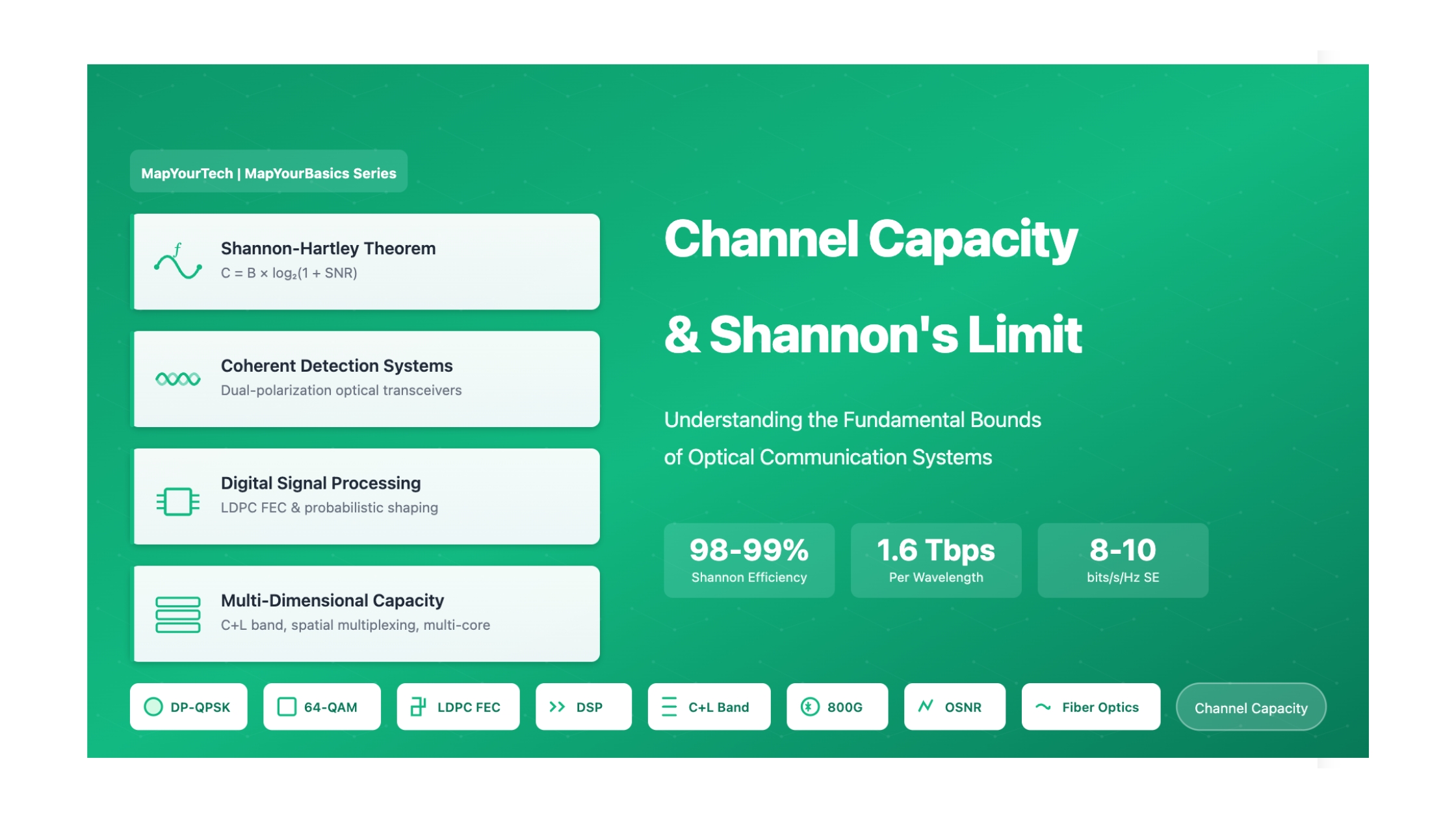
Channel Capacity& Shannons Limit - Image 1

Channel Capacity: The Complete Guide to Understanding Shannon's Limit

A comprehensive exploration of information theory, optical communications, and the fundamental limits governing data transmission in modern networks

Introduction

What is Channel Capacity?

Channel capacity represents the fundamental limit of how much information can be reliably transmitted through a communication channel per unit of time. First formalized by Claude Shannon in 1948, this concept defines the theoretical maximum data rate at which information can be sent over a noisy channel with an arbitrarily low probability of error.

In simple terms, channel capacity is like the maximum speed limit on a highway—it tells us the fastest rate at which we can safely transmit data without losing information. Just as a highway's capacity depends on the number of lanes and traffic conditions, a communication channel's capacity depends on its bandwidth and the amount of noise present.

Key Concept

Channel capacity is measured in bits per second (bps) and represents the upper bound of reliable data transmission. No coding or modulation scheme can exceed this limit without incurring errors, making it a fundamental law of information theory.

Why is Channel Capacity Important?

Understanding channel capacity is crucial for several compelling reasons:

Network Design

Channel capacity guides engineers in designing communication systems that operate efficiently near theoretical limits. Modern optical networks achieve spectral efficiency within 1-2 dB of the Shannon limit, extracting maximum performance from available infrastructure.

Resource Allocation

Knowing capacity limits helps operators optimize bandwidth usage, determine when to upgrade infrastructure, and make informed decisions about spectrum allocation in increasingly crowded networks.

Technology Evolution

As we approach Shannon's limit in single-mode fiber (currently 98-99% efficiency), the industry shifts focus to multi-band systems, spatial-division multiplexing, and other innovative approaches to expand total capacity.

Cost Optimization

Understanding where systems operate relative to capacity limits prevents over-engineering (wasted resources) and under-engineering (poor performance), enabling cost-effective network deployments.

Real-World Relevance

Channel capacity isn't just theoretical—it directly impacts everyday technologies:

5G and Beyond: Mobile networks must carefully manage spectral efficiency to deliver promised speeds. Understanding channel capacity helps operators maximize data rates within limited spectrum allocations, supporting billions of connected devices.

Data Center Interconnects: As AI and machine learning workloads explode, data centers require terabit-scale optical links. Modern 800G and 1.6T coherent transponders operate at the edge of Shannon's limit, using advanced techniques like probabilistic constellation shaping to extract every possible bit.

Submarine Cable Systems: Undersea fiber optic cables spanning oceans operate continuously for 25+ years. Engineers must optimize capacity from day one, as reaching the Shannon limit means physical infrastructure limits total achievable throughput—upgrading requires laying new cables.

Satellite Communications: With constrained power budgets and challenging propagation conditions, satellite links must operate efficiently. Channel capacity calculations determine optimal modulation schemes and error correction codes for reliable communications.

Industry Applications

Industry Application Capacity Challenge Current Solution
Telecommunications Long-haul fiber networks Approaching C-band Shannon limit (~100 Tb/s per fiber) C+L band expansion, multi-core fiber
Cloud Computing Inter-datacenter links AI workloads demanding 10x capacity increase 800G/1.6T coherent pluggables, CPO
Financial Services High-frequency trading Ultra-low latency with high capacity Dark fiber, advanced DSP for minimum overhead
Broadcasting 8K video transmission 48+ Gbps per channel requirement DWDM with efficient modulation (64-QAM)
Defense Secure tactical communications Jam-resistant, high-capacity links Spread spectrum near capacity limit, quantum-safe encryption

What You'll Learn in This Guide

This comprehensive resource takes you on a journey from fundamental concepts to cutting-edge implementations:

  • Historical Context: Trace channel capacity from Shannon's 1948 breakthrough through modern optical communications achieving 98% theoretical efficiency
  • Core Theory: Master the Shannon-Hartley theorem, understand signal-to-noise ratio (SNR), and learn how bandwidth and noise fundamentally limit communication
  • Mathematical Foundations: Explore derivations, work through real calculations, and see how formulas translate into practical system design
  • Technical Architecture: Understand how coherent optical systems, DSP algorithms, and forward error correction (FEC) approach capacity limits
  • Interactive Tools: Use four comprehensive simulators to visualize channel capacity, experiment with parameters, and see real-time impacts on system performance
  • Implementation Guidance: Learn from case studies how Netflix, Google, and major carriers optimize networks using capacity theory
  • Future Trends: Discover how the industry tackles Shannon's limit through spatial-division multiplexing, multi-band systems, and emerging technologies

Key Concepts Preview

Shannon-Hartley Theorem

The fundamental equation C = B log₂(1 + SNR) that defines maximum channel capacity based on bandwidth and signal-to-noise ratio. This elegant formula guides all modern communication system design.

Spectral Efficiency

Measured in bits/s/Hz, spectral efficiency indicates how effectively a system uses available bandwidth. Modern coherent optics achieve 8-10 bits/s/Hz, approaching theoretical maximums.

OSNR (Optical SNR)

In optical fiber systems, OSNR typically ranges from 15-25 dB. Higher OSNR enables higher-order modulation (64-QAM, 128-QAM) but faces physical limits from amplifier noise.

Nonlinear Shannon Limit

Unlike linear channels, optical fiber capacity peaks at optimal power due to Kerr nonlinearity. Increasing power beyond this point creates nonlinear noise that reduces capacity.

Premium Article — Free 20% Preview

Read the Full Analysis with Premium

The remaining 80% of this article — the design numbers, trade-offs and field guidance — is part of MapYourTech Premium, along with the full premium library, courses and professional tools.

Instant access · Cancel anytime · 48-hour trial available
Sanjay Yadav

Optical Communications & Network Automation Expert | Author of 3 Books for Optical Engineers | Founder, MapYourTech

Optical networking engineer with nearly two decades of experience across DWDM, OTN, coherent optics, submarine systems, and cloud infrastructure. Founder of MapYourTech.

Follow on LinkedIn
Share:

You May Also Like

52 min read 12 0 Like The Submarine Cable Stack: Open Cables, GSNR, SDM and Power Skip to main content...
  • Free
  • July 10, 2026
32 min read 10 0 Like Coherent DSP Architecture: From ADC Samples to Client Bits MAPYOURTECH | COHERENT OPTICS DEEP...
  • Free
  • July 10, 2026
42 min read 14 0 Like Building an Optical NOC Dashboard with OpenConfig Telemetry Skip to main content MapYourTech |...
  • Free
  • July 10, 2026

Course Title

Course description and key highlights

Course Content

Course Details