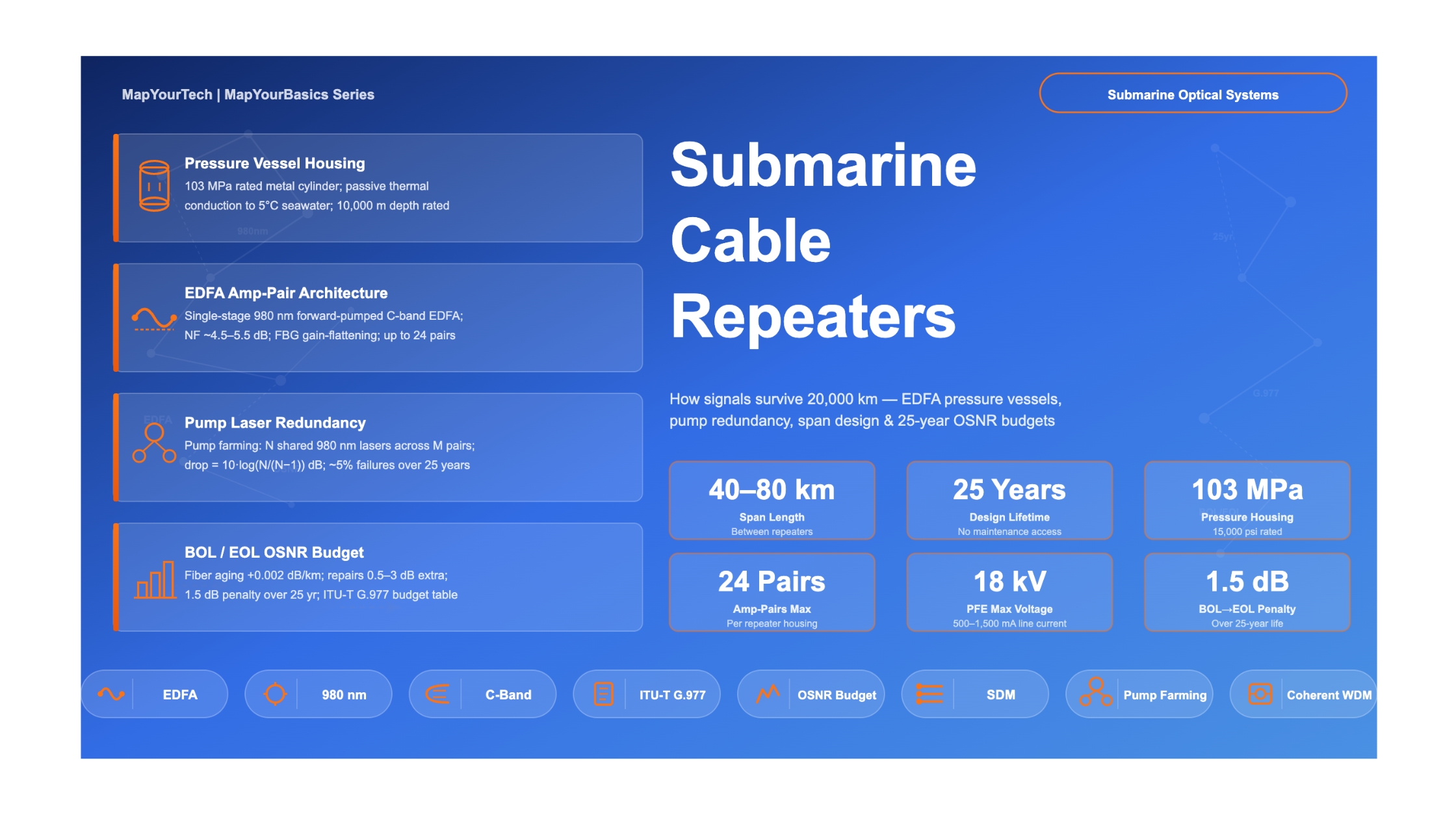

Submarine Cable Repeaters: How Signals Survive 20,000 km
How undersea EDFA repeaters extend optical transmission across transoceanic distances — pressure-vessel housing design, pump laser redundancy, span lengths, and the 25-year OSNR budget challenge.
1. Introduction
The internet carries exabytes of data each day across transoceanic distances — and the overwhelming majority of that traffic travels not through satellites, but along a network of slender fiber-optic cables resting on the ocean floor. These cables cross the Atlantic in roughly 7,000 km, span the Pacific in more than 13,000 km, and connect continents with latencies in the tens of milliseconds. For any of that to work, optical signals — which follow the same physics as any other light, attenuating as they travel — must be continuously regenerated across distances where no technician can reach and no truck roll is possible.
The device that makes transoceanic optical transmission viable is the submarine cable repeater: a sealed pressure vessel containing erbium-doped fiber amplifiers (EDFAs) that restore optical signal power at intervals of approximately 40 to 80 km. These repeaters are engineered to entirely different tolerances than their terrestrial counterparts. They must operate reliably at ocean depths of 4,000 to 8,000 meters, under hydrostatic pressures exceeding 1,000 atmospheres, at constant near-freezing temperatures, for a design lifetime of 25 years, without any possibility of hands-on maintenance. When a repeater fails, the only option is a cable ship — a repair that costs several million dollars and takes weeks. The stakes of getting the design right are therefore exceptionally high.
This article provides a thorough technical examination of how submarine repeaters are built and how they function. It covers the physics of EDFA amplification as applied to the undersea environment, the mechanical engineering of pressure-vessel housings, pump laser architecture and redundancy strategies, the relationship between span length and system performance, and — critically — how system designers plan for optical signal-to-noise ratio (OSNR) degradation over a 25-year life through beginning-of-life (BOL) and end-of-life (EOL) budget calculations. The treatment is aimed at engineers who need to understand these systems at a design level, whether for network planning, system commissioning, procurement evaluation, or academic study.
2. Why Repeaters Are Necessary — Fiber Loss at Ocean Scale
Optical fiber transmits light with very low attenuation compared to copper wire, but it is not lossless. Standard single-mode fiber used in submarine systems exhibits an attenuation of approximately 0.17–0.20 dB/km in the C-band (1,525–1,568 nm), with the best ultra-low-loss fibers approaching 0.154 dB/km. Even at 0.17 dB/km, a transoceanic cable of 10,000 km accumulates 1,700 dB of total fiber loss. No practical transmitter and receiver pair can bridge that gap unaided.
Before the introduction of EDFAs in the early 1990s, submarine systems used electronic regenerators — devices that converted optical signals to electrical form, reshaped the data, and retransmitted them optically (a process called 3R regeneration: re-amplification, re-shaping, re-timing). These regenerators were expensive, bit-rate specific, and generated substantial heat. The EDFA changed everything. An EDFA amplifies light in the optical domain across an entire wavelength division multiplexing (WDM) band simultaneously, without any optical-to-electrical conversion. It is transparent to modulation format and data rate. Once EDFA-based repeaters became sufficiently reliable, submarine system designers could scale capacity by adding wavelength channels rather than deploying additional cables.
Why EDFAs dominate undersea systems: The erbium-doped fiber amplifier covers the C-band (approximately 1,525–1,568 nm) with efficient gain, a noise figure approaching the 3 dB quantum limit, and electrical power conversion efficiency between 40% and 50% from pump to signal. This combination of optical performance and electrical efficiency — critical when every milliwatt of power must travel thousands of kilometers down a cable conductor — makes EDFA the technology of choice for virtually all deployed submarine systems.
The fundamental challenge of optical amplification at ocean scale is noise accumulation. Each EDFA adds amplified spontaneous emission (ASE) noise alongside signal gain. Over hundreds of cascaded amplifiers, this noise accumulates and progressively degrades the OSNR. The system designer's task is to select span length, amplifier gain, output power, and noise figure such that the OSNR at the receiving terminal, after accounting for 25 years of aging, remains above the minimum threshold required by the coherent transceivers.
3. EDFA Architecture in Undersea Repeaters
3.1 The Amp-Pair Architecture
The fundamental building block of an undersea repeater is the amplifier pair, commonly called the "amp-pair." A submarine cable carries multiple fiber pairs, where each fiber pair carries bidirectional optical traffic — one fiber for each direction of propagation. Each amp-pair amplifies the signal on one fiber pair: one EDFA amplifies traffic traveling east, the other amplifies traffic traveling west. The two EDFAs in an amp-pair share a common pump laser unit and monitoring circuitry, which improves both reliability and packaging efficiency.
A typical repeater housing in a modern system contains one amp-pair for each fiber pair in the cable. As cable capacity has grown through space division multiplexing (SDM), the fiber pair count has increased accordingly. A state-of-the-practice repeater as of the mid-2020s can house up to 24 amp-pairs, accommodating cables with 24 fiber pairs of single-core fiber or 24 core-pairs in multi-core fiber cables. Increasing this count is an active area of development, with research into multicore EDFAs and more compact packaging to support higher fiber pair counts within the existing mechanical envelope.
3.2 Single-Stage Amplifier Design
Undersea amplifiers use a single-stage design — one section of erbium-doped fiber (EDF), one pump multiplexer, and two isolators — rather than the dual-stage designs common in terrestrial long-haul systems. This choice is deliberate: minimizing component count directly reduces failure probability over the 25-year life. Every passive optical component in the signal path is a potential failure point or a source of insertion loss that degrades noise figure.
Forward pumping at 980 nm is the standard approach. Forward pumping (where the pump travels in the same direction as the signal through the EDF) provides lower noise figure than backward pumping when pump power degrades, because the pump is still present at the EDF input even with reduced power. This characteristic matters greatly in a system where pump degradation must be tolerated gracefully over 25 years. The 980-nm pump also achieves higher population inversion than 1,480-nm pumps, enabling noise figures closer to the 3 dB quantum limit.
An input isolator is placed before the EDF to prevent backward-propagating ASE from re-entering the input fiber and causing additional noise through Rayleigh backscattering. An output isolator after the gain-flattening filter (GFF) prevents reflections from outside the repeater from reaching the GFF. These isolators add a small insertion loss penalty, but the noise figure improvement they provide far outweighs that cost in high-gain amplifier designs.
3.3 Gain Flattening and Spectral Management
EDFA gain is not uniform across the C-band — it has a peaked profile, amplifying some wavelengths more than others. In a terrestrial system with perhaps 20–30 cascaded amplifiers, this non-uniformity can be managed with gain-flattening filters at the mid-amplifier stage. In a submarine system with 100–200 cascaded amplifiers, even a fraction of a decibel of per-amplifier gain non-uniformity compounds into many decibels of spectral tilt at the receiving terminal.
Submarine EDFAs therefore use fiber Bragg grating (FBG) gain-flattening filters with very tight specifications — the gain excursion per amplifier must be held to a few tenths of a decibel across the full C-band bandwidth. The stable, near-constant deep-sea temperature (approximately +5°C at most transoceanic depths) is a significant enabler here: unlike terrestrial amplifiers, which must cope with temperature swings from –5°C to +70°C that affect EDF gain characteristics, submarine amplifiers operate at an essentially fixed temperature. This stability allows the GFF design to be precisely optimized and reliably maintained over the system's life.
Temperature stability advantage: The near-constant deep-sea temperature allows submarine EDFA gain flatness to be held to a few tenths of a dB, versus >1 dB excursion for terrestrial amplifiers over their operating temperature range. This precision is essential when concatenating hundreds of amplifiers: a gain excursion of 0.3 dB per amplifier compounds to 30 dB across 100 cascaded stages.
4. Pressure Vessel Housing Design
4.1 Mechanical Requirements
Submarine repeaters must survive at ocean depths reaching more than 10,000 meters — the deepest floors of the world's oceans, where hydrostatic pressure exceeds 1,000 atmospheres (approximately 100 MPa). The pressure housing must withstand 103 MPa (15,000 psi) with minimal physical deformation, because internal optical components cannot tolerate significant movement or stress. The housing must also maintain its integrity through decades of cyclic loading from tidal and current-driven pressure variations, as well as the mechanical stress of being laid and recovered by cable ships.
The housing is a metal cylinder — typically beryllium copper or a high-strength aluminum alloy, selected for both mechanical strength and high thermal conductivity — with welded end covers. The choice of material is not arbitrary: the same high thermal conductivity that makes certain alloys attractive for structural use also provides the necessary thermal path from internal components to the surrounding seawater. There is no active cooling system. All heat generated by the pump lasers and electronics must conduct from the internal mounting structures, through the housing wall, and into the ocean.
4.2 Thermal Management
Thermal design is critical for long-term pump laser reliability. The primary heat source inside the repeater is the 980-nm pump lasers. Pump laser junction temperature is one of the strongest predictors of long-term failure rate — higher junction temperature accelerates the dominant failure mechanisms in semiconductor lasers. The housing design establishes a low-thermal-impedance path from the pump laser mounting surface through the internal chassis, into the housing wall, and ultimately to seawater. Hard-mounting of the internal network to the housing, with metal-to-metal contact at critical interfaces and no thermally resistive adhesives in the heat flow path, achieves the required thermal performance.
The deep-sea temperature of approximately +5°C provides an enormous advantage over terrestrial deployment. While terrestrial repeaters must handle ambient temperatures up to +70°C, undersea repeaters operate in a thermal environment that changes by only a few degrees Celsius over the entire life of the system — except for short segments near beach landings or in shallow water, which require special thermal attention. For shallow-water sections, Peltier (thermoelectric) cooling is explicitly avoided because of reliability concerns with active cooling elements; instead, the amplifier design is chosen to operate acceptably at the higher temperatures encountered in shallow water without active cooling intervention.
4.3 Electrical Isolation and Powering Interface
A critical and often overlooked aspect of housing design is electrical isolation. The housing itself is in direct contact with seawater and is therefore at ocean ground potential. The internal electronics — pump laser drivers, control circuits, monitoring — must be maintained at a different, elevated electrical potential because the repeaters are powered by a high-voltage direct current flowing through the cable conductor. This requirement means that a high-voltage dielectric material must physically separate the internal chassis from the housing body, preventing the powering path from being short-circuited to ground through the seawater.
The power feed equipment (PFE) at terminal stations drives line current values typically in the range of 500 to 1,500 mA through the cable conductor, with PFE voltages reaching as high as 18 kV for long transoceanic routes. Each repeater taps the power it needs from this current through a network power supply (NPS). The NPS uses a chain of Zener diodes to provide a stable supply voltage to the pump laser drive electronics, regardless of variations in the line current within the operating range. The pump laser control is designed so that a constant current to the pump laser produces a constant optical output power — critical for maintaining system OSNR over the life of the cable.
5. Pump Laser Redundancy — The Reliability Architecture
5.1 Why Pump Lasers Are the Critical Component
The 980-nm pump laser is the single most reliability-critical component in a submarine repeater. It is an active semiconductor device operating continuously at elevated optical power, and its failure rate over a 25-year period is the dominant driver of system reliability analysis. When a pump laser fails catastrophically, the amplifier gain drops, reducing the output power of that amp-pair and increasing the OSNR penalty for all subsequent spans on the same fiber pair. Unlike a fiber break, a pump failure does not typically cause a complete service outage on that fiber pair — instead, it causes a gradual degradation of transmission quality that consumes margin from the EOL budget.
The classical approach to managing this risk — originally employed in early submarine EDFA systems — was to dedicate two pump lasers per amp-pair: a working laser and a hot-standby laser. If the working laser failed, the standby would take over. This "1+1 pump redundancy" per amp-pair approach provided good protection but consumed significant space and power budget inside the housing.
5.2 Pump Sharing and Pump Farming
As fiber pair counts per cable have grown — driven by the industry shift to SDM designs with many fiber pairs per cable — a more efficient redundancy strategy called pump sharing or pump farming has become standard. In a pump-sharing architecture, a single optical pump unit (OPU) containing multiple 980-nm pump lasers serves multiple amp-pairs simultaneously through a combiner/splitter network. For example, an OPU with four pump lasers might power two or three amp-pairs. If one pump laser fails, the remaining lasers in the OPU can partially compensate — the gain of each affected amplifier drops by the factor 10 × log₁₀(N/(N−1)) dB, where N is the number of pumps that were sharing that amp-pair before the failure.
ΔPout = 10 × log₁₀(N / (N − 1))  dB

where N = number of shared pumps before failure
ΔP_out — output power drop of the affected amp-pair (dB)
N — total pump lasers sharing that amp-pair before failure
Example: N = 4 → ΔP = 10 × log₁₀(4/3) = 1.25 dB drop per failed pump
After one failed pump, subsequent repeaters see nominal input power — the penalty is localized to one span.
The pump-sharing architecture achieves several advantages simultaneously. Operating each pump laser at lower drive current (since the total power requirement is shared) reduces the junction temperature of each device, which meaningfully extends its expected lifetime. It also allows the OPU to deliver more total pump power to the fiber pair ensemble than any single pump could provide, enabling higher output power per amp-pair where needed. And the statistical benefit of having multiple pumps per OPU — where the OPU continues to function acceptably even after one or two individual laser failures — provides better system-level reliability than the 1+1 approach at the same total pump laser count.
5.3 Reliability Qualification and the 25-Year Standard
Submarine system reliability requirements are among the most demanding in the telecommunications industry. Terrestrial EDFA equipment is typically designed for a 15-year lifetime. Submarine systems require 25 years of continuous, unattended operation, which translates to on the order of 219,000 hours. Meeting this requirement for pump lasers involves a combination of design-for-reliability (identifying and eliminating failure modes through analysis and testing), burn-in screening (exposing devices to elevated stress conditions before deployment to eliminate infant-mortality failures), and redundancy design (ensuring that the system can tolerate a statistically expected number of individual component failures over the design life without service impact).
Field data assumption used in OSNR budgets: System designers typically assume that approximately 5% of repeaters will experience a 980-nm pump failure over the 25-year design lifetime. This assumption, along with fiber aging and cable repair contributions, is used to calculate the expected OSNR reduction from BOL to EOL. Cables with pump-sharing designs plan for this by sizing the BOL OSNR margin to cover the worst-case EOL condition.
6. Span Length — The Core Design Trade-Off
6.1 Span Length Ranges and Their Drivers
The distance between consecutive repeaters — the span length — is one of the most consequential parameters in submarine cable system design. It is not arbitrary: it results from the intersection of optical performance requirements, mechanical deployment constraints, ocean floor topology, and economic optimization.
Typical span lengths in deployed transoceanic systems range from approximately 40 km at the shorter end (used in high-capacity cables where very good OSNR is needed) to 80 km at the longer end (used when cable route conditions or capacity requirements allow it). Some regional and festoon cables use spans approaching 100 km, while ultra-long-haul systems pushing maximum capacity may use spans of 50 km or shorter. Shallow-water and continental shelf segments often have shorter spans because the cable route can be planned in advance and the engineering constraints differ from deep water.
The fundamental optical trade-off is straightforward: a longer span introduces more fiber attenuation, requiring higher EDFA gain and output power to compensate, which in turn generates more ASE noise per span. Across the many hundreds of spans in a transoceanic system, higher per-span noise accumulation translates directly to lower end-of-link OSNR. Conversely, shorter spans allow lower EDFA gain (and therefore lower noise) per span, but increase the total repeater count, which increases cost, increases total accumulated ASE from more amplification stages, and increases the total electrical power consumption of the cable.
6.2 OSNR from a Cascaded EDFA Chain
The analytical foundation of span-length selection is the cascaded EDFA OSNR formula. For a chain of identical amplifiers, each compensating the loss of one span, the OSNR at the end of the chain is:
OSNR = P_s − NF − 10·log(N_span) − L_span + 58  [dB in 0.1 nm reference BW]

Equivalent form per ITU-T G.977 for unrepeatered sections:
OSNR = 58 + P_s − LinkLoss − NF
P_s — signal power per channel at amplifier output (dBm)
NF — amplifier noise figure (dB); practical submarine EDFAs: ~4.5–5.5 dB
N_span — number of spans (= number of cascaded amplifiers)
L_span — loss per span (dB) = span length (km) × fiber attenuation (dB/km)
58 — constant derived from photon energy at 1,550 nm and reference bandwidth
Example: P_s = 0 dBm, NF = 5 dB, 200 spans, L_span = 10 dB → OSNR ≈ 0 − 5 − 23 − 10 + 58 = 20 dB
This formula shows immediately why every decibel matters: a 1 dB improvement in noise figure is worth 1 dB of OSNR at the receive terminal. Doubling the number of spans costs 3 dB of OSNR (10 × log 2). These relationships drive the tight NF specifications on submarine amplifiers and the careful optimization of span length.
6.3 Nonlinear Impairments and the Optimal Launch Power
The cascaded EDFA OSNR formula assumes that higher launch power is always better — and up to a point, that is true. More signal power at the amplifier output means a higher signal-to-noise ratio after each span. However, at sufficiently high powers, the fiber itself becomes nonlinear through effects including self-phase modulation (SPM), cross-phase modulation (XPM), and four-wave mixing (FWM). Nonlinear effects introduce signal distortion and inter-channel crosstalk that degrade transmission quality in ways that cannot be recovered by more amplifier gain.
The result is that system OSNR performance peaks at an optimal launch power, with lower performance on both sides of that optimum — too low, and the signal is dominated by amplifier noise; too high, and fiber nonlinearities dominate. In a transoceanic system with many hundreds of spans, nonlinear effects accumulate along the entire length, and the optimal power per channel is typically in the range of −3 to +3 dBm depending on channel spacing, fiber type, and system length. The generalized OSNR (G-OSNR) metric combines both linear noise and nonlinear distortion into a single performance parameter that the system design must satisfy.
7. The 25-Year OSNR Budget — BOL and EOL Planning
7.1 Why Beginning-of-Life and End-of-Life Conditions Differ
A submarine cable system is designed for its full 25-year life from the first day. The system must perform acceptably not only when it is newly installed — beginning of life (BOL) — but also on the last day of its design life — end of life (EOL). These two conditions differ because of several processes that degrade system performance irreversibly over time:
Fiber attenuation aging occurs at a rate of approximately 0.002 dB/km over 25 years. This is caused by the slow diffusion of hydrogen into the fiber, which causes additional absorption. In a long system with 5,000 km of fiber, this adds 10 dB of extra span loss over the life of the cable. In a span of 50 km with 0.2 dB/km initial attenuation (10 dB span loss), the EOL span loss becomes 10.1 dB — a 0.1 dB increase per span, which after 100 spans amounts to 0.25 dB additional OSNR penalty.
Pump laser degradation and failure is planned for statistically, with approximately 5% of repeaters expected to experience pump failure over 25 years. Each pump failure causes a localized increase in the input power deficit for that span (since the amplifier output drops when a pump fails). This translates into increased noise accumulation for that span, which adds to the overall OSNR penalty.
Cable repairs introduce localized loss increases. Each repair in deep water (depth >1,000 m) adds approximately 3 dB of extra loss, while a shallow-water repair adds approximately 0.5 dB. The frequency of repairs is typically planned as one deep-water repair per 1,000 km and one shallow-water repair per 20 km.
7.2 Calculating the BOL/EOL OSNR Degradation
The ratio of BOL to EOL OSNR for a system with non-uniform input powers (as would result from pump failures, cable repairs, and fiber aging) is given by the relationship between the uniform and non-uniform sums of inverse input powers. If all repeaters see the same input power P_in at BOL, then:
OSNR_BOL / OSNR_EOL = Σ (P_in / k·P_in,j)

Where:
k   = total number of spans
P_in,j = input power to repeater j at EOL (accounting for aging, repairs, pump failures)
At BOL: all k repeaters see the same input power P_in → ratio = 1.0
At EOL: some repeaters see reduced input power → sum > 1.0 → OSNR_EOL < OSNR_BOL
Worked Example — 2,000 km system (30 spans, 70 km each):
• 14 spans: extra −1.75 dB (shallow-water repairs) + −0.35 dB (fiber aging)
• 14 spans: extra −0.35 dB (fiber aging only)
• 1 span: extra −3 dB (deep-water repair) + −0.35 dB (fiber aging)
• 1 span: extra −3 dB (pump failure) + −0.35 dB (fiber aging)
→ OSNR_BOL / OSNR_EOL ≈ 1.4 → OSNR degradation = 1.5 dB
Worked Example — 6,000 km system (120 spans, 50 km each):
→ OSNR_BOL / OSNR_EOL ≈ 1.21 → OSNR degradation = 0.85 dB
Note: shorter systems have larger percentage EOL penalty because a single repair represents more of the total loss budget.
Case Study: Power Budget Table for a 10,000 km / 100×100G Submarine DLS (ITU-T G.977)
7.3 The Role of Soft-Decision FEC in Modern Systems
The Q² factor values in the budget table above — a line Q² of 6.0 dB before FEC translating to an effective Q² of >17.3 dB after FEC — illustrate how critically important forward error correction (FEC) has become in submarine systems. The raw bit error rate before FEC at 6 dB Q² is approximately 2×10⁻², which is far too high for any practical application. After modern soft-decision FEC processing, the output BER drops below 10⁻¹³, which meets the ITU-T minimum Q² requirement of 5.0 dB with substantial margin.
This FEC capability allows submarine system designers to operate at lower OSNR than would otherwise be possible, which in turn allows longer span lengths, higher channel counts, or more margin for EOL degradation. Advances in FEC coding gain — from hard-decision FEC (approximately 8 dB net coding gain) to soft-decision FEC (typically 11–12 dB net coding gain) — have been one of the major enablers of doubling and tripling submarine cable capacity without changing the wet plant.
8. Line Monitoring and Repeater Supervision
8.1 High-Loss Loopback Monitoring
Because submarine repeaters cannot be accessed for maintenance, the system must be designed to monitor its own health from the terminal stations. The primary in-service monitoring mechanism is the high-loss loopback (HLLB), a passive optical circuit built into each amp-pair. The HLLB taps a small fraction of the amplifier output power and couples it back into the counterpropagating amplifier of the same amp-pair. At the terminal, line monitoring equipment (LME) sends a chain of short pulses down the cable and measures the reflected signal from each HLLB point. The timing and strength of each reflection tells the LME the location and relative performance of each repeater.
By comparing the amplitude of the HLLB reflection against historical data, the LME can detect events including pump laser power decrease (which causes a characteristic change in gain tilt), localized span loss increases, and complete fiber pair cuts. HLLB data identifies which span is affected; if more precise fault location is needed, an out-of-service optical time domain reflectometry (OTDR) measurement can then pinpoint the fault within the span to the resolution needed for cable repair vessel navigation.
8.2 Repeater Supervisory Channel
In addition to the HLLB passive monitoring, undersea repeaters use a supervisory function that modulates a tone on the pump laser current at low amplitude (modulation index typically below 10% to limit the supervisory impairment to the transmission signal to <0.2 dB). This allows the terminal to monitor the repeater input and output power, verify pump laser health, and confirm correct repeater operation without interfering with the traffic-bearing WDM channels.
9. Submarine vs. Terrestrial EDFAs — Key Differences
Understanding submarine repeaters requires appreciating how fundamentally different they are from terrestrial amplifiers, even though both use the same core technology — an erbium-doped fiber pumped at 980 nm.
| Design Aspect | Submarine EDFA | Terrestrial EDFA |
|---|---|---|
| Design lifetime | 25 years, continuous, unattended | 15 years; access for maintenance available |
| Temperature environment | ~+5°C constant (deep water); limited variation | −5°C to +70°C; wide variation, active cooling required |
| Amplifier stages | Single-stage; minimum component count | Often dual-stage with mid-stage gain equalization |
| Gain range | Low (typically 8–12 dB, matched to span loss) | High (20–35 dB; accommodates variable span loss) |
| Gain flatness | Tenths of dB excursion over full C-band | >1 dB excursion typical due to temperature variation |
| Pump redundancy | Pump sharing across fiber pairs (N pumps for M pairs) | 1+1 redundancy per amplifier, or single pump with maintenance access |
| Cooling mechanism | Passive conduction to seawater through housing wall | Forced air or liquid cooling in controlled room environment |
| Power supply | Derived from constant-current cable conductor via Zener NPS | Local AC mains power with redundant power supply units |
| Gain equalization filter | Placed after EDF (single stage; lower loss acceptable) | Often at mid-stage to handle larger gain excursion |
| Access for repair | Not possible; cable ship required at multi-million dollar cost | Field replaceable within hours; hot-swap line cards |
| Adhesives on optical path | Not used (reliability concern over 25 yr) | Used in connectors and splitter assemblies |
10. Operations, Fault Detection, and Troubleshooting
10.1 Performance Monitoring from the Terminal
Submarine cable operations centers monitor system health through several mechanisms, all of which are accessible from the terminal stations without any access to the wet plant itself. Key performance indicators include the total received power on each fiber pair, the Q² factor or BER performance of each WDM channel (measured by the coherent transceivers), and the HLLB-based repeater health data from the LME.
Gradual decline in any of these metrics is expected over the system's life and is tracked against the EOL budget. The operations team must distinguish between planned degradation (fiber aging, accumulated repairs) and unexpected events (anchor damage, spontaneous cable break, shark bite in shallow water, seismic activity). An anomalous step change in HLLB data, or a sudden loss of service on a fiber pair, triggers an investigation to locate the fault.
10.2 Fault Isolation Procedure
10.3 Common Fault Types and Signatures
| Fault Type | HLLB Signature | Impact | Response |
|---|---|---|---|
| Single pump laser failure | Step change in gain tilt at one repeater | Partial output power drop; localized OSNR penalty | Log; track EOL margin; no immediate repair needed |
| Span insertion loss increase | Reduced HLLB reflection level for affected span | Gradual OSNR degradation proportional to loss increase | Monitor; may trigger cable repair decision based on margin |
| Fiber pair cut | Complete loss of HLLB return from affected span and beyond | Full service outage on that fiber pair | OTDR for precise location; cable ship dispatch |
| Cable shunt fault (sea water ingress) | PFE detects voltage anomaly; repeaters beyond fault lose power | Potential loss of all fiber pairs beyond shunt location | PFE reconfiguration; cable ship; may require splicing new segment |
| Amplifier unit failure | Complete loss of specific amp-pair; OTDR on that path | Service outage on that fiber pair | Cable ship; entire repeater replacement |
11. Optimization, SDM Evolution, and Future Directions
11.1 Space Division Multiplexing Impact on Repeater Design
The most significant ongoing evolution in submarine repeater architecture is the drive toward space division multiplexing (SDM) — increasing the number of fiber pairs per cable. Higher fiber pair counts deliver more total system capacity at lower cost per bit, since much of the system cost (cable lay, terminal stations, landing rights) is independent of fiber pair count. SDM cables with 12, 16, 24 and higher fiber pair counts have been deployed and are driving repeater design toward higher amp-pair density within the same mechanical housing envelope.
The pump-sharing architecture described in Section 5 was specifically developed to enable SDM scaling. By sharing pump power across multiple fiber pairs, the total pump laser count grows much more slowly than the fiber pair count, controlling the repeater's power consumption and physical size. This sharing approach has required the industry to formally abandon the "fiber pair independence" rule that characterized earlier submarine cable designs, where each fiber pair's amplification was engineered to be entirely independent of others. Modern SDM systems accept that a shared pump failure affects multiple fiber pairs simultaneously, and design the system OSNR budget to absorb this impact.
11.2 C+L Band Expansion
Current submarine cables operate primarily in the C-band (1,525–1,568 nm). A significant capacity expansion opportunity lies in also using the L-band (1,568–1,625 nm), which would approximately double the usable spectral bandwidth. C+L band submarine repeaters are under active development and early deployment. They require either two separate EDF gain sections (one optimized for C-band, one for L-band) or a modified EDF composition that covers both bands. The thermal and power management challenges of L-band EDFAs in the undersea environment are active research topics.
11.3 Multicore Fiber and Future Repeater Concepts
Multicore fiber (MCF) — fiber containing multiple propagation cores within a single glass strand — offers a path to even higher fiber pair density within the existing cable mechanical cross-section. A 2-core MCF, for example, effectively doubles the fiber pair count within the same cable diameter. Scaling to 4-core MCF would quadruple it. This creates new challenges for repeater design: a 24-fiber-pair cable using 4-core MCF would require 96 effective amp-pairs. Even with single-core EDFAs, this exceeds the capacity of any current repeater housing, motivating research into multicore EDFA architectures where a single pump drives all cores of one fiber simultaneously.
12. Quick Reference
Span and System Parameters
Housing and Environment
OSNR Budget Parameters
Key Formulas
13. Conclusion
The submarine cable repeater is one of the most demanding engineered devices in the telecommunications industry. It must achieve, simultaneously: near-theoretical amplifier noise performance, exceptional mechanical robustness at extreme ocean pressure, passive thermal management in an environment that provides only cold seawater as a heat sink, electrical isolation under high-voltage DC powering, and 25 years of unattended reliable operation. The EDFA technology at its core is the same technology used in terrestrial equipment, but the submarine implementation of that technology represents a distinctly different engineering discipline with different trade-offs, design margins, and qualification standards.
The BOL/EOL OSNR budget discipline described in this article — accounting for fiber aging, cable repairs, and the statistical expectation of pump laser failures over 25 years — provides the quantitative framework that connects repeater design choices to long-term system performance. Engineers working in submarine cable system design, terminal equipment specification, or network planning need to understand these budgets to correctly evaluate design margin, interpret performance monitoring data, and make informed decisions about upgrade and repair thresholds.
The ongoing evolution toward SDM cables with higher fiber pair counts, C+L band operation, and multicore fiber will continue to drive repeater design innovation. Pump-sharing architectures, multicore EDFA development, and advances in FEC coding gain are the key technical levers that will allow future cables to carry substantially more capacity within the existing constraints of pressure housing size, cable cross-section, and long-haul power delivery. The 25-year lifetime requirement, however, is not expected to change — making the reliability engineering of submarine repeaters a permanent cornerstone of deep-sea optical transmission.
Main Points
- Submarine EDFA repeaters compensate for fiber attenuation at 40–80 km intervals, enabling transoceanic transmission over 20,000 km.
- Pressure-vessel housings rated to 103 MPa (15,000 psi) protect amplifier electronics, with passive thermal management relying on conduction to 5°C seawater.
- Pump-sharing (pump farming) distributes 980-nm pump power across multiple amp-pairs, improving reliability and enabling SDM scaling.
- The 25-year OSNR budget accounts for three main degradation sources: fiber aging (+0.002 dB/km), cable repairs (0.5–3 dB each), and pump failures (~5% of repeaters over life).
- BOL-to-EOL OSNR penalty is typically 0.85–1.5 dB depending on system length; shorter systems carry a larger percentage penalty.
- HLLB monitoring enables in-service fault detection and isolation from terminal stations, with OTDR providing precise fault location within spans.
References
- ITU-T Recommendation G.977 – Characteristics of optically amplified optical fibre submarine cable systems.
- ITU-T Recommendation G.652 – Characteristics of a single-mode optical fibre and cable.
- Elsevier, "Undersea Fiber Communication Systems," 2nd Edition — reference material for submarine optical systems engineering and design.
- OIF IA # OIF-FEC-100G-01.0 — 100G Ultra Long Haul DWDM Framework Document.
- IEEE Journal of Lightwave Technology, Vol. 36, No. 2 — Advances in submarine cable capacity and SDM design.
- Sanjay Yadav, "Optical Network Communications: An Engineer's Perspective" – Bridge the Gap Between Theory and Practice in Optical Networking.
Developed by MapYourTech Team
For educational purposes in Optical Networking Communications Technologies
Note: This article is based on industry standards, published technical literature, and established engineering principles. Specific implementations may vary based on equipment vendors, cable route, and system design choices. Always consult qualified submarine cable engineers and vendor documentation for actual system deployments.
Feedback Welcome: Suggestions, corrections, or improvements — write to us at [email protected]