The pump wavelength used is either 980nm or 1480 nm due to the availability of these laser sources. In the course of the explanation let see the energy level diagrams for the (Erbium) Er3+ ion, the absorption band of Er+, and the pump efficiency.
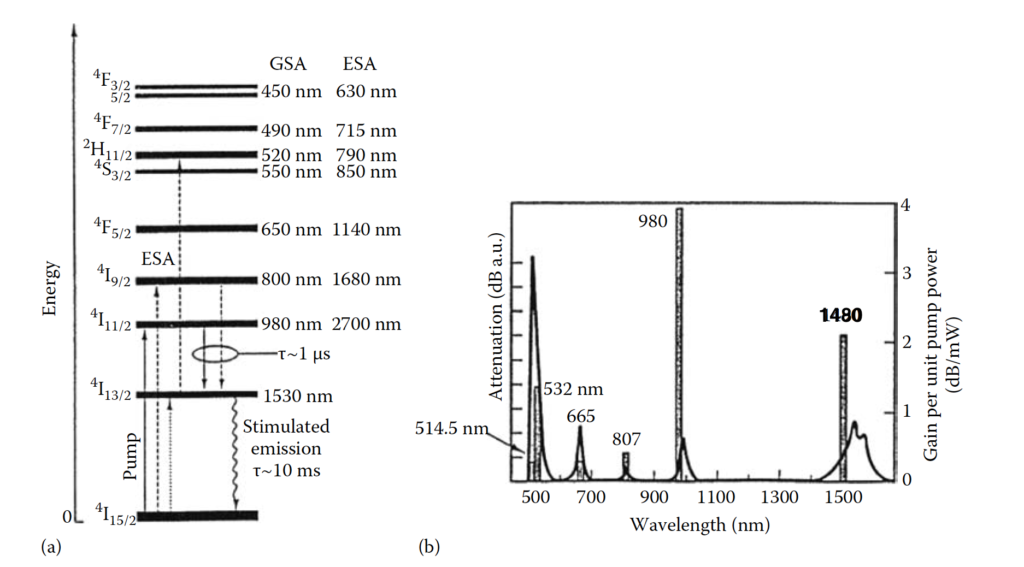
(a) Energy levels of erbium ions and (b) gain and attenuation spectra.
Excited State Absorption (ESA)
Ground-state absorption (GSA)
There are several states to which the erbium ions can be pumped using sources of different wavelengths, such as those operating at 1480, 980, and 800 nm. However, in practical optical systems, the pump wavelength must provide a high power to achieve a high gain per pump.
The commonly available laser diodes can operate at 800, 980, and 1480 nm, but the pump efficiency can go more than 1 dB/mW with low attenuation depending on the pump frequency.
The only pump wavelength laser sources that can give a high pumping efficiency with lower attenuations are those operating at 980 and 1480 nm.
In practice, the 980 nm pumping source is commonly used due to its high gain coefficient (4 dB/mW). The difference in the effects of these two wavelength sources is mainly caused by the absorption and emission factors.


Optical Communications & Network Automation Expert | Author of 3 Books for Optical Engineers | Founder, MapYourTech
Optical networking engineer with nearly two decades of experience across DWDM, OTN, coherent optics, submarine systems, and cloud infrastructure. Founder of MapYourTech. Read full bio →
Follow on LinkedIn