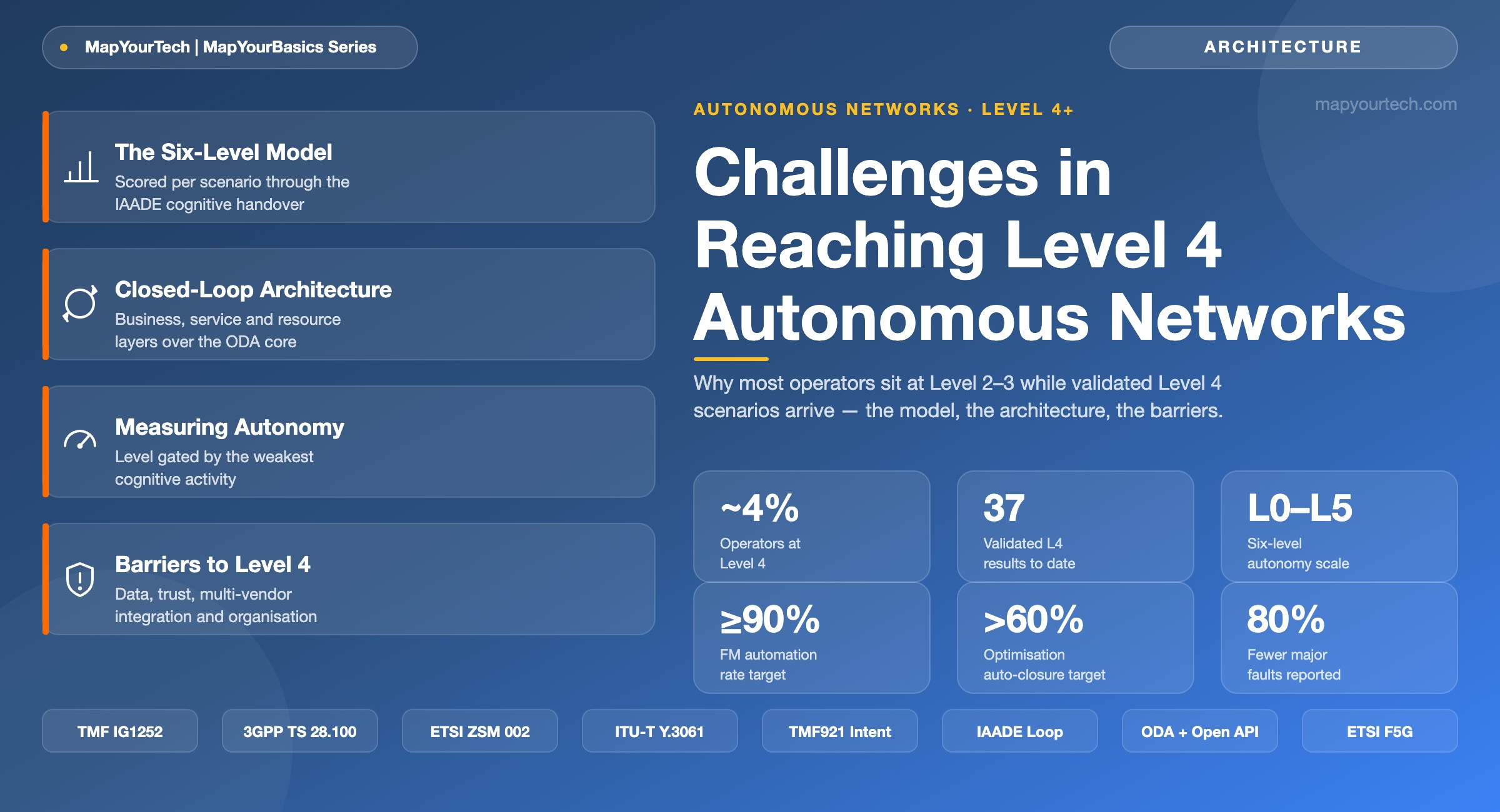
Challenges in Achieving TM Forum Level 4 and Above Autonomous Networks
Validated Level 4 scenarios are arriving, yet most operators sit at Level 2–3. A working breakdown of what Level 4 demands, the layered closed-loop architecture behind it, how autonomy is scored, and the legacy-underlay, data, trust, multi-vendor and organisational barriers that gate the move to Level 4 and above.
1. Introduction
In late 2025, TM Forum presented 37 independent validations of progress toward Level 4 autonomous networks, and Ericsson — working with TDC NET in Denmark — took the first validated Level 4 result under the new assessment-validation scheme. The scenario was narrow and concrete: a Predictive Cell Energy Management solution that has run in production since May 2024, automating radio-access energy-efficiency optimisation by reading per-site traffic profiles and trading energy savings against measured customer experience. It earned full marks on the assessment. It also covers exactly one operation flow in one network domain.
Read past the certifications and the wider picture is sober. A TM Forum regional benchmark covering 2025–2026 placed only about 4% of operators at Level 4 overall, 17% at Level 3 and 31% at Level 2. A separate Accenture study found 79% of telcos still at Level 0 or Level 1, with only 22% expecting to reach Level 4 by 2030. Both readings hold at once because they measure different objects: a validated Level 4 result is a single scenario, while the maturity surveys score an operator’s network as a whole.
That gap — between certified islands of autonomy and end-to-end self-management — is what this article is about. TM Forum frames the move to Level 4 as a shift from “systems assist humans” to “humans assist machines,” and the barrier is rarely the algorithm. It is data quality, trust and assurance, multi-vendor brownfield integration, and the reorganisation of the people who run the network. What follows is the level model and the cognitive handover that defines it, the layered closed-loop architecture and the data-centric core beneath it, how autonomy is scored and why a score stalls one step short, the concrete barriers, and what the leaders actually did. If you want the level taxonomy on its own first, the companion guide to the six levels of autonomous networks, L0 to L5, walks each level in detail.
2. Fundamentals: the level model and what Level 4 demands
TM Forum’s Autonomous Networks Project, formed in 2019, defines a six-level taxonomy from Level 0 (manual operation) to Level 5 (full autonomy), modelled loosely on driving-automation levels but scored per scenario rather than per network. A scenario is one operation flow on one network domain — fault management on the radio access network, quality optimisation on the IP backbone, energy management on a base-station fleet. Each level is set by which actor performs five cognitive activities: Intent and experience, Awareness, Analysis, Decision and Execution, abbreviated IAADE. The level rises as each activity moves from people (P) to system (S).
The handover is the whole point. At Level 2 the system executes repetitive operations inside statically configured rules. At Level 3 it owns awareness and analysis and proposes an action, but a human still approves the decision. At Level 4 the system owns awareness, analysis, decision and execution for the chosen scenarios, and the human retains only intent and exception handling. At Level 5 the system owns intent as well, across every scenario and domain. The table below shows the canonical handover.
| Level | Awareness | Analysis | Decision | Intent | Execution | Applicability |
|---|---|---|---|---|---|---|
| L0 — Manual O&M | P | P | P | P | P | — |
| L1 — Assisted O&M | P / S | P | P | P | P / S | Select tasks |
| L2 — Partial autonomy | P / S | P / S | P | P | S | Select scenarios |
| L3 — Conditional autonomy | S | P / S | P / S | P | S | Select scenarios |
| L4 — High autonomy | S | S | S | P / S | S | Select scenarios |
| L5 — Full autonomy | S | S | S | S | S | All scenarios |
The difference between Level 3 and Level 4 is the difference between automation and autonomy. Automation follows rules a person wrote; autonomy infers. At Level 4 the system generates the rules — predictive models read the situation and generative models translate intent and synthesise configuration. That is also where the new failure mode lives: a model that drifts on stale data, or hallucinates a configuration, is acting without the human checkpoint that Level 3 deliberately keeps. The capability and the risk are the same mechanism.
Level 4 runs on intent, and intent is the “what,” not the “how.” It expresses a goal and its constraints, abstracted from the network’s internal workings, and is carried into the architecture by the TM Forum Intent Management API (TMF921). The decoupling is what lets the system choose resources and innovate behind a stable boundary — the same idea explored in intent-based networking for optical systems. The boundary is also a hazard at Level 4: an ambiguous or malformed intent has no operator to catch it before the loop acts.
Above this sits the vision TM Forum calls Zero-X and Self-X — zero-touch, zero-wait, zero-trouble services delivered by self-configuring, self-healing, self-optimising operations. The structural unit that makes it tractable is the autonomous domain: a slice of the estate — access, metro, core, edge, or a service such as SD-WAN or VoLTE — that runs its own closed loop behind an intent-based interface and collaborates with its neighbours.
No single body owns this. TM Forum writes the domain-agnostic layer — the reference architecture (IG1251), the levels evaluation methodology (IG1252), intent management (IG1253 with the TMF921 API), and the effectiveness indicators (IG1256). 3GPP writes the technology-specific layer for mobile, including the levels of autonomous network (TS 28.100) and intent-driven management services (TS 28.312). ETSI’s Zero-touch network and Service Management group defines the closed-loop framework (the GS ZSM 002 reference architecture and the GS ZSM 009-1 closed-loop enablers), and ETSI F5G extends autonomy-level work to the transport layer. ITU-T Study Group 13 publishes an autonomous-networks architecture framework (Y.3061), and CCSA aligns its definitions to the same level scale. The split across bodies is itself a challenge: a network-wide “level” is only ever a weighted blend of many separately scored scenarios.
Takeaway: There is no single autonomy level for an operator. The honest unit of measurement is the scenario — one operation flow on one domain — and a network sits at many levels at once, Level 4 in radio-access energy while still Level 1 in customer care.
3. The Level 4 architecture: layered closed loops over a data-centric core
The TM Forum target architecture stacks three operations layers — business, service and resource — each running its own closed loop, with a cross-layer loop binding them end to end. Intent flows down (business intent becomes service intent becomes resource intent) and observed state flows back up. AI runs at every layer rather than bolted on top, an arrangement TM Forum calls full-stack AI.
Each layer applies AI to its own work. The business layer translates customer intent and shapes offers and experience; the service layer translates service intent, orchestrates resources end to end, creates SLA policy and runs fault and performance management; the resource layer does local inference, perception and control down at the element-management systems and network elements. Generative AI handles configuration synthesis and operator question-answering while traditional machine learning handles pattern detection and prediction — the two run together.
The loop itself is the IAADE engine: awareness collects and correlates multi-layer state, analysis finds root cause and predicts impact, decision chooses an action (at Level 4 the AI generates the rule), and execution applies it. The next diagram traces that loop and the Level 4 handover. Execution is mechanically an API call from a controller to a network element — over TL1, NETCONF, RESTCONF or gNMI — and the multi-vendor model that carries it is increasingly OpenConfig, the subject of the guide to northbound and southbound interface protocols.
Underneath the layers sits the TM Forum Open Digital Architecture, the cloud-native core that makes self-management buildable. ODA rests on five principles: it is AI-capable and autonomous, data-centric rather than process-centric, microservice-based over the TM Forum Open API suite, real-time at every layer, and built for platform and cloud-native operation. Each component belongs to one function block, is meant to be intent-based, and is secure by design. Operators already on ODA can recast it into composable, self-managing autonomous domains rather than starting over.
The plane that feeds every loop is data and knowledge: streaming telemetry, a digital twin, and increasingly a telecom foundation model. The twin matters because it gives the loop somewhere safe to test a decision before it touches production. In one published case, China Telecom ran a high-precision IP-network twin that lifted the rate of preventing change-induced risk by more than 80% in pilots, with a projected avoidance of roughly USD 140 million a year if applied nationally. The boundary is plain: a twin is only as accurate as the data feeding it.
That dependence is the first hard barrier. A closed loop acts on telemetry, and brownfield estates run 2G through 5G in vertical silos with vendor-locked element managers, inconsistent schemas and inventory that is frequently wrong. Without a common data spine, automation stays trapped inside each silo and never reaches the cross-domain orchestration that on-demand services need — the central argument for migrating legacy OSS and BSS toward a data-centric core. The first project on most Level 4 roadmaps is therefore not an AI model; it is a unified data layer.
Engineering note — data before models. A closed loop can be no more correct than the telemetry and inventory beneath it. Operators that built a unified data lake first — cleaning inventory, normalising alarms and exposing state through a consistent interface — are the ones whose loops cleared Level 3. Where inventory is wrong, autonomy caps at Level 2 no matter how capable the tooling.
The second barrier is multi-vendor integration. Open APIs were meant to give zero-touch integration, but adoption is uneven, and the brownfield carries proprietary management for years. The southbound is converging on OpenConfig and OpenROADM over NETCONF and gNMI, yet vendors implement the same models differently, so each integration still carries cost. Analysys Mason notes that network-automation software revenue in the radio domain dipped in 2024 precisely because of integration complexity in disaggregated, multi-vendor environments — the topic of the network-as-code control loop for keeping that integration testable.
The third barrier is the one the framework itself flags: at Level 4 several closed loops run at once, and the system “may not know how to resolve conflicts between multiple automatic closed-loop objectives” — an energy loop and an experience loop pulling opposite ways on the same cluster. ETSI ZSM answers with hierarchy: a superior loop sets non-conflicting goals for subordinate loops by delegating policy and intent, and a subordinate escalates when it cannot meet a goal it was given. That is the mechanism, and it breaks where the objectives cannot be expressed as a clean hierarchy of goals.
This is why Level 4 is being pursued scenario by scenario. TM Forum has published a set of high-value-scenario solution packs — RAN fault management, core fault management including network stability, IP-network optimisation, IP-network fault management, change management, network planning and energy-efficiency optimisation — that define where the industry attacks first, behind interfaces such as TMF921 for intent, ZSM for closed loops, and OpenConfig or OpenROADM with gNMI streaming for the resource layer.
4. Measuring autonomy and where the score stalls
The level is not declared; it is evaluated. The first step is to fix an evaluation object, a point in three dimensions: a services domain (for example mobile B2B), a network domain (RAN, core, IP, optical transport) and an operation flow (planning, deployment, provisioning, maintenance, optimisation, inventory). For that object, TM Forum’s methodology runs an IAADE questionnaire whose tasks are weighted and scored, with weights drawn from the professional grading in 3GPP’s autonomy-level specification. An AN Level Evaluation Tool produces the self-assessment, and an AN Level Assessment Validation service audits it independently — only evaluators who have completed the skills path may submit. More than 30 operators have run the evaluation; the late-2025 wave produced 37 validated results.
Scenario autonomy score and level gating
Scored = Σ ( wi · ti )
Levelscenario = mind Level( Scored )
- Scored — weighted automation score of cognitive dimension d (Awareness, Analysis, Decision, Intent, Execution)
- wi — weight of task i within the dimension, with Σ wi = 1
- ti — automation score of task i, 0 (fully manual) to 1 (fully system-owned)
- Level(·) — maps a dimension score onto L0–L5 against published thresholds
- mind — the scenario level is gated by its least-mature dimension
A scenario is only as autonomous as its weakest cognitive activity. This is why “almost Level 4” scenarios stall.
The gating term is the whole story. A scenario can have three of five dimensions sitting at system level and still certify a level lower, because the minimum across dimensions decides. The dimension that lags is almost always Decision, and the reason is almost always trust rather than capability: operators will let the system see and analyse, but they hold approval for any change that could hurt a revenue-bearing cluster.
Practical Example — RAN fault management gated at Level 3. A large operator automates radio-access fault management. Telemetry collection and correlation (Awareness) and root-cause analysis (Analysis) are fully system-owned, and remediation scripts run without a technician (Execution). One dimension lags: any change that could affect a high-traffic cluster still needs an engineer’s sign-off, so Decision scores P/S, not S. Because the scenario level is the minimum across dimensions, the whole scenario certifies at Level 3 even though three of four activities already sit at Level 4. Closing the gap is an organisational decision about who is allowed to approve a change, not an algorithmic one.
Value is measured separately, through a three-tier index of key business, effectiveness and capability indicators feeding a business-value model. TM Forum’s Level 4 target-state definitions put concrete numbers on the goal: for fault management, an automation rate of at least 90% of sub-scenarios, a sharp cut in mean time to repair, and at most one engineer site visit; for wireless quality optimisation, an automatic-closure rate above 60%, optimisation time down about 15% and issue-handling time down about 25%, with most optimisation needing no site visit. These are targets, not measured outcomes — the bar a Level 4 scenario is expected to clear.
The measured outcomes that operators report are encouraging where the data and the scenario are clean. China Mobile, nearing Level 4 across IP backhaul and RAN fault management, reports an 80% reduction in major network faults and more than 3,200 person-years of labour saved. Thailand’s AIS, evaluated at Level 3 in complaint and fault management, reports a 10% improvement in customer experience, a 90% reduction in traffic loss in extreme events and a 20% gain in efficiency. The Ericsson and TDC NET radio-energy scenario earned full marks on its Level 4 assessment. The two charts below show where operators actually sit and how they are applying generative AI.
Show data table for Figure 3
| Level | Share of operators |
|---|---|
| L0–L1 (remainder / unspecified) | 48% |
| L2 | 31% |
| L3 | 17% |
| L4 | 4% |
Show data table for Figure 4
| Application area | Share |
|---|---|
| Network maintenance | 81% |
| Network optimisation | 72% |
| Network operations | 53% |
| Network planning | 50% |
| Energy saving | 44% |
| Network deployment | 44% |
| Intelligent training | 31% |
The design trade-off follows from per-scenario scoring. End-to-end Level 4 is not the goal everywhere; in deterministic domains such as IP and optical transport, Level 2 or Level 3 already returns strong value without the cost of pushing all the way. The right move is to apply Level 4 where effort and value are highest — fault management on the expensive radio access network — and to accept lower levels where the pain is smaller. Operators rate operational-cost reduction as very important far more often than they rate the jump from Level 3 to Level 4, which tells you where the real prize sits.
5. Deployment: who has reached Level 4, and how
The validated results to date are single-domain scenarios, not whole networks. Ericsson and TDC NET took the first independently validated Level 4 in Denmark for radio-access energy optimisation, in production since 2024. Telefónica reports its first two Level 4 milestones — one in Brazil and one in Germany — for network optimisation. Orange, which began its programme in 2023, has reached high autonomy across a spread of scenarios: RAN fault management and 5G service assurance in Romania, RAN energy management in Slovakia, an externally certified Level 4 result for IP-network optimisation through its Spanish operation, and RAN performance, capacity and provisioning work in France. China Mobile is nearing Level 4 across IP backhaul and RAN fault management. Thailand’s AIS, running a “cognitive techco” strategy, sits at Level 3 in complaint and fault management. T-Mobile used its autonomous network during a January 2026 winter storm to make roughly 30,000 antenna adjustments to keep customers connected, and frames its target as an intent-based, agent-driven platform.
The configuration pattern is consistent across these programmes: domain-scoped closed loops rather than one monolith, a digital-twin sandbox to validate changes, operation-scenario agents and copilots for analysis and recommendation, and humans on the loop for intent and exceptions. Single-domain autonomy comes first; cross-domain collaboration follows. Transport often reaches higher autonomy earlier than other domains because it is more deterministic, which is part of why a structured approach to optical network automation pays off.
On the supplier side, Analysys Mason has Huawei, Nokia and Ericsson leading network automation and orchestration on the strength of combined AI, intent-driven networking and domain-level control. Independent software vendors are gaining with modular, cloud-native stacks that integrate across vendors and domains more freely than monolithic platforms — the case for consolidating multi-vendor operations behind common interfaces. Among optical-line suppliers, Ribbon’s Muse domain orchestration drives multi-vendor optical through NETCONF/YANG with OpenROADM interworking, alongside Ciena, Cisco with Acacia coherent optics, Nokia and Adtran.
Engineering note — prove one scenario, then replicate. The pattern that works is to pick one high-value scenario, instrument it until awareness and analysis are trustworthy, run the decision under human approval, then hand the decision to the system once the digital twin and rollback path are proven. Replicate the blueprint to the next scenario. Operators that tried to automate everything at once stalled; those that proved one loop and copied it moved up the levels.
The troubleshooting checklist for why a Level 4 ambition stalls is short and repeats across operators. Inaccurate inventory or siloed data caps autonomy at Level 2. Concurrent closed loops with conflicting objectives need a goal hierarchy that may not exist. Brownfield multi-vendor silos make each integration expensive. The workforce lacks AIOps, MLOps and data-engineering skills at scale. And trust in handing over decisions for revenue-bearing scenarios lags the technical capability — which, as the gating formula shows, is exactly what keeps the Decision dimension below system level.
6. What is holding Level 4 back: the underlay first, then the rest
An autonomous network is a control overlay, and it can act only on what the network beneath it exposes. ITU-T Y.3061 makes the dependency explicit: the architecture is expected to discover the characteristics of the underlay network at runtime, and an optimisation decision frequently resolves to a configuration change pushed into that underlay. A loop that cannot observe a device at sub-second granularity, or cannot write to it through a model, has nothing to close the loop on. That is why the factor operators name first is rarely the model at the top of the stack — it is the state of the transport, IP and radio underlay at the bottom.
Brownfield estates run 2G through 5G as vertical silos, each with its own vendor-locked element manager, its own data schema, and a management plane built for human hands: SNMP polling on a multi-minute cycle, a command-line interface, or TL1. None of that feeds a closed loop. Awareness needs streaming telemetry — gNMI pushing state on change or on a sub-second sample — and execution needs model-driven write access over NETCONF or RESTCONF against a YANG model the controller understands. A device you can only poll every few minutes and reconfigure by hand caps the scenario above it at Level 2, no matter how capable the analytics are. The underlay has to become a programmable, observable substrate — the role of vendor-neutral OpenConfig and OpenROADM models — before the loop on top of it can certify past partial autonomy.
Modernising that underlay is the multi-year, capital-heavy programme that competes for the same budget as the automation itself. It means decommissioning 3G to recover spectrum and power, densifying 5G across non-standalone and standalone, migrating network functions onto telco cloud and hyperscaler infrastructure, and disaggregating transport so the line system answers to an API rather than a vendor element manager. The routed-optical, IP-over-DWDM model is part of that shift: collapsing the transponder shelf into a coherent pluggable in the router port removes a whole managed layer and its element-management system, which is as much an operations simplification as a capital one. Early adopters report meaningful capital and operations savings (a vendor and operator claim, not a measured industry average); the historical barrier was the faceplate and power penalty of line-side optics, now eased by 400G ZR and ZR+ pluggables.
Operators do not wait for the underlay to finish modernising. The working pattern is two parallel threads: the network modernises on its own multi-year schedule, while an operations-layer Level 4 programme automates high-value scenarios on whatever subset of the estate is already observable, widening the eligible scope as more of the underlay becomes model-driven. The corollary, which leading operators state plainly, is that they deliberately exclude the parts of the estate too legacy to instrument — there is no real automation case for a device that cannot expose its state — so the underlay does not stop the programme, it bounds which scenarios are eligible for it.
Engineering note — the underlay is the long pole. Operators that modernised transport and built a model-driven data spine first are the ones whose loops cleared Level 3. Where the substrate is still SNMP polling and spreadsheet inventory, the autonomy programme stalls at Level 2 regardless of the AI bolted on top. Budget and sequence the substrate before the algorithm, not the other way round.
Underneath that headline sit the factors operators and analysts name consistently. Each one gates Level 4 through a specific mechanism, and each has a specific thing that unblocks it.
| Factor | Why it gates Level 4 (mechanism) | What unblocks it |
|---|---|---|
| Legacy, observability-poor underlay | Closed loops need streaming telemetry and model-driven write access; legacy network elements expose only SNMP, CLI or TL1. | Modernise to gNMI and NETCONF over OpenConfig / OpenROADM; disaggregate transport; wrap or replace legacy EMS with model-driven adaptors. |
| Data silos and inaccurate inventory | A loop acts on data; product-specific schemas behind product-specific integrations keep it local, and wrong inventory makes automation unsafe. | A unified data lake or fabric, normalised alarms and inventory, and a common information model exposed through one interface. |
| Process-centric legacy OSS/BSS | Imperative, monolithic stacks cannot present the consistent intent and policy interface a loop needs to act on. | Evolutionary migration to a data-centric, microservice, API-driven ODA — domain by domain, not big-bang. |
| Multi-vendor interoperability | The same OpenConfig or OpenROADM model is implemented with vendor extensions, so each integration carries test and certification cost and surveys report low native test coverage. | Conformance testing against reference models, version tracking, and abstraction at the T-API or domain-controller boundary. |
| Conflicting concurrent closed loops | At Level 4 several loops run at once and can pull against each other — an energy loop versus an experience loop on the same cluster. | A goal hierarchy with ETSI ZSM-style delegation downward and escalation upward, so a superior loop sets non-conflicting goals. |
| Trust, assurance and regulation | Operators will not cede the Decision step for revenue-bearing, SLA-bound services without proof; telecoms are critical infrastructure with accountability rules. | Explainability, drift detection, rollback paths, and digital-twin validation before a change reaches production. |
| Skills and organisation | AIOps, MLOps and data-engineering skills are scarce at scale, and organisational silos mirror the network silos. | Reskilling toward intent, AIOps/MLOps and closed-loop assurance; a combined skilled-and-agentic workforce; teams reorganised around loops. |
| Economics and the business case | Modernisation capital competes with the automation budget, and the Level 3-to-Level 4 jump is rated below operational-cost reduction. | Scenario-level ROI: target Level 4 where effort and value align (RAN fault and energy) and accept lower levels elsewhere. |
| Standards and evaluation maturity | Definitions span TM Forum, 3GPP, ETSI, ITU-T and CCSA, and the evaluation and validation tooling is still settling. | Converging level scales, the maturing evaluation and independent-validation tooling, and wider intent-model adoption. |
| AI reliability and security | Model drift and hallucination act without a checkpoint at Level 4, and autonomous control widens the attack surface. | Telecom foundation models with guardrails, secure-by-design ODA, and validation against a digital twin. |
Practical Example — modernise one domain, then automate it. A tier-one operator took IP transport as the first domain to fully modernise: real-time model-driven inventory, intent-based service orchestration, and AI/ML in the loop. Only once the underlay was observable and programmable did that single domain reach self-service provisioning and closed-loop assurance — and the operator turned the result into a domain blueprint to replicate across the rest of the estate, rather than attempting the whole network at once. The sequence is the point: the domain became automatable after its underlay became model-driven, not before.
Takeaway: Level 4 is gated from the bottom up. The model at the top of the stack is rarely the blocker; the SNMP-managed, vendor-locked, siloed underlay beneath it is. Modernise the substrate to a programmable, observable, model-driven layer and the autonomy programme has something to stand on — until then it caps at Level 2.
7. Future outlook
TM Forum splits the road to Level 4 into two phases. The first, running 2025 to 2027, focuses on roughly 20 high-value scenarios and applies single-domain agents for self-optimisation and self-healing. The second, 2028 to 2030, moves to multiple cross-layer and cross-domain agents that collaborate on harder, end-to-end problems. Level 5 — where the system generates its own intents and could trade customer experience against carbon on its own — remains a research target, and some operators say plainly they will stop short of it, unwilling to remove humans from assurance for revenue-bearing services.
The gating problem stays the trustworthiness of AI. The work that matters most is making intent understanding, inference, decision and execution reliable enough to cede control, and proving it — explainability, drift detection, and validation against a digital twin before a change reaches production. Telecom foundation models and agentic AI for network operations are the tools the industry is betting on, with security and trust as the explicit condition for scaling them.
For engineers, the skills that compound are intent modelling, AIOps and MLOps, data engineering, closed-loop assurance and digital-twin operation. The standards worth tracking are the maturing TM Forum evaluation and validation tooling, 3GPP’s continuing autonomy and intent work, ETSI F5G transport autonomy levels, and ITU-T’s autonomous-networks architecture framework. The honest near-term picture is incremental: most operators target Level 4 by 2030, scenario by scenario, and the ones who get there first will be the ones who fixed their data and their organisation, not just their models.
8. Reference
Standards and specifications
| Body | Document | Scope |
|---|---|---|
| TM Forum | IG1251 | Autonomous Networks reference architecture |
| TM Forum | IG1252 | Autonomous Network Levels evaluation methodology |
| TM Forum | IG1253 / TMF921 | Intent management and the Intent Management API |
| TM Forum | IG1256 | Autonomous Network effectiveness indicators (KEI / KBI / KCI) |
| 3GPP | TS 28.100 | Levels of autonomous network (mobile management) |
| 3GPP | TS 28.312 | Intent-driven management services for mobile networks |
| ETSI | GS ZSM 002 | Zero-touch network and Service Management reference architecture |
| ETSI | GS ZSM 009-1 | Closed-loop automation enablers (delegation and escalation) |
| ETSI F5G | Transport AN levels | Autonomy-level work for the optical transport layer |
| ITU-T | Y.3061 | Autonomous networks architecture framework |
Glossary
| Term | Meaning |
|---|---|
| AN | Autonomous network |
| ANL | Autonomous Network Level — the L0–L5 score for a scenario |
| ANLET | AN Level Evaluation Tool — the self-assessment instrument |
| ANLAV | AN Level Assessment Validation — independent audit of an assessment |
| IAADE | Intent/experience, Awareness, Analysis, Decision, Execution — the scored cognitive activities |
| KEI / KBI / KCI | Key Effectiveness / Business / Capability Indicators |
| ODA | Open Digital Architecture — the cloud-native, API-driven core |
| Open API | TM Forum standardised REST API; the suite numbers 60-plus |
| TMF921 | Intent Management API |
| ZSM | Zero-touch network and Service Management — ETSI closed-loop framework |
| Closed loop | The sense–analyse–decide–act cycle that runs without per-step human action |
| Digital twin | A live virtual model used to validate a change before it reaches production |
| Autonomous domain | A self-contained network slice running its own closed loop behind an intent interface |
| HVS | High-value scenario — an operation flow on a domain prioritised for Level 4 |
References
- TM Forum, Autonomous Networks: Level 4 Industry Blueprint, TM Forum Autonomous Networks Project.
- TM Forum, Autonomous Network Levels Evaluation Methodology (IG1252), TM Forum.
- TM Forum, Intent Management (IG1253) and Intent Management API (TMF921), TM Forum.
- 3GPP, Levels of Autonomous Network (TS 28.100), 3rd Generation Partnership Project.
- ETSI, Zero-touch network and Service Management; Reference Architecture (GS ZSM 002) and Closed-Loop Automation Enablers (GS ZSM 009-1), ETSI Industry Specification Group ZSM.
- ITU-T, Autonomous Networks – Architecture Framework (Y.3061), ITU-T Study Group 13.
Sanjay Yadav, "Optical Network Communications: An Engineer's Perspective" — Bridge the Gap Between Theory and Practice in Optical Networking.
Related Articles on MapYourTech