
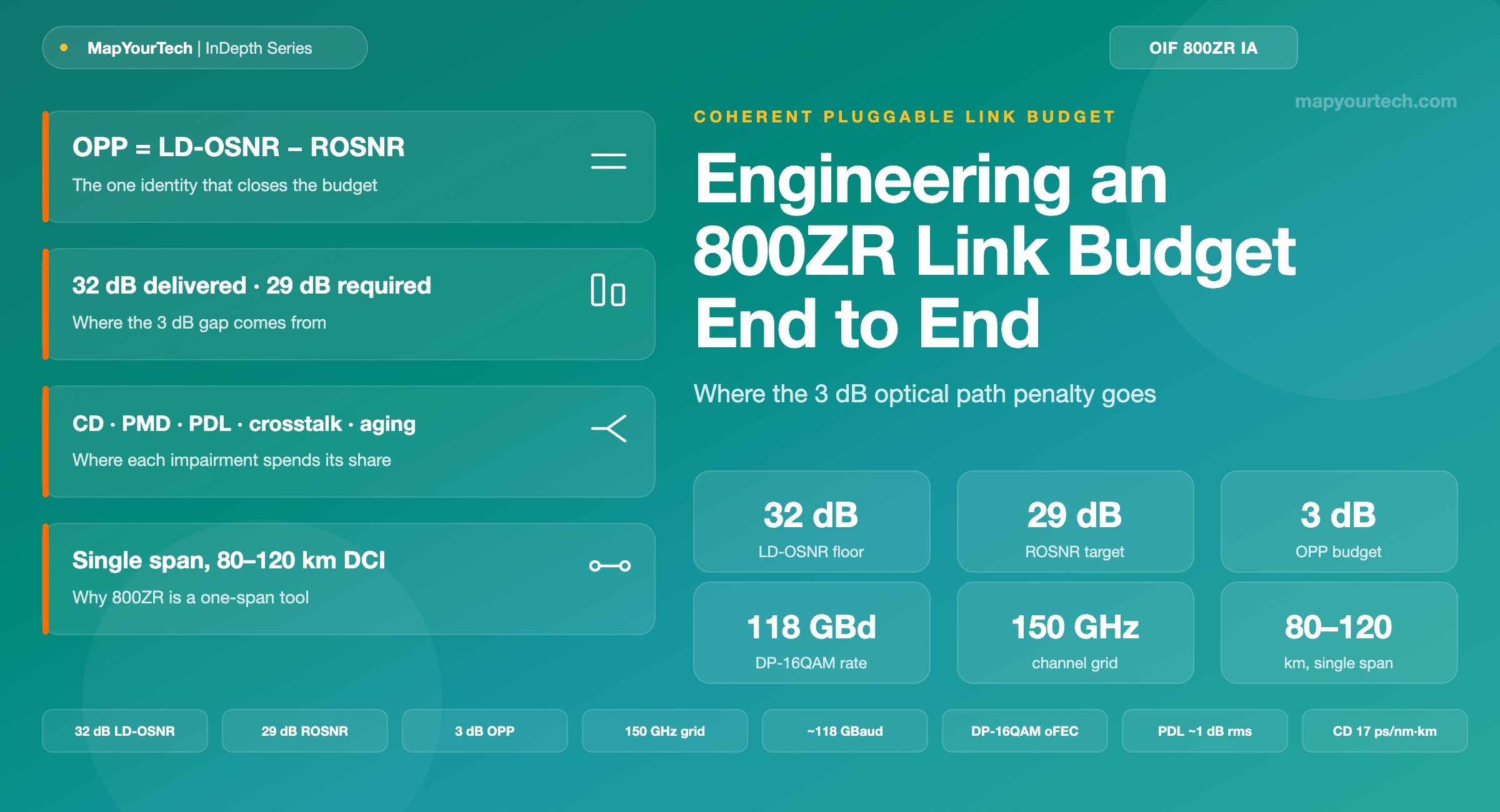
Engineering an 800ZR Link Budget End to End
One identity governs the whole design: OPP = LD-OSNR − ROSNR. Start from a 32 dB delivered OSNR and a 29 dB required OSNR, and the 3 dB optical path penalty that remains has to pay for every impairment between the two transceivers.
1. Introduction
The OIF 800ZR Implementation Agreement, published in October 2024, specifies a single-carrier coherent DP-16QAM interface running at roughly 118 GBaud on a 150 GHz channel grid, with open forward error correction (oFEC) carrying the line, over a single amplified span of 80 to 120 km. That short paragraph already fixes most of the link budget. The modulation sets how much signal-to-noise the receiver needs; the symbol rate sets how wide the signal is and therefore how much amplified-spontaneous-emission noise falls inside it; the grid spacing sets how much power each channel can take from a fixed total; and the single-span reach sets how little the line system degrades the wavelength before it reaches the far end. Everything else in this article is the arithmetic that ties those four facts into a closed budget.
That budget reduces to one subtraction. The line system delivers a Link-Delivered OSNR, written LD-OSNR. The receiver, tested back to back against a compliant transmitter with no line in between, needs a Required OSNR, written ROSNR. The difference between what arrives and what the receiver needs is the Optical Path Penalty, written OPP, and it is the headroom available to absorb every transmission impairment along the way. For 800ZR the working analysis behind the standard settled on a 32 dB LD-OSNR that a reference link delivers comfortably, a 29 dB ROSNR target the transceiver must meet, and therefore a 3 dB OPP. Three decibels is not much. The whole point of this article is to show where those three decibels go — how chromatic dispersion, polarization-mode dispersion, polarization-dependent loss, crosstalk, fiber nonlinearity, fast polarization transients, and end-of-life aging each draw a slice, and how little is left as margin when the link is new.
This is a working budget, not a textbook abstraction. 800ZR and its higher-performance 800ZR+ cousin are shipping into data-center interconnect and IP-over-DWDM builds in volume: industry analysts publicly forecast more than 200,000 800ZR and 800ZR+ module shipments in 2026, with hyperscalers leading adoption to stitch geographically separated AI clusters together over amplified DWDM. OIF's interoperability program continues to validate multivendor penalties at OFC and ECOC plugfests, with a 40-company demonstration scheduled for OFC 2026. When a module from one vendor has to close a budget over a line system from another, the OPP framework is the contract language they share. If you design, plan, or operate these links, you are negotiating against the 3 dB. For the wider product context, the MapYourTech overview of 800G ZR and ZR+ coherent optics sets the scene; this article goes inside the budget.
Three evidentiary classes appear throughout, and the distinction is stated wherever a figure is given. Standard values (for example ITU-T G.652.D fiber dispersion near 17 ps/(nm·km)) are fixed by published specifications. Spec and analysis values (32 dB LD-OSNR, 29 dB ROSNR, 3 dB OPP, the 150 GHz grid) come from the OIF 400ZR and 800ZR Implementation Agreements and the link-budget analyses behind them. Measured and forecast values (plugfest penalties, shipment projections) are attributed to the body that published them. A theoretical limit (the Shannon bound, the Gaussian-Noise nonlinear model) is labelled as such. Mixing these classes silently is what makes a budget read as marketing; keeping them apart is what makes it auditable.
One framing decision shapes the entire walkthrough. The OPP identity treats the line system as a single LD-OSNR number and the transceiver as a single ROSNR number, then asks whether the gap between them is wide enough to swallow the impairments. That is deliberately a black-link view: the standard defines the line only by its channel characteristics, not by the internal design of the amplifiers and filters. It lets a transceiver vendor and a line-system vendor agree on a budget without exposing either design. The cost of that abstraction is that the OPP has to be conservative, because neither side fully controls the other. The sections that follow open the black box just far enough to see where each decibel is spent.
2. LD-OSNR, ROSNR, and the Optical Path Penalty
Three quantities carry the budget, and they belong to different parts of the system. LD-OSNR belongs to the line: it is the optical signal-to-noise ratio the line system delivers to the receiver input, for a given transmitter output power and transmitter launch OSNR. It is a minimum specification — the line guarantees at least this much. ROSNR belongs to the transceiver: it is the maximum noise the receiver tolerates, measured back to back against a compliant transmitter with no line impairments in the path, while still reaching the post-FEC error floor. It is a maximum specification — the receiver needs no more OSNR than this. OPP belongs to the transceiver's tolerance against the line: it is the penalty the transceiver can absorb from static and dynamic line impairments and still work. The three are bound by a single identity.
OPP = LD-OSNR − ROSNR
Where: LD-OSNR = link-delivered OSNR, the line-system minimum, in dB at 0.1 nm. ROSNR = required OSNR, the back-to-back receiver maximum, in dB at 0.1 nm. OPP = optical path penalty, the headroom for line impairments, in dB. For 800ZR: OPP = 32 − 29 = 3 dB.
The identity reads as an inequality in disguise. A link closes when the OPP the transceiver can tolerate is at least as large as the sum of penalties the line actually inflicts. Write the link margin as the delivered OSNR minus the receiver requirement minus the impairment penalties: margin = LD-OSNR − ROSNR − Σ(penalties). When the penalties exactly fill the gap, margin is zero and the link sits at its edge. The 3 dB OPP is therefore a budget, not a guarantee that the link works — it works only if the impairments, summed, stay under 3 dB, and only if enough of that 3 dB is held back as aging margin to keep the link alive to end of life.
Read the Full Analysis with Premium
The remaining 89% of this article — the design numbers, trade-offs and field guidance — is part of MapYourTech Premium, along with the full premium library, courses and professional tools.
You May Also Like
-
Free
-
September 4, 2026
-
Premium
-
September 4, 2026
-
Premium
-
September 4, 2026