
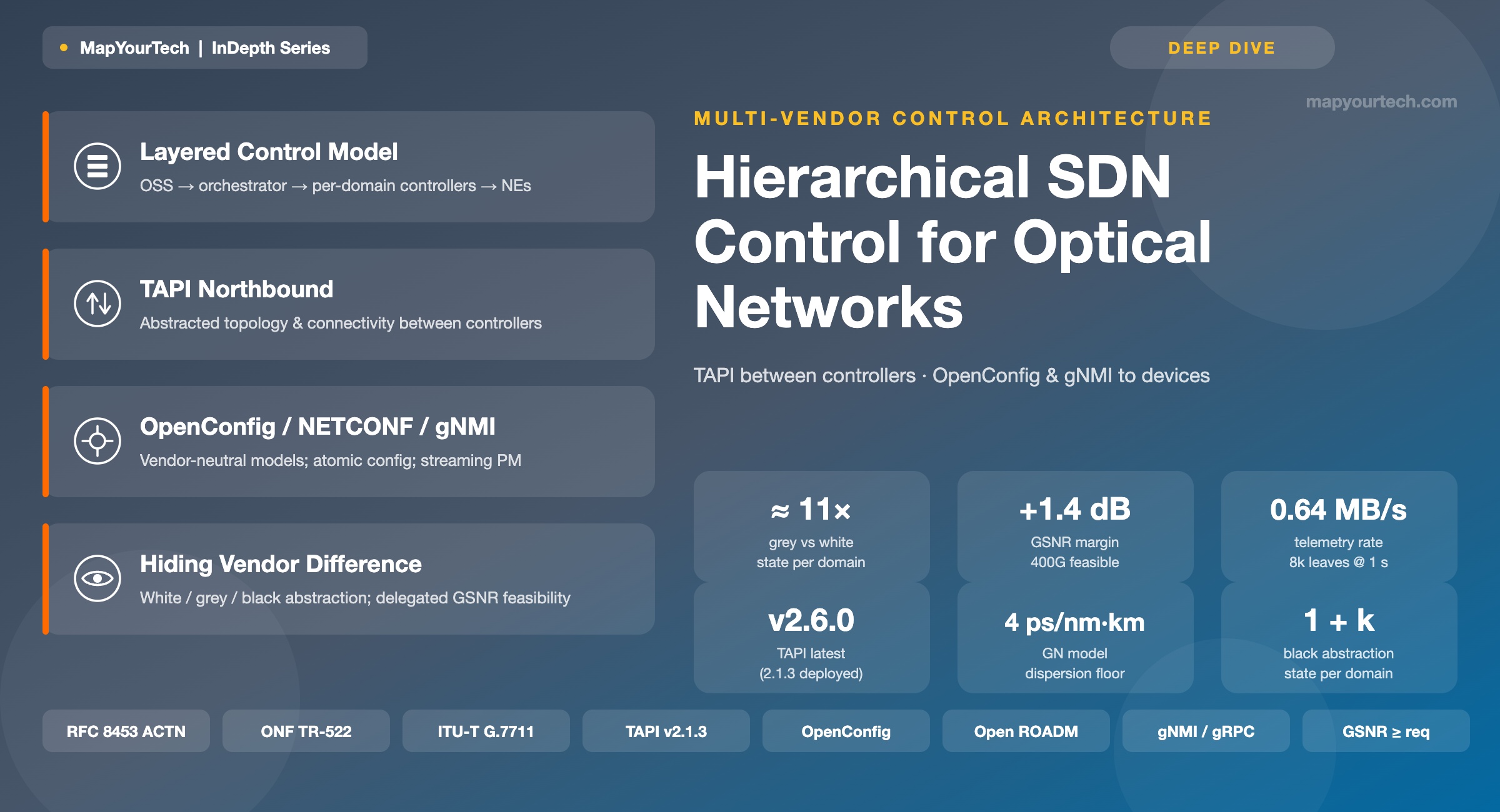
Hierarchical SDN Control for Multi-Vendor Optical Networks
The control stack the industry converged on: TAPI northbound between controllers, OpenConfig southbound to devices, gNMI for telemetry and NETCONF for transactional change, aligned with ONF TR-522 and IETF ACTN. How per-domain controllers hide vendor difference from the orchestrator above.
1. Introduction
A national optical backbone is almost never one vendor end to end. Long-haul corridors carry amplifiers and reconfigurable optical add-drop multiplexers (ROADMs) procured in one cycle; the metro rings hanging off them came from a different supplier two refresh cycles later; and the routers terminating services increasingly carry coherent pluggables from a third. Each of those layers ships with its own element manager, its own command-line grammar, and its own idea of what a "service" is. The operator still has to present all of it to an Operations Support System (OSS) as a single programmable network, provision a wavelength from a city in one domain to a city in another without a human translating between three management systems, and do it in minutes rather than days.
Hierarchical Software-Defined Networking (SDN) is the structure the transport industry settled on to make that possible. The idea is a stack of controllers in which each layer hides detail from the layer above it. At the bottom sit the network elements (NEs): transponders, muxponders, ROADMs, amplifiers, and packet-optical platforms. Above each technology-or-vendor island sits a domain controller that speaks that island's native data models southbound and exposes a vendor-neutral abstraction northbound. Above the domain controllers sits an orchestrator — a parent controller that stitches the domains into end-to-end services and never has to know whose ROADM is whose. Above that sits the OSS/BSS, which deals in customer-facing services and is shielded from the network entirely.
Four interfaces became the consensus for wiring that stack together, and they are the spine of this article. TAPI, the Open Networking Foundation Transport API, runs northbound between controllers and carries an abstracted, technology-agnostic view of topology and connectivity. OpenConfig, a set of operator-driven vendor-neutral YANG models, runs southbound to configure and read devices. gNMI, the gRPC Network Management Interface, carries streaming telemetry off those devices. And NETCONF carries transactional configuration change, with the candidate-datastore and commit semantics that let a controller apply a multi-device change atomically or roll it all back. This division of labour is aligned with two reference architectures that describe the same shape from different angles: the ONF SDN Architecture for Transport Networks (TR-522) and the IETF Abstraction and Control of TE Networks framework (ACTN, RFC 8453).
The thesis of the article is the load-bearing idea behind all of it: per-domain controllers hide vendor difference from the orchestrator above. Abstraction is not a convenience layer bolted on for tidiness. It is the mechanism that makes the whole structure tractable, and it is the reason the architecture is hierarchical rather than flat. A single flat controller talking directly to every device in a multi-vendor optical network would have to model every vendor's proprietary configuration grammar, every vendor's analog impairment behaviour, and the full internal state of every domain at once. That neither scales nor respects the business and operational boundaries between an operator and its suppliers. Splitting control into a hierarchy lets each domain controller own the messy, vendor-specific detail locally and publish a clean summary upward, and lets the orchestrator reason about the network as a graph of abstract nodes and links.
That separation of concerns buys three things at once. It bounds the state any one controller has to hold, because the orchestrator sees an abstracted topology rather than every internal fibre and amplifier. It contains fault domains, because a domain controller failure does not take down the orchestrator's view of other domains. And it lets each domain controller keep using the deep, proprietary intelligence its vendor built for managing its own hardware, while still answering the orchestrator in a standard language. The price is that abstraction can hide information the orchestrator turns out to need, and that keeping the abstracted view consistent with the real network is a genuine engineering problem — both of which this article treats directly later on.
The scope here is the control and management plane for the optical transport layer specifically, and the model families and protocols that make multi-vendor control work in practice. The article walks down the stack and back up: why the optical layer's physics forces the hierarchy in the first place; the canonical layered model and how the ONF, IETF, and TM Forum vocabularies map onto each other; what TAPI actually carries northbound; how OpenConfig, NETCONF, and gNMI split the work southbound; the mechanics of how a domain controller abstracts vendor difference; the two pieces of mathematics — abstraction state-reduction and impairment-aware feasibility — that make the abstraction safe; the real controllers and open-source stacks that implement it; where the architecture still breaks; and where it is heading. The reader who has built any part of this will find the failure modes more interesting than the diagrams, and they are deliberately not glossed over.
Takeaway: Hierarchical SDN for optical transport is a stack of controllers where each layer abstracts the one below. TAPI carries the abstraction between controllers; OpenConfig, NETCONF, and gNMI do the device-level work; and the per-domain controller's job of hiding vendor difference is the mechanism that lets the whole structure scale to a national footprint while staying operationally sane.
2. Why the optical layer forces a hierarchy
An EDFA adds amplified spontaneous emission (ASE) noise with every gain stage, typically at a noise figure of 4–6 dB. A wavelength-selective switch (WSS) inside a ROADM imposes 5–7 dB of insertion loss and a passband whose exact shape is the vendor's own. Standard single-mode fibre to ITU-T G.652 loses roughly 0.18–0.20 dB/km in the C-band, and over thousands of kilometres that loss, the noise that accumulates fighting it, and the nonlinear interference generated when many channels share a fibre all combine into the single number that decides whether a lightpath works: its optical signal-to-noise ratio, conventionally referenced to a 0.1 nm (12.5 GHz) bandwidth. For modern coherent channels at 32 GBaud and above, the relevant figure is the generalized signal-to-noise ratio (GSNR), which folds nonlinear interference in alongside ASE across the channel's true bandwidth. These are measured quantities and physical limits, not configuration knobs — and they are the reason optical control cannot be flattened the way a packet network can.
The packet layer is digital and regenerative: a router either forwards a packet correctly or it does not, and a controller can treat each hop as independent. The optical layer is analog and accumulative. A wavelength is a continuous waveform that degrades end to end, and whether it arrives with enough margin depends on every amplifier, every span length, every filter it passed through, and on the power and proximity of every other channel sharing the fibre. Working out whether a given route is feasible means modelling all of that physics — the quality of transmission (QoT) — and that model is where vendors differ most. Two suppliers' amplifiers have different noise figures; two WSS designs filter the channel edges differently; the way a vendor equalizes power across the band is part of its calibration. A controller that wanted to compute a feasible cross-vendor lightpath from first principles would need an accurate, vendor-agnostic physical-layer model of a heterogeneous mix of components, which is precisely the hard problem that open-source efforts like the GNPy library set out to solve and which remains an active field rather than a settled one.
A second pressure comes from timing. Coherent digital signal processing advances on roughly a two-year cadence — each generation lifts baud rate, spectral efficiency, and reach — while the analog photonic line of amplifiers and ROADMs has a service life closer to a decade. Locking both to one vendor forces an operator to replace a perfectly good line system to get the latest transponder, or to forgo the transponder to protect the line system. Disaggregation breaks that coupling, and it is why the most widely deployed form of multi-vendor optical today is the alien wavelength model: a transponder from one vendor launched across an open line system from another, where the line-system vendor characterizes its network and the alien transponder is configured to meet a published envelope of frequency, launch power, and OSNR tolerance. Putting multiple vendors' components inside one line system is the emerging next step, and true ROADM-to-ROADM interoperation across vendors — where a lightpath is switched by one vendor's WSS and received by another's — remains the hard frontier, gated by passband shape, insertion loss, transient response, and crosstalk that a multi-wavelength interface specification has yet to make fully plug-and-play.
Read the Full Analysis with Premium
The remaining 88% of this article — the design numbers, trade-offs and field guidance — is part of MapYourTech Premium, along with the full premium library, courses and professional tools.
You May Also Like
-
Free
-
September 4, 2026
-
Premium
-
September 4, 2026
-
Premium
-
September 4, 2026