
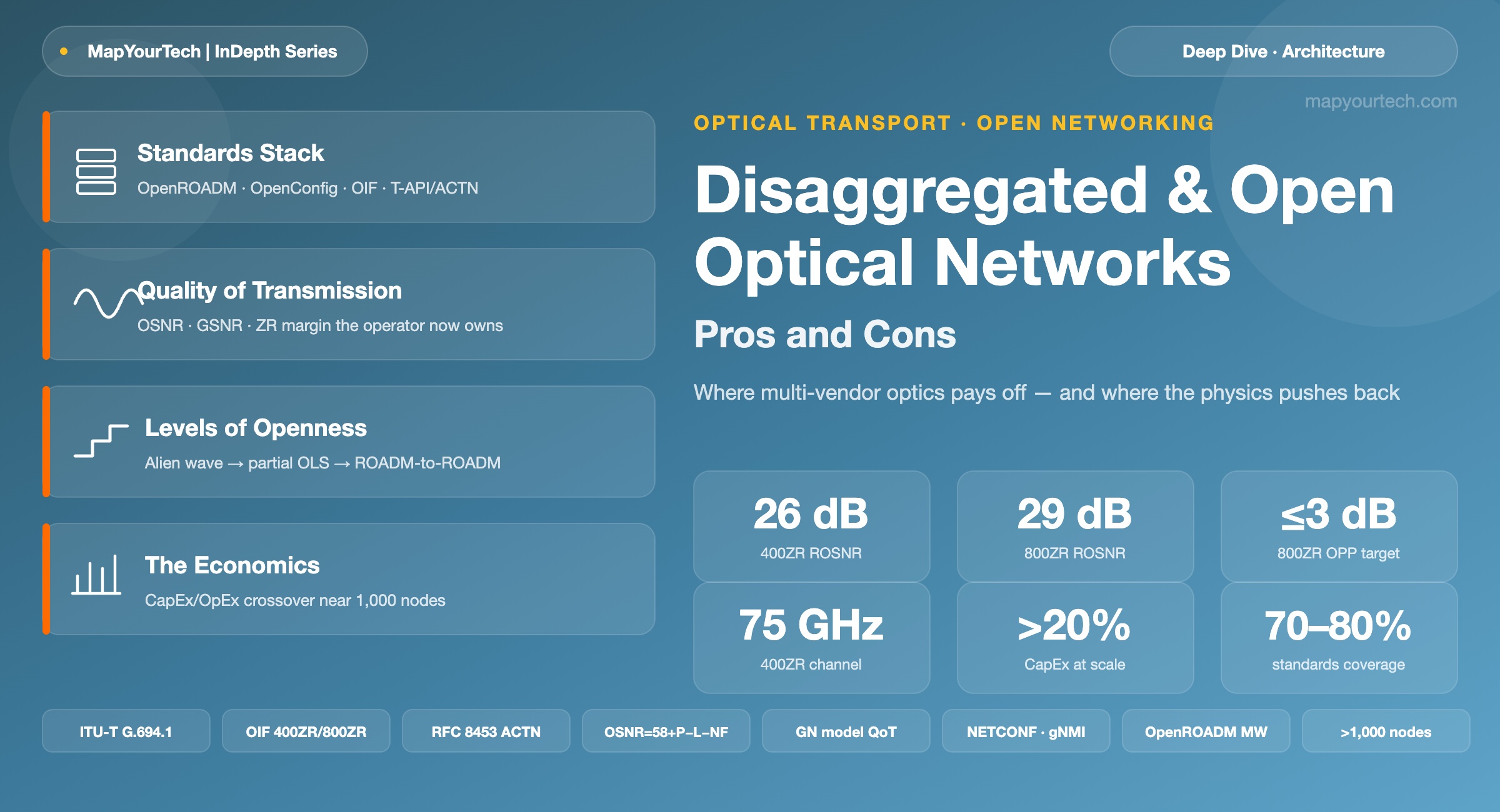
Disaggregated and Open Optical Networks: Pros and Cons
Decoupling the transponder from the line system changed the economics of optical transport and shifted a vendor's integration burden onto the operator. This is where the trade keeps its promises, and where the physics and the operating model push back.
1. Introduction
A coherent transponder and the amplifier chain it feeds age on different clocks. The transponder, carrying the digital signal processor (DSP) that does the coherent detection, follows a roughly two-year cadence: each generation buys more baud, a denser modulation, or lower power per bit. The optical line system underneath it, the erbium-doped fiber amplifiers (EDFAs), the reconfigurable optical add-drop multiplexers (ROADMs), and the fiber plant itself, is a seven-to-ten-year capital asset. In a single-vendor, vertically integrated system those two clocks are bolted together, so adopting the newest transponder can force a forklift replacement of a line system that is doing its job. Disaggregation is the engineering response to that mismatch: separate the fast-moving digital layer from the slow-moving photonic layer and let each be sourced, upgraded, and operated on its own schedule.
That single decoupling is the root of every advantage and every problem that follows. On the benefit side, an operator can run best-of-breed optics over an existing line system, put competitive pressure on hardware pricing, diversify its supply chain, and collapse network layers into router ports. On the cost side, the moment a wavelength generated by one vendor's optics has to survive an analog path built or partly built by another, the operator inherits a job that the integrated vendor used to do silently: predicting and guaranteeing the quality of transmission across hardware whose filter shapes, noise figures, and transient behavior were never characterized against each other.
This article treats disaggregation the way an architect treats any design choice, by naming the mechanism behind each claimed benefit and the boundary where it stops being true. It walks the standards that make interoperability possible, from the OpenROADM Multi-Source Agreement (MSA) through OpenConfig and the Open Networking Foundation's Transport API (T-API); the hierarchical control plane that ties multiple vendor domains into one programmable network; the quality-of-transmission physics that no abstraction layer can wish away; the economics, which favor large operators and punish small ones; and the expanded security surface that comes with opening interfaces that used to be sealed. It closes with a practical taxonomy that separates what is deployed today from what is still a research demonstration, because the single most expensive mistake in this area is treating all three as equally ready.
The audience here spans the engineer meeting OpenROADM for the first time and the architect who has already qualified two transponder vendors and now has to defend the integration budget. For the newcomer, the foundations are explained as they arise. For the architect, the value is in the boundaries: the span count where a low-launch pluggable runs out of margin, the dispersion threshold below which the standard nonlinear model fails, the node count above which the techno-economic case turns positive. The verdict, stated up front so the rest of the article can earn it, is that open optical networking is not one decision but a spectrum, and the right position on that spectrum is set by an operator's scale and its appetite for owning system integration.
Takeaway: Disaggregation decouples a two-year transponder cycle from a seven-to-ten-year line-system cycle. Every benefit traces back to that decoupling, and so does the central cost: the operator absorbs the quality-of-transmission and integration responsibility a single vendor used to carry.
2. From Monolithic Systems to Open Optical Networks
Until the late 2010s, a dense wavelength division multiplexing (DWDM) network arrived as one sealed product. A single supplier delivered the transponders and muxponders that turn client signals into colored wavelengths, the line system of amplifiers and ROADMs that carries those wavelengths, and the element and network management systems that configure and monitor all of it. The argument for that model was accountability: one vendor owned end-to-end performance, so when a circuit underperformed there was exactly one number to call. For a network that changed slowly, that was a reasonable trade.
Two pressures broke it. The first was vendor lock-in in its plainest form. Sourcing the whole system from one supplier ties the operator to that supplier's roadmap, release cadence, and price list, with no competitive lever to pull. The second, and the one that actually drove the architecture, was the lifecycle mismatch described in the introduction. Coupling a two-year optics cycle to a ten-year photonics asset means an operator either runs old optics to protect the line-system investment or rips out a working line system to deploy new optics. Neither is efficient, and at the traffic growth rates of the last decade neither is affordable.
Disaggregation borrowed its thesis from the data center, where separating hardware from software and buying merchant silicon had already been normal practice for years. Applied to optics, it means breaking the system into functional blocks, the transponder, the ROADM, the amplifier, the optical channel monitor, and letting each be sourced and upgraded independently across vendors. The transponder is the digital layer; the line system is the analog photonic layer; the contract between them is a set of open interfaces and data models rather than a proprietary backplane. The fuller architectural treatment of that shift, and the milestones that led to it, are covered in the MapYourTech overview of exploring disaggregated and open optical networks.
The ROADM as the programmable heart of the line system
Disaggregation only works because the ROADM stopped being a static multiplexer and became a software-driven switch. A modern colorless, directionless, and contentionless (CDC) ROADM routes any wavelength to any degree on any port without optical-electrical-optical conversion, and a flex-grid ROADM allocates spectrum in fine slices rather than on a fixed 50 GHz or 100 GHz raster. Colorless means a port is not tied to one wavelength; directionless means an added wavelength can leave by any line degree; contentionless means the same wavelength can be dropped from two degrees to two ports without an internal blocking conflict. Flex-grid matters because a 400G or 800G coherent carrier needs more than 50 GHz, so the node has to carve channels at, say, 75 GHz or 150 GHz to fit them. A typical CDC ROADM supports two to sixteen line degrees and up to ninety-six C-band wavelengths per degree, and it is the programmability of that switch fabric, exposed through an open interface, that turns a pile of independent boxes into something a controller can provision automatically.
The catch hides inside the Wavelength Selective Switch (WSS) that does the switching. A WSS has a finite filter roll-off, so the passband it presents to a channel has soft edges, not vertical walls. Cascade several ROADMs and those soft edges stack: experimental data from 110 Gbaud super-Nyquist systems shows that after ten ROADM cascades, each with a 94.8 GHz 3 dB passband, the effective 3 dB bandwidth narrows to roughly 84.5 GHz, a loss of about 10 GHz. That narrowing clips the signal spectrum and costs optical signal-to-noise ratio (OSNR), which is why guard bands and cascade limits are first-order design parameters rather than afterthoughts. The mechanics of filter roll-off and cascaded narrowing are worked through in the MapYourTech treatment of guard band optimization and design.
Why an open ecosystem exists at all
No single company can deliver multi-vendor interoperability, because by definition it requires agreement among competitors on the interfaces between their products. The industry answer has been a set of collaborative bodies, each owning a different layer of the problem. Tier-1 carriers including AT&T, Orange, Deutsche Telekom, and KDDI launched the OpenROADM MSA in 2016 to specify both the optical parameters and the management models that let ROADMs and transponders from different vendors interwork. The operator-driven OpenConfig project defines vendor-neutral device models. The Optical Internetworking Forum (OIF) standardizes the physical pluggable interface through specifications such as 400ZR and the Common Management Interface Specification (CMIS). The Telecom Infra Project's Open Optical and Packet Transport (OOPT) group runs the field and lab validation, including the GNPy quality-of-transmission engine and the MUST requirements that operators use to hold vendors to account. Each of these is examined in the standards section; the point here is that openness is an industry construct, assembled deliberately, not a property that hardware has on its own.
Read the Full Analysis with Premium
The remaining 88% of this article — the design numbers, trade-offs and field guidance — is part of MapYourTech Premium, along with the full premium library, courses and professional tools.
You May Also Like
-
Free
-
September 4, 2026
-
Premium
-
September 4, 2026
-
Premium
-
September 4, 2026