
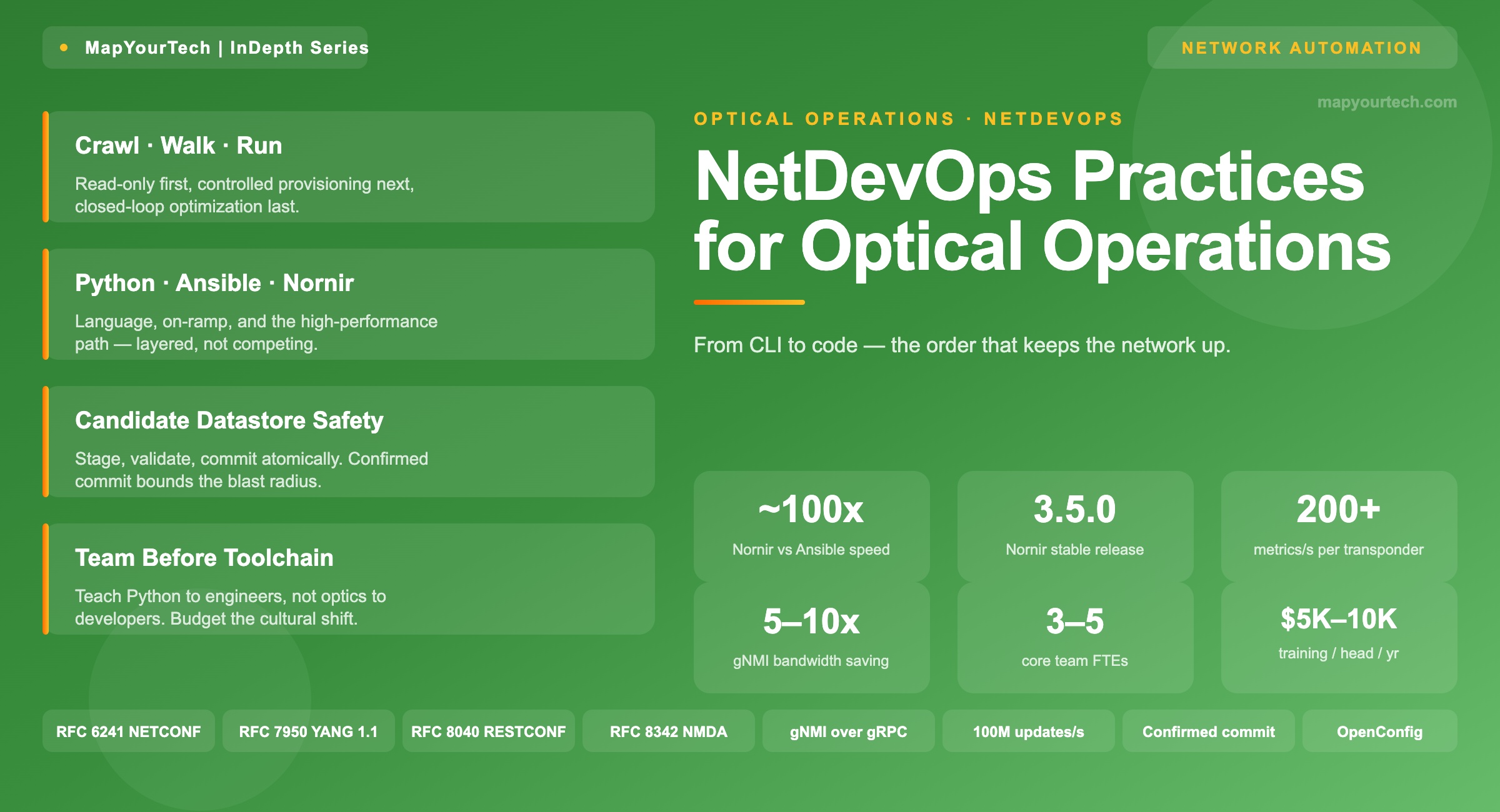
NetDevOps Practices for Optical Operations
Moving optical operations off the CLI and into code, in the order that keeps the network up: read-only monitoring first, controlled provisioning on non-critical segments next, closed-loop optimization last — built on Python, Ansible, and Nornir, and on a team that was budgeted for the transition rather than told to absorb it.
1. Introduction
A single coherent transponder reports more than 200 metrics every second — optical power, OSNR, chromatic dispersion, differential group delay, pre-FEC and post-FEC bit error rates, laser bias current, temperature. A metro region with a few hundred line cards generates millions of telemetry updates per second. No team logs into those devices and reads that by hand, yet the configuration that produced those metrics was, until recently, typed in one SSH session at a time. That gap — machine-scale state, human-scale change — is what NetDevOps closes for optical operations.
NetDevOps applies the practices software teams settled on years ago — version control, automated testing, continuous integration and delivery, infrastructure described as code — to the network itself. The configuration of a ROADM, an amplifier chain, or a transponder stops being a thing an engineer remembers how to type and becomes a file in Git that a pipeline validates, deploys, and verifies. The point is not novelty. It is that optical network complexity has grown past the scale at which manual operations keep pace: coherent pluggable optics at 400G, 800G and 1.6T, C+L band expansion that doubles the channel count an amplifier must hold flat, and AI-driven traffic patterns that move faster than a change-control ticket.
This article lays out how to make that transition without breaking the network in the process. The governing idea is sequence. You do not flip optical operations from CLI to code in one release; you move read-only first, then controlled provisioning on segments where a mistake is survivable, then closed-loop optimization once the first two have earned trust. Underneath sits a specific toolchain — Python as the language, Ansible for fleet configuration, Nornir for when Ansible runs out of road — and a specific protocol stack — NETCONF for transactional change, gNMI for streaming telemetry, RESTCONF for lightweight integration.
The harder half of the transition is not technical. It is the team. The recurring finding across operators who have done this is that teaching Python to a network engineer who already understands OSNR budgets and ROADM behavior is faster and cheaper than teaching optical physics to a software developer. That choice — who you train, what you budget, how the culture shifts — decides whether the automation survives its first outage. We will treat it as a first-class engineering problem, not an afterthought.
2. What NetDevOps Means on the Optical Layer
The CLI is an imperative interface: you tell a device what commands to run, in what order, and you hope the running configuration ends where you intended. NetDevOps replaces that with a declarative one: you describe the desired state — this wavelength on this channel, this launch power, this amplifier gain target — and a system drives the device to that state and reports whether it got there. The difference matters most when something goes wrong halfway through. A CLI script that fails on line forty leaves the device in a state nobody designed. A declarative, transactional change either lands completely or rolls back to where it started.
Four practices carry over from software DevOps, and each maps onto a concrete optical-operations problem.
Version control as the source of truth
Every intended configuration lives in Git, not in an engineer's head or a device's NVRAM. The running configuration of the network should be reconstructable from the repository at any commit. This is what makes a change auditable — you can see who proposed a launch-power adjustment, who reviewed it, and what the network looked like before and after. It is also what makes rollback meaningful: reverting a commit and re-running the pipeline is a defined operation, not an act of memory.
Read the Full Analysis with Premium
The remaining 88% of this article — the design numbers, trade-offs and field guidance — is part of MapYourTech Premium, along with the full premium library, courses and professional tools.
You May Also Like
-
Free
-
September 4, 2026
-
Premium
-
September 4, 2026
-
Premium
-
September 4, 2026