Last Updated: August 16, 2025
1 min read
80
Advantages and drawbacks of EDFAs are as follows:-
Advantages:
- Commercially available in C band (1,530 to 1,565 nm) and L band (1,560 to 1,605) and up to 84-nm range at the laboratory stage.
- Excellent coupling: The amplifier medium is an SM fiber;
- Insensitivity to light polarization state;
- Low sensitivity to temperature;
- High gain: > 30 dB with gain flatness < ±0.8 dB and < ±0.5 dB in C and L band, respectively, in the scientific literature and in the manufacturer documentation
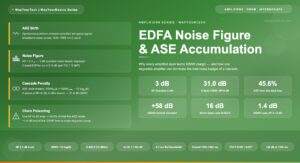
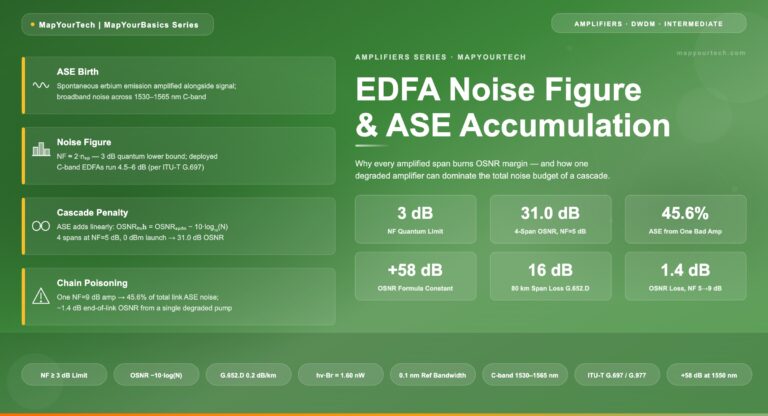
- Low noise figure: 4.5 to 6 dB
- No distortion at high bit rates;
- Simultaneous amplification of wavelength division multiplexed signals;
- Immunity to crosstalk among wavelength multiplexed channels (to a large extent)
Drawbacks:
- Pump laser necessary;
- Difficult to integrate with other components;
- Need to use a gain equalizer for multistage amplification;
- Dropping channels can give rise to errors in surviving channels: dynamic control of amplifiers is necessary.

Optical Communications & Network Automation Expert | Author of 3 Books for Optical Engineers | Founder, MapYourTech
Optical networking engineer with nearly two decades of experience across DWDM, OTN, coherent optics, submarine systems, and cloud infrastructure. Founder of MapYourTech. Read full bio →
Follow on LinkedIn