Latency is a time delay experienced in system and it describes how long it takes for data to get from transmission side to receiver side. In a fiber optical communication system, it is essentially the length of optical fiber divided by the speed of light in fiber core, supplemented with delay induced by optical and electro optical elements plus any extra processing time required by system, also called overhead. Signal processing delay can be reduced by using parallel processing based on large scale integration CMOS technologies.
Added to the latency due to propagation in the fiber, there are other path building blocks that affect the total data transport time. These elements include
- opto-electrical conversion,
- switching and routing,
- signal regeneration,
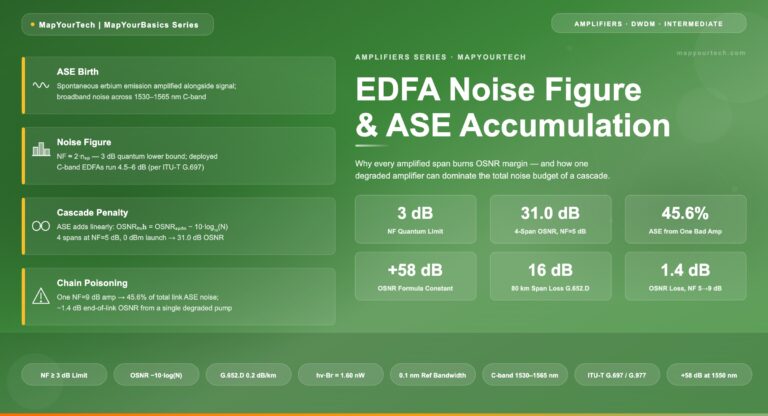
- Amplification,
- chromatic dispersion (CD) compensation,
- polarization mode dispersion (PMD) compensation,
- data packing, digital signal processing (DSP),
- protocols and addition forward error correction (FEC)

Optical Communications & Network Automation Expert | Author of 3 Books for Optical Engineers | Founder, MapYourTech
Optical networking engineer with nearly two decades of experience across DWDM, OTN, coherent optics, submarine systems, and cloud infrastructure. Founder of MapYourTech. Read full bio →
Follow on LinkedIn