
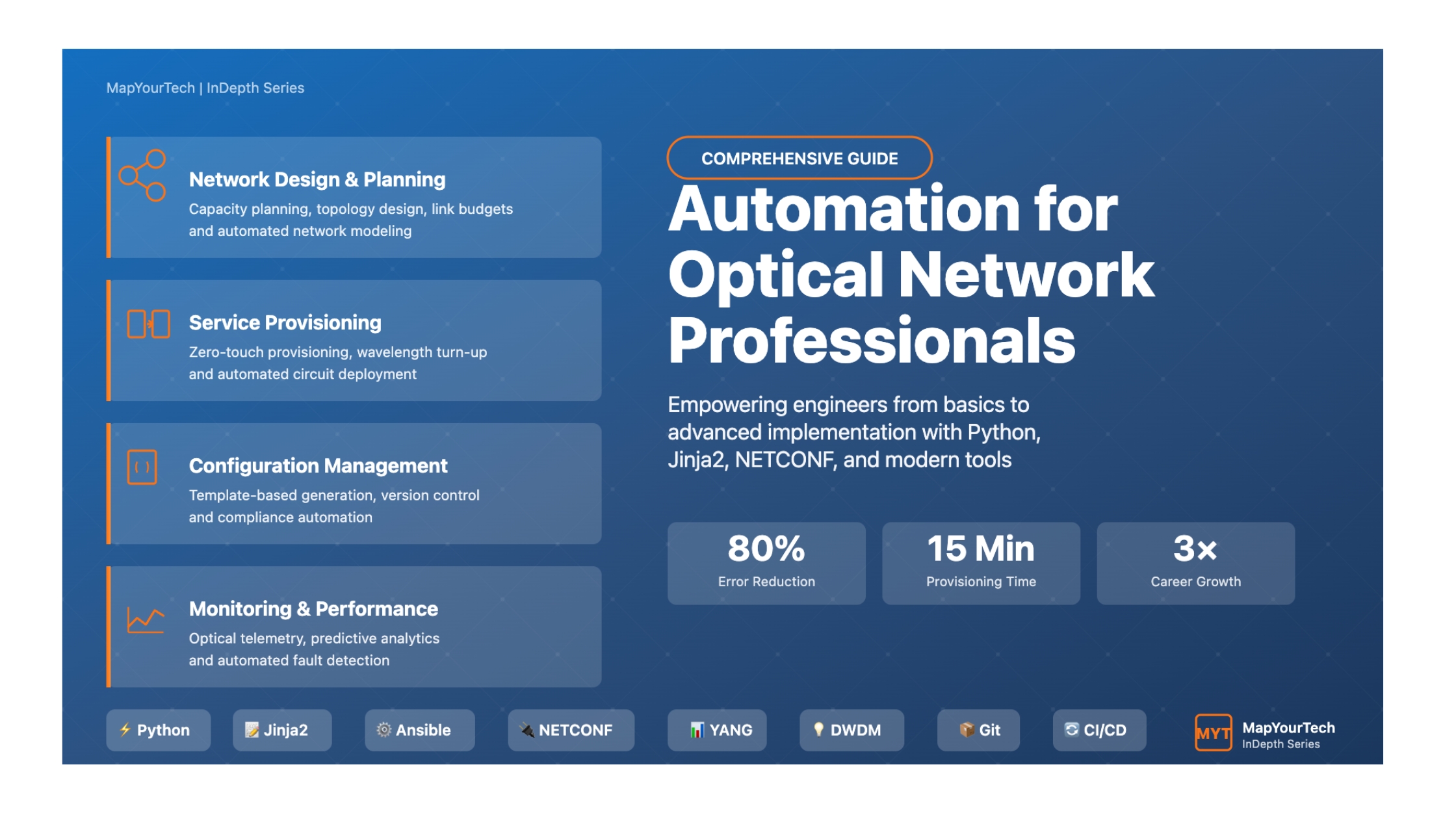

Automation for Optical Networking Professionals: A Comprehensive Guide from Basics to Advanced Implementation
Empowering Network Engineers with Skills, Tools, and Confidence to Navigate the Automation Revolution in Optical Communications
A Personal Note: This comprehensive guide is crafted from years of hands-on experience in optical network automation. My goal is to demystify automation for network professionals at every stage of their journey—whether you're taking your first steps or looking to expand your expertise. Remember: Automation is not replacing jobs but enabling you to live life more efficiently and with freedom. It is an act of kindness by technology to give back to its users and creators.
Introduction: The Automation role in Modern Optical Networks
The optical networking landscape is experiencing a fundamental transformation. As global data traffic continues its exponential growth—driven by cloud computing, streaming services, 5G networks, and emerging technologies like the Internet of Things—the demand for network bandwidth has never been greater. Traditional manual approaches to network operations, configuration, and management are rapidly becoming insufficient to meet the scale, speed, and complexity requirements of modern telecommunications infrastructure.
Consider the operational reality facing network engineers today: hyperscale data centers processing petabytes of data daily, wavelength-division multiplexed systems carrying hundreds of optical channels across thousands of kilometers, dense wavelength division multiplexing technology enabling unprecedented capacity on single fiber pairs, and software-defined networking principles demanding programmable and agile network infrastructure. In this environment, manual configuration of network devices is not just inefficient—it's becoming operationally impossible.
Automation has evolved from a competitive advantage to an operational necessity. Leading technology companies and service providers have already embraced this reality. Organizations operating global-scale networks no longer perform manual device configurations; instead, network changes are executed through code and automated pipelines. This shift represents more than just efficiency gains—it fundamentally redefines what it means to be a network engineer in the modern era.
The Scale Challenge: Why Manual Operations Cannot Keep Pace
The telecommunications industry faces an unprecedented challenge of scale. Global internet traffic has been growing at approximately 25-30% annually, with projections suggesting continued exponential growth through the end of this decade. Optical transport networks form the backbone of this infrastructure, and the operational demands are staggering. A single modern hyperscale network operator may manage tens of thousands of optical network elements distributed across hundreds of locations worldwide.
Consider the operational mathematics: if configuring a single Dense Wavelength Division Multiplexing system takes an experienced engineer 2-3 hours, managing even a modest network of 1,000 such systems would require over 3,000 person-hours for a single configuration update cycle. When factoring in the need for regular maintenance, software upgrades, capacity expansions, and troubleshooting, the human resource requirements become unsustainable. More critically, human error rates in manual configuration tasks typically range from 1-5%, which in large-scale networks translates to dozens or hundreds of misconfigurations—each potentially causing service disruptions.
Automation addresses these scale challenges through several key mechanisms. First, it enables configuration consistency across thousands of devices by generating configurations from validated templates rather than manual entry. Second, it dramatically reduces deployment time—tasks that might take hours manually can be completed in minutes through automated scripts. Third, it minimizes human error by eliminating repetitive manual tasks where mistakes commonly occur. Fourth, it provides comprehensive auditability, with every configuration change tracked, versioned, and documented automatically.
The Evolution of Network Engineering Roles
The advent of network automation is fundamentally transforming the role of optical network engineers. Traditional responsibilities centered on device-level configuration, manual troubleshooting, and reactive problem-solving are evolving toward system-level design, proactive optimization, and strategic network architecture. This evolution doesn't diminish the importance of network engineering—rather, it elevates it to a higher level of impact and value creation.
In modern network operations, engineers are increasingly expected to think like software developers. Version control systems like Git, once the exclusive domain of programmers, are now standard tools for managing network configuration repositories. Continuous integration and continuous deployment pipelines, borrowed from software engineering practices, are being adapted for network operations. Infrastructure-as-code principles, where network configurations are defined in declarative code rather than imperatively configured, are becoming the norm rather than the exception.
This transformation creates new opportunities and challenges for network professionals. Engineers who develop automation skills position themselves at the intersection of networking and software development—a space with high demand and limited supply. Job postings from leading technology companies increasingly list programming proficiency, automation framework experience, and software development practices as core requirements rather than optional skills. The market clearly signals that the future of network engineering is inseparable from automation capabilities.
The Reality of Automation in Leading Organizations
Major technology companies and hyperscale network operators have already made the transition to fully automated network operations. In these environments, engineers do not manually configure individual devices. Instead, they develop and maintain automation tools, design network architectures that support programmatic control, and create self-service interfaces that allow other teams to provision network resources without direct engineering intervention.
This operational model delivers several advantages: reduced time-to-market for new services, improved network reliability through consistent configurations, enhanced security through automated compliance checking, better resource utilization through dynamic optimization, and the ability to scale operations without proportional increases in staffing.
Understanding the Automation Spectrum
Network automation exists on a spectrum, from simple scripting tasks to fully autonomous, AI-driven systems. Understanding this spectrum helps engineers identify appropriate automation opportunities and set realistic expectations for implementation.
Basic Automation: At the foundational level, automation involves creating scripts to perform repetitive tasks—collecting device information, generating configuration snippets, parsing log files, or backing up device configurations. These scripts typically focus on a single device type or vendor and address specific, well-defined tasks. While basic, these automations provide immediate value by eliminating manual work and reducing errors.
Intermediate Automation: The next level involves using automation frameworks and tools to manage configurations across multiple devices and vendors. This includes using tools like Ansible for configuration management, implementing version control for network configurations, creating template-based configuration generation systems, and integrating with network monitoring systems for data collection. Intermediate automation often requires understanding data formats like YAML and JSON, working with APIs, and designing reusable automation components.
Advanced Automation: Advanced implementations incorporate orchestration across multiple network domains, closed-loop automation that responds to network conditions without human intervention, integration with business support systems and operational support systems, and the application of machine learning for predictive analytics and optimization. These systems require sophisticated software architecture, robust error handling, comprehensive testing frameworks, and careful consideration of failure scenarios.
Autonomous Networks: The ultimate vision involves self-configuring, self-healing networks that can detect issues, determine optimal responses, and implement changes with minimal or no human intervention. While fully autonomous networks remain largely aspirational, elements of autonomy are increasingly being deployed in production environments, particularly for routine tasks like traffic optimization, fault detection and remediation, and capacity management.
The Business Case for Automation
Beyond the technical imperatives, automation delivers compelling business value that justifies the investment in skills development and infrastructure. Studies across the telecommunications industry consistently demonstrate significant returns on automation initiatives.
Operational Efficiency: Automation dramatically reduces the time required for routine tasks. Service provisioning that might take days or weeks manually can be accomplished in minutes through automated workflows. Network operators report 50-80% reductions in provisioning time after implementing automation. This efficiency translates directly to cost savings and improved customer satisfaction.
Error Reduction: Human error is a leading cause of network outages. Industry data suggests that 50-70% of network incidents stem from configuration errors or procedural mistakes. Automated configuration generation and validation reduces these errors significantly, with organizations reporting 60-90% reductions in configuration-related incidents after implementing robust automation.
Resource Optimization: Automation enables existing engineering staff to accomplish more with the same or fewer resources. Rather than spending time on repetitive tasks, engineers can focus on strategic projects, network design improvements, and innovation. This workforce multiplication effect is particularly valuable given the shortage of experienced network engineers in many markets.
Read the Full Analysis with Premium
The remaining 89% of this article — the design numbers, trade-offs and field guidance — is part of MapYourTech Premium, along with the full premium library, courses and professional tools.

Course Title
Course description and key highlights
Course Content
Course Details
Celebrating 1,000+ LinkedIn posts
3 hours of Premium Pro, free
The full Premium Pro library, unlocked with one click. The clock starts the moment you check out and runs for 3 full hours - pick a time when you can make the most of it.
- Courses
- Interview preparation content
- Career development posts
- Simulators
- Calculators
- Market research
No card, nothing to cancel. One pass per person. Sign in or create a free account at checkout.
Follow MapYourTech on LinkedIn for regular updates and future promos.
New articles, tool releases and member offers, posted as they go live.
Follow MapYourTech on LinkedIn
Enjoying MapYourTech? Follow us on LinkedIn. One click and this stops appearing.
- New technical articles and tool releases, posted as they go live
- Course launches and member offers before they reach the site
- Standards and industry updates worth an optical engineer's time
New articles, tool releases and member offers, posted as they go live.