
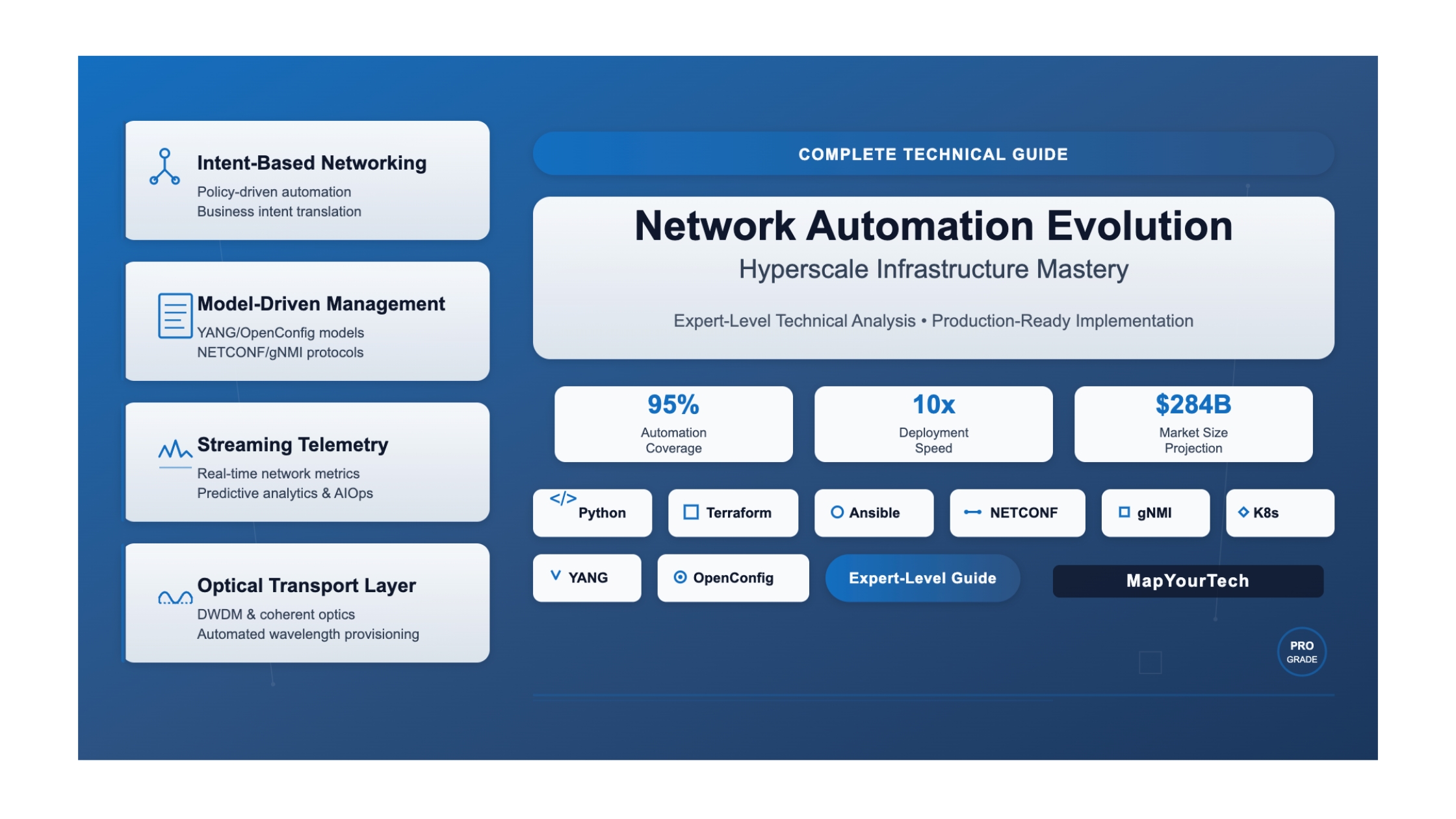
Network Automation Evolution in Hyperscale Infrastructure
A Comprehensive Technical Analysis for Optical and Network Engineers
Part 1: Introduction
Market Dynamics and Economic Impact
The hyperscale infrastructure market is driven by several converging forces that create both unprecedented challenges and opportunities for network engineering professionals. Amazon's $75 billion infrastructure expansion commitment exemplifies the scale of investment flowing into this sector, while the emergence of AI/ML workloads has fundamentally altered traffic patterns and performance requirements.
| Experience Level | Salary Range (Base) | Total Compensation | Key Automation Skills | Market Demand |
|---|---|---|---|---|
| Entry-Level (0-2 years) | $70K - $120K | $80K - $140K | Python, Netmiko, Basic IaC | ↗ High Growth |
| Mid-Level (3-7 years) | $120K - $180K | $150K - $250K | Terraform, Kubernetes, APIs | ↗ Critical Shortage |
| Senior (8+ years) | $200K - $300K | $300K - $500K | Architecture, ML/AI, Strategy | ↗ Extreme Demand |
Technical Evolution Trajectory
The evolution from traditional network operations (NetOps) to Network Reliability Engineering (NRE) and NetDevOps represents more than a change in tooling—it embodies a fundamental philosophical shift toward treating network infrastructure as software. This transformation is characterized by several key technical pillars:
Automation Adoption Timeline in Hyperscale Networks
Skill Transformation Matrix
The transition from traditional networking to hyperscale automation requires a systematic approach to skill development. The following matrix illustrates the evolution of required competencies across career progression levels:
| Skill Domain | Traditional Focus | Hyperscale Evolution | Automation Impact | Future Trajectory |
|---|---|---|---|---|
| Configuration Management | Manual CLI operations | Infrastructure as Code | ↗ 95% automation | Intent-based networking |
| Monitoring & Observability | SNMP polling, manual analysis | Streaming telemetry, ML analytics | ↗ Real-time insights | Predictive AIOps |
| Troubleshooting | Reactive, manual diagnosis | Proactive automation, digital twins | ↗ Self-healing networks | Autonomous remediation |
| Capacity Planning | Historical trend analysis | ML-driven forecasting | ↗ Predictive scaling | Dynamic resource allocation |
| Security Implementation | Static ACLs, manual policies | Microsegmentation, automated policies | ↗ Zero-trust architecture | Adaptive security |
Historical Context & Foundational Principles
The Evolution of Network Scale
The journey from traditional enterprise networking to hyperscale infrastructure represents one of the most significant technological transitions in modern computing. Understanding this evolution is crucial for engineers positioning themselves for success in hyperscale environments.
Network Characteristics: Enterprise networks typically managed 100-1000 devices using manual configuration methods. Change management relied heavily on human expertise and CLI-based operations.
Key Technologies: SNMP monitoring, manual configuration templates, basic scripting with Perl or shell scripts.
Operational Model: Reactive troubleshooting, ticket-driven workflows, siloed teams.
Network Characteristics: First-generation cloud providers began operating networks with 10,000+ devices. Software-defined networking emerged as a necessity rather than luxury.
Key Technologies: OpenFlow, early SDN controllers, Python automation scripts, configuration management tools.
Operational Model: Introduction of Infrastructure as Code principles, early DevOps practices.
Network Characteristics: Hyperscalers managing 100,000+ network devices across global infrastructure. Manual operations became physically impossible.
Key Technologies: Ansible, Terraform, streaming telemetry (gNMI), YANG data models, container networking.
Operational Model: NetDevOps practices, CI/CD pipelines for network changes, SRE principles applied to networking.
Network Characteristics: Networks with millions of endpoints, AI/ML workloads driving unique traffic patterns, autonomous operation capabilities.
Key Technologies: AIOps platforms, intent-based networking, eBPF programmability, machine learning for network optimization.
Operational Model: Self-healing networks, predictive analytics, autonomous incident response.
Network Characteristics: Fully autonomous networks capable of self-configuration, self-optimization, and self-healing without human intervention.
Key Technologies: Advanced AI/ML models, digital twin technology, quantum networking integration, edge-cloud convergence.
Operational Model: Intent-driven infrastructure, policy-based automation, human-AI collaboration.
Foundational Technical Principles
In hyperscale environments, network configurations are treated as immutable artifacts. Rather than modifying existing configurations, changes are implemented by deploying new, versioned configurations and rolling back to previous versions when issues arise.
Network engineers define the desired end state rather than the procedural steps to achieve it. Automation systems are responsible for determining and executing the appropriate sequence of operations.
Every network component must provide comprehensive telemetry data by default. Observability is not retrofitted but designed into the architecture from the beginning.
Hyperscale networks are designed with the assumption that failures will occur regularly. Resilience is achieved through redundancy, automated failover, and graceful degradation rather than attempting to prevent all failures.
The Network Reliability Engineering Paradigm
Network Reliability Engineering (NRE) represents the application of Site Reliability Engineering (SRE) principles to networking infrastructure. This approach fundamentally changes how network engineers think about their role and responsibilities.
NRE vs Traditional NetOps: Key Differences
Current Market Forces and Technology Drivers
Several key forces are reshaping the network automation landscape in 2025, creating both challenges and opportunities for network engineers:
| Technology Driver | Business Impact | Technical Requirements | Skill Implications | Timeline |
|---|---|---|---|---|
| AI/ML Workloads | $1.3T AI market by 2030 | Ultra-low latency, high bandwidth, RDMA over Ethernet | Understanding of GPU networking, InfiniBand concepts | Immediate |
| Edge Computing | 5G and IoT proliferation | Distributed network management, edge-cloud orchestration | Multi-cloud networking, edge automation | 2025-2027 |
| Quantum Networking | Quantum-safe cryptography | Quantum key distribution, post-quantum algorithms | Cryptographic network protocols, quantum concepts | 2027-2030 |
| Sustainability Requirements | Carbon neutrality commitments | Energy-efficient routing, green network design | Power optimization algorithms, sustainable architecture | Ongoing |
| Zero Trust Architecture | Enhanced security posture | Microsegmentation, identity-based networking | Security automation, policy-driven networking | Immediate |
Read the Full Analysis with Premium
The remaining 89% of this article — the design numbers, trade-offs and field guidance — is part of MapYourTech Premium, along with the full premium library, courses and professional tools.
You May Also Like
-
Free
-
September 4, 2026
-
Premium
-
September 4, 2026
-
Premium
-
September 4, 2026