
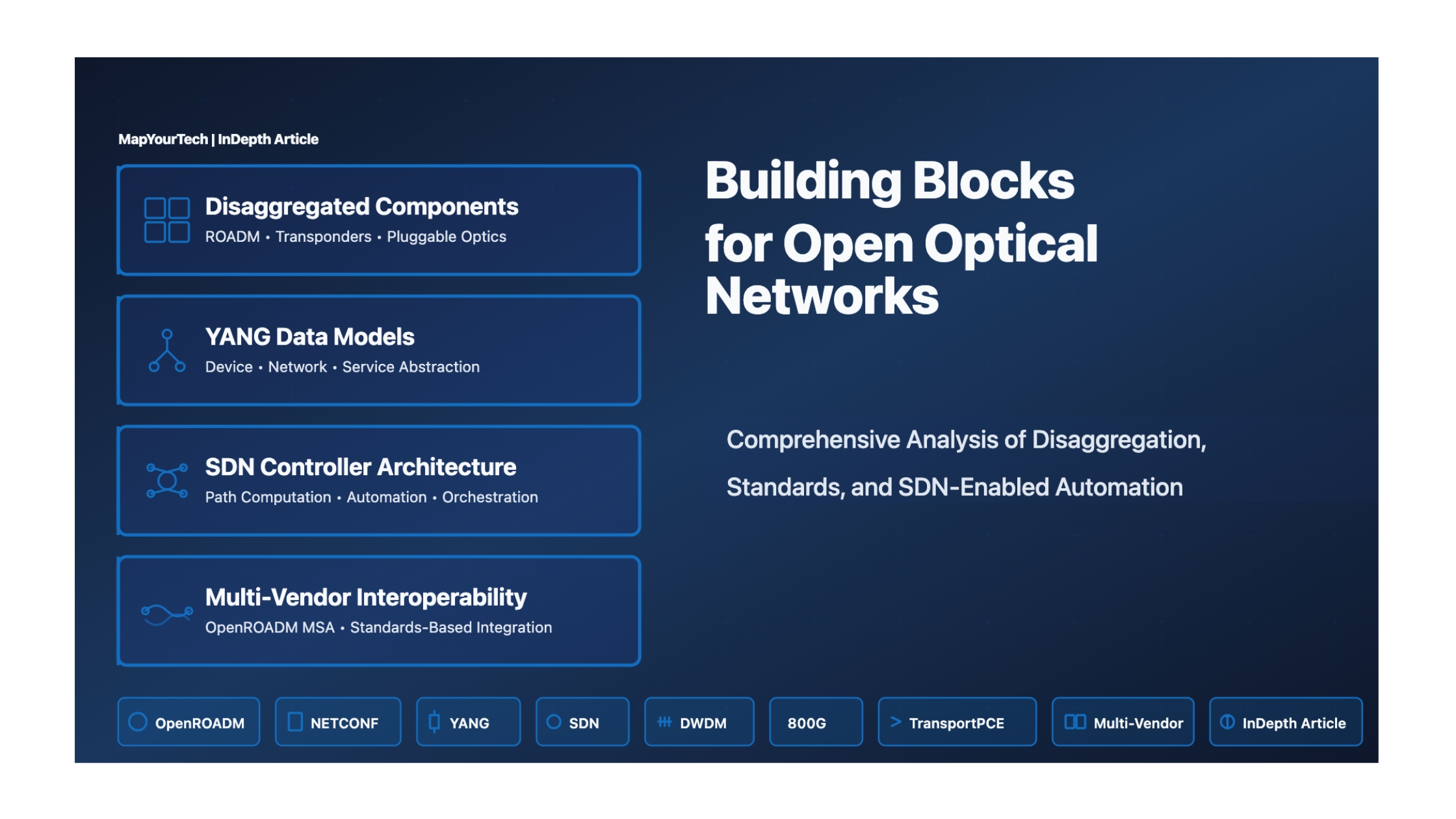

Building Blocks for Open Optical Networks
Introduction
The optical networking industry stands at a transformative inflection point, driven by the convergence of three powerful forces: exponential bandwidth demand from artificial intelligence and cloud computing, the maturation of open standardization initiatives, and the pressing need for operational efficiency amid persistent economic constraints. This comprehensive technical analysis examines the foundational building blocks that enable open optical networks, providing network architects, engineers, and decision-makers with the conceptual frameworks and practical insights necessary to navigate this paradigm shift.
Open optical networks represent a fundamental departure from the vertically integrated, proprietary systems that have dominated optical transport for decades. Through functional disaggregation, standardized data models, and software-defined control planes, these architectures enable unprecedented flexibility in vendor selection, accelerate innovation cycles, and reduce total cost of ownership while maintaining the reliability and performance characteristics essential for carrier-grade infrastructure.
Key Findings and Critical Insights
Disaggregation as Strategic Enabler: The separation of optical network functions into discrete building blocks—including reconfigurable optical add-drop multiplexers (ROADMs), transponders, and pluggable optical modules—creates vendor-neutral interfaces that break traditional lock-in patterns. The OpenROADM Multi-Source Agreement has emerged as the de facto reference architecture, providing comprehensive specifications across device, network, and service layers through YANG data models and NETCONF protocols.
Standards-Based Control Frameworks: Modern optical networks leverage model-driven programmability through standardized southbound interfaces (NETCONF, RESTCONF, gNMI) and northbound APIs (TAPI, IETF TEAS models). This architectural approach enables centralized Software-Defined Networking (SDN) controllers to orchestrate multi-vendor equipment while abstracting network complexity from higher-layer management systems and orchestrators.
Capacity Evolution Beyond Shannon's Limit: As sixth-generation 800G coherent engines approach theoretical capacity limits for conventional C-band systems, network operators are adopting complementary strategies including spectrum expansion (Super C-band, C+L band implementations), advanced modulation techniques, and emerging technologies such as hollow-core fiber and space-division multiplexing to sustain capacity growth trajectories.
Economic and Operational Imperatives: The transition to open optical architectures delivers measurable benefits through reduced capital expenditures via competitive procurement, operational efficiency gains through standardized automation workflows, and accelerated service velocity enabled by programmable infrastructure. Early adopters report 25-40% reductions in per-bit transport costs while simultaneously improving network agility and resilience.
This analysis synthesizes insights from industry-leading implementations, standardization body specifications, and real-world multi-vendor deployments to illuminate the technical foundations, architectural principles, and practical considerations that define successful open optical network strategies. The document progresses from historical context through detailed technical architecture, explores implementation approaches and optimization techniques, and concludes with forward-looking perspectives on emerging technologies and research frontiers.
For network operators contemplating the transition to open optical architectures, this resource provides the conceptual depth and technical rigor necessary to make informed decisions about technology selection, migration strategies, and operational models. The open optical paradigm is not merely a technological evolution but a strategic transformation that reshapes the competitive dynamics, economic models, and innovation trajectories of the global telecommunications industry.
Implications for Industry Stakeholders
Network Operators: Open architectures enable strategic flexibility through multi-vendor sourcing, risk mitigation through disaggregation, and operational agility through programmable infrastructure. However, success requires investment in new skill sets, evolution of operational processes, and careful attention to interoperability validation and lifecycle management.
Equipment Vendors: The open networking paradigm shifts competitive dynamics from integrated system sales toward best-of-breed component innovation, software differentiation, and value-added services. Vendors that embrace open standards while delivering superior performance, management capabilities, and customer experience will thrive in this transformed marketplace.
Service Providers and Enterprises: The maturation of open optical technologies enables new service delivery models including managed optical fiber networks (MOFNs), disaggregated infrastructure-as-a-service offerings, and hybrid architectures that balance openness with operational simplicity. These models create opportunities for differentiation while meeting the escalating bandwidth requirements of AI, cloud, and edge computing workloads.
The journey toward fully realized open optical networks continues to evolve, with ongoing standardization efforts, technology innovations, and operational learnings progressively expanding the boundaries of what is achievable. This document serves as both a technical reference and a strategic guide for professionals navigating this transformation, providing the foundational knowledge necessary to architect, deploy, and operate next-generation optical transport infrastructure that meets the bandwidth, flexibility, and economic requirements of the digital economy.
Historical Context & Foundational Principles
The Evolution from Proprietary to Open Optical Systems
The optical networking industry's journey toward openness represents a decades-long evolution driven by technological maturation, economic imperatives, and the demonstrated success of disaggregation in adjacent networking domains. Understanding this historical trajectory is essential for appreciating both the opportunities and challenges inherent in open optical architectures.
The Proprietary Era: Integrated System Dominance (1990-2010)
The commercial deployment of dense wavelength division multiplexing (DWDM) systems in the mid-1990s marked the beginning of modern optical transport networks. During this foundational period, optical networking systems were characterized by tight vertical integration, where a single equipment manufacturer provided all components—from optical line amplifiers and reconfigurable add-drop multiplexers to transponders and network management systems. This architectural approach, while technologically sophisticated and operationally mature, created several structural limitations that would later drive the movement toward open systems.
Proprietary optical systems delivered significant advantages during their era of dominance. Integrated vendors could optimize performance across all system components, ensuring tight wavelength control, power management, and optical reach characteristics. The closed-loop feedback mechanisms between ROADM elements and transponders enabled sophisticated adaptive equalization and nonlinearity compensation that maximized spectral efficiency. Network management systems were tightly coupled to device capabilities, providing comprehensive fault management, performance monitoring, and provisioning workflows specifically tailored to each vendor's implementation.
However, this integration came at substantial cost. Network operators faced vendor lock-in that constrained strategic flexibility and negotiating leverage. Technology refresh cycles were dictated by integrated system roadmaps rather than best-of-breed innovation across multiple suppliers. The introduction of new capabilities required coordinated upgrades across the entire optical layer, creating lengthy deployment cycles and capital expenditure concentration. Furthermore, the lack of standardized interfaces between optical subsystems meant that even minor equipment additions or replacements required single-vendor sourcing, perpetuating lock-in dynamics throughout the network's operational lifetime.
Pioneering Efforts: Early Disaggregation Initiatives
The seeds of optical disaggregation were planted in the early 2000s through initiatives like alien wavelength systems, where transponders from one vendor could be transmitted over optical line systems from another. These early efforts, while limited in scope, demonstrated that functional separation between client-side equipment and line-side infrastructure was technically feasible. However, the lack of standardized specifications for optical interfaces, power levels, and management protocols constrained widespread adoption and required extensive bilateral testing and integration efforts.
The Catalyst for Change: Lessons from IP Networking and Data Centers (2010-2016)
The success of disaggregation and white-box networking in IP routing and data center switching domains provided compelling evidence that open architectures could deliver both economic and operational benefits without sacrificing performance or reliability. Hyperscale data center operators demonstrated that commodity hardware running open-source network operating systems could achieve carrier-grade reliability while dramatically reducing capital costs and accelerating innovation cycles. These lessons proved particularly influential among large service providers and cloud operators who sought to apply similar principles to optical transport infrastructure.
Simultaneously, the telecommunications industry faced mounting economic pressures. The exponential growth in bandwidth demand—driven initially by video streaming and mobile data, and later amplified by cloud computing and artificial intelligence workloads—created an imperative to reduce the per-bit cost of transport. Traditional proprietary optical systems, while technically excellent, could not deliver cost reduction trajectories sufficient to maintain profitability amid declining service revenues and intensifying competitive dynamics. This economic context created both urgency and organizational commitment to explore alternative architectural approaches.
The Software-Defined Networking (SDN) movement further catalyzed the open optical transformation. The separation of control plane and data plane functions, pioneered in IP networking through protocols like OpenFlow, demonstrated that centralized, software-based control could enable network-wide optimization and automation impossible with distributed, device-centric architectures. Leading network operators recognized that applying similar principles to optical transport could unlock transformative capabilities in path computation, service provisioning, and multi-layer coordination between IP and optical domains.
The Formation of OpenROADM: Industry Convergence (2016-Present)
The establishment of the OpenROADM Multi-Source Agreement in 2016 represented a watershed moment in optical networking standardization. Unlike previous initiatives that focused narrowly on specific interfaces or technologies, OpenROADM adopted a comprehensive approach, defining specifications across device models, network topology representations, service abstractions, and optical interfaces. This holistic vision was essential for achieving true multi-vendor interoperability rather than merely enabling narrow point solutions.
The founding membership of OpenROADM reflected broad industry alignment, bringing together major network operators (AT&T, Deutsche Telekom, Orange, SK Telecom, Telecom Italia), leading equipment vendors (Ciena, Fujitsu, Nokia, Infinera, Cisco), and innovative component suppliers. This diverse stakeholder base ensured that specifications balanced operator requirements for openness and flexibility with vendor concerns about intellectual property protection and sustainable business models. The collaborative development process, conducted through public GitHub repositories and open technical discussions, established a precedent for transparency and community-driven evolution that continues to characterize the initiative.
Read the Full Analysis with Premium
The remaining 89% of this article — the design numbers, trade-offs and field guidance — is part of MapYourTech Premium, along with the full premium library, courses and professional tools.

Course Title
Course description and key highlights